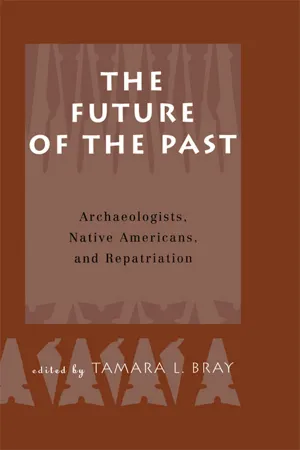
- 266 pages
- English
- ePUB (mobile friendly)
- Available on iOS & Android
eBook - ePub
About this book
To date, the notion of repatriation has been formulated as a highly polarized debate with museums, archaeologists, and anthropologists on one side, and Native Americans on the other. This volume offers both a retrospective and a prospective look at the topic of repatriation. By juxtaposing the divergent views of native peoples, anthropologists, museum professionals, and members of the legal profession, it illustrates the complexity of the repatriation issue.
Information
Chapter One
American Archaeologists and Native Americans
A Relationship Under Construction
At the dawn of the new millennium, American archaeology finds itself at the threshold of a new, more humanistic orientation toward the past. At the core of this transformation is a redefinition of the relationship between archaeologists and Indian peoples. Over the past twenty years, the discipline of archaeology has suffered the loss of a unified vision of its purpose and goals. This general experience of disciplinary fragmentation is best understood within the context of the post-positivist, anti-colonialist, and post-modernist movements that have swept through many sectors of late twentieth-century academia. In the case of American archaeology, the somewhat reluctant turn toward a more self-conscious, inclusive and humanistic approach to the construction of knowledge about the past has been accelerated by the passage of repatriation legislation.
The Repatriation Watershed
The term repatriation, as used in this book, refers to the federally prescribed return of human remains and specific categories of objects to culturally affiliated Indian tribes. The force of this directive has had a profound effect on the way both archaeologists and physical anthropologists conceive of and conduct research in the United States. The issue of repatriation has also become a focal point for many within the Native American community due to deeply held convictions about the need to rectify past injustices and prevent further transgressions. No less profound is the impact repatriation has had on the museum world with regard to collections management, curation practices, and public exhibits. Embedded within the repatriation mandate are a number of issues that fundamentally challenge the archaeological profession’s views and treatment of Native American peoples, call into question the “absolute” values of science, and force critical rethinking of the role of archaeology, anthropology, and museums in contemporary society.
Repatriation has often been formulated as a highly polarized debate with museums, archaeologists, and anthropologists on one side, and Native Americans on the other (Echo Hawk 1986; Goldstein and Kintigh 1990; Jones and Harris 1997; Meighan 1992; Preston 1989; Riding In 1992; Zimmerman 1992). One of the central points of contention is whether Native American interests in reburying the skeletal remains of ancestral populations should take precedence over the interests of archaeologists and physical anthropologists in studying and preserving them. As a result, the divide over repatriation has often been glossed as one of religion versus science (Clark 1998; Meighan 1992). Characterizing the issue in this way has the effect of casting Native peoples as anti-science or anti-intellectual, playing upon and reinforcing existing stereotypes of Native Americans as non-progressive and backward-looking. Locating repatriation within its specific historic and sociopolitical context, however, brings into relief the asymmetrical power relations that have actually given rise to and helped shape the contours of this debate (Bray 1996; McGuire 1989; Zimmerman 1989).
The idea of recovering ancestral remains for reburial began to acquire widespread support during the civil rights movements of the 1960s (Hill, this volume; Trope and Echo-Hawk 1992, reprinted this volume). During this period, Native Americans, like other minority groups in the United States, gained increased political influence and recognition. It was within the activist climate of this era that Native peoples began to express their long-felt resentment towards archaeological excavations, the public display of Indian skeletons, and the permanent curation of Native American remains in museums. The fact that Native American dead were accorded different treatment than Whites, and the seeming disregard with which archaeologists treated the sensibilities of modern tribes became powerful symbols of oppression and the pervasiveness of racist attitudes for the Native community.
In 1974, the activist group American Indians Against Desecration was formed with the explicit intent of bringing political pressure to bear on the question of the return and reburial of Native American remains. Through the efforts of this group and the media attention they were able to attract, the repatriation issue percolated into the public consciousness and eventually captured the attention of several sympathetic law-makers. The first federal legislation to treat the issue of repatriation was the National Museum of the American Indian Act (P.L. 101-185). Passed in 1989, it required the Smithsonian Institution to return all culturally identifiable Native American remains and associated funerary objects to culturally affiliated tribal groups. The subsequent year saw passage of the Native American Graves Protection and Repatriation Act (NAGPRA) (P.L. 101-601). In addition to affording protection to unmarked Native burials, this law also expanded the repatriation mandate to cover additional categories of cultural items, specifically sacred objects and items of cultural patrimony, and all other federally funded museums, institutions, and agencies (see Appendices 1 and 2).
Since passage of NAGPRA, museums have scrambled to meet collection inventory deadlines imposed by the law. The National Park Service, charged with implementation of the act, has held countless instructional meetings to clarify legal intent, requirements, and procedures. Tribes have formed standing committees or appointed ‘NAGPRA coordinators’ to sift through the mountains of inventory data transmitted by museums. Mandatory consultations between tribal representatives and museum personnel have been undertaken with varying degrees of cooperation. Innumerable articles and news stories have been written on the subject; considerable quantities of human remains and associated funerary items have been repatriated to tribes; and archaeologists still find themselves divided over the issue.
Repatriation has created what might usefully be understood as a federally mandated ‘zone of contact’ between Native people, archaeologists, and museums. The notion of a ‘contact zone,’ borrowed from Pratt’s work on nineteenth-century Western travel, is defined as the “space of colonial encounters … in which peoples geographically and historically separated come into contact with each other and establish relations” Such a “contact perspective,” which stands in opposition to a “frontier mentality” with its unidirectional implications, emphasizes how subjects are constituted in and by their relations to each other, stressing co-presence, interaction, and interlocking understandings and practices (ibid.; see also Clifford 1997).
Repatriation may be usefully understood as a ‘contact process,’ one that occurs within a new kind of intercultural space essentially decreed by federal mandate. Within this conceptual framework, the human remains and cultural objects that are the focal point of repatriation become the fundamental physical elements of a contact history, sites of political negotiation and occasions for ongoing interaction. Rather than being containers of a fixed or singular meaning, the significance of these items may be seen as contingent and emergent. Formulated within the discourse of repatriation, the remains and objects in question have become crucial press in the politics of identity and recognition.
A contact perspective also permits the difficulties that often characterize repatriation-related encounters to be understood as problems of cross-cultural communication, translation, and inequality. As Jacknis (1996:284) observes, the interlocutors in these encounters often develop “a shared code, like a pidgin or Creole… that allows speakers of different languages to communicate without necessarily reaching full agreement or even full comprehension.” Archaeologists, most of whom are trained first and foremost as anthropologists, presumably have the skills to work at this cultural interface.
Reinventing Archaeology as a Democratic Enterprise
The hesitancy some archaeologists may feel about engaging a ‘contact perspective’ stems from a deep commitment to Western science and the ideals of objectivity and comprehensive truth embedded within this tradition. The longstanding preoccupation with the practices and goals of the natural versus the social sciences hinges on the issue of objectivity. The idea that core sciences like physics perform their operations upon a separate, empirical world in a value-free context, is typically contrasted with the way social sciences like history and anthropology constitute the objects of their study intersubjectively and without the benefit of neutral detachment. Archaeology has traditionally occupied the borderlands between science and history, periodically leaning more toward one side, then swinging back toward the other.
It has been generally recognized since the 1960s, however, that scientific theories of any stripe are under-determined by the evidence, that data are theory-laden and recognized only within specific conceptual frameworks, and that facts are mediated through an array of auxiliary hypotheses (see Wylie 1995). Post-positivist philosophers of science have extended these observations, noting that even the core sciences must be understood to incorporate an interpretive, hermeneutic dimension (Kuhn 1970; Hesse 1960; Salmon 1984; Wylie 1995). It has also been amply demonstrated that the study of the past is always a political undertaking (Leone 1984; Rubertone 1989; Schmidt and Patterson 1995; Sued Badillo 1992). A parallel argument is made by feminist scholars and historians of science that even core scientific disciplines are cultural and political enterprises, whatever commitment their practioners may have to a stance of detached neutrality (Code 1991; Haraway 1988, 1991; Harding 1986, 1991). Even though these points are by now accepted by most in the academic community, they still continue to be contentious within some circles (see Wylie 2000).
The ‘moralization of objectivity’ (Conkey and Gero 1997:427; Daston and Galison 1992) is one of the key aspects of mainstream archaeology to be confronted if we hope to redefine the field as a more inclusive and democratic endeavor (after Leone and Preucel 1992). One domain of critical inquiry that has tried to come to terms with the concept of objectivity is feminist theory. As Haraway (1991:183-188) notes, we often seem trapped between two poles of a tempting dichotomy with regard to objectivity. We recognize, on the one hand, that there have been very strong arguments made for the social construction of all knowledge claims, especially scientific ones. Yet unmasking the doctrine of objectivity cuts out everyone’s claims to even partial truths about the world, giving all pronouncements essentially equal status.
The dilemma has become how to simultaneously have an account of radical historical contingency for all knowledge claims and a commitment to faithful accounts of a “real” world that science strives to deliver. Recognizing the need for a usable doctrine of objectivity that could accommodate these paradoxical requirements, feminist theorists have developed the notion of “embodied objectivity” (Haraway 1991:185-196). This concept incorporates the ideas of situated knowledge and partial perspective. Fundamental building blocks of feminist science, these ideas lead to a notion of objectivity that is, as Haraway (ibid.) puts it, usable but not innocent.
Engaging a critical science perspective is not about the myth of being beyond human agency and responsibility in a neutral realm above the fray. “The science question in feminism is about objectivity as positioned rationality; its images are not the products of escape and transcendence … i.e. ‘the view from above,’ but the joining of partial views and halting voices into a collective subject position, … i.e., of views from somewhere” (Haraway 1991:196). Feminist science argues for politics and epistemologies of location, positioning and situating, where partiality—not universality—is the prerequisite to being heard to make rational knowledge claims (Ibid.:195). I would suggest that such an approach to science holds much promise for the theory and practice of a responsible and inclusive archaeology in the twenty-first century.
These comments on the impossibility of political neutrality and objectivity in any human endeavor are intended as prologue to the papers that follow which collectively point to the need for American archaeology to reinvent itself. Many scholars have written about the fact that science in general, and archaeology in particular, are not disinterested undertakings (cf. Kohl and Fawcett 1995; Layton 1989; Leone et al. 1987; Leone and Preucel 1992; Miller and Tilley 1984; Schmidt and Patterson 1995; Trigger 1989). Whether or not the practitioner is aware of the uses to which his or her research and theories are put, social theory serves some purpose if it has any relevance at all. Following the suggestions of Leone and Preucel (1992), archaeology needs to become a more inclusive, responsive and democratic activity. Various labels have been suggested for this endeavor, including ‘covenantal archaeology’ (Powell et al. 1993; Wood and Powell 1993), ‘ethnocritical archaeology’ (Zimmerman 1996), ‘ancient Indian history’ (Echo-Hawk 1993,1997), and ‘indigenous archaeology’ (Nicholas and Andrews 1997). Regardless of how it is to be known, such a course is being charted for the discipline by virtue of the repatriation mandate. The papers presented in this volume offer some markers for the road that lies ahead.
References Cited
Bray, Tamara L. 1996. “Repatriation, power relations, and the politics of the past.” Antiquity 70:440-444.
Clark, Geoffrey. 1998. “NAGPRA, religion, and science.” Anthropol...
Table of contents
- Cover
- Title
- Copyright
- Dedication
- Contents
- Contributors
- Acknowledgments
- 1 American Archaeologists and Native Americans: A Relationship Under Construction
- 2 The Native American Graves Protection and Repatriation Act: Background and Legislative History
- CURRENT ISSUES AND DIFFERENT PERSPECTIVES
- FUTURE PROSPECTS
- Appendix 1 Public Law 101-185 National Museum of the American Indian Act (NMAIA)
- Appendix 2 Public Law 101-601 Native American Graves Protection and Repatriation Act (NAGPRA)
- Appendix 3 Agreement between the National Museum of Natural History, Smithsonian Institution, and The Cheyenne and Arapaho Tribes of Oklahoma Regarding Cheyenne Funerary Objects in the Collection of the National Museum of Natural History
- Index
Trusted by 375,005 students
Access to over 1.5 million titles for a fair monthly price.
Study more efficiently using our study tools.
Frequently asked questions
Yes, you can cancel anytime from the Subscription tab in your account settings on the Perlego website. Your subscription will stay active until the end of your current billing period. Learn how to cancel your subscription
No, books cannot be downloaded as external files, such as PDFs, for use outside of Perlego. However, you can download books within the Perlego app for offline reading on mobile or tablet. Learn how to download books offline
Perlego offers two plans: Essential and Complete
- Essential is ideal for learners and professionals who enjoy exploring a wide range of subjects. Access the Essential Library with 800,000+ trusted titles and best-sellers across business, personal growth, and the humanities. Includes unlimited reading time and Standard Read Aloud voice.
- Complete: Perfect for advanced learners and researchers needing full, unrestricted access. Unlock 1.5M+ books across hundreds of subjects, including academic and specialized titles. The Complete Plan also includes advanced features like Premium Read Aloud and Research Assistant.
We are an online textbook subscription service, where you can get access to an entire online library for less than the price of a single book per month. With over 1.5 million books across 990+ topics, we’ve got you covered! Learn about our mission
Look out for the read-aloud symbol on your next book to see if you can listen to it. The read-aloud tool reads text aloud for you, highlighting the text as it is being read. You can pause it, speed it up and slow it down. Learn more about Read Aloud
Yes! You can use the Perlego app on both iOS and Android devices to read anytime, anywhere — even offline. Perfect for commutes or when you’re on the go.
Please note we cannot support devices running on iOS 13 and Android 7 or earlier. Learn more about using the app
Please note we cannot support devices running on iOS 13 and Android 7 or earlier. Learn more about using the app
Yes, you can access The Future of the Past by Tamara Bray in PDF and/or ePUB format, as well as other popular books in Scienze sociali & Sociologia. We have over 1.5 million books available in our catalogue for you to explore.