eBook - ePub
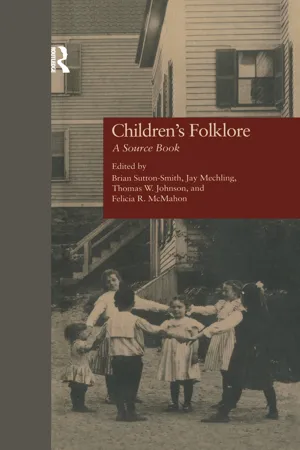
Children's Folklore
A SourceBook
- 390 pages
- English
- ePUB (mobile friendly)
- Available on iOS & Android
eBook - ePub
About this book
A groundbreaking collection of essays on a hitherto underexplored subject that challenges the existing stereotypical views of the trivial and innocent nature of children's culture, this work reveals for the first time the artistic and complex interactions among children. Based on research of scholars from such diverse fields as American studies, anthropology, education, folklore, psychology, and sociology, this volume represents a radical new attempt to redefine and reinterpret the expressive behaviors of children. The book is divided into four major sections: history, methodology, genres, and setting, with a concluding chapter on theory. Each section is introduced by an overview by Brian Sutton-Smith. The accompanying bibliography lists historical references through the present, representing works by scholars for over 100 years.
Information
1
Who Are the Folklorists of Childhood?
Most scholars date the serious study of children’s folklore to two nineteenth-century collections of children’s games: The Traditional Games of England, Scotland, and Ireland: Tunes, Singing-Rhymes and Methods of Playing According to the Variants Extant and Recorded in Different Parts of the Kingdom (1894-98) by Lady Alice Bertha Gomme and Games and Songs of American Children (1883) by William Wells Newell, the first secretary of the American Folklore Society.
Lady Alice was married to the distinguished British scholar Sir George Laurence Gomme, and together they formed a successful research team. Consistent with Victorian mores, she limited her studies almost exclusively to children’s games while her husband’s interests ranged much more widely. The two of them intended to edit a multivolume Dictionary of British Folklore with Traditional Games as Part I, but the project was never completed. The Gommes were part of the intellectual milieu that adhered to the theory of cultural survivals, and Traditional Games reflects that discredited bias. Lady Alice regarded the games in her vast collection as remnants from the ancient past that reflected the ideas and practices of primitive peoples. She arranged the games alphabetically, which, as one historian has pointed out, “camouflaged Lady Gomme’s primary intent, to reconstruct the evolutionary ladder of children’s pastimes” (Dorson 1968, 27). For example, she decided that the game of “Sally Water” originated as a pre-Celtic “marriage ceremonial involving water worship,” and that “London Bridge” echoed an ancient foundation sacrifice. She gathered her data from a network of retrospective adult correspondents rather than from direct fieldwork. Dorothy Howard writes the following in her introduction to the 1963 edition:
The games in her Dictionary, it must therefore be inferred, are games belonging to Lady Alice’s childhood or earlier and not necessarily current among children at her time of reporting; the descriptions came from the memories (accurate or otherwise) of adults and not from observation of children at play. The games reported represent the play life (or part of the play life) of articulate, ‘proper’ Victorian adults (of Queen Victoria’s youth) reporting on ‘proper’ games. Lady Alice, if she had any inkling of improper games lurking in the memories of her literate adult informants, gave no hint of it. And she chose to ignore the games of Dickens’ illiterate back alleys and tenements though she could hardly have been unaware that they existed. Since, according to statistics, Dickens’ children far outnumbered well-fed-and-housed Victorian children and since psychological excavators have dug up evidence to indicate that nice Victorian children were often naughty, we can only conjecture that Lady Alice’s Dictionary might have run to twenty volumes, had she undertaken a different study with a different point of view. (Howard 1964, viii)
Although Traditional Games is her most significant work, Lady Gomme published other works on children’s games, including Old English Singing Games (1900); Children’s Singing Games (1909-1912), a schoolbook co-edited with the distinguished folksong collector and educator Cecil J. Sharp; and British Folklore, Folk-Songs and Singing Games (1916), in which she collaborated with her husband, Sir George.
Games and Songs of American Children was first published in 1883 by American folklorist William Wells Newell, eleven years before Lady Alice’s work in England; it was enlarged and reissued in 1903. As the preface to the 1963 edition points out, “It was the first systematic large-scale gathering and presentation of the games and game-songs of English-speaking children. More important still, it was the first annotated, comparative study which showed conclusively that these games and their texts were part of an international body of data” (Withers 1963, v-vi). A literary scholar, poet, and translator who was also the first editor of the Journal of American Folklore, Newell “gathered the melodies, formulas, rules, and prescribed movements of the games both from the memories of adults and by observing and interviewing the children who played them. He set them down with tenderness and extraordinary sensitivity to the imaginative qualities of childhood and with a surprising amount of surrounding social circumstance to illuminate their use. … He accomplished his descriptions of children’s pastimes with many literary and other testimonies to the antiquity and tenacity of childhood tradition. Since Newell believed—somewhat wrongly—that the games were vanishing so rapidly in a general ruin of popular traditions that they would soon be wholly extinct, the book conveys an elegiac quality of lament.” He categorized his games according to function, or how they were used, instead of arbitrarily, as Lady Alice did later by alphabetizing hers; there are few games in her collection that he had not already documented. Both of these Victorian compendia are still valuable to students of childlore today, in part because of the vast amount of well-documented raw data they contain.
Although these two monumental studies are probably the most important studies of childlore, they were not the first. The predecessors included Joseph Strutt, Sports and Pastimes of the People of England (1801); Robert Chambers, Popular Rhymes of Scotland (1826); James Halliwell, The Nursery Rhymes of England (1842) and Popular Rhymes and Nursery Tales (1849); and G.F. Northall, English Folk-Rhymes (1892). Consistent with the late-Victorian interest in collecting and organizing novelties was the 1897 publication of Golspie: Contributions to Its Folklore by Edward W.B. Nicholson, librarian of the Bodleian at Oxford. Nicholson asked Scottish schoolchildren to write down descriptions of their traditional lore and awarded prizes for the best essays. These essays are the basis of the book, and the names of the seven young prizewinners are listed as coauthors. The subject matter ranged from legends and ghost stories to songs, rhymes, games, and superstitions. [In 1952-53, Golspie Scottish schoolchildren filled out a special questionnaire for the Opies based on the items in the books, and thus provided some valuable comparative data (Opie and Opie 1959). The results predictably indicate considerable stability of these traditions over time.]
By World War I, interest in children’s folklore became more and more diversified. Researchers sought more than conventional and socially acceptable games and nursery rhymes. Various journals on both sides of the Atlantic featured a spectrum of articles. In 1916 Norman Douglas published London Street Games, which, according to one authority, is a “pioneer work and social document of first importance. … Written by a fastidious literary craftsman, and based on genuine research amongst young cockneys, it records the secret joys of the gutter in a finely printed limited edition for the bibliophile. Even so, the book might have been a success if it had not been almost incomprehensible to anyone but a street arab. It is a skillful prose-poem fashioned out of the sayings and terminology of Douglas’s urchin friends” (Opie and Opie 1959, v). Like Newell before him, he wrongly believed that all of the games he recorded were on the verge of extinction and so he wanted to preserve an accurate account of them—whether his reading audience could understand the esoteric argot or not.
A radical change in the approach to collecting, interpreting, and publishing children’s folklore came about in the 1950s with the work of the English husband-and-wife team of Peter and Iona Opie, who were greatly influenced by the pioneering work of the American Dorothy Howard (Cott 1983). Two decades earlier, Howard successfully experimented with collecting traditional materials directly from children without the filter of adult memory (1937, 1938). Unlike the Opies, however, her work never reached a wide international lay and professional audience (1937, 1938). Howard’s approach was also paralleled by the work of Brian Sutton-Smith, who used this direct technique in his fieldwork in New Zealand in 1949-51 (1954), although his direct approach was influenced by current trends in cultural anthropology (Beaglehole 1946). He says that he remembers meeting Peter Opie in a London pub in 1952 after his own thesis on games was complete. At that time the Opies had just completed their work on nursery rhymes (1952).
The Opies are recognized today as the world’s foremost authorities on the traditions associated with childhood. Their works are consulted by specialists from museums, libraries, and universities regarding details about children’s books, toys, games, and beliefs. The Opie home, not far from London, is a veritable museum and library of childhood. Their first major book, The Oxford Dictionary of Nursery Rhymes, was published in 1952 and has been reprinted eleven times. The Dictionary led to The Lore and Language of Schoolchildren in 1959, Children’s Games in Street and Playground in 1969, and The Singing Game in 1985. As one: viewer stated, “The Lore and Language of Schoolchildren for the first $$ and thoroughly explored ‘the curious lore passing between children aged about 6-14, which … continues to be almost unnoticed by the other six-sevenths of the population. Based on the contributions of five thousand children attending seventy schools in parts of England, Scotland, Wales, and Ireland, the Opies’ book presents the riddles, epithets, jokes, quips, jeers, pranks, significant calls, truce terms, codes, superstitions, strange beliefs, and rites of the modern schoolchild, examining and commenting on them with fascinating historical annotation and comparative material that suggest the extraordinary continuity of the beliefs and customs of the tribe of children” (Cott 1983,54).
The Opies were leaders in refuting the premise that literacy and the pervasive mass media are destroying the traditions of children, and of course we know today that the media even help to diffuse many traditions (Grider 1976, 1981). As they remark in the preface to Lore and Language, “The modern schoolchild, when out of sight and on his own, appears to be rich in language, well-versed in custom, a respecter of the details of his own code and a practising authority on self-amusements. And a generation which cares for the traditions and entertainments which have been passed down to it is not one which is less good than its predecessors” (Opie and Opie 1959, ix). The Opies speak of the continuity of children’s traditions:
No matter how uncouth schoolchildren may outwardly appear, they remain tradition’s warmest friends. Like the savage, they are respecters, even venerators, of custom. And in their self-contained community their basic lore and language seems scarcely to alter from generation to generation. Boys continue to crack jokes that Swift collected from his friends in Queen Anne’s time; they play tricks which lads used to play on each other in the heyday of Beau Brummel; they ask riddles that were posed when Henry VIII was a boy. Young girls continue to perform a major feat of body raising (levitation) of which Pepys heard tell …, they hoard bus tickets and milk-bottle tops in distant memory of a love-lorn girl held ransom by a tyrannical father; they learn to cure warts (and are successful in curing them) after the manner in which Francis Bacon learnt when he was young. They call after the tearful the same jeer Charles Lamb recollected; they cry “Halves!” for something found as Stuart children were accustomed to do; and they rebuke one of their number who seeks back a gift with a couplet used in Shakespeare’s day. They attempt, too, to learn their fortune from snails, nuts, and apple parings—divinations which the poet Gay described nearly two and a half centuries ago; they span wrists to know if someone loves them in the way that Southey used at school to tell if a boy was a bastard; and when they confide to each other that the Lord’s Prayer said backwards will make Lucifer appear, they are perpetuating a story which was gossip in Elizabethan times.” (Opie and Opie 1959, 2)
Other folklorists, of course, were turning their sophisticated attention toward children’s lore in the 1950s, leading to a major assault on the “triviality barrier” (Sutton-Smith 1970a). In 1953 the influential American Non-Singing Games by Paul Brewster was published. Then in 1959, the same year as The Lore and Language of Schoolchildren, the University of California published the first major work by Brian Sutton-Smith, The Games of New Zealand Children. According to Dorothy Howard, “Dr. Sutton-Smith, working in a folklorist’s paradise (two small isolated islands with a total population of two million people) spent two years (1949 and 1950) in the equable climate traveling, sleeping in a sleeping bag, watching children play and recording what he saw and heard. The study is a unique gem” (Howard 1964, vii). In the twenty years or so since the Opies popularized the trend, innumerable studies of children’s lore have been published, including a popular American analog to The Lore and Language of Schoolchildren entitled One Potato, Two Potato: The Secret Education of American Children by the husband-and-wife team Herbert and Mary Knapp (1976). The subtitle of the book was changed in later editions to The Folklore of American Children. The most recent significant contribution to the field is the extensive and thoroughly annotated collection of children’s folklore compiled and edited by Simon J. Bronner and aptly entitled American Children’s Folklore: A Book of Rhymes, Games, Jokes, Stories, Secret Languages, Beliefs and Camp Legends for Parents, Grandparents, Teachers, Counselors and All Adults Who Were Once Children (1988).
In general, contemporary international scholarship dealing with children’s folklore tends toward limited, specialized case studies based on meticulous ethnographic fieldwork. Significant work is being done throughout Scandinavia, Germany, and Australia. Two important reference books, Jump-Rope Rhymes: A Dictionary (1969) and Counting-Out Rhymes: A Dictionary (1980), have been edited by the American folklorist Roger D. Abrahams. Scholars also finally are investigating previously taboo topics such as children’s use of obscenity and scatalogical materials. Graduate students at major universities throughout the country have written dissertations dealing with children’s folklore. Brian Sutton-Smith, long an international leader in the field, has focused his work primarily on games and play behavior. In 1975 he helped organize The Association for the Anthropological Study of Play (TAASP) in order to facilitate communication among researchers. His most recent work in children’s folklore, The Folkstories of Children (1981b), however, departs from games and play and turns instead to narrative, using a phenomenological approach radically different from that of previous studies. Speech Play: Research and Resources for the Study of Linguistic Creativity (1976), edited by Barbara Kirshenblatt-Gimblett, is an extensive investigation of the application of linguistics to the study of children’s verbal lore.
In conclusion, we see that the field of children’s folklore is interdisciplinary, depending heavily on cross-cultural, comparative systems that have been worked out through generations of research. Folklorists have stayed in the research forefront because their discipline is the best for documentation and analysis of traditional materials of all kinds. The triviality barrier probably will be a continuing concern in the study of children’s traditions, at least for some segments of the academic community. Even so, folklorists have not abdicated their responsibility to the enrichment of knowledge just because the subject matter happens to concern children. Specialists throughout the world are continuing to document and investigate the traditions of childhood in an attempt to understand this integral aspect of our common cultural heritage.
Section I
Overview
History of Children’s Folklore
This section continues to be centrally concerned with who the children in children’s folklore are. It approaches that question through two reviews of the field of children’s folklore. The first, by Zumwalt, is about the history of the concept of the child; the second, by McDowell, is about the way in which folklore gets transmitted.
In order to set these chapters in context some further remarks on the history of childhood are needed. In recent scholarship the notion has become widespread that childhood is a modern and invented concept. This brilliant idea, attributed to Philippe Aries, has had a powerful impact on the recognition of how relative many of our current twentieth-century ideas about childhood are, although many historians have been dubious about the simplicity of the picture that Aries has drawn (Wilson 1980). What does seem worth stressing is that, with the industrial revolution, children became increasingly separated from the work world and gradually accrued more and more markers as a distinctive subcultural group. Their acquisition of special clothes, special literatures, and special toys, particularly in the late seventeenth century, is taken by some historians as evidence of a change toward a special status (L.J. Stone 1977). Over the next two hundred years a series of steps brought this group into coordination with the rest of the sociopolitical system. Universal schooling was introduced, and, in our own century, the ever-increasing organization of children’s recreational time, at first through games and sports and subsequently through television and the mass marketing of toys. Through these two hundred years children also organized themselves, within a variety of subcultures of street and playground and neighborhood (see chapters by Mechling, Mergen, and Beresin). As they became free from apprenticeships in vil...
Table of contents
- Cover
- Title
- Copyright
- Contents
- Contributors
- Preface
- Introduction: What Is Children’s Folklore?
- Chapter 1 Who Are the Folklorists of Childhood?
- Section I Overview: History of Children’s Folklore
- Section II Overview: Methods in Children’s Folklore
- Section III Overview: Children’s Folklore Concerns
- Section IV Overview: Settings and Activities
- Glossary: An Aid for Source Book Readers
- Bibliography of Children’s Folklore
- Index
Trusted by 375,005 students
Access to over 1.5 million titles for a fair monthly price.
Study more efficiently using our study tools.
Frequently asked questions
Yes, you can cancel anytime from the Subscription tab in your account settings on the Perlego website. Your subscription will stay active until the end of your current billing period. Learn how to cancel your subscription
No, books cannot be downloaded as external files, such as PDFs, for use outside of Perlego. However, you can download books within the Perlego app for offline reading on mobile or tablet. Learn how to download books offline
Perlego offers two plans: Essential and Complete
- Essential is ideal for learners and professionals who enjoy exploring a wide range of subjects. Access the Essential Library with 800,000+ trusted titles and best-sellers across business, personal growth, and the humanities. Includes unlimited reading time and Standard Read Aloud voice.
- Complete: Perfect for advanced learners and researchers needing full, unrestricted access. Unlock 1.5M+ books across hundreds of subjects, including academic and specialized titles. The Complete Plan also includes advanced features like Premium Read Aloud and Research Assistant.
We are an online textbook subscription service, where you can get access to an entire online library for less than the price of a single book per month. With over 1.5 million books across 990+ topics, we’ve got you covered! Learn about our mission
Look out for the read-aloud symbol on your next book to see if you can listen to it. The read-aloud tool reads text aloud for you, highlighting the text as it is being read. You can pause it, speed it up and slow it down. Learn more about Read Aloud
Yes! You can use the Perlego app on both iOS and Android devices to read anytime, anywhere — even offline. Perfect for commutes or when you’re on the go.
Please note we cannot support devices running on iOS 13 and Android 7 or earlier. Learn more about using the app
Please note we cannot support devices running on iOS 13 and Android 7 or earlier. Learn more about using the app
Yes, you can access Children's Folklore by Brian Sutton-Smith,Jay Mechling,Thomas W. Johnson,Felicia McMahon in PDF and/or ePUB format, as well as other popular books in Education & Education General. We have over 1.5 million books available in our catalogue for you to explore.