Spiritual management is required for spiritual organization, and yet a ministry's master plan should be the Master's plan for that ministry. Church and Ministry Strategic Planning assists readers in developing a Biblically based blueprint for carrying out the many activities in which the church or ministry is involved. The authors show clearly how careful planning is inspired by the Scriptures ("Suppose one of you wants to build a tower. Will he not first sit down and estimate the cost to see if he has enough money to complete it?"--Luke 14:28) and how it improves making decisions today which ultimately affect the ministry's effectiveness tomorrow.Church and Ministry Strategic Planning covers all areas of this type of planning and can be read and reviewed quickly. Through the use of a model of the strategic planning process, the authors show how to develop mission statements, define strategic objectives, develop strategy options and operating strategies, appraise performance, and monitor strategic planning. Readers are led step-by-step through these key areas of creating a strategic plan. Examples and worksheets at the end of each chapter enable pastors, administrators, and lay leaders to develop a strategic plan fitting to their specific ministry or church. The appendixes provide tools used in planning as well as a complete sample strategic plan for a large church. Put these concepts to immediate use in decisionmaking and pursue God's purpose and vision for the church or ministry. If readers take the time and effort to study this book, apply its format, and prayerfully keep God in every step of the plan, here is what the authors believe plan administrators can expect:1. A sense of enthusiasm in the church or ministry
2. A 5-year plan in writing to which everyone is committed
3. A sense of commitment by the entire church to its overall direction
4. Time for the leaders to do what they have been called to do
5. Clear job duties and responsibilities
6. Clear and evident improvement in the health and vitality of every member of the church staff
7. Measurable improvement in the personal lives of all those in responsible positions with time for vacations, family, and personal pursuits
8.The ability to measure very specifically, the growth and contribution made by senior pastors or evangelists at the close of their careers
9. Guaranteed leadership of the church or ministry because a plan is in place--in writing--and is understood. Even more importantly, a management team and philosophy will be in place to guide the church or ministry into its next era of growthExplore this Biblical perspective on planning and develop a strategic plan that is systematic and continuous and allows the church or ministry to assess its market position, establish goals, objectives, priorities, and strategies to be completed within specified time periods, achieve greater staff and member commitment and teamwork aimed at meeting challenges and solving problems, and muster its resources to meet these changes through anticipation.
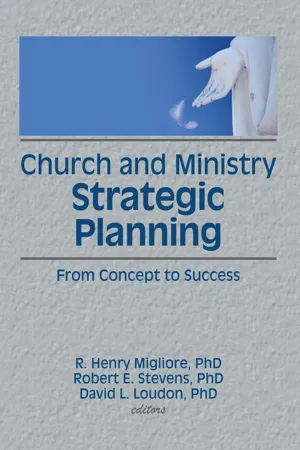
eBook - ePub
Church and Ministry Strategic Planning
From Concept to Success
- 174 pages
- English
- ePUB (mobile friendly)
- Available on iOS & Android
eBook - ePub
Church and Ministry Strategic Planning
From Concept to Success
About this book
Chapter 1
Biblical Perspectives of Planning
Commit to the LORD whatever you do, and your plans will succeed.
–Proverbs 16: 3
If you are struggling with any of the following problems or questions, this book, Church and Ministry Strategic Planning, may be very important to you.
Why is there so much confusion among our associate pastors on what we are trying to accomplish?
Why is there so much dissension and disagreement in this church?
Why is there such a high turnover of people in our church, especially in leadership positions?
Why did we build that building when it is not being used?
As a pastor, why am I working 12 hours a day, and can never keep up?
Why have we failed on a number of projects and missions? Why did God let us down?
Why is the Devil stopping us?
Why have the elders asked me to resign after everything I have put into this church or ministry?
Why does this church lack enthusiasm?
If you are wrestling with one of these questions, the answer might be that your church or ministry lacks good long-term strategic planning. Part of strategic planning is the team-building approach of developing leaders and involving people in the plan.
Planning is Important
Planning as part of the management process is crucial to the success of any organization. This is especially true for the Church, although little research has been done on the relationship of planning to successful church ministry. Recently, however, an empirical study of the relationship between the use of the planning process and ministry effectiveness was conducted among senior pastors in one denomination. The study found that
- Larger churches (congregations of 250 or more) are more inclined to engage in written long-range planning;
- Most churches had been using long-range planning for less than three years and achieved attendance increases of 100 percent, twice the growth rate experienced by churches not using long-range planning;
- Ministry effectiveness was increased by the presence of written yearly and long-range plans;
- The lack of a written plan (yearly and/or long-range) hindered the ability of the church/pastor to be effective in ministering to the community.
The most important conclusion, according to the author of this research study, is that
pastors and church leaders must be taught the importance of utilizing administration and management skills, especially planning, in the Church. They must also be given the tools necessary to incorporate planning into the ministries of the churches they serve. It is only through prayer and the use of the planning process that the Church, as an organization, can effectively fulfill the Great Commission that it has been given. (Bums 1992)
Of a large number of decisions made by a church or by an individual pastor there are a handful that can significantly impact the future of the church or pastor. These strategic decisions require careful identification and thoughtful consideration. This is the nature of the role of strategic planning.
Perspectives of strategic thinking can be illustrated with this question: Who are the two most important persons responsible for the success of an airplane’s flight? Typical responses would be
- the pilot and the navigator,
- the pilot and the maintenance supervisor,
- the pilot and the air traffic controller, or
- the pilot and the flight engineer
All of these responses recognize the day-to-day hands-on importance of the pilot, and they all introduce one of several other important support or auxiliary functionaries to the answer. However, each of these segmented responses ignores the one person who is perhaps the single most important individual to the ultimate success of the airplane-the designer. The pilot and the designer are perhaps the two most important individuals to the success of an airplane: the pilot because of his day-to-day responsibilities in commanding the craft, and the designer because of his ability to create a concept that can be economically constructed, easily operated by any normally competent flight crew, and maintained safely by the ground crew.
Most contemporary pastors perceive themselves as the “pilot” of the church: taking off, landing, conferring with the navigator, and communicating with the air traffic controller. They generally view themselves as the chief hands-on operational manager. However, what has been most lacking in churches and ministries in the past few years has been an appreciation for the strategic viewpoint. There is a need for more emphasis on the “designer’s” approach to operating a church or ministry. A well-conceived strategic planning system can facilitate this emphasis.
In a similar analogy, consider the illustration offered in the book, The Master Builder (Benjamin, Durkin, and Iverson 1985, 45) in which church strategic planning and flying are compared. The authors note that, before radios and instruments became common in small planes, pilots had to fly by visual flight rules. This meant that after take-off the plane had to be oriented in the right direction by some visual landmarks, perhaps a mountain that could be seen 50 miles out on the horizon. By keeping their eyes fixed on that landmark, the pilots could keep the plane steady and moving straight toward a long-range destination. A plane’s magnetic compass needle would tend to sway, causing the plane to swerve back and forth in a wide zig-zag pattern. It could not provide steady direction because of its short-term gyrations. A pilot who tried to follow it strictly might never reach the destination, especially if fuel was limited.
This analogy clearly illustrates the difference between a shortand long-term perspective: one is choppy, erratic, and wastes fuel; the other guides the plane on a steady, constant, and certain course. A church without a long-term planning perspective faces the same situation. Instead of moving steadily toward God’s goals, it will continually swerve off course due to the endless distractions that can prevent a church from pursuing God’s purpose and vision. Thus, strategic planning is one of the keys to success of any undertaking and nowhere is it more important than in churches and ministries.
What is Planning?
Planning may be defined as a managerial activity which involves analyzing the environment, setting objectives, deciding on specific actions needed to reach the objectives, and also providing feedback on results. This process should be distinguished from the plan itself, which is a written document containing the results of the planning process; it is a written statement of what is to be done and how it is to be done. Planning is a continuous process which both precedes and follows other functions, in which plans are made and executed, and results are used to make new plans as the process continues.
Types of Plans
There are many types of plans but most can be categorized as strategic or tactical. Strategic plans cover a long period of time and may be referred to as a long-term plan. They are broad in scope and basically answer the question of how an organization is to commit its resources over the next five to ten years. Strategic plans are altered on an infrequent basis to reflect changes in the environment or overall direction of the ministry.
Tactical plans cover a short time period, usually a year or less. They are often referred to as short-term or operational plans. They specify what is to be done in a given year to move the organization toward its long-term objectives. In other words, what we do this year (short term) needs to be tied to where we want to be five to ten years in the future (long term).
Most churches and ministries which have been involved in planning have focused on short-term rather than long-term planning. Although this is better than not planning at all, it also means each year’s plan is not related to anything long-term in nature and usually fails to move the organization to where it wants to be in the future.
Programs and events require planning. A ministry program is a large set of activities involving a whole area of a church’s capabilities, such as planning for a church day school program. Planning for programs involves
1. dividing the total set of activities into meaningful parts;
2. assigning planning responsibility for each part to appropriate people;
3. assigning target dates for completion of plans;
4. determining and allocating the resources needed for each part.
Each major program or division within a church or ministry should have a strategic plan in place to provide a blueprint for the program over time.
A ministry event is generally of less scope and complexity. It is also not likely to be repeated on a regular basis. An event may be a part of a broader program or it may be self-contained. Even though it is a one-time event, planning is essential to accomplishing the objectives of the project and coordinating the activities which make up the event. A plan to have a “friend day” would be an example of a project plan.
Advantages of Planning for Churches and Ministries
Why should a church or ministry devote time to planning? Consider the following questions:
Do you know where you are going and how you are going to get there?
Does everyone know what you are trying to accomplish?
Do all those involved know what is expected of them?
If the answer to any of these is no, then your church or ministry needs to develop a long-range plan with as many people involved as possible. Alvin J. Lindgren observed that
most churches do not engage in such systematic long-range planning. Perhaps this is one reason why the church has not been able to reach and change society more effectively. Many churches operate on hand-to-mouth planning. They consider the pressing problems of the moment at each board meeting without placing them in proper perspective in relationship to either past or future. (1965, 226)
In many small churches, pastors may object to planning, thinking that it makes no sense for them, since theirs is only a small organization and everyone in the congregation knows what happened in the past year and what is likely to happen in the coming year. Another frequent objection is that there is no time for planning. A third is that there are not enough resources to allow for planning. All of these objections actually point out the necessity for planning even in the small church. Such an organization may actually have a sizeable budget, making it imperative to have a plan of where the church is heading. The observation that there is no time for planning may seem accurate, but this is probably due to the lack of planning in the past, which has left insufficient time for attention to such necessities. Finally, the argument that there are insufficient resources actually justifies the role of planning in order to obtain the maximum benefit from those resources being used in the church or ministry. Thus, planning is a critical element in any church’s success.
Planning has many advantages. For example, it helps church or ministry administrators to adapt to changing environments, take advantage of opportunities created by change, reach agreements on major issues, and place responsibi...
Table of contents
- Cover Page
- Half Title page
- Title Page
- Copyright Page
- Contents
- List of Contributors
- Preface
- Acknowledgments
- Biblical Perspectives of Planning
- Overview of Strategic Planning
- Defining your Purpose
- Analysis and Assumptions
- Establishing Objectives
- Developing Strategy and Operational Plans
- Evaluation and Control Procedures
- References
- Appendix A Appendix A: Biblical References to the Planning Process
- Appendix B Appendix B: Outline of a Strategic Plan
- Appendix C Appendix C: Sample Strategic Plan for Bellmar Church
- Appendix D Appendix D: Planning and Management Systems Audit
- Appendix E Appendix E: Sample Church/Ministry Questionnaires
- Index
Trusted by 375,005 students
Access to over 1.5 million titles for a fair monthly price.
Study more efficiently using our study tools.
Frequently asked questions
Yes, you can cancel anytime from the Subscription tab in your account settings on the Perlego website. Your subscription will stay active until the end of your current billing period. Learn how to cancel your subscription
No, books cannot be downloaded as external files, such as PDFs, for use outside of Perlego. However, you can download books within the Perlego app for offline reading on mobile or tablet. Learn how to download books offline
Perlego offers two plans: Essential and Complete
- Essential is ideal for learners and professionals who enjoy exploring a wide range of subjects. Access the Essential Library with 800,000+ trusted titles and best-sellers across business, personal growth, and the humanities. Includes unlimited reading time and Standard Read Aloud voice.
- Complete: Perfect for advanced learners and researchers needing full, unrestricted access. Unlock 1.5M+ books across hundreds of subjects, including academic and specialized titles. The Complete Plan also includes advanced features like Premium Read Aloud and Research Assistant.
We are an online textbook subscription service, where you can get access to an entire online library for less than the price of a single book per month. With over 1.5 million books across 990+ topics, we’ve got you covered! Learn about our mission
Look out for the read-aloud symbol on your next book to see if you can listen to it. The read-aloud tool reads text aloud for you, highlighting the text as it is being read. You can pause it, speed it up and slow it down. Learn more about Read Aloud
Yes! You can use the Perlego app on both iOS and Android devices to read anytime, anywhere — even offline. Perfect for commutes or when you’re on the go.
Please note we cannot support devices running on iOS 13 and Android 7 or earlier. Learn more about using the app
Please note we cannot support devices running on iOS 13 and Android 7 or earlier. Learn more about using the app
Yes, you can access Church and Ministry Strategic Planning by William Winston,Robert E Stevens,David L Loudon,R Henry Migliore in PDF and/or ePUB format, as well as other popular books in Business & Business General. We have over 1.5 million books available in our catalogue for you to explore.