eBook - ePub
Colonial Space
Spatiality in the Discourse of German South West Africa 1884-1915
- 328 pages
- English
- ePUB (mobile friendly)
- Available on iOS & Android
eBook - ePub
About this book
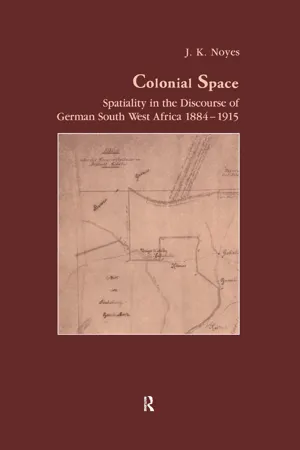
First Published in 1992. This book is about space of a colony and how it was produced. It began as a study of the literature of the German colony of South-West Africa between the years 1884 and 1915. The author's aim is to demonstrate the active role which literature had played in structuring the experience of the colony. If it could be shown that literature not only describes, but also helps to structure the forms of experience, then it would follow that it also plays an important role in structuring the experience of colonization, and hence the form of the colony itself. From the outset, therefore, the study was concerned with a number of issues centering around colonization, representation, experience, and social form, where spatiality is the concept which allows us to understand how these various aspects of colonialism interrelate.
Information
PART ONE
Spatiality: signification,
subjectivity, society
CHAPTER ONE
The struggle for the point: the metaphysical construction of space
The opposition of our positions is indeed radical; in this, we are in complete agreement…
Jean-Francois Lyotard
ARISTOTELIAN SPACE: BEING IN SPACE AND THINKING ABOUT SPACE
Any study of space and spatiality must at the outset confront certain conceptual difficulties. First and foremost is a certain “inadequacy of procedures for thinking about… space. Chosen here as an object of study, space is not really accessible through the usual political and economic determinations.”1 A discourse concerned with politics, economics, or for that matter aesthetics must apparently grant its own concepts of spatiality axiomatic status before embarking upon its discussions. That is to say, it stakes out or frames its field prior to any investigatory work. This act of framing may be explicit or implicit. In all cases, it seems to be necessary for the maintenance of scientific discourse.
There are, however, problems associated with this initial act of framing which are very relevant for a discussion of spatiality. These are apparent in the metaphorical nature of the word “framing.” The establishment of a frame is an act of selection which not only defines a field. It in fact creates that field. This is done by establishing strategies which allow the field to be spoken of as if the speaker could occupy a position transcendent to it.2 Such strategies are themselves essentially spatial in nature, and involve spatializing techniques, such as focussing, perspective, foregrounding, etc. Discourses of spatiality are therefore by nature in constant dialogue with their own spatiality. This dialogue tends to center on two seemingly non-spatial phenomena – signification and subjectivity. Signification and subjectivity are, however, only seemingly non-spatial phenomena. In fact they are both products of the same kinds of framing which establish the field of a discourse.
What this means, however, is that a discourse of spatiality which seeks to establish its own truth value will have to evolve a secondary set of strategies for concealing its strategies of framing. It will have to elide those strategies whereby it creates its own field in conjunction with specific fields of subjectivity or signification – or in other words, whereby the field of a discourse tolerates only a certain range of meanings, and only for certain subjects. Any discourse which lays claim to the truth value of its statements must at least implicitly define the positions for which these statements are not only meaningful, but consistent with specified aspects of the “real world.” Discourses of spatiality create spatiality by projecting positions of truth onto the “real world” – that is, by stipulating how subjects are to behave in non-discursive space. Thinking about space is thus not a purely philosophical concern. “How we represent space and time in theory matters, because it affects how we and others interpret and then act with respect to the world.”3
A meaningful position which may be occupied in any discourse implies the occupation of other positions outside the discourse. The present study is to a large extent a study of the status and function of such positions. I will be concerned with positions in space capable of bearing meaning, of representing a subject and of structuring ambient space in a particular way. I will begin with an examination of the point as a vital concept in the metaphysical discussion of space. I will be attempting to show that, even in explicit attempts to describe spatiality as a problem of being or of knowledge, the point is at all times “contaminating” itself with questions of signification and subjectivity. This is because subjectivity and signification are themselves spatial. It may under certain conditions be possible to insist on a sharp differentiation between mythical and geometrical space – the former infused with subjective and social qualities, and the latter to a large extent the space of metaphysics.4 However, closer examination will show that mythical space is dependant upon “geometric” strategies of reference and consistency, just as geometric space relies upon “mythic” strategies of subjective position and observation.5 In later chapters I will be seeking to explore the nature of these strategies in more detail, with the aim of showing that a point is always in a relationship with more than one quality of space, irrespective of the quality in which we initially attempt to situate it. I will then show various ways in which this multiple quality may be actualized in discourse, with definite political repercussions for the colonial project. Such repercussions arise because the problem of spatiality is not only a problem for philosophy. To interrogate spatiality is to pose questions concerning subjectivity and meaning in social practice.
A certain ambivalence is built into the Western tradition of thinking about space. On the one hand, we are accustomed to speaking of space as something real -something which exists, in which we are situated. On the other hand, theoretical or philosophical models of spatiality imply the ability to place ourselves outside of specific spaces, pretending that there is a place from which the nature of space might be contemplated free of all spatiality. As a result, philosophical models of spatiality are generally characterized by an attempt to reconcile the contradictions arising from a common sense grasp of space on the one hand, and the necessity of thinking about space in abstract terms on the other. Thinking about space is as a result always in dialogue with its own limits. This emerges clearly when we interrogate the very foundations of Western spatiality – Zeno’s paradox of space, and Aristotle’s attempt to solve it. In this attempt, the ambivalence of space is formulated as integral to the metaphysical tradition. On the one hand, a paradox arises from thinking and speaking about space, and on the other hand, an attempt is made by virtue of common sense to show that this paradox cannot be. Zeno’s famous paradox states, in Max Jammer’s paraphrase, that “everything is in place; this means that it is in something; but if place is something, then place itself is in something, etc.”6 With this paradox, the entire metaphysical discussion of the nature of space is constituted as a question of framing – of boundaries and discrete levels of logical status. For, in order to solve the paradox, it must be demonstrated that everything is not in place, or that place itself is not something, or at least that it is something of a different nature than everything else which must be in place. And this was how Aristotle sought to solve Zeno’s paradox – by shifting attention away from the ambiguous nature of framing which was so important to Zeno.
Aristotle has been called “the philosopher of common sense,” the defendant of the beliefs of “the plain man.”7 And his discussion of space has been seen as an elaboration and systematization of common knowledge relating to objective space. The fundamental position of both of these concepts (objectivity and common knowledge) in Aristotle’s philosophy must in turn be seen in conjunction with his mistrust of a philosophical usage of language aimed at introducing complexity on a metaphysical level where there is no objective justification for this complexity – in other words, his rejection of the Sophist tradition as he saw it.8 The importance of this rejection lies in the need to eliminate specific questions of subjectivity and meaning from the discussion about space. In other words, this rejection assumes the nature of a repression. In the ideas of Aristotle we may clearly see that common sense produces notions of spa-tiality by glossing over innate areas of contradiction and conflict. As David Harvey notes, spatiality is still characterized by this gloss. “Beneath the veneer of common-sense and seemingly natural ideas about space and time, there lie hidden terrains of ambiguity, contradiction and struggle.”9
In the Categories, Aristotle describes space as a continuous quantity, and place is defined in terms of a continent function.10 What this means is that “‘Space’ here is conceived as the sum total of all places occupied by bodies, and ‘place’ (topos), conversely, is conceived as that part of space whose limits coincide with the limit of the occupying body.”11 In the major work dealing with “space,”De Physica, Aristotle “does not advance a theory of space at all, but only a theory of place or a theory of positions in space. However, since the Platonic and Democritian conceptions of space are unacceptable to the Aristotelian system of thought, and since the notion of empty space is incompatible with his physics, Aristotle develops only a theory of positions in space.”12 Aristotle argued that place is distinct from the bodies which occupy it to the extent that it may be seen as a “continent vessel” for these bodies. In rejecting previous attempts to define place (among these Plato’...
Table of contents
- Cover Page
- Half Title page
- Series page
- Title Page
- Copyright Page
- Contents
- Acknowledgements
- Introduction: Confronting the spatiality of colonial discourse
- Part One Spatiality: signification, subjectivity, society
- Part Two Colonial space
- Bibliography of works cited
- Author index
- Subject index
Trusted by 375,005 students
Access to over 1.5 million titles for a fair monthly price.
Study more efficiently using our study tools.
Frequently asked questions
Yes, you can cancel anytime from the Subscription tab in your account settings on the Perlego website. Your subscription will stay active until the end of your current billing period. Learn how to cancel your subscription
No, books cannot be downloaded as external files, such as PDFs, for use outside of Perlego. However, you can download books within the Perlego app for offline reading on mobile or tablet. Learn how to download books offline
Perlego offers two plans: Essential and Complete
- Essential is ideal for learners and professionals who enjoy exploring a wide range of subjects. Access the Essential Library with 800,000+ trusted titles and best-sellers across business, personal growth, and the humanities. Includes unlimited reading time and Standard Read Aloud voice.
- Complete: Perfect for advanced learners and researchers needing full, unrestricted access. Unlock 1.5M+ books across hundreds of subjects, including academic and specialized titles. The Complete Plan also includes advanced features like Premium Read Aloud and Research Assistant.
We are an online textbook subscription service, where you can get access to an entire online library for less than the price of a single book per month. With over 1.5 million books across 990+ topics, we’ve got you covered! Learn about our mission
Look out for the read-aloud symbol on your next book to see if you can listen to it. The read-aloud tool reads text aloud for you, highlighting the text as it is being read. You can pause it, speed it up and slow it down. Learn more about Read Aloud
Yes! You can use the Perlego app on both iOS and Android devices to read anytime, anywhere — even offline. Perfect for commutes or when you’re on the go.
Please note we cannot support devices running on iOS 13 and Android 7 or earlier. Learn more about using the app
Please note we cannot support devices running on iOS 13 and Android 7 or earlier. Learn more about using the app
Yes, you can access Colonial Space by J.K. Noyes in PDF and/or ePUB format, as well as other popular books in Scienze sociali & Antropologia. We have over 1.5 million books available in our catalogue for you to explore.