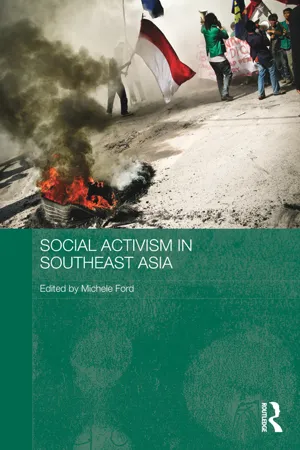
Social Activism in Southeast Asia examines the ways in which social movements operate in a region characterized by a history of authoritarian regimes and relatively weak civil society. It situates cutting-edge accounts of activism around civil and political rights, globalization, peace, the environment, migrant and factory labour, the rights of middle- and working-class women, and sexual identity in an overarching framework of analysis that forefronts the importance of human rights and the state as a focus for social activism. Drawing on contemporary evidence from Cambodia, Indonesia, Malaysia, Myanmar, the Philippines, Singapore, Thailand and Timor-Leste, the book explores the ways in which social movement actors engage with their international allies, the community and the state in order to promote social change. As well as providing detailed and nuanced analyses of particular movements in specific areas of Southeast Asia, the book addresses difficult questions about the politics, strategies and authenticity of social movements.
- 226 pages
- English
- ePUB (mobile friendly)
- Available on iOS & Android
eBook - ePub
Social Activism in Southeast Asia
About this book
Information
1 Social activism in Southeast Asia
An introduction
Michele Ford
From People Power in the Philippines to the Saffron Revolution in Myanmar, Southeast Asia is a region in constant political and social flux. It is home to myriad forms of social activism, from lone cyber-activists and small study groups to semi-professional non-governmental organizations (NGOs) and mass movements that advocate change on a plethora of issues from ethnic or religious identity, to labour and gender rights, to gross human rights violations, to the environment. Some activists and organizations operate entirely in their local or national context. Others are deeply embedded in transnational activist networks. But almost all imagine themselves to be engaged in a struggle against the state, which is simultaneously seen as enemy and potential ally in the struggle for social change.
How, then, do the concerns of global social movements play out in the social and cultural contexts of the region and particular Southeast Asian states, and vice versa? To what extent are social movement forms and repertoires of action indigenous and to what extent are they products of ‘globalization from below’? What makes social activism ‘real’? How collective or sustained does activism have to be before it can be called a social movement? With its history of authoritarian developmentalism and relatively weak civil society, Southeast Asia is an ideal region in which to examine these and other difficult questions that arise in social movement studies about activists’ politics, motivations, tactics and strategies, and their claims to authenticity. It is these kinds of questions that the in-depth case studies of different social movements in different Southeast Asian contexts included in this volume seek to address.
Many studies of social activism in the global South use models of social movements developed in the North, although few participate in theory-making, operating instead within the strictures imposed by those models’ geographical and historical roots in the United States and Europe. Others eschew such models entirely, choosing instead to locate their empirically rich accounts within an Area Studies framework or to adopt another theoretical approach. This volume takes a different tack, engaging critically with the key analytical concepts of social movement studies in order to interrogate the sometimes taken-for-granted assumptions that underpin them. The cases presented here challenge the widely held belief that social movements cannot exist without a considerable measure of democracy — in doing so, confirming that ‘even in very difficult situations, it is possible to observe a social group develop a certain representation of its situation and a certain capacity to act’ (Touraine 2002: 90). In addition, they show that similar levels but different styles of state repression not only generate different kinds of opportunities for social activism (Caraway 2006) but also different activist cultures (Boudreau 2004). Finally, they force us to think more carefully about the extent to which local social movements have been influenced by global social movement concerns and international discourse and shaped by funding and repertoires of action; and are able to leverage transnational networks to pursue local causes.
Studying social activism in Southeast Asia
In the late 1960s, Europe, the Anglophone world and much of Latin America erupted in waves of protest against war and environmental destruction, and for civil rights, gender equality and the sexual revolution. Attempts to explain this large-scale social unrest saw the emergence of New Social Movement Theory and Resource Mobilization Theory, two of the five approaches that have come to dominate social movement studies. New Social Movement Theory, which emerged in Western Europe in response to the tumult of the late 1960s, is concerned with movements based on identity politics (for example, sexuality) and universalist concerns (such as peace or the environment), which it contrasts with the materialist concerns of the ‘old’ labour movement (see Habermas 1981; Melucci 1980; Offe 1985; Touraine 1981, 1988). The goals of these ‘new’ social movements tend to challenge the separation between the public and the private sphere and are likely to reference aspects of everyday life and individuals’ need for self-realization (Melucci 1996: 102–4). Not surprisingly, these concerns are pursued primarily within the cultural sphere and in civil society rather than through attempts to seize political power.
Outside Europe, and particularly in Latin America, this emphasis on the multiple non-material identities of individuals, spontaneity and the central role of progressive cultural practice in political transformation proved attractive to activists and intellectuals (Edelman 2001). At the same time, however, it is relatively uncontroversial to observe that the sharpness with which the distinction is drawn between ‘old’ and ‘new’ social movements is an ahistorical generalization of the first flush of European post-materialism. As well as ignoring the antecedents of supposedly ‘new’ movements — for example, the women’s and peace movements — New Social Movement theorists have been charged with over-emphasizing new social movements’ lack of engagement in the political arena and for their ambiguous claims with regard to those movements’ class base.1 Most importantly, because this body of theory is an extrapolation from a particular historical moment in a particular kind of society, it has limited descriptive power in situations where social movements are in effect a hybrid between ‘old’ and ‘new’.
These flaws are most pronounced when New Social Movement Theory is applied outside the context in which it was developed. In the Southeast Asian context, New Social Movement Theory’s emphasis on post-materialist social movements driven by the middle class has been productive, making visible the most vibrant forms of social activism to be found in a region where the labour movement had long been domesticated by the state. But its insistence on an old-new dichotomy is counter-productive. This is a region in which middle-class social movement organizations have not only developed alongside the labour movement, but have engaged with indisputably materialist concerns such as the plight of the urban poor (Phongpaichit 2002; Weiss 2006). Middle-class activists in Indonesia, for example, not only engage with both materialist and post-materialist issues, but individuals have been known to move, for instance, from an environmental NGO to a labour NGO (Ford 2009). In other examples, social movements that focus on universalist concerns have a working-class base, as is the case with the environmental movement in Thailand (Forsyth 2001).2
In roughly the same period that Touraine, Melucci and others were attempting to explain the rise of identity politics in Europe, Resource Mobilization Theory emerged in the United States as a response to the puzzle of why the breakdown of traditional social patterns, shared grievances and relative deprivation — the focus of earlier scholarship on social unrest — did not explain patterns of social upheaval in the late 1960s. However, unlike New Social Movement theorists, with their emphasis on cultural politics, proponents of Resource Mobilization Theory were concerned primarily with the mechanics of social movements and, in particular, with the pivotal role of moral, cultural, human and financial resources in the operation of social movement organizations (McCarthy and Zald 1977; Oberschall 1973; Zald and McCarthy 1987). The key assumption of this model is that modern social movements are highly centralized and consist of formally structured social movement organizations that respond rationally to the opportunities available for collective action. These movements seek to address widespread grievances that exist as a result of conflicts of interest within institutionalized power relations in dialogue with the holders of formal political power. However, Resource Mobilization theorists also emphasize that shared grievance by itself is not enough: the emergence of social movements depends on the availability of the right resources and opportunities (Jenkins 1983: 528). In other words, social movements are seen to be ‘an extension of politics by other means, and can be analyzed in terms of conflicts of interest just like other forms of political struggle’, and ‘in terms of organizational dynamics just like other forms of institutionalized action’ (Buechler 1993: 218).
In addition to questioning these assumptions, critics have focused on Resource Mobilization Theory’s emphasis on inputs and outputs, its side-lining of grievances, ideology and collective identity, and its emphasis on the rationality of social movement actors.3 Concepts like access to resources and repertoires of action are useful tools in the analysis of particular social movements in Southeast Asia (e.g. Shigetomi 2009). But Resource Mobilization Theory’s assumptions about the degree to which social movements are institutionalized — and the degree to which they have access to politicians — are predicated on a kind of political system that is very different from those found even in the more democratic polities in the region. Importantly, also, Resource Mobilization Theory has little to say about the state beyond its role as interlocutor. Yet more often than not, in the Southeast Asian context the state has been perceived not just as a potential ally, but as the violator of its citizens’ civil and political rights, the entity responsible for the destruction of the environment and the obstacle to social change.
In their attempts to address this obvious weakness, scholars in the North American tradition increasingly focused on the question of the state, primarily through an analysis of the ‘dimensions of the political struggle that encourage people to engage in contentious politics’, which they dubbed ‘political opportunity structures’ (Tarrow 1998: 19–20; see also McAdam 1982; McAdam et al. 1996; Tarrow 1989). This iteration in the scholarship, which has come most commonly to be known as Political Process Theory, seeks to explain cycles of protest and their outcomes through an examination of the relative openness of the institutionalized political system; the stability of a broad set of elite alignment; the presence of elite allies; and the state’s capacity and propensity for repression (McAdam et al. 1996). It is an approach that has a greater emphasis on movement success and failure than on movement structure and process, and is more sensitive to the relationship between social movement organizations and their socio-political and institutional environments than traditional Resource Mobilization Theory (Caniglia and Carmin 2005). However, like both New Social Movement Theory and Resource Mobilization Theory, the analytical tools of Political Process Theory have been shaped by their genesis in the experience of the industrialized, liberal democratic North.
Although it has evolved through its application in Latin America — and has been fruitfully applied in the Southeast Asian context — the liberal democratic experience remains the normative focus of Political Process Theory. This has led to a tendency to characterize people living under authoritarian regimes as compliant — a tendency that belies the fact that political opposition and collective action can exist even where no social movement organization directly challenges the regime, as is the case in Vietnam (Wells-Dang 2010). In addition, analyses of the relationship between regime repressiveness and the likelihood of contention within this tradition tend to emphasize the difference between non-democratic regimes and the liberal democracies of the West rather than seeking to explain the differences between particular non- or semi-democratic contexts. Yet, as Caraway (2006: 280) has argued in her work on the labour movements of India, Indonesia and Burma, significant differences exist within regime categories, and thus political openness ‘is not synonymous with regime type’. Where Political Process Theory does seek to explain differences within regime categories, it tends to see individual countries as hermetically sealed political systems. Consequently, as Schock (1999) notes in his comparative analysis of social movements in the Philippines and Burma in the 1980s, it accounts for the role of influential allies and elite divisions but fails to adequately consider movements’ international links.
The fourth approach of note is the US-based social constructivist approach to social movements (Benford and Snow 2000; Gamson 1992; Johnston 2009; Snow and Benford 1988). Like New Social Movement Theory, this body of scholarship is concerned with the idea of collective identity as a process and with what Benford and Snow (1988) call ‘meaning work’. According to...
Table of contents
- Cover
- Title
- Copyright
- Contents
- List of illustrations
- Contributors
- Acknowledgements
- 1 Social activism in Southeast Asia: An introduction
- 2 Southeast Asian activism and limits to independent political space
- 3 Separatism in Aceh: From social rebellion to political movement
- 4 Philippine contention in the democratic 'transitions'
- 5 Values and the institutionalization of Indonesia's organic agriculture movement
- 6 Burmese social movements in exile: Labour, migration and democracy
- 7 Labour activism in Thailand
- 8 The anti-globalization movement in the Philippines
- 9 Activism and aid: Shaping the peace movement in Timor-Leste
- 10 International agendas and sex worker rights in Cambodia
- 11 Sexuality rights activism in Malaysia: The case of Seksualiti Merdeka
- 12 The Christian Right and the Singaporean feminist movement
- Index
Trusted by 375,005 students
Access to over 1.5 million titles for a fair monthly price.
Study more efficiently using our study tools.
Frequently asked questions
Yes, you can cancel anytime from the Subscription tab in your account settings on the Perlego website. Your subscription will stay active until the end of your current billing period. Learn how to cancel your subscription
No, books cannot be downloaded as external files, such as PDFs, for use outside of Perlego. However, you can download books within the Perlego app for offline reading on mobile or tablet. Learn how to download books offline
Perlego offers two plans: Essential and Complete
- Essential is ideal for learners and professionals who enjoy exploring a wide range of subjects. Access the Essential Library with 800,000+ trusted titles and best-sellers across business, personal growth, and the humanities. Includes unlimited reading time and Standard Read Aloud voice.
- Complete: Perfect for advanced learners and researchers needing full, unrestricted access. Unlock 1.5M+ books across hundreds of subjects, including academic and specialized titles. The Complete Plan also includes advanced features like Premium Read Aloud and Research Assistant.
We are an online textbook subscription service, where you can get access to an entire online library for less than the price of a single book per month. With over 1.5 million books across 990+ topics, we’ve got you covered! Learn about our mission
Look out for the read-aloud symbol on your next book to see if you can listen to it. The read-aloud tool reads text aloud for you, highlighting the text as it is being read. You can pause it, speed it up and slow it down. Learn more about Read Aloud
Yes! You can use the Perlego app on both iOS and Android devices to read anytime, anywhere — even offline. Perfect for commutes or when you’re on the go.
Please note we cannot support devices running on iOS 13 and Android 7 or earlier. Learn more about using the app
Please note we cannot support devices running on iOS 13 and Android 7 or earlier. Learn more about using the app
Yes, you can access Social Activism in Southeast Asia by Michele Ford in PDF and/or ePUB format, as well as other popular books in Social Sciences & Ethnic Studies. We have over 1.5 million books available in our catalogue for you to explore.