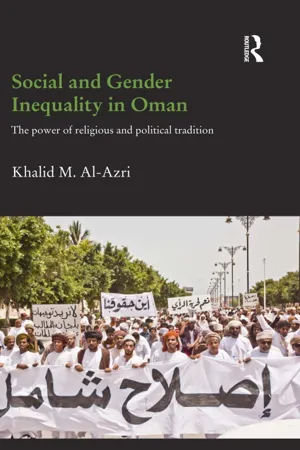
Looking at the social, political and legal changes in Oman since 1970, this book challenges the Islamic and tribal traditional cultural norms relating to marriage, divorce and women's rights which guide social and legal practice in the modern Omani state. The book argues that despite the establishment of legal instruments guaranteeing equality for all citizens, the fact that the state depends upon Islamic and tribal elites for its legitimacy invalidates these guarantees in practice. Two particular features of the legal and cultural regulation of marriage and marital rights are focused on - the perceived requirement for kafa'a or equality in marriage between so called high and low socio-economic status peoples is examined, and the institution of talaq, which grants greater rights to men than to women in appeals for divorce. This book addresses highly complex subjects with great rigor, in terms of empirical research and engagement with theory, sociological and political as well as theological and legal. It is an interesting investigation of the divisions of authority between the state, Islam and tribal norms, highlighting barriers to reform in both Oman and wider Islamic society, and advocating the removal of such obstacles.
eBook - ePub
Social and Gender Inequality in Oman
The Power of Religious and Political Tradition
- 202 pages
- English
- ePUB (mobile friendly)
- Available on iOS & Android
eBook - ePub
Social and Gender Inequality in Oman
The Power of Religious and Political Tradition
About this book
Information
1 ‘Doing gender’ in uncharted territory
Scope of the study
Very few studies have discussed post-1970 Omani society and almost no studies concerning Omani society have been conducted in the last decade. Oman remains an absolute monarchy with tremendous power vested in Sultan Qaboos. Despite the modernizing discourse and infrastructural developments, the Sultanate has been less keen to overturn tribal socio-cultural and traditional gender norms in its project to build a new Oman. The country thus presents an ideal test case for investigating the differences between the appearance and reality of modernization programmes in authoritarian Islamic states. Nevertheless, works concerning social and gender equality in Oman and the conflict between cultural, legal and political issues on one hand, and social change on the other, are very limited in number.1 The study of Islamic societies and Islamic thought during modern times has tradi- tionally concentrated on Sunni or Shi‘a communities and their scholarly opinions. Very few studies have documented Ibadi legal thought and Ibadi opinion on con- temporary issues such as the rights of women, social equality or modernization of the Omani state. The focus of this book then is on the opinions of current Ibadi scholars in Oman in relation to these topics and to the ways in which socio-cultural modernization is held back by reliance upon traditional and tribal cultural norms.
While a number of questions regarding political, legal and cultural reform in many Arab and Islamic societies have been addressed and debated, Oman seems to have been largely omitted from these discussions. Within Oman itself, the airing of such issues is highly limited and works on such subjects often face censorship.2While new media, such as the Internet, have brought about an increase in dis- course and consideration of the possibility of political, legal and cultural reform in society, discussion of these issues is generally limited to expressions of individual opinions rather than serious scholarship. This study therefore aims to open up new and serious possibilities for public discussion and debate about gender, the role of Islam and the importance of legal and cultural reform in Oman.
Directions and significance
In order to explore the tension between development and traditional culture in Oman, two traditional cultural norms are taken as the focus of this investigation. Notions and practices of kafa’a and talaq govern marriage and divorce in Oman, and help to maintain rights and roles in marriage as one of the most conservative aspects of social life. Kafa’a (equality) is a cultural belief that an acceptable mar- riage is one between a man and a woman whose family is ranked equally or lower than that of her proposed husband. Talaq is the right given to a man, but not so to a woman, to divorce his partner by uttering the word ‘talaq’ three times (‘triple talaq ’). Both of these institutions perpetuate discriminatory relationships between classes and genders in Omani kinship.
This study aims, first, to examine the reasons used to justify kafa’a and tri- ple talaq from an Islamic perspective. In order to understand the contemporary practice of kafa’a and talaq it is necessary to investigate how these ideas are con- structed in Islamic jurisprudence and how they were developed and viewed in the early Muslim community.
On the basis of such a historical context it will be possible to ask how contem- porary Muslim scholars contest previous juristic opinions regarding kafa’a and talaq.
The second objective thereafter is to examine the reasons and justifications for the practice of kafa’a and talaq in Omani society in the current period. In par- ticular, confusion surrounds these practices since the Omani Personal Status Law recognizes kafa’a in marriage even though ‘equality’ is a guarantee in the Basic Law of the State. In many cases these contradictory provisions are glossed over by judicial reliance upon the opinions of Ibadi scholars, which are often considered more seriously than the provisions of the Personal Status Law, especially in rela- tion to triple talaq.
Kafa’a and talaq throw up difficulties for judges attempting to mediate in fam- ily disputes, given the divergent traditional and post-1970 legal rulings on per- sonal and kin-based equality. Tensions caused by the maintenance of the ideal of kafa’a and the discriminatory practices of talaq impact upon marital decisions and are being sharpened by the increasing socio-economic independence of women, who are more able to earn independent incomes in modern Oman. More than ever, family law demands renewal.
The third objective of the book therefore is to explore conflicts of opinion regarding change, women’s rights, equality, development and culture in Oman. The views expressed by Omani men and women regarding gender relations, equality, women’s rights and development are crucial perspectives on guarded topics. Commentary on the relationship between development and the role of the State in relation to traditional culture brings new light to the disconnects between the opinions of society on the one hand and the opinions of the State and reli- gious scholars on the other with relation to gender roles, equality, women’s rights and legal reform. The gradual widening of such disconnects is likely to inflame demands that family law reform be brought in line with reform of economics and public infrastructure to enable more equable subjectivities to be inhabited by both genders in all aspects of social life.
Approaching the study of gender in Oman
This study is limited, in time and scope, to the period of political change in post-1970 Oman and to the two specific cultural practices of kafa’a in marriage and triple talaq. Both of these involve historical, economic and political aspects. How- ever, the present enquiry does not presume to be able to investigate all problematic aspects related to development and traditional culture in Oman. Although kafa’a and talaq are attached to certain provisions of the Omani Personal Status Law and the Omani Basic Law (the Constitution), an examination of the legal system in Oman – such as the function of the courts and the judiciary – is beyond the scope of this book. The intention is not to examine the Omani Personal Status Law or the Omani Basic Law in general, but to focus only on those specific provisions within these two laws that are associated with kafa’a and talaq. In addition, since the practice of kafa’a and talaq in Oman are associated with the socio-political nature of the Omani State, and are structured and justified in Islamic terms, they are not merely indicative of a lack of legal reform, but must be considered essential parts of the fabric of political culture. Accordingly, the enquiry views these two prac- tices from both socio-political and Islamic legal perspectives.
Naturally, dealing with the contradictions inherent in the preservation of kafa’a and talaq in a modernizing state requires both abstract and practical approaches. Thus, a combination of analytical, critical-exploratory, case study and fieldwork research methods are necessary. The most important purpose this book can have is to give voice to the Omani people in their negotiation of tradition and modernity in the construction of kinship relations in the current period. A major contribution of this study lies therefore in its fieldwork method, which includes the opinions of many people in Omani society, thus offering insight into contradictions and con- flicts between traditional culture and development in contemporary Oman.
Challenges of fieldwork research
Fieldwork research conducted in the Sultanate of Oman was mainly focused in the capital, Muscat, but on other occasions consultations with specific scholars, mainly in the al-Sharqiyya region, were undertaken. Preliminary work in Mus- cat, al-Dakhilyya and the al-Batina coast involved discussing a number of aspects related to the study with Omani authorities and attending a number of ‘personal status’ cases in the Court of Muscat. Various meetings with a number of judges and administrators were also arranged. The careful preparation of preliminary soundings was necessary in order to obtain useful research material in a highly restrictive political climate. It was necessary to find effective channels for gath- ering information regarding the subjects of kafa’a in marriage and talaq , and to gauge the reaction of members of the community and officials to the questions of the enquiry. In asking questions which might invite criticism of state law and policy, it was essential to ascertain the degree of support that people were prepared to give in terms of accepting to be interviewed and divulging appropriate informa- tion, in addition to determining the personal safety of participants and, indeed, myself.
Having weighed up the safe boundaries of the possible scope of enquiry in Oman itself, the data upon which the book is built was derived from different sources. First, the collection of material from, and interviews with, relevant reli- gious authorities. This included collecting published and unpublished religious contemporary fatwas (legal opinions of Islamic scholars) in addition to interview- ing a number of respected Ibadi scholars, and periods of (participant) observa- tion at public discussions such as seminars, religious lessons, televised religious programmes, Internet discussions and daily media. Second, the collection of pub- lished and unpublished materials from a number of government institutions. Inter- views with a number of male and female government administrators were also conducted. Third, data was also gathered from focus group discussions organized by the author. Four focus groups were arranged with groups of Omani students in spring 2005. Thirty-two students in total took part. Finally, sets of interviews were conducted with representatives from various professions with the help of a trained female assistant, while extensive selective interviews of various male and female persons aged between 18 and 70 were also conducted.3 Most of the selected women and men were educated to the level of Bachelor Degree and were selected according to their educational, employment and activity backgrounds. Many of the participants were employed by the government; this was unavoid- able given the considerable size of the public sector. The women and men in the focus group interviews included writers, lawyers, journalists, professionals such as teachers, researchers and government and non-government administrators, aca- demics and religious scholars. In addition to these selected participants, a number of litigants who had attended the court in Muscat were interviewed. Some of these were highly qualified; others were not. Reference to private citizens who partici- pated will be made anonymously throughout the book.
The greater part of the fieldwork took place in the capital of Oman, Muscat, and on rare occasions, in the interior region of al-Sharqiyya. Muscat is a complex city, which encompasses residents from various social, economic and legal back- grounds. This complexity not only offers diverse views in relation to traditional culture and social interaction, it also comprises the most educated people in soci- ety. Second, all significant courts, including the Appeal Court, are located in the al-Khuwair district in the capital. Most of the country’s ministries are naturally to be found in Muscat and the city offers extensive opportunities to observe cases of kafa’a in marriage. Third, most of the material, government and otherwise, has inevitably been collected from Muscat.
The focus group discussions were conducted in different educational institu- tions in Muscat. As a very capital-centric nation, almost all educational institu- tions are located in Muscat. These discussions provide insight into the way in which men and women from the new generation in Oman view each other in terms of equality, marriage, and social and cultural behaviour, and, further, how they view the State’s development. The aim of these discussions was to assess the opinion of students who were studying either Shari‘a or Law in a segregated envi- ronment, or studying different subjects in an integrated environment. This was to assess the extent of influence of State development on people born after 1970, and to determine the extent of their adherence to cultural norms. Data collected from the fieldwork was therefore wide-ranging. It includes personal knowledge and observations, individual and focus group interviews, and published and unpub- lished materials.
Fieldwork difficulties
The first obstacle to be overcome in enquiring into kafa’a and talaq was the sensitivity of the High Court to the disclosure of information. In terms of admin- istration, the relationship between the High Court, Lower Courts and the Min- istry of Justice is unclear. The judiciary system places the Minister of Justice as the Sultan’s Deputy.4 The Ministry of Justice therefore comprises a special department headed by a General Director named the ‘General Department of the Courts’. Article 6 of the judiciary, issued by Royal Decree in 1999, stipu- lates that ‘administrative and financial issues of courts should follow Ministry of Justice guidelines’.5 With this information in mind, initial permissions were obtained from the ‘General Department of the Courts’. The Ministry provided written affirmation in addition to informing the courts about this research. Yet, approximately three weeks later, during attendance in a Muscat Court, and while attempting to interview a number of Shari‘a judges, the court decided that further permission from the High Court was necessary. On my attempting to gain this permission, the High Court denied access to interview judges who hear cases of Personal Status, although one such judge had already been inter- viewed.6 Accordingly, the High Court permitted interviews only of the head of the Preliminary Court, and the head of the Appeal Court. This restriction was justified by the argument that judges who decide Personal Status cases are Shari‘a-graduated judges and lack experience in interviews.
Similar difficulties occurred at the Shari‘a and Law College. Appointments to meet officials7 were delayed twice without reason. Later, the Dean of the col- lege asked to see the questions before granting any interviews. Eventually, this difficulty was overcome by the intervention of a professor at the college. It was my wish to interview random students of both sexes but this goal could not be achieved: students were selected by the college and were male only. Similarly, students I interviewed from the Institute of Islamic Science8 were selected by the Institute. According to the Dean this was ‘to ensure that you will receive the appropriate answers, since the selected students are in their final year of studying’.
Further, a number of participants were hesitant about being interviewed. Although assurances were provided that interviews were for research purposes only and that participants would remain anonymous, on occasions a participant’s answers and behaviour indicated clear signs of anxiety. For instance, at one edu- cational institute, participants in their early twenties sought to preserve their anonymity by introducing themselves using common pseudonyms such as ‘Abu al-‘Abbas’, ‘Abu al-Fadl’, ‘Abu al-Hasan’ and so on. Students and a number of other participants either studying Shari‘a or dealing with Islam, such as scholars, exhibited caution in their answers to questions related to the relationship between the Shari‘a and the State. For instance, when I questioned an Ibadi scholar who had been employed by different authorities (Imama and the Sultanate) before and after 1970 about the changes in the position of women during this time, his answer was vague, asserting that as ‘women were more respectful [compliant with social norms]... now they can go out freely [more independently]’. As an Omani national, it was easy to infer from such an answer that the scholar was not happy with the present situation of Omani women but wished to avoid saying so directly.
Omanis display a general suspicion about research being conducted at Western universities. On occasions, participants asked questions such as: ‘How can you conduct research about Islam in a Western university?’ One reason for this mis- trust might be related to unfamiliarity with qualitative research methods and a lack of comprehension in the effort to obtain a cross-section of opi...
Table of contents
- Front Cover
- Social and gender inequality in oman
- Durham modern middle east and islamic world series
- Title
- Copyright
- Dedication
- Contents
- Figures
- Preface
- Acknowledgments
- Notes on transliteration and acknowledgment of publication
- 1 ‘Doing gender’ in uncharted territory
- 2 Omani contexts: shaping of the Al Sa‘id policy
- 3 Islamic law: conceptual framework of the study
- 4 The scholarly debate on kafa’a and socio-economic change
- 5 Change and conflict: kafa’a in marriage in contemporary Omani society
- 6 One or three? Talaq and triple talaq at one time: pre-modern Islamic argument and modern practice
- 7 The dilemma of talaq in Oman
- 8 Arrested development: the Omani state and the question of cultural identity
- 9 Gender, tribe and religion in post-1970 Oman
- 10 A time of uncertainty
- Notes
- Bibliography
- Index
Trusted by 375,005 students
Access to over 1.5 million titles for a fair monthly price.
Study more efficiently using our study tools.
Frequently asked questions
Yes, you can cancel anytime from the Subscription tab in your account settings on the Perlego website. Your subscription will stay active until the end of your current billing period. Learn how to cancel your subscription
No, books cannot be downloaded as external files, such as PDFs, for use outside of Perlego. However, you can download books within the Perlego app for offline reading on mobile or tablet. Learn how to download books offline
Perlego offers two plans: Essential and Complete
- Essential is ideal for learners and professionals who enjoy exploring a wide range of subjects. Access the Essential Library with 800,000+ trusted titles and best-sellers across business, personal growth, and the humanities. Includes unlimited reading time and Standard Read Aloud voice.
- Complete: Perfect for advanced learners and researchers needing full, unrestricted access. Unlock 1.5M+ books across hundreds of subjects, including academic and specialized titles. The Complete Plan also includes advanced features like Premium Read Aloud and Research Assistant.
We are an online textbook subscription service, where you can get access to an entire online library for less than the price of a single book per month. With over 1.5 million books across 990+ topics, we’ve got you covered! Learn about our mission
Look out for the read-aloud symbol on your next book to see if you can listen to it. The read-aloud tool reads text aloud for you, highlighting the text as it is being read. You can pause it, speed it up and slow it down. Learn more about Read Aloud
Yes! You can use the Perlego app on both iOS and Android devices to read anytime, anywhere — even offline. Perfect for commutes or when you’re on the go.
Please note we cannot support devices running on iOS 13 and Android 7 or earlier. Learn more about using the app
Please note we cannot support devices running on iOS 13 and Android 7 or earlier. Learn more about using the app
Yes, you can access Social and Gender Inequality in Oman by Khalid M. Al-Azri in PDF and/or ePUB format, as well as other popular books in Social Sciences & Ethnic Studies. We have over 1.5 million books available in our catalogue for you to explore.