Sanctuary Practices in Perspective examines the diverse, complex, and mutating practice of providing sanctuary to asylum-seekers. The ancient tradition of church sanctuary underwent a revival in the late 1970s. Christian churches began providing physical protection to migrants living without legal status and who were facing imminent deportation in church buildings and communities: first in the United Kingdom and then in the United States, Canada, and several other European countries. These practices arose amidst a dramatic increase in the number of asylum-seekers arriving in the West, and a corresponding escalation in national and international efforts to discourage and control their arrival through myriad threats of deportation and other means. This collection of papers by prominent US, European, and Canadian scholars is the first to place contemporary sanctuary practices in international, theoretical, and historical perspective. Moving beyond isolated case studies of sanctuary activities and movements, it reveals sanctuary as a far more complex, regional, theoretically-rich, and institutionally adaptable set of practices.
eBook - ePub
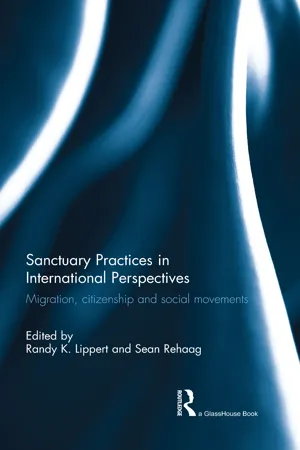
Sanctuary Practices in International Perspectives
Migration, Citizenship and Social Movements
- 288 pages
- English
- ePUB (mobile friendly)
- Available on iOS & Android
eBook - ePub
Sanctuary Practices in International Perspectives
Migration, Citizenship and Social Movements
Part I
Sanctuary perspectives
Historical, theological, legal, theoretical
Chapter 1
Sanctuary for crime in the early common law
Introduction
Around the year 1086, speaking through a royal charter attributed to him, William the Conqueror reminisced about his military victory over the English at the Battle of Hastings twenty years earlier and recalled, ‘I made a vow then that if by God’s grace we would be able to obtain victory I would construct a church to the honour of God.’ Making good on this battlefield vow, William ordered the endowment of a church on the site and named it Battle Abbey in honour of the decisive battle by which he secured the English crown. As was customary in such charters, the king then proceeded to enumerate a list of liberties that the abbey could claim against royal justice. Last in the list was the following: ‘If any thief or homicide or other guilty person flee from fear of death to this church, let him not be harmed, but let him be released wholly free’ (Davis 1913: charter no. 62). With these words King William conferred upon the church at Battle Abbey the right to serve as a sanctuary for criminals who might take refuge within it.
Three points should be noted immediately. First, the specific articulation of sanctuary rights in the charter was superfluous because any consecrated church in England, and indeed throughout medieval Christendom, was understood to provide sanctuary to fugitive criminals, regardless of whether or not the right had been granted by a specific royal act. Second, and much more important for our present purposes, the royal charter is spurious. It was forged nearly a century after William’s death, probably in the 1170s, by monks at Battle Abbey who sought to secure a raft of privileges against the crown by resting them upon William’s imagined grant (Searle 1980: 17–23). But like all forgeries produced with any hope of success, the charter put assertions into William’s mouth that rang with plausibility to contemporaries. The image of a heroic king, flush with victory and Christian piety, announcing that a criminal would be free from harm if he fled to the church provided the monks with an effective vehicle by which to authenticate the privileges they hoped the crown would honour. The monks were not merely attempting to secure sanctuary protections through a forged charter. Rather, they invoked a royal grant of sanctuary in their charter in order to create a more convincing forgery. Seen in this light, the forged Battle Abbey charter prompts an important observation: the expectation that a murderer or thief could find escape from punishment by fleeing to a church and claiming sanctuary was so replete within twelfth-century England that royal recognition of it could be used to manufacture authenticity in a forged charter. Nor was medieval English law exceptional in its regard for sanctuary. At the time the monks at Battle Abbey forged this charter in the late twelfth century, they might have noted that sanctuary for criminals had been attested not only in centuries of ecclesiastical legislation, but also in centuries of Anglo-Saxon and Frankish royal legislation, as well as in late imperial Roman law. To these legislative examples one might add the myriad instances of sanctuary for crimes that had been described in patristic letters, chronicles, and saints’ lives. The monks at Battle Abbey had good reason to pin their forgery to the image of a sanctuary-granting king (Shoemaker 2011: 8–37). The forged charter evoked a pleasing confluence of royal and ecclesiastical power, reminding its audience that good Christian kings looked favorably on sanctuary protections for fugitive criminals. Finally, a third point requires emphasis. The sanctuary contemplated by the Battle Abbey charter, and indeed by medieval sanctuary law as a whole, was specifically aimed at protecting avowed criminals, even (or perhaps especially) murderers and thieves. It was not intended to protect innocent fugitives, though it may on occasion have accomplished this. Sanctuary was for the guilty.
The Battle Abbey charter serves as a useful introduction to medieval sanctuary law because it appeared at a crucial juncture in the life of sanctuary, particularly in England. For while sanctuary had been recognized in Anglo-Saxon law for centuries, procedural reforms instituted (or perhaps reinstituted) by Henry II in the 1170s were about to bring sanctuary more squarely within the ambit of royal administration, domesticating sanctuary within the processes of the English common law (Shoemaker 2011: 112–51). Once integrated into the common law procedures governing felonies, sanctuary survived for nearly four more centuries until it was all but abolished by legal reforms instituted under Henry VIII. The virtual abolition of sanctuary in the sixteenth century was a pan-European phenomenon, accomplished in Protestant and Catholic countries alike by a combination of royal, parliamentary, and papal decrees. Before examining the fate of sanctuary in sixteenth-century Europe, however, it will be instructive to explore the attempts by which early modern and modern historians have attempted to understand the development and eventual decline of medieval sanctuary laws.
Historians and sanctuary
How did the notion that criminals who fled to churches should receive impunity come to occupy such a central place in medieval European law? Why, in other words, would those who had committed the worst sorts of violence and depredation be singled out for special protections which were announced and enforced by Church and Crown alike? Since its abolition in the sixteenth century, sanctuary has attracted the attention of historians who sought to explain its ubiquitous presence in medieval legal traditions. Sometimes, but certainly not always, these explanations could be mapped onto confessional differences. Some early modern Protestant scholars accused the medieval Church of smuggling pagan sanctuary practices into Christian law (Mattheas 1684, 1987–94: 4, 632). Samuel Pegge, for example, denounced ancient ‘Christian leaders, from whom we might expect the best’ for recklessly ‘transferring all of the privileges and immunities of the Heathen temples … onto the Christian churches’. Sanctuary laws consecrated in the ancient sources, Pegge continued scathingly, were born from a pagan propensity for ‘blind reverence and devotion’ and rested upon ‘a mistaken and ill-judged veneration for fabrics, and altars, and the saints’ (Pegge 1787: 1).
Such arguments were often a response to attempts by some early modern canon lawyers to ground sanctuary in reason or divine law, as opposed to ancient pagan superstitions. For example, sixteenth-century Italian canon lawyer Jacobus Menochius acknowledged that sanctuary privileges could be found among pagan peoples, but then asked rhetorically: ‘If even the ius gentium’ recognized sanctuary, ‘how much more should these immunities be bestowed upon the churches of God?’ (Menochius 1695: 298). Despite such attempts to ground sanctuary in divine law, however, by the late sixteenth century even the papacy was working to restrict the scope of sanctuary law by drastically limiting the sorts of crimes for which one could claim sanctuary (Shoemaker 2011: 172).
Interestingly, whatever they thought of its origins, jurists and historians of all stripes largely held the end of sanctuary to be a good thing. Scholarly descriptions of medieval sanctuary law often veered into litanies of the evils it visited upon society. On account of sanctuary, ‘the strong, the swift, the premeditating murderer cheated the gallows’ (Maitland and Montague 1915: 71). In sum, sanctuary was an ‘error … costly to the civilized community, in that wrongdoing was protected’ (Trenholme 1903: 96). From its infancy, criminology agreed. Beccaria concluded that ‘places of asylum invite to crime more than punishments influence against it’ (Beccaria 1986: 92). By the early modern period, not only had sanctuary come to be identified with injustice, but it was also credited with encouraging more crimes.
Just as detrimental was sanctuary’s infringement upon the province of the sovereign and its laws. ‘Within the borders of a country there should be no place independent of its laws’, and ‘to multiply such places of asylum is to create so many small sovereignties … where laws have no say’ (ibid.: 92). With the end of sanctuary, ‘we may see more clearly from what a fruitful source of outrages we are freed by the laws obtaining in all cases their natural and uninterrupted course’ (Pegge 1787: 2).
The abolition of sanctuary, then, was heralded as a hallmark of progress. In the modern age, ‘under a due administration of Justice’, sanctuary can only be ‘simply and constantly mischievous’ (Hallam 1818: 2, 449). One nineteenth-century writer asserted that ‘the more the administration of laws improved, and the less imperfect was the system of laws which they had to administer, the fewer the instances of resort to sanctuary’ (de Mazzinghi 1887: 101). Indeed, if due process and a fair trial were guaranteed, ‘sanctuary was a public nuisance’ (Maitland and Montague 1915: 70). Its ‘abolition was a measure calculated to advance the interests of justice and morality in the land’ (Trenholme 1903: 98). For ‘with the advent of a well-organized judiciary and even-handed justice, sanctuaries and asylums became places of escape rather than refuge’ (ibid.: 1). The triumph of the rule of law was thought to have rendered sanctuary detrimental to the public good.
The uniform judgment of nineteenth- and early twentieth-century historians confirmed these opinions. For historians, sanctuary laws thrived in the Middle Ages because structures of law enforcement were weak and unorganized, leaving the field to violent bloodfeuds or, on occasions where wrongdoers were actually apprehended, to the overwhelming cruelty of royal punishments. In this lawless welter, historians saw sanctuary laws providing ‘some green spots in the wilderness, where the feeble and the persecuted could find refuge’ (Hallam 1818: 2, 449). ‘The sanctuaries of medieval Christendom’ were a stopgap measure – ‘necessary remedies for a barbarous state of society’ (Stanley 1861: 414). Indicative of ‘all rude ages’, sanctuary was thought to have ‘substituted impartiality for prejudice’ and ‘mitigated the ferocious punishment’ (de Mazzinghi 1887: 102). Examples could be multiplied, but the gist is clear. Without ‘a universally competent public justice, where neither the general peace nor protection of the individual was well assured, and where common respect for sacred things preserved certain edifices and certain districts from acts of violence’, sanctuaries flourished (Le Bras 1930: 1035). On the other hand, ‘strong political power assured the order and restraint of asylum’ (Timbal 1939: 454).
Recent scholarship has moved beyond assessing the utility of sanctuary for weak states. For example, Gervase Rosser has noticed that medieval sanctuary flourished not only in periods of relative disorder and violence but also in periods of relative stability and strong governance (Rosser 1996: 61). In addition, William Jordan has recently cautioned against ‘reading the medieval history of sanctuary from the early modern assault on it’, helpfully recognizing the extent to which early modern juridical accounts of sanctuary established the parameters of the historical accounts (Jordan 2008: 17). An essay by Richard Helmholz sets sanctuary law within its internal juridical context, showing how medieval sanctuary provides fertile ground for exploring how medieval canon lawyers developed rules to administer it (Helmholz 2001: 22). If we recall for a moment the creative forgers at Battle Abbey, it is clear that they considered sanctuary to be both an expression of strong, pious kingship and an integral feature of a just legal order.
Sanctuary and good kingship
Therefore, it is worth considering in more detail the historical conditions under which our forgers thought it significant to have William the Conqueror pronounce sanctuary protections for their church. For one thing, by the late twelfth century, William, despite being a conqueror, represented legal continuity with Anglo-Saxon rule. William had, after all, claimed the English throne by right of succession, not sheer conquest. The policies articulated in William’s authentic post-Conquest charters and often repeated in twelfth-century Anglo-Norman legal collections favoured confirmation of the old laws and customs of England. William the Conqueror himself oversaw an ecclesiastical council in Normandy in 1080 which gave attention to the preservation of sanctuary law (Vitalis 1968–80: 5.5). The image of sanctuary-respecting kings was sufficiently powerful that William I’s son, King Henry I, explained to Pope Calixtus II that he had invaded Normandy in 1106 because he had heard reports of frequent sanctuary breaches there. He thought he could justify his actions to the Pope by reference to his desire to protect sanctuary rights (ibid.: 6.12).
Twelfth-century English legal collections consistently credited old kings with promulgating laws that protected criminals who fled to churches. The so-called Leis Willelme affirmed sanctuary in its very first chapter, immediately following the prologue: ‘Concerning some misdeed that a man has done, if he is able to come to a holy church, he shall have peace of his life and his limbs’ (Liebermann 1903–16: 1, 498). The Leis were not promulgated by William. They were compiled (and created) by twelfth-century scribes who knew, or guessed, what the laws of William should have looked like (Wormald 1999: 410). Such collections, which proliferated in the twelfth century, consistently emphasized sanctuary to be chief among the legislative acts that gave old kings their proper kingly attributes.
The early twelfth-century Laws of Edward the Confessor provide similar evidence. Their fifth chapter provided that only a bishop or his ministers could remove one guilty or accused of a crime who had fled to a church (Liebermann 1903–16: 1, 630). The sanctuary articles in the Laws of Edward, consistent with twelfth-century canon laws, also extended sanctuary protection to the house of priests, not just the church itself (ibid.). At the same time, the Laws of Edward commanded thieves who fled to sanctuary to return what they had stolen or to make restitution from out of their own goods (ibid.). They also provided that those we might today call recidivists, those who took frequent recourse to sanctuary, were to ‘foreswear the province and never return’ (ibid.). If such a repeat offender did return from exile, the laws declared: ‘let no one presume to receive him’ except by consent of the king (ibid.). It has been observed that the sanctuary provisions in Edward’s laws bore more similarity to the canons of Frankish church councils than to pre-Conquest Anglo-Saxon sanctuary laws, but the important point conveyed by the text to the twelfth-century reader was that Kin...
Table of contents
- Cover Page
- Half Title Page
- Title Page
- Copyright Page
- Table of Contents
- Notes on contributors
- Foreword: The Ambiguity of Migration
- Acknowledgements
- List of abbreviations
- Introduction: sanctuary across countries, institutions, and disciplines
- Part I Sanctuary perspectives: historical, theological, legal, theoretical
- Part II Sanctuary movements and practices in the United States: old and new
- Part III Sanctuary movements and practices in Europe and Canada: international comparative and case studies
- Part IV Emergent realms: Cities of Sanctuary and military sanctuaries
- Index
Trusted by 375,005 students
Access to over 1.5 million titles for a fair monthly price.
Study more efficiently using our study tools.
Frequently asked questions
Yes, you can cancel anytime from the Subscription tab in your account settings on the Perlego website. Your subscription will stay active until the end of your current billing period. Learn how to cancel your subscription
No, books cannot be downloaded as external files, such as PDFs, for use outside of Perlego. However, you can download books within the Perlego app for offline reading on mobile or tablet. Learn how to download books offline
Perlego offers two plans: Essential and Complete
- Essential is ideal for learners and professionals who enjoy exploring a wide range of subjects. Access the Essential Library with 800,000+ trusted titles and best-sellers across business, personal growth, and the humanities. Includes unlimited reading time and Standard Read Aloud voice.
- Complete: Perfect for advanced learners and researchers needing full, unrestricted access. Unlock 1.5M+ books across hundreds of subjects, including academic and specialized titles. The Complete Plan also includes advanced features like Premium Read Aloud and Research Assistant.
We are an online textbook subscription service, where you can get access to an entire online library for less than the price of a single book per month. With over 1.5 million books across 990+ topics, we’ve got you covered! Learn about our mission
Look out for the read-aloud symbol on your next book to see if you can listen to it. The read-aloud tool reads text aloud for you, highlighting the text as it is being read. You can pause it, speed it up and slow it down. Learn more about Read Aloud
Yes! You can use the Perlego app on both iOS and Android devices to read anytime, anywhere — even offline. Perfect for commutes or when you’re on the go.
Please note we cannot support devices running on iOS 13 and Android 7 or earlier. Learn more about using the app
Please note we cannot support devices running on iOS 13 and Android 7 or earlier. Learn more about using the app
Yes, you can access Sanctuary Practices in International Perspectives by Randy Lippert,Sean Rehaag in PDF and/or ePUB format, as well as other popular books in Law & Comparative Law. We have over 1.5 million books available in our catalogue for you to explore.