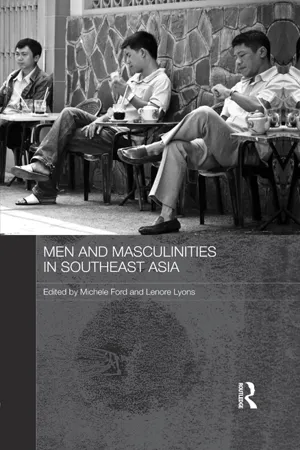
This book brings together extensive recent innovative research on the study of men and masculinities in Southeast Asia. Drawing on rich ethnographic fieldwork from Vietnam, Cambodia, Thailand, the Philippines, Singapore, Indonesia and Timor-Leste, the book examines both dominant and marginal constructions of heterosexual masculinity and the ways in which these are performed in different localized contexts in insular and mainland Southeast Asia. Through the presentation of detailed ethnographic studies on topics ranging from the professional practices of Filipino merchant seafarers to the sex lives of Thai migrant workers to the stand-over tactics of Indonesian gangsters, the authors in this collection challenge the idea of emerging globalizing forms of masculinities. Where existing studies of gender in Asia tend to concentrate on women, East Asia and gay men, this book fills a significant gap and demonstrates, overall, how gender, ethnicity, class, sexuality and nationality shape contemporary understandings of what it means to be a 'man' in contemporary Southeast Asia.
- 176 pages
- English
- ePUB (mobile friendly)
- Available on iOS & Android
eBook - ePub
Men and Masculinities in Southeast Asia
About this book
Information
1 Masculinities Afloat
Filipino Seafarers and the Situational Performance of Manhood
Steven McKay and Don Eliseo Lucero-Prisno III
Migrants from the Philippines have been central to the scholarship on both gender and migration. Yet few studies have focused on Filipino masculinity and almost none on one of the country’s most dominant global occupational niches: merchant seafaring. Our research reveals that due to their work, remittances and growing visibility, Filipino seamen are often constructed – by themselves and by other Filipinos – as ‘exemplars of masculinity’ (Connell 1995). Nevertheless, they toil primarily at the lower rungs of an occupational and multinational hierarchy, and must grapple with both limited upward mobility and a reputation in the industry as merely ‘good followers’. Drawing on interviews and extensive ethnographic field research conducted in the Philippines; in seaports in Europe, Asia and South America; and onboard five merchant ships with Filipino and mixed-nationality crews, this chapter focuses on the constructions and transnational performances of manhood among Filipino seafarers, tracing their strategies to compensate for their marginalization.1 We argue that Filipino seafarers are caught in a ‘masculine dialectic’ between models of middle-class professionalism on the one hand, and working-class hyper-masculinity of adventure on the other.
Theoretically, we develop the notion of not only multiple but conflicting masculinities to better understand how the situational performance of competing masculinities are spatially practised. This account complicates Connell’s (1995, 1998) extension of a single hegemonic masculinity at the global scale. With rising global economic interdependence and greater cross-border flows, Connell and Wood (2005) have argued that a certain ‘transnational business masculinity’ is becoming hegemonic over the local. Our focus on the workplace demonstrates how occupational and organizational structures influence both the class character of and power relations between different nationally grounded masculinities (Collinson and Hearn 2004; Ashcraft 2005), adding weight to assertions that there continues to be a diverse range of masculinities among regions and countries, and that it remains crucial to specify the constraints and contexts in which such masculinities are formed (Louie and Low 2003; Osella and Osella 2006; Gutmann 2007).
The chapter also captures the discursive and performative elements of masculinity and how men actually ‘do masculinity’ in multiple contexts (Fenstermaker and West 2002). Migratory workers in particular highlight such creative efforts, since there is a greater separation of workplace and home and migrant men are able to enact their masculine identities in a broader array of locations. The fact that these migrant working men operate in a transnational environment highlights how masculinities can conflict, particularly in interaction with other types of social difference, such as nation, race and ethnicity (Connell and Messerschmidt 2005), and the extent to which constructions of masculinities are both situational and performative (Paap 2006; Gutmann 2007). While facing considerable structural constraints, Filipino seafarers succeed in acting across a variety of stages to render this masculine dialectic both productive and creative. They resist a marginalized masculinity driven by workplace subordination and labour-market insecurity by combining a ‘cautious masculinity’ of self-control and competence on the job, an ‘expressive hyper-masculinity’ of compensation in port and among peers, and a ‘breadwinner masculinity’ of providership, sacrifice and responsible fatherhood at home.
Masculinity and Work
A key arena in which masculinities are fashioned is the workplace, where central elements associated with hegemonic masculinity, such as competitiveness, autonomy, providership and risk-taking, are played out. One of the primary divisions between masculinities contrasts a dominant, ‘civilized’ middle-class masculinity of professional or managerial men against a subordinate or marginal ‘primitive’ masculinity of working-class men (Willis 1977; Ashcraft and Flores 2003). Of course, there is variation within each of these masculinities related to organizational or occupational specialization. Barrett (1996) demonstrates that while all the American naval officers in his study construct their masculinity against women and gay men, their occupational specialties mean that each highlights an element of hegemonic masculinity that sets his group apart – whether it is autonomy and risk-taking by pilots, competence under pressure by bridge officers, or technical rationality by supply officers. This strategic and variable approach is also evident among working-class men. As Paap (2006) has shown in the American context, working-class labourers often celebrate a masculine ‘pigness’ – coarse, physically tough and aggressively heterosexual – to set themselves apart from more refined, effete professionals who lack ‘real’ manhood. But since this strategic ‘pigness’ conflicts directly with managerial-class masculinities, it is used to justify the continued subordination of such working-class ‘pigs’. Taking into account occupational and class relations highlights how men often struggle with a classtinged ‘masculine dialectic’ between a more civilized model of middle-class manhood associated with professionalism and upward mobility, and a more physical, aggressive and hyper-masculine working-class model (Willis 1977; Ashcraft and Flores 2003).
Merchant seafaring has had a distinct masculine identity since its earliest years in the Mediterranean and in East and Southeast Asia (Hohman 1956; Reid 1993; Connell 1995). Because shipboard relations were modelled along military lines, merchant ships have also historically had an extremely hierarchical power structure. Thus, like other kinds of subordinate workers, sailors tend to construct their dangerous work as particularly masculine and even heroic, in part to help them survive exploitative relations (Willis 1977; Reid 1993; Kimmel 1996). Filipinos on Western merchant ships also have a long history, from forced labour aboard Spanish galleons from the sixteenth to the nineteenth century, to crew members on British trading and American whaling ships in the nineteenth century, to a brief stint as stewards in the American merchant marines in the early twentieth century (Melendy 1977; Borah 1995/1996; Aguilar 2003). In fact, Filipinos became so identified with crewing that the term Manilamen became an entire category for ‘Asiatic’ seafarers on Western ships, including Filipinos, Chinese, Malays, Pacific Islanders, South Asians and those of mixed race (Chappell 2004).
Changes in the modern shipping industry have altered the jobs and masculine image of the seafarer. With larger ships, smaller crews, and increased automation, there has been a marked push to professionalize both maritime education and the workforce (Alderton et al. 2004). For most seafarers – particularly those from developing countries like the Philippines – this means that even entry-level positions often require a post-secondary degree from an accredited maritime college. Such changes have also led to a contemporary occupational masculinity that embodies professional, military and working-class masculinities, depending on one’s position onboard. At the top of the hierarchy, junior and senior officers support their claims to professionalism through their authority, education, licences and relatively high salaries. Yet they share with their unlicensed subordinates a workplace that is generally all-men, hierarchical, risky, and often dangerous and physically taxing. Taken together, seamen in many ways project an image of what Connell (1995: 185) calls ‘exemplars of masculinity’: heterosexual, competitive, adventurous, homosocial and able to dominate women as well as other men. But how different masculinities get constructed, and by whom, pivots on rank and nationality, markers that are often closely correlated.
Another important development in contemporary shipping has been the increasing dominance of multinational crews. Since the economic crisis of the mid-1970s, ship owners have begun hiring cheaper crews from the Philippines, South Korea, India and Indonesia (Turnbull 2000). From only 2,000 Filipinos on foreign ships in the 1960s, today there are over 275,000 and Filipinos are now by far the largest national group, making up 28.1 per cent of the global workforce (NSB 1982; Amante 2003; POEA 2007). Despite this influx, the seafaring labour market remains quite stratified as strong European and Japanese maritime unions have fought to protect their senior officers in exchange for allowing ship owners to hire junior officers and low-level ‘ratings’ (non-licensed deck, engine or catering crew) from other countries. As a result, Filipino seafarers’ position within the occupational hierarchy has shifted only slowly. In the mid-1970s, 90 per cent of Filipinos sailed as lower-level ratings, and 10 per cent were junior officers (NSB 1976). In 2005 73 per cent of Filipinos were still sailing as lower-level crew, with 19 per cent as junior officers and 8 per cent as senior officers (POEA 2007).
The Situational Performance of Conflicting Masculinities
The limited scholarship on contemporary Filipino masculinities has generally situated its analysis in a colonial and/or international context. As Rafael (2000) and others note, the American colonial project from 1898 was racialized and gendered, with the masculinist imperial conquest aiming in part to ‘rationalize and buttress the power of “civilized” white men’ while simultaneously constructing Filipino colonial subjects as savage, child-like, feminized, unmanly and generally unfit for self-rule (Espiritu 2003: 50). Yet resistance to colonial conquest also created opportunities to exercise local notions of masculinity. For example, anti-colonial fighters were often mythologized as magaling na lalaki, literally ‘good men’, for their bravery, invincible bodies and indomitable spirit (Aguilar 1998: 53). These notions drew on older beliefs – shared across much of Southeast Asia – regarding ideal male qualities of malakas or strength, embodied in pre-colonial datu chiefs or ‘Big Men’ who combined bravery, physical strength, intelligence, eloquence and rapport with the spirit world to gain followers (Aguilar 1998: 29).
Colonization by Spain and the United States and the drawing of the Philippines into the modern capitalist system then led to a mixing of Western concepts of a ‘civilized’ and self-disciplined masculinity with local concepts of male power and potency focused on kapangyarihan ng loob or interior strength of will, physical prowess and invulnerability of the body (Rafael 2000; Tremlett 2006: 13). This mixing is evident in studies of contemporary Filipino masculinity. Pingol (2001), in her study of Illocano men whose wives work abroad, demonstrates that the Philippines’ deep interconnection with the global economy has proven to be an enormous challenge for Filipino men facing norms of masculinity that centre on being ‘good providers, virile sex partners, firm and strong fathers’ (ibid.: 8). House-husbands left behind by migrating women actively refashioned their masculine identities, appealing to broader masculine ideologies of ‘being in control’ and ‘maintaining autonomy’. Respect was earned through a man’s self-discipline, independent earnings, leadership, endurance of suffering and ability to abstain sexually, while fear was maintained through physical domination, risk-taking, psychological coercion and publicly expressing the ‘machismo of rogues and daredevils’ (ibid.: 4). Margold (1995: 290) makes a similar argument, contrasting the masculine ideals of verbal eloquence, galante (gracefulness) and adventurousness among Illocanos with the ‘aggressive control’ over wives and children chosen by some ‘failed’ migrant men returning from the Middle East. Importantly, Margold points out the class associations of the two ends of the spectrum and how the exploitation and humiliation of low-paid, low-status labour can limit men’s ability to construct a masculine identity from actions garnering respect rather than fear. At the same time, Parreñas (2005, 2008) argues that while migration tends to heighten gendered norms of conventional fatherhood around providing material support and projecting authority from afar at the expense of emotional attachment and shared child-centred parenting, when migrant fathers were home, they tended to do more housework and childcare than fathers in families whose wives worked abroad. This may demonstrate that being in the economic position to be a good provider can allow for a wider repertoire for enacting one’s masculinity.
Masculinities Onboard
As Gutmann (2007: 245) points out, ‘[M]en and women are presented with stages and scripts not of their own choosing. What they do creatively within these social and cultural constraints, and how originally they perform their roles, however, is not preordained.’ The character of the maritime workplace and the stratification of the seafarer labour market are both key factors that influence the construction of Filipino masculinities and the ways Filipino seafarers act to develop meaningful masculine selves. This stratification is felt most directly onboard, where many Filipinos feel there is a national if not racial division of labour by rank. As one seafarer commented:
There are mixed crews, with Europeans. But the Filipinos are only seconds [engineers or officers] and below. You’ll never see a European crew under a Filipino captain – no way. Maybe someday in the future, but now, no way.
Another Filipino – who held a junior officer licence but was working as an Ordinary Seaman (the lowest-level position on deck) – observed bitterly that:
Germans are prejudiced. Ukrainians are also a bit prejudiced. They would say that Filipinos have studied in school so long but onboard all we do is clean and remove rust. Unlike them, they just studied for a short period of time and still get promoted easily . . . The Ukrainians sometimes even call us slaves.
Such workplace segmentation in a hierarchical and homosocial environment can lead to a questioning of the masculinity of the lower ranked, especially in a multinational workforce, as demonstrated by a study aboard two cargo ships with Norwegian officers and Filipino crews, which concluded that the Norwegian sailors constructed a hegemonic masculinity in direct contrast to the subordinate masculinity of the lower-ranked Filipinos (Ostreng 2001: 7).
Filipinos vigorously resist this ascribed, subordinate masculinity by enacting their own combinations of professional and selective marginal strategies. On the one hand, many Filipino seamen, particularly of lower ranks, view their jobs in traditionally masculine terms, reinterpreting their exploitative and dangerous work as ‘a heroic exercise of manly confrontation with the task’ (Willis 1977). This is clear in the gender typing of the job’s unique characteristics. As one seaman exclaimed:
From the start, I knew that this is a man’s job. Before, I read in comic magazines that if you are a seaman, you are macho. You have to be a real man [lalakenglalake] with tremendous endurance to survive staying for a long time at sea . . . When you are aboard a ship, the things you discuss are man’s stuff [usapang lalake]. You would really feel like a man because work is really hard.
Yet on the other hand, many Filipino seamen also realize the class stigma of manual work and seek to cast their jobs in more professional terms, arguing that all Filipino seafarers should be considered ‘professionals’. For example, a young Second Mate explained that, regardless of rank, Filipinos exhibited professionalism through their skill, competence and quality as attested to by the government accreditation they received before leaving the Philippines. As a result, he argued, even unlicensed lower-level crew members are ‘professional in the sense that they are quality exports of the Philippines because they would not send you to other countries if you are not qualified, if you are not competent’. This observation reflects the fact that, since 90 per cent of Filipino seafarers do not have the authority of a master (captain) or chief engineer, many choose to emphasize occupational competence in their claims for professional status.
In part because many Filipinos have had long tenures without significant upward mobility, they tend to highlight their experience, ingenuity, and capacity for i...
Table of contents
- Cover
- Half Title
- Title Page
- Copyright
- Contents
- List of contributors
- Preface
- Introduction
- 1. Masculinities afloat: Filipino seafarers and the situational performance of manhood
- 2. Masculine intent and migrant manhood: Thai workmen talking sex
- 3. Low-wage Vietnamese immigrants, social class and masculinity in the homeland
- 4. Homosociality and desire: charting Chinese Singaporean sex tourists’ online conversations
- 5. Being broh:the good, the bad and the successful man in Cambodia
- 6. Violence, masculinities and patriarchy in post-conflict Timor-Leste
- 7. The biggest cock: territoriality, invulnerability and honour amongst Jakarta‘s gangsters
- 8. Defending the nation: Malay men‘s experience of National Service in Singapore
- Index
Trusted by 375,005 students
Access to over 1.5 million titles for a fair monthly price.
Study more efficiently using our study tools.
Frequently asked questions
Yes, you can cancel anytime from the Subscription tab in your account settings on the Perlego website. Your subscription will stay active until the end of your current billing period. Learn how to cancel your subscription
No, books cannot be downloaded as external files, such as PDFs, for use outside of Perlego. However, you can download books within the Perlego app for offline reading on mobile or tablet. Learn how to download books offline
Perlego offers two plans: Essential and Complete
- Essential is ideal for learners and professionals who enjoy exploring a wide range of subjects. Access the Essential Library with 800,000+ trusted titles and best-sellers across business, personal growth, and the humanities. Includes unlimited reading time and Standard Read Aloud voice.
- Complete: Perfect for advanced learners and researchers needing full, unrestricted access. Unlock 1.5M+ books across hundreds of subjects, including academic and specialized titles. The Complete Plan also includes advanced features like Premium Read Aloud and Research Assistant.
We are an online textbook subscription service, where you can get access to an entire online library for less than the price of a single book per month. With over 1.5 million books across 990+ topics, we’ve got you covered! Learn about our mission
Look out for the read-aloud symbol on your next book to see if you can listen to it. The read-aloud tool reads text aloud for you, highlighting the text as it is being read. You can pause it, speed it up and slow it down. Learn more about Read Aloud
Yes! You can use the Perlego app on both iOS and Android devices to read anytime, anywhere — even offline. Perfect for commutes or when you’re on the go.
Please note we cannot support devices running on iOS 13 and Android 7 or earlier. Learn more about using the app
Please note we cannot support devices running on iOS 13 and Android 7 or earlier. Learn more about using the app
Yes, you can access Men and Masculinities in Southeast Asia by Michele Ford,Lenore Lyons in PDF and/or ePUB format, as well as other popular books in Social Sciences & Ethnic Studies. We have over 1.5 million books available in our catalogue for you to explore.