- 444 pages
- English
- ePUB (mobile friendly)
- Available on iOS & Android
eBook - ePub
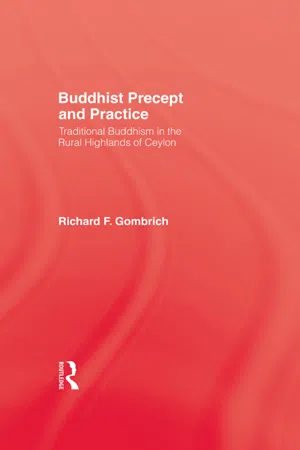
Buddhist Precept & Practice
About this book
First published in 1995. This study is intended as a contribution to the empirical study of religion, and in particular to the study of religious change. Using empirical method of using documents, interviews and experiments the author tests his old hypotheses in order to formulate new ones that my lead him to the truth. He focusses on the distinctions used throughout this book, that are between what people say they believe and say they do, and what they really believe and really do, using his research of the Sinhalese Buddhists in Ceylon
Information
1
Sinhalese Buddhism—Orthodox or Syncretistic?
LET me at the outset state a general conclusion. I found the Buddhism which I observed in Kandyan villages surprisingly orthodox. Religious doctrines and practices seem to have changed very little over the last 1,500 years. But Buddhism is 2,500 years old so why do I say 1,500 years, and what do I mean by orthodoxy?
I mentioned in the introduction that Buddhism came to Ceylon in the days of the Indian emperor Aśoka, about 243 B.C.1 This was Theravāda Buddhism. The contents of Theravāda Buddhist oral traditions go back uninterrupted to the time of the Buddha himself, but we only have histories written nearly a thousand years after the Buddha’s death,2 so the accuracy of these traditions for the early period, especially before Buddhism came to Ceylon, is controversial. To enter this controversy lies outside my present scope, and so does the adjudication of Theravādin claims that they alone represent true Buddhist orthodoxy, and that other sects are heretics. But whatever we make of the Theravādin accounts which tell how three Buddhist councils within a couple of centuries of the Buddha’s death established the scriptural canon and expelled heretics, it is certain that in Asoka’s day schisms had occurred, that there were different sects and different (though perhaps only very slightly different) scriptures, and that from some of these sects was to grow Mahāyāna Buddhism, which became so influential in India, Tibet, and the Far East.
Theravādin orthodoxy rests on the Pali Canon; it is so defined by Theravāda Buddhists themselves, in so far as they are sophisticated enough to pose the question. More precisely, we may add, it rests on the Pali Canon as interpreted by the ancient commentaries, an interpretation which is accepted without question in Ceylon and with only very minor disagreement by most western scholars. At first glance scriptural authority thus seems to be two-tier; but this picture is rather over-simplified, because the Canon itself contains ancient commentaries, and its chronology is largely problematic. The Canon is called in Pali the Tipiṭaka, because it consists of three Piṭakas (‘baskets’): the Vinaya Piṭaka (monastic rules), Sutta Piṭaka (sermons consisting in turn of five Nikāyas,3 of which the first four contain the sermons and the last miscellaneous texts, many of them in verse), and Abhidhamma Piṭaka (systematic philosophy). Buddhists believe a passage at the end of the Vinaya Piṭaka ( Cullavagga 11 and 12) which says that two councils of monks were held, one just after the Buddha’s death and one a hundred years later, and that at the first council were composed the Vinaya and Sutta Piṭakas, in their final form.4 The passage, being a part of the Vinaya Piṭaka, contradicts its own literal accuracy by mentioning the second council. Most other texts in these two Piṭakas claim to be, and therefore according to Buddhist tradition are, the very words of the Buddha; but even in the four Nikāyas, the collection of sermons setting out the Buddha’s teachings, there are some sermons attributed not to Buddha but to disciples. Some of these are said to have been delivered in the Buddha’s lifetime; but a few explicitly state that the Buddha is dead, or refer to events after his death.5 Part of the Abhidhamma Piṭaka is said by Theravādin tradition to have been compiled at the third council, held c. 247 B.C. under the auspices of Asoka, and whether or not such a council took place scholars agree with this relative chronology, and go further by assigning to the whole Abhidhamma a date when Buddhism was already organized and scholastic. Without discussing the dates of the miscellaneous texts (Khuddaka Nikāya) of the Suita Piṭaka, of which scholars consider some as likely to be the Buddha’s words as anything, some to be certainly much later, and some to be based perhaps even on pre- Buddhist material, we have found a measure of agreement between religious and scholarly opinion: the Pali Canon as we have it was not all compiled at one time. Therefore, we may add, it cannot reflect the state of the Buddhist religion at one given moment; nor indeed is it likely that so large and heterogeneous a body of material should be entirely free from contradictions.
Whatever its origins,6 the Pali Canon must have existed more or less as we have it now in the time of Aśoka, when Mahinda brought it over to Ceylon. An Aśokan inscription lists seven texts, five of which we can identify in the Canon we know, though mostly under different titles, which suggests that the other two also may be in our Canon. Among the sculptures at Bharhut and Sanchi (second century B.C.) are pictures of stories in the Canon. These are by far the oldest records of the Canon physically to survive: the Pali Canon was not even written down till the first century B.C., and of course no manuscript from that era exists.
It may be a slight over-simplification that Mahinda and his colleagues brought the Pali Canon (in their heads) to Ceylon, but it cannot be far from the truth. We owe the story to the great commentator Buddhaghosa, who wrote in the early fifth century A.D. Buddhaghosa adds that they brought commentaries in Pali, which Mahinda translated or recomposed in Sinhalese. If Pali originals of the Sinhalese commentaries ever existed, they had been lost before Buddhaghosa’s time. Adikaram7 has shown that the Sinhalese commentaries on which Buddhaghosa’s work is based were principally compiled in the first century A.D. The Mahāvaṃsa (XXXVII) says that Buddhaghosa came from North India to the Mahāvihāra in Anurādhapura because in India the commentaries (aṭṭhakathā) had been lost; his teacher told him that the Sinhalese commentaries were the genuine work of Mahinda, and he should translate them into Pali. His first work in Ceylon was the Vi-suddhimagga8 (The Path of Purity), an exhaustive summary in Pali of Buddhist doctrine, still the best work of its kind.9 He then wrote commentaries in Pali on most works in the Canon.10 The Sinhalese books on which these commentaries are based have perished, because he superseded them. Though he may at first have intended only to translate them he in fact edited and systematized them. He quotes nearly every earlier work of Pali literature known to have existed. His interpretations are mutually consistent. To this day Buddhaghosa’s Buddhism is in effect the unitary standard of doctrinal orthodoxy for all Theravāda Buddhists, whether or not they are educated enough to be aware of the problem.
The authors of the Pali commentaries on the parts of the Canon which Buddhaghosa did not treat do not conflict with him, so the commentatorial stand-point is unified and homogeneous. We know very little about these other authors, but they probably were contemporaries of Buddhaghosa or lived slightly later. The two more important ones are Buddhadatta11 and Dhammapāla.12 Tradition has it that Buddhadatta was born in the Coḷa kingdom but became a monk at the Mahāvihāra; there is an unlikely story that he was on a ship going back to India when he met Buddhaghosa on his way out. Dhammapāla wrote in South India and was probably a Tamil too; ‘he states… that he follows the traditional interpretation of texts as handed down in the Mahāvihara’; and ‘it is quite likely that he had the advantage of studying the Tamil commentaries (of which we know that at least two existed) as well.13 A further anonymous author wrote the Pali version of the Jātaka commentary which has come down to us; the Jātakas are stories of the 550 previous births of the Buddha; their Pali verses are canonical, but the prose parts, which carry the story forward so that without them the verses are mostly unintelligible, rank as commentary and for a while existed only in Sinhalese, like the other commentaries.14 The author says that he follows the traditions of the Mahāvihāra at Anurādhapura. The commentary on the Dhammapada, which is not so much a true commentary as a collection of stories much in the style of the Jātaka commentary, is like the latter traditionally but probably wrongly attributed to Buddhaghosa. The other two authors15 of commentaries whose names are known also lived at Anurādhapura and wrote in the same tradition.16
Though the Pali Canon is strictly the only sacred work and the supreme authority, there is another book which though neither Canon nor commentary has in Ceylon received the kind of fame and respect usually reserved for sacred books. This is the Mahāvaṃsa, the Pali verse chronicle of Ceylon, mentioned in the Introduction. The first part of it was written in the late fifth century by a monk called Mahānāma who lived in a monastery at Anurādhapura belonging to the Mahāvihāra. Like the commentaries, it was based on much Sinhalese written material, which has long since disappeared. It was based also on another similar Pali chronicle, the Dīpavaṃsa, which was written also in Anurādhapura, perhaps by nuns,17 about a century earlier, which makes it the oldest work written in Ceylon to have survived. But the Mahāvaṃsa follows it so closely, quoting long passages verbatim, and at the same time is so superior, that the Dīpavaṃsa is comparatively neglected. Both chronicles are—luckily for us—predominantly histories of the Buddha’s teaching (sāsana), and focus throughout on episodes of religious interest, beginning with mythical accounts of the Buddha’s visits to Ceylon. The earliest date for which the Mahāvaṃsa is authoritative may thus be fixed by the most sceptical at the fourth century A.D., by the sanguine at the third century B.C. (Mahinda’s mission to Ceylon), and by the pious during the lifetime of the Buddha himself. The chronicles are not primarily expositions of doctrine (albeit each chapter ends with a pious verse reflecting on the vanity of worldly pomp or some such orthodox sentiment); and though they afford fascinating material for the history of Buddhist ideas, they plainly do not form a touchstone of doctrinal orthodoxy as I have defined it; but they give accounts of religious practices and especially festivals which are rather outside the scope of the canonical literature. So though we may not be able to call a practice canonically orthodox, because the Canon does not mention it, we may often say that it stands in an orthodox tradition if it occurs in the Mahāvamṃa. And it cannot fail to strike a modern observer that many festivals described in the ancient Mahāvaṃsa, as well as in its continuations, differ little, except in scale, from festivals in Kandyan villages today.
This then is what I meant when I said at the beginning of the chapter that I found the Buddhism which I observed orthodox: that the doctrines of the villagers would have been approved by Buddhaghosa and that most of their religious practices would have been familiar to him and his contemporaries. But I also said that I found this orthodoxy surprising. Why so? I suppose it is unusual for the religion of a society to change so little over 1,500 years; certainly it is unusual for societies of which we have the records. But my surprise was caused rather by the frequency with which I had been...
Table of contents
- Cover
- Half Title
- Title Page
- Copyright
- Dedication
- Preface
- Abbreviations
- Pronunciation
- Contents
- Introduction: Aims and Scope of this Book
- 1. Sinhalese Buddhism—Orthodox or Syncretistic?
- 2. The Basic Vocabulary of Buddhism
- 3. The Buddha
- 4. A Sketch of the Universe as seen from Mīgala
- 5. Total Responsibility in Theory and Practice
- 6. The Ethics of Intention
- 7. The Monastic Ideal and the Decline of Buddhism
- 8. Caste in the Monastery
- 9. Conclusion
- Appendix
- Glossary
- Bibliography
- Index
Trusted by 375,005 students
Access to over 1.5 million titles for a fair monthly price.
Study more efficiently using our study tools.
Frequently asked questions
Yes, you can cancel anytime from the Subscription tab in your account settings on the Perlego website. Your subscription will stay active until the end of your current billing period. Learn how to cancel your subscription
No, books cannot be downloaded as external files, such as PDFs, for use outside of Perlego. However, you can download books within the Perlego app for offline reading on mobile or tablet. Learn how to download books offline
Perlego offers two plans: Essential and Complete
- Essential is ideal for learners and professionals who enjoy exploring a wide range of subjects. Access the Essential Library with 800,000+ trusted titles and best-sellers across business, personal growth, and the humanities. Includes unlimited reading time and Standard Read Aloud voice.
- Complete: Perfect for advanced learners and researchers needing full, unrestricted access. Unlock 1.5M+ books across hundreds of subjects, including academic and specialized titles. The Complete Plan also includes advanced features like Premium Read Aloud and Research Assistant.
We are an online textbook subscription service, where you can get access to an entire online library for less than the price of a single book per month. With over 1.5 million books across 990+ topics, we’ve got you covered! Learn about our mission
Look out for the read-aloud symbol on your next book to see if you can listen to it. The read-aloud tool reads text aloud for you, highlighting the text as it is being read. You can pause it, speed it up and slow it down. Learn more about Read Aloud
Yes! You can use the Perlego app on both iOS and Android devices to read anytime, anywhere — even offline. Perfect for commutes or when you’re on the go.
Please note we cannot support devices running on iOS 13 and Android 7 or earlier. Learn more about using the app
Please note we cannot support devices running on iOS 13 and Android 7 or earlier. Learn more about using the app
Yes, you can access Buddhist Precept & Practice by Richard F. Gombrich in PDF and/or ePUB format, as well as other popular books in Theology & Religion & Buddhism. We have over 1.5 million books available in our catalogue for you to explore.