Published in 1981, Religious Change in Zambia is a valuable contribution to the field of Middle East Studies.
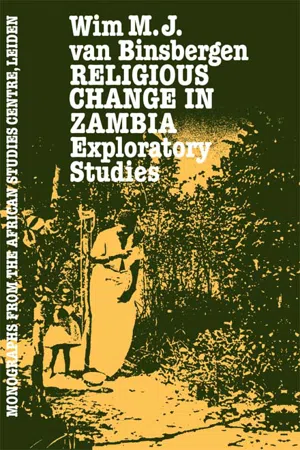
- 256 pages
- English
- ePUB (mobile friendly)
- Available on iOS & Android
eBook - ePub
Religious Change In Zambia
About this book
Information
Chapter 1
Introduction: Towards a theory of religious change in Central Africa1
The background of the present studies
In the early 1970s, when I started my research into Central African religious change, this field of enquiry was in what we might call a state of ‘great expectations’. It was the time when established anthropological and historical approaches to Africa were beginning to be challenged by new work pursuing new questions with a combination of old and new data.
Anthropology had become fully aware of the limitations of single-tribe studies, but was still looking for a theory and a method capable of dealing with the unmistakable regional similarities, the permutations of a limited number of recurrent structural themes, as emerging from the accumulation of anthropological work done on specific areas and subcontinents. The method of cross-cultural comparison2 seemed to offer one possible solution. It attempted to itemize the societal elements identified at a given place and time, and to compare their distribution across societies, apparently without challenging the assumptions (usually holistic and structural-functionalist) underlying the original descriptions of such items in the single-tribe monographs they had been gleaned from. Regional studies calling for a less mechanical and more structural approach to the problem of societal comparison were not lacking, particularly not in the field of Central and Southern African studies,3 but they had not yet proceeded far beyond the stage of programmatic statements and tentative explorations. Comprehensive, more-than-single-tribe anthropological studies of Central African religion were virtually absent, although the few studies dealing with urban religion4 reflected the fact that Central African towns were of multi-ethnic composition.
Through its association with the Rhodes-Livingstone Institute and its post-Independence heir (the Institute for Social Research, later Institute for African Studies, University of Zambia, Lusaka), Max Gluckman's Manchester School dominated Zambian social research. Whatever the strengths and weaknesses of the evolving Manchester approach,5 it had no strong interest in religion, nor in regional studies. No doubt, this research tradition did produce several deservedly classic analyses of a single rural religious system in Central Africa.6 But however brilliant these contributions were, they were conceived within the framework of a unique local social structure, whose similarities with the structures prevailing in adjacent geographical areas were hardly investigated. And while synchronic comparison was ignored, these religious studies would also hesitate to explore the historical dimensions of the religious phenomena they dealt with, or to interpret the synchronic material in a context of social change.7 Such depth as Manchester religious studies achieved lay in their tracing of ramifications of religious phenomena within the overall structure of local group processes, or (especially in the case of Turner) in the unprecedented exploration of fundamental patterns of ritual and symbolism which, from the purely local, immediately proceeded to a universal human plane (colour symbolism, liminality, the opposition between ‘structure’ and ‘com-munitas’), regardless of historical or regional communalities. Meanwhile, the intensive coverage of Zambia by anthropological research, coupled with the significance of religious phenomena in many aspects of Zambian life during the colonial and post-colonial period, produced an abundance of shorter anthropological discussions of aspects of religion in Zambia – many of which will be referred to in the present book.
In the field of history, around 1970 the transition took place from a Central African historiography still largely based on documentary evidence, to one in which a variety of non-documentary sources (derived from archeology, linguistics, the examination of ethnographic distribution patterns, and particularly oral evidence) enables us to chart areas and periods for which no written records are available. Documentary historiography had produced some insights into aspects of religion in Zambia during the colonial period.8 However, the scope of these studies was limited, and as pioneer studies they were still unable to analyse convincingly forms of missionary or independent Christianity against the context of evolving economic and political structure of colonial society, or to make the link with non-Christian Central African religious forms. In these respects the earlier Zambian studies were inferior, both to Shepperson and Price's classic on Malawi, Independent African, and to Zimbabwean studies appearing around 1970: Murphree's analysis of contemporary Shona religion, and especially Daneel's masterly Old and New in Shona Independent Churches.9
In 1971 Werner,10 preparing for historiographic field-work in the extreme north-east of Zambia, published a seminal article in which he tried to reconstruct processes of change in pre-colonial Bemba religion, on the basis of such documentary sources as were then available. By that time a few other historians had already begun to conduct intensive oral-historical research in Zambia.11 Although none of them concentrated on religion, they produced the first tentative and necessarily crude analyses of the changes the historical religious systems in this part of Africa might have undergone prior to colonial times.12 The most brilliant of these researchers, Roberts, did not concentrate much on religion, but happened to be doing field-work in north-eastern Zambia at the time of the Lumpa rising; his analysis of the history of Lumpa13 is one of the most comprehensive and sophisticated studies yet to appear not only on the Lumpa church but also on religious innovation in Zambia in general.
Specific historical field-work into aspects of the pre-colonial religious history of Zambia was undertaken only after 1970.14 These projects were greatly influenced by Terence Ranger, who in the period 1969–74 was the recipient of a Ford Foundation grant for the development of African religious research. Ranger organized a number of eminently successful and inspiring conferences; interested some of his PhD students in religion and related topics; founded and virtually filled the pages of the excellent though short-lived journal African Religious Research, and through numerous articles, conference papers and reviews kept the world constantly informed of the new and exciting advances that were being made in this field. His own major contribution to the development of Central and Southern African religious studies prior to the early 1970s was his full-length study of Revolt in Southern Rhodesia 1896–1897,15 based on colonial archives. In this study he developed some of the themes which were to provide paradigms and objects for criticism for a decade or more:16 the model of a centrally organized southern African High God cult of considerable scope and antiquity; the identification of the religious basis of colonial protest, and of colonial protest in religious movements; and the persistence and resilience of historical African religious institutions, despite the imposition of colonial rule, the advent of Christianity, and (as one would phrase it in the 1970s) the penetration of capitalism.
By 1972, when unpublished papers of several of Ranger's conferences were frantically being circulated, and the Lusaka conference was imminent, the first volume to come out of these conferences was published: The Historical Study of African Religion17 The title sounded like a programme, and was meant to. It was the contention of the editors that African religious systems did not represent undifferentiated ‘traditional beliefs’, but instead had a rich and traceable history; and the time had come to try to write that history. The book was a proud statement of such advances as had recently been made in the field of non-documentary historiography. On the other hand, many of the contributions showed how scarce the data still were, and how difficult it was to make sense of them.
Not surprisingly, many of the tentative models employed to organize and interpret the data had an anthropological origin. Turner's approaches to symbolism and ritual were discussed by Shorter, Alpers, Posnansky and Ranger and Kimambo;18 Lewis's studies of spirit possession and peripheral cults, and Beattie and Middleton's attempts at systematizing similar material,19 were likewise advertised by the editors of The Historical Study of African Religion20 so was Horton's intellectualist theory of African conversion, and of African religious change in general.21 De Heusch's structural approach to myths formed a major inspiration for Gilsenan's discussion of the historical analysis of African myths.22 Finally, Marcia Wright could set her more historical approach to Nyakyusa political leadership against the models developed by the Wilsons.23 Significantly, out of the fourteen contributors to The Historical Study of African Religion only seven were originally trained as historians; and of the remaining seven, three were anthropologists – who together contributed four papers. A study of African religion was developing where the historically-minded anthropologist could feel at home; where the models and theories of his discipline were eagerly but not uncritically welcomed as possible aids towards the structuring of the gigantic tasks the historians had set for themselves; and where the anthropologists were tempted to explore geographical expanses and time depths of a scope and perhaps relevance that contrasted favourably with what had become almost routine anthropological research in one or other thoroughly mapped rural backwater in post-colonial Africa.
For despite all the specificity of the historical and ethnographic data, it was clear that the patterns which slowly emerged from painstaking data collection and exciting debate were seldom entirely confined to the period and the small part of Africa covered by any single field-work project. It could hardly have been mere perspectival distortion that led to the recognition of broad similarities in process and structure over large areas and long time-spans. Ranger contributed even more than his enthusiasm, organizing skill, elegance of style, dexterity in summarizing, and access to funds. By constantly searching for, reporting on, and commenting on patterns which to him seemed to have a wider than merely local occurrence,24 he continued to inspire and partly direct the complex debate to which anthropologists could contribute as much as historians, political scientists, and missiologists, and of which the present book is one of the outcomes.
This was the background against which the earliest studies in the present book (chapters 2 and 3) were conceived. Since I have actively participated in the subsequent developments in the study of Zambian religious change during the 1970s, there is little need to trace these developments at this point in my argument. Such more recent work as is directly relevant for the present book will be discussed in the polemical parts of this Introduction, and throughout the other chapters. However, my aim is certainly not to write a representative review of the entire field; and since not all religious studies deal primarily with religious change, some of the significant recent work on central African religion falls outside the scope of this book.25
Possible anthropological contributions to the study of Central African religious change
Within the context sketched in the preceding section, what could be the contribution of the anthropologist? The papers collected in the present volume suggest three major dimensions: the examination of historically-relevant distribution patterns of ethnographic traits; the development of new or better conceptual and analytical tools; and the development of theoretical models of religious change.
There is, however, a fourth dimension, which is much less stressed in this book but which yet most anthropologists and historians working on African religion would consider crucial: the anthropologist's ability to act as a medium through which the religious concepts of African people are made accessible to a western-educated audience, in Africa and elsewhere. Patterns of distribution, analytical tools and theoretical models of change are all rather remote from the immediate reality of the participants’ experience and conceptualizations. The anthropologist, through his techniques of participant observation and interviewing, through the intimacy with a particular community which he builds up over his years of field-work, is in a position to describe and translate these immediate data on African religion, and to explain the significance they have for the participants themselves – before these data become systematized, and more likely than not violated, in the process of scientific generalization and abstraction.
Throughout the chapters of this book, my emphasis is on such generalization and abstraction. In so far as I, as an anthropologist, have insights to offer on Central African religion, these insights are mainly on the level of the contextualization of this religion, i.e. the way it operates within a wider social, political and economic field. Contrary to many studies of African religion, there is little to be found here in the way of an intra-religious symbolic analysis, and then only in so far as religious symbols can be argued to have specific, detectable relations with that wider field.26 Yet, like Turner,27 we do well to heed Monica Wilson's reminder that ‘any analysis not based on some translation of the symbols used by people of [a specific] culture is open to suspicion’.28 Therefore, while accepting the limitations which my approach to African religion so manifestly contains, I shall have to come back to the problems of symbolic translation in the course of this introductory chapter. But let us first consider what an anthropologist's contribution to the problem of contextualization might consist of.
Examination of distribution patterns of ethnographic traits
The simplest anthropological contribution would be extracting, from the existing anthropological literature, the scattered and fragmentary references to religion and religious change as are available in abundance. When we collate these fragments so as to form broad distributional patterns, it is most likely that systematic similarities and differences emerge that lend themselves to historical interpretation.29 I followed this approach in chapters 3 and 4, where I traced the geographical and historical distribution of various types of shrine cults, prophetic movements, and cults of affliction. The systematic patterns which became visible could be interpreted through an analogy with geological layers that have been formed one after the other.
In contemporary rural society, various religious sub-systems exist side by side. They revolve around different, mutually irreducible conceptions of the supernatural (ancestors, spirits of the wilds, alien affliction spirits, the High God, the evil powers of sorcerers); and around mutually fairly unrelated forms of religious organization (various more or less permanent and more or less local structures of religious interaction, ranging from the ad hoc relationship between the healer and patient, via local and inter-local congregations such as involved in cults of affliction and prophetic cults, to fully-fledged Christian church organizations). A first step towards historical interpretation of this synchronic pattern is: to interpret the horizontal co-occurrence of these sub-systems as a vertically layered composite structure, where each layer (characterized by a specific type of supernatural entity, specific ritual and specific organization) represents a complex that is historically distinct from the other main layers or strata. The ancestral cult is an example of one such stratum. The next step is to trace the wider distribution over the geographical region or sub-cont...
Table of contents
- Front Cover
- Half title
- Title Page
- Copyright
- Contents
- Illustrations
- Map
- Preface and acknowledgments
- 1 Introduction: Towards a theory of religious change in Central Africa
- 2 Possession and mediumship in Zambia: towards a comparative approach
- 3 Explorations in the history and sociology of territorial cults in Zambia
- 4 Religious change and the problem of evil in western Zambia
- 5 Regional and non-regional cults of affliction in western Zambia
- 6 Ritual, class and urban-rural relations
- 7 Cults of affliction in town, and the articulation of modes of production
- 8 Religious innovation and political conflict in Zambia: the Lumpa rising
- Notes
- Bibliography
- Archival materials consulted
- Notes to plates
- Author index
- Subject index
Trusted by 375,005 students
Access to over 1.5 million titles for a fair monthly price.
Study more efficiently using our study tools.
Frequently asked questions
Yes, you can cancel anytime from the Subscription tab in your account settings on the Perlego website. Your subscription will stay active until the end of your current billing period. Learn how to cancel your subscription
No, books cannot be downloaded as external files, such as PDFs, for use outside of Perlego. However, you can download books within the Perlego app for offline reading on mobile or tablet. Learn how to download books offline
Perlego offers two plans: Essential and Complete
- Essential is ideal for learners and professionals who enjoy exploring a wide range of subjects. Access the Essential Library with 800,000+ trusted titles and best-sellers across business, personal growth, and the humanities. Includes unlimited reading time and Standard Read Aloud voice.
- Complete: Perfect for advanced learners and researchers needing full, unrestricted access. Unlock 1.5M+ books across hundreds of subjects, including academic and specialized titles. The Complete Plan also includes advanced features like Premium Read Aloud and Research Assistant.
We are an online textbook subscription service, where you can get access to an entire online library for less than the price of a single book per month. With over 1.5 million books across 990+ topics, we’ve got you covered! Learn about our mission
Look out for the read-aloud symbol on your next book to see if you can listen to it. The read-aloud tool reads text aloud for you, highlighting the text as it is being read. You can pause it, speed it up and slow it down. Learn more about Read Aloud
Yes! You can use the Perlego app on both iOS and Android devices to read anytime, anywhere — even offline. Perfect for commutes or when you’re on the go.
Please note we cannot support devices running on iOS 13 and Android 7 or earlier. Learn more about using the app
Please note we cannot support devices running on iOS 13 and Android 7 or earlier. Learn more about using the app
Yes, you can access Religious Change In Zambia by Wim M.J. van Binsbergen in PDF and/or ePUB format, as well as other popular books in Social Sciences & Anthropology. We have over 1.5 million books available in our catalogue for you to explore.