eBook - ePub
Arid Land Resources and Their Management
Jordan's Desert Margin
- 350 pages
- English
- ePUB (mobile friendly)
- Available on iOS & Android
eBook - ePub
Arid Land Resources and Their Management
Jordan's Desert Margin
About this book
First published in 1998. This volume contains papers from The Jordan Badia Research and Development Programme which has been an excellent collaborative venture between Jordan's Higher Council for Science and Technology and the Royal Geographical Society (with the Institute of British Geographers) of London. It has brought together numerous Jordanian and British scientists, as well as those of other nations, to study a wide variety of aspects of the physical and human environment with a view towards sustainable development.
Trusted by 375,005 students
Access to over 1.5 million titles for a fair monthly price.
Study more efficiently using our study tools.
Information
Subtopic
AnthropologyIndex
Social SciencesField Research
CHAPTER 3
A Synthesis of Climatic Data with Specific Interest in the Precipitation Record
(University of Durham)
1. INTRODUCTION
Whilst arid lands can be resource rich, this is not the case in eastern Jordan and the fact that the area suffers from a large water deficit compounds the human and ecological hardship. The removal of what little vegetation there was, associated with population pressure and more specifically over-grazing, is held to be the major cause of land degradation (Farhan and Mikbel 1986; Agnew and Anderson 1992).
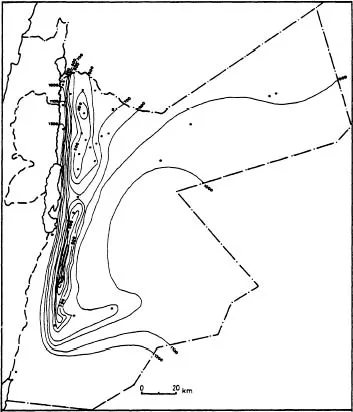
Jordan occupies the position of a buffer state, separating on the national scale, the Mediterranean state of Israel to the west and the Arabian desert to the east and on the continental scale, Jordan along with Israel lies on the narrow strip of land which connects the two largest continents on this earth; Asia and Africa (Phillips 1954). Despite its small size, however, the country has a large diversity, both culturally and physically which comes from its being a transition zone. The desert areas or Badia includes the whole of the eastern part of Jordan, making up over 80 per cent of Jordan’s total land area (Al- Homoud et al. 1995; Ch. 2). It is classified as a semiarid to arid steppe environment and falls almost exclusively in the arid climate zone with rainfall less than 100mm p.a. in most areas (see Fig. 1). The natural response of most human groups to harsh and fragile environmental conditions is to diversify, to rely on a variety of different resources so that if one fails there will always be another (Betts 1992). It is in such a precarious environment that development is being encouraged and provides the context and indeed the necessity for research into the physical environment. More specifically, rainfall is the one environmental variable which can allow a population to survive in such a region. The lives of the communities of the Badia depend absolutely upon it. Therefore, the collection of good climatic data is vitally important as a foundation not only for research looking into surface and groundwater hydrology, but also for all studies of soil-water interactions and their subsequent effect on agricultural productivity.
Long (1957) describes the climate of the Syrian desert, of which the Jordanian Badia is a part, as ‘Mediterranean Saharan’ because although it is arid, it is less arid than the Arabian or North African deserts and has a smaller seasonal and diurnal temperature range, with all the sparse rainfall concentrated in the winter months. Air temperature is highly variable and although the average is only 17.5° C, the minimum and maximum temperatures lie in the range of -5° C and 46° C.
The general pattern of climate which controls much of the Levant and the Gulf is dominated by certain large-scale atmospheric circulation conditions which would have definitely been present in the past, although they could have been geographically displaced and changed in intensity over time (Wigley and Farmer 1982). Winter is characterized by cyclonic disturbances and low mean pressure in the Mediterranean, with higher pressure further east associated with the Siberian high. Unsettled weather in the Mediterranean basin is especially prevalent when the westerlies are in their ‘low-index’ or ‘blocked stages’ and the Polar Front Jetstream (PFJ) exhibits a strong oscillatory pattern allowing meridional transport of cold air (Perry 1981). The lower position of the PFJ over central Europe brings with it substantial amounts of rain. During spring the Subtropical Jetstream (STJ) begins to move northwards from its location over the Tropic of Cancer and as the PFJ is pushed northward, precipitation is reduced.
Source: Shehadeh (1985, 34)
Fig. 1. Mean moisture deficiency (mm).
By May, the influence of the polar front and its associated westerlies is negligible while they are replaced with the sub-tropical ridges of high pressure. It is during the summer months that the contracted circumpolar vortex ensures that the Mediterranean is a region of subsidence associated with a subtropical upper tropospheric high (Perry 1981). The effect of the Indian Monsoonal system is considerable: as it advances northwards during June, the easterly jet strengthens due to pressure differentials over continental Asia. The resultant complex set of jets extend over southern Arabia and East Africa, the intensity of which is directly proportional to the rainfall received by the Upper Nile catchment. The jet system is also associated with upper air convergence causing widespread subsidence which is characteristic of the Middle Eastern desert areas.
In the winter and spring, the Cyprus lows are an important key to precipitation over the Levant. Eastern penetration depends on the zonality of the upper flow and by the strength of the Siberian High. There is some debate as to whether the position of the European Trough in the Mediterranean gives more of less rainfall in the Levant. It is generally believed that if cyclonic conditions stagnate over Cyprus, dry winter conditions will tend to prevail over the Middle East, but if the surface cyclonic conditions move eastwards, westerly winds begin to predominate and precipitation occurs especially corresponding to orographic features. Lamb (1968) believes that wetter conditions between the first and third millennium before Christ were primarily due to the easterly position of the trough. Krown (1966), however, relates wetter conditions in the Levant to a more westerly position of the trough in the Mediterranean.
It is during the transitional seasons, and especially in early autumn that year to year variations in the general circulation are greatest causing widely differing weather conditions in the Mediterranean. The combination of the irregular southerly movement of the STJ from its summer position over Turkey down to northern Sudan and the subsequent increase in surface pressure over the Levant causes a somewhat pulsatory seasonal transition (Perry 1981).
2. CLIMATE CHANGE OVER THE HOLOCENE
When analysing contemporary rainfall observations it is important to realize that present- day cycles in climate and precipitation are just a small part of the overall pattern which extends back over thousands of years. If such a context is ignored, it is likely that the observer will consider present fluctuations as more important than they are. Instead small differences over tens of years need to be seen in the context of larger differences over hundreds or thousands of years.
It is evident from archaeological studies of the Badia that the climate has not always been as dry as it is today. The area, named by archaeologists as the southern Haurân (Butler 1919), has been irregularly populated since the prehistoric period (Gerrard et al. 1975). Although there is much circumstantial evidence for small fluctuations in the climate over the last two millenia (Butzer 1955; 1958) there is very little quaternary geological research which verifies such evidence. Roberts (1982) could only identify 31 sites in the whole of the Middle East where quaternary climate change research had taken place and much of that has been confined to the Nile and Israel (Butzer 1975). The only research which has taken place in the vicinity of the Badia is that at al-Jafr in the southern Badia (Huckriede and Wieseman 1968) and in the Damascus Basin (Kaiser et al. 1973). It is clear that there have been periods of relatively good levels of precipitation, or pluvials, throughout the Pleistocene and Holocene, but what is very unclear is the frequency and magnitude of these periods. The example from Huckriede and Wieseman (1968) gives a date of 27 700 ± 870 for the end of pluvial limestone sedimentation in the El-Jafr depression. Whilst most scientists would agree that the end of the last pluvial was towards the end of the Pleistocene, there is much controversy over smaller fluctuations since that period. Issar and Bruins (1983) propose a series of multi- annual cycles of relative drought and periods of higher humidity, related to deuterium levels in the geochemistry of the Kurnub Sandstone. Bruins and Yaalon (1979) use particle size data from palaeo-eolian deposits in the Negev to suggest changes in the magnitude of summer Hamseen winds which again can be related to climate and more particularly precipitation. However, it remains a significant problem to try and quantify smaller sub-pluvial events where small fluctuations in climate have le...
Table of contents
- Front Cover
- Half Title
- Title Page
- Copyright
- Patrons…
- The Jordan Badia…
- Steering Committee Members…
- CONTENTS
- ACRONYMS
- Foreword, HRH Crown Prince Hassan bin Talal and HRH The Duke of Kent
- Preface, Roderic W. Dutton and John I. Clarke
- Overviews
- Field Research
Frequently asked questions
Yes, you can cancel anytime from the Subscription tab in your account settings on the Perlego website. Your subscription will stay active until the end of your current billing period. Learn how to cancel your subscription
No, books cannot be downloaded as external files, such as PDFs, for use outside of Perlego. However, you can download books within the Perlego app for offline reading on mobile or tablet. Learn how to download books offline
Perlego offers two plans: Essential and Complete
- Essential is ideal for learners and professionals who enjoy exploring a wide range of subjects. Access the Essential Library with 800,000+ trusted titles and best-sellers across business, personal growth, and the humanities. Includes unlimited reading time and Standard Read Aloud voice.
- Complete: Perfect for advanced learners and researchers needing full, unrestricted access. Unlock 1.5M+ books across hundreds of subjects, including academic and specialized titles. The Complete Plan also includes advanced features like Premium Read Aloud and Research Assistant.
We are an online textbook subscription service, where you can get access to an entire online library for less than the price of a single book per month. With over 1.5 million books across 990+ topics, we’ve got you covered! Learn about our mission
Look out for the read-aloud symbol on your next book to see if you can listen to it. The read-aloud tool reads text aloud for you, highlighting the text as it is being read. You can pause it, speed it up and slow it down. Learn more about Read Aloud
Yes! You can use the Perlego app on both iOS and Android devices to read anytime, anywhere — even offline. Perfect for commutes or when you’re on the go.
Please note we cannot support devices running on iOS 13 and Android 7 or earlier. Learn more about using the app
Please note we cannot support devices running on iOS 13 and Android 7 or earlier. Learn more about using the app
Yes, you can access Arid Land Resources and Their Management by Roderic W. Dutton,John I. Clarke,Anwar Battikhi in PDF and/or ePUB format, as well as other popular books in Social Sciences & Anthropology. We have over 1.5 million books available in our catalogue for you to explore.