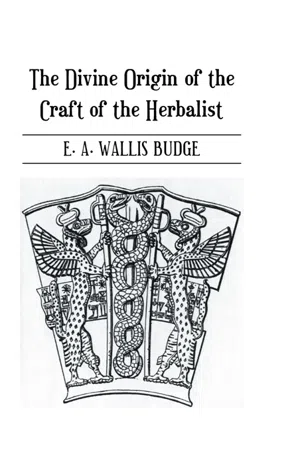
First Published in 2005. Natural medicine has never been more popular, nor has the timeless craft of herbalism. This remarkable book traces the history of herbs far back into antiquity, and shows that the gods themselves were believed to be the original healers, not only by revealing the knowledge of their healing properties of mankind but by creating the sustaining herbs out of their own bodies. Written by the doyen of orientalists with an unrivalled knowledge of Sumerian, Babylonian, Assyrian and Egyptian herbal literature and traditions, this key volume deals with the old gods as herbalists and their divine medicine: water as a divine element; ancient Egyptian, Sumerian and Assyrian herbals; divine plants; the Greek and Latin herbals, herbals in Syrian and Arabic; Coptic lists of plants and the Ethiopian or Abyssinian herbal, illustrated with examples of the original text. Proving conclusively both the antiquity and worth of herbal medicine, this work is indispensable for modern practitioners who want to know about of the true roots of their work, as well as for all those interested in the history of medicine.
- 108 pages
- English
- ePUB (mobile friendly)
- Available on iOS & Android
eBook - ePub
The Divine Origin of the Craft of the Herbalist
About this book
Information
THE DIVINE ORIGIN OF THE CRAFT OF THE HERBALIST
I
THE OLD GODS AS HERBALISTS AND THEIR DIVINE MEDICINES
THE religious and magical writings of the great nations of antiquity, that is to say, the Chinese and the Indians, the Sumerians and Babylonians, the Persians and Assyrians (or, as we may now call them, the Akkadians), and the Egyptians and Nubians, contain abundant evidence that these primitive peoples believed that the first beings who possessed a knowledge of plants and their healing properties were the gods themselves. They further thought that the substances of plants were parts and parcels of the substances of which the persons of the gods were composed, and that the juices of plants were exudations or effluxes from them likewise. Some of the ancients thought that certain curative plants and herbs contained portions of the souls or spirits of the gods and spirits that were benevolent to man, and that poisonous plants were the abodes of evil spirits that were hostile to the Creator—inasmuch as they destroyed His handiwork, man—and to man and beast.
The oldest gods were too remote from the trivial affairs of the daily life of men to prevent accidents and calamities from overtaking them, but they placed in the hands of their vicars upon earth a certain kind of knowledge and power which, if rightly used, would enable them to annul and destroy the machinations of evil spirits, and bring to nought the works effected by them, and even to alter the courses of natural phenomena in heaven and upon earth. To this knowledge and power the unsatisfactory name of “Magic” has been given, and though primarily the word “Magic” only described the learning of the priests and sages of the Medes and Persians, who were famed for their skill in working enchantments, the word is now used to describe any supposed supernatural art, but more particularly any system of learning or art which claims to control the actions of spiritual or superhuman beings. “Magic” has always appealed greatly to men of all nations, for by the use of it a man ceases to be a supplicant of the gods, and is able to command and to force supernatural beings and things to do his will.
When the gods transmitted the knowledge of plants and their medical properties to their priests, they intended that knowledge to be used for the benefit of their worshippers, whether they were rich or poor, gentle or simple. What the priests had obtained from the gods was not “Magic,” or “Natural Magic,” but Natural Wisdom, and it was only because those who were treated by the priests did not understand even the rudiments of that wisdom, that they regarded it as “magic” and called it so. As time went on those who applied this natural wisdom to the relief of suffering humanity magnified their office, and introduced into their operations incantations, divinations, astrology and at a later period alchemy. In fact the medical magic of the oldest period represented a confused mass of beliefs and practices which, because they were beyond the ordinary views of cause and effect, were regarded as supernatural. In all ages there have been minds which were not satisfied with the facts and explanations afforded by reason, and these have always served as a fruitful field for the operations of unprincipled priests, and been the dupes of the “magician” and the charlatan.
During the nineteenth century the craft of the herbalist fell into disrepute, chiefly because men’s minds were carried away by the discoveries concerning the nature and functions of plants and herbs which were being made by the men who were steadily endeavouring to establish a scientific system of pharmacology. Secondary causes were the intense conservatism and ignorance of the herb-doctors and the dealers in herbs, who refused to believe anything about the world of plants used in medicine which was not to be found in the antiquated Herbals of Grattarola of Bergamo (1515–1568), and Turner’s New Herball, which was published between 1551 and 1568, and the Herbal of Gerarde (1545–1607), the herb-gardener of Lord Burghley, and the Physical Directory which Nicholas Culpeper (born 1616, died 1654) published in 1649. This last-named work in no way deserved the excessive abuse which was heaped upon it by interested persons. Here is an example quoted by the D.N.B. from the periodical Mercurius Pragmaticus, No. 21, 1649. This book is “done (very filthily) into English by one Nicholas Culpeper, who commenced the several degrees of Independency, Brownisme, Anabaptisme; admitted himself of John Goodwin’s schools (of all ungodlinesse) in Coleman Street; after that he turned Seeker,Manifestarian, and now he is arrived at the battlement of an Atheist, and by two yeeres drunken labour hath Gallimawfred the apothecaries book into nonsense, mixing every receipt therein with some scruples, at least, of rebellion or atheisme besides the danger of poysoning men’s bodies. And (to supply his drunkenness and leachery with a thirty shilling reward) endeavoured to bring into obloquy the famous societies of apothecaries and chyrurgeons.”
There seems to be little doubt that the Physical Directory and Culpeper’s later work, the English Physician Enlarged, were recognized as authoritative by a very large number of people. Of the last-named work five editions appeared before 1698, and further editions appeared as late as 1802 and 1809. We may note in connection with these facts that Dr. G. A. Gordon prepared a collective edition of Culpeper’s works which appeared in 1802.
In these works, and in others of similar character, common sense and even common decency were alike set at nought, and in these days it is very hard to understand how prescriptions like the following could ever have been written and published.
1. FOR EPILEPSY.—“Vitriol, calcined until it becomes yellow; saturate with alcohol, add mistletoe, hearts of peonies, elks’ hoofs, and the pulverized skull of an executed malefactor (!): distil all these dry, rectify the distillate over castoreum (species diamoschi dulcis), elephants’ lice: then digest in a water-bath for a whole month, after mixing with salt of peony, alcohol, liquor salis perlarum et corallorum, oil of anisi and succini” (Baas, Hist. Med., p. 436).
2. TINCTURE OF MUMMY.—“Select the cadaver of a red, uninjured, fresh, unspotted malefactor 24 years old, and killed by hanging, broken (sic) on the wheel, or impaled, upon which the moon and the sun have shone once: cut it in pieces, sprinkle with myrrh and aloes; then macerate for a few days, pour on spirits,” etc. (Ibid., p. 436).
3. EXTRACTION OF A TOOTH.—“The powder of earthworms, of mice dung, and of a hare’s tooth, put into the hole of a rotten tooth, it will drop out without any instrument” (Culpeper’s Last Legacy, p. 107).
The men who invented and published such disgusting prescriptions as the above did the craft of the herbalist much harm, but it must also be confessed that in the “sixties” and “seventies” of the last century the state of the herbalists’ shops, especially those which were situated in the outlying districts of London, was not calculated to increase the faith of the public in the efficacy of herbs, or belief in the knowledge of those who sold them. Many of my contemporaries will remember a herbalist’s shop which was situated in a popular street near King’s Cross in the year 1865, and its dirty and unkempt appearance. The shop proper was about 8 feet wide and 20 feet long. Its window front was glazed with small panes of bottle-green glass, which were seldom washed or cleaned, and on the brightest day very little light entered the shop through them; during the winter months, and especially in foggy weather, the shopkeeper was obliged to carry on his business by the light of two or three guttering “dips,” i.e. tallow candles. A low narrow counter took up much of the floor space. On one end of this stood a rickety glass case containing small bowls of seeds and berries, which were well coated with dust, and on the other stood a pair of rusty iron scales and a huge glass bowl of a mixture called “sarsaparilla wine.” Men and women, as well as the children, who came in and spent their halfpennies and pennies freely drank this wine out of teacups of various sizes and shapes and makes, which were rarely rinsed in water, and were usually turned bottom upwards on the counter to dry. A large cardboard label was tied round the bowl, and on this were written in large capitals the names of all the ailments and sicknesses which this particular brand of sarsaparilla wine was said to cure.
On the end wall was a shelf whereon stood a couple of ostrich egg-shells, and several bottles containing “preparations” of various kinds, of a most uninviting appearance, and two human skulls. Below the shelf, nailed to the wall, was a small dried crocodile or lizard, and below this a miscellaneous collection of dried “specimens,” all richly coated with dust. To the wall behind the counter several narrow shelves were fastened. On one of these stood a row of yellow glazed pottery jars on which were painted the names of herbs and compounds; some had covers and some had not, and the legends were half concealed by dust. On another shelf was a series of small bottles and flasks which contained extracts, or decoctions, of herbs, medicated unguents and perfumes and vegetable oils. Another shelf was filled with bottles of medicated sweets, such as paregoric drops, squills, lozenges, sticks of horehound candy, “stick liquorice,”etc., and these sweets were in great demand by juvenile customers. From the ceiling and on the wall in front of the counter hung bundles of dried herbs, lavender, rosemary, mint, camomile, dandelion, sorrel and many others, all well covered with dust. Under the counter were wooden boxes containing poppy-heads, senna leaves, marsh-mallow, linseed meal, etc., and a stock of paper bags and phials of various sizes.
The proprietor sold his wares rather by “rule of thumb” than by measures or scales, and he eschewed the writing of directions for the use of his patients. He was old and very shabby, but kindly, and many of his customers were evidently friends and acquaintances, judging by the way in which he advised them as to their ailments. His shop was well patronized by children, who came there to see him exhibit “Pharaoh’s serpents.” He would set on a plate a lump of some brown substance rather like chocolate, and when he applied a lighted match to a certain part of it, the lump changed its shape and heaved, and from its sides several spirals emerged and went wriggling across the plate like worms, to the great delight of the onlookers. When asked why these wriggling things were called “Pharaoh’s serpents,” he said that he did not know, but that his father and his grandfather had always called them by this name. When he was unable to advise a customer, he used to knock the counter with a weight, and then his wife, a little old wizened woman, would appear from behind the shop and take charge of the case. It was generally thought that she was the real herbalist to the establishment, and certainly her reputation in the neighbourhood was great.
The shop described above and its contemporary herbal establishments have long since passed away, and the modern establishments of the Society of Herbalists leave nothing to be desired. There are now many signs that the craft of the herbalist in Great Britain is regaining its rightful position among the systems of medicine which have been evolved by the generations of men in their efforts to heal the sicknesses and diseases which attack their bodies and which, if not annulled, destroy life itself. For the general public have learned that the methods now used in extracting the essential juices, etc., from medicinal herbs, and in the preparation of extracts, tinctures, etc., are scientific and accurate. Moreover the effects of herbal drugs on the body are better known and understood, and it is now possible to obtain herbal preparations of uniform strength and quality.
II
THE DIVINE HERBALISTS
IT has already been said that many ancient nations thought that the gods themselves were the first herbalists, and that it was they who had taught their vicars upon earth how to heal the sicknesses of mankind by means of certain herbs ...
Table of contents
- Cover
- Halftitle
- Title
- Copyright
- Prefatory Note
- Contents
- List of Illustrations
- 1. The Old Gods as Herbalists and their Divine Medicines
- 2. The Divine Herbalists
- 3. Water a Divine Element
- 4. Vegetable Substances of Divine Origin
- 5. Ancient Egyptian Herbals and Books of Medicine
- 6. Holy Oils and Medicated Unguents
- 7. Sumerian and Assyrian Herbals
- 8. The Greek Herbals
- 9. The Latin Herbals
- 10. The Herbal in Syriac
- 11. The Herbal in Arabic
- 12. Coptic Lists of Plants
- 13. The Ethiopian (Abyssinian) Herbal
- Index
Trusted by 375,005 students
Access to over 1.5 million titles for a fair monthly price.
Study more efficiently using our study tools.
Frequently asked questions
Yes, you can cancel anytime from the Subscription tab in your account settings on the Perlego website. Your subscription will stay active until the end of your current billing period. Learn how to cancel your subscription
No, books cannot be downloaded as external files, such as PDFs, for use outside of Perlego. However, you can download books within the Perlego app for offline reading on mobile or tablet. Learn how to download books offline
Perlego offers two plans: Essential and Complete
- Essential is ideal for learners and professionals who enjoy exploring a wide range of subjects. Access the Essential Library with 800,000+ trusted titles and best-sellers across business, personal growth, and the humanities. Includes unlimited reading time and Standard Read Aloud voice.
- Complete: Perfect for advanced learners and researchers needing full, unrestricted access. Unlock 1.5M+ books across hundreds of subjects, including academic and specialized titles. The Complete Plan also includes advanced features like Premium Read Aloud and Research Assistant.
We are an online textbook subscription service, where you can get access to an entire online library for less than the price of a single book per month. With over 1.5 million books across 990+ topics, we’ve got you covered! Learn about our mission
Look out for the read-aloud symbol on your next book to see if you can listen to it. The read-aloud tool reads text aloud for you, highlighting the text as it is being read. You can pause it, speed it up and slow it down. Learn more about Read Aloud
Yes! You can use the Perlego app on both iOS and Android devices to read anytime, anywhere — even offline. Perfect for commutes or when you’re on the go.
Please note we cannot support devices running on iOS 13 and Android 7 or earlier. Learn more about using the app
Please note we cannot support devices running on iOS 13 and Android 7 or earlier. Learn more about using the app
Yes, you can access The Divine Origin of the Craft of the Herbalist by E.A. Wallis Budge,E. A. Wallis Budge in PDF and/or ePUB format, as well as other popular books in Social Sciences & Anthropology. We have over 1.5 million books available in our catalogue for you to explore.