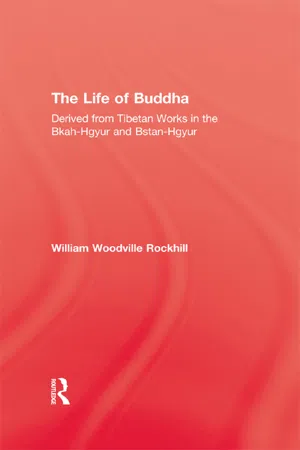
This classic volume focuses on the life of the Buddha and the early history of his order, and includes the first translation of many works. The first part of the book consists of the translation and analysis of contained in the Tibetan Dulva or Vinaya-pitaka, and the second part includes chapters on the early history of Tibet and Khosan and an index of Tibetan words with their Sanskrit equivalents. The author, William Woodville Rockhill, (1854-1914) was a scholar-diplomat, linguist, ethnologist and Tibetan expert who was the first American to speak, read and write Tibetan and the first to explore the Tibetan highlands. While serving as the American Minister to China, he became an authority on Buddhism and a friend of the thirteenth Dalai Lama. His collection of Tibetan manuscripts, including those consulted for this volume, became the core of the Library of Congress's Tibetan holdings.
- 256 pages
- English
- ePUB (mobile friendly)
- Available on iOS & Android
eBook - ePub
Life Of Buddha
About this book
Information
THE LIFE OF THE BUDDHA.

CHAPTER I.
HISTORY OF THE WORLD FROM THE TIME OF ITS RENOVATION TO THE REIGN OF ÇUDDHODANA, FATHER OF THE BUDDHA.
THE following history of the world’s renovation and of the origin of castes is taken from the fifth volume of the ’Dulva, fol. 155–166. It also occurs in the third volume of the same work, fol. 421–430, but several interesting passages are there omitted, although the rest of the text is exactly the same as that of vol. v. In the third volume it is Maudgalyayana who, at the Buddha’s request, tells to the Çakyas the story of the world’s regeneration, and of the ancient peoples who inhabited it. The Buddha feared that if he himself told the story the tirthikas would accuse him of unduly extolling his own clan (D. iii. 420b). In the fifth volume the story is told to the bhikshus by the Buddha, to teach them how sin first made its appearance in the world.
“At the time when the world was destroyed, many of its inhabitants were born in the region of the ‘bhâsvara devas, and there they had éthereal bodies, free from every impurity; their faculties were unimpaired, they were perfect in all their principal and secondary parts, of goodly appearance and of a pleasing colour. Light proceeded from their persons; they moved through space and fed on joy, and they lived in this state to great ages for a long period.
In the meanwhile this great earth was mingled up with the waters and with the mighty deep. Then on the face of the great earth, of the water and of the ocean that were mingled together, there blew a wind,1 which solidified and concentrated the rich surface (lit. the cream); as when the wind blowing over the surface of boiled milk which is cooling, solidifies and concentrates the cream, so likewise did this wind blowing over the surface of the earth, the water and the ocean which were mixed together, solidify and coagulate it.
This rime (lit. essence of the earth, prithivîrasa) was of exquisite colour, of delicious taste, of delightful (f. 156b) fragrance, in colour like unto butter, its taste like that of uncooked honey.
At this period when the world was formed, some of the beings in the region of the Âbhâsvara devas had accomplished their allotted time, the merit of their good works being exhausted; so they departed that life and became men, but with attributes similar to those they previously had.2
At that period there was neither sun nor moon in the world; there were no stars in the world, neither was there night or day, minutes, seconds, or fractions of seconds; there were no months, half months, no periods of time, no years: neither were there males or females; there were only animated beings.
Then it happened that a being of an inquisitive nature tasted the rime with the tip of his finger, and thus he conceived a liking (f. 157a) for it, and he commenced eating pieces of it as food.3
Other beings saw this being tasting the rime [so they followed his example], and commenced eating pieces of it as food.
From these beings eating the rime as food their bodies became coarse and gross; they lost their brilliancy and their goodly appearance, and darkness was upon the face of the earth.
For these reasons the sun and moon were created; stars also (f. 157b) came into existence, as did night and day, minutes, seconds, fractions of seconds, months and half months, divisions of time and years. The beings feeding on this rime lived to great ages for a long space of time.
The complexion of those who ate but little of this food was clear, whereas that of those who ate much of it was dark. Then those whose complexion was clear said to the others, “Why, I have a fine complexion, whereas you are dark !” and thus were established distinctions. They whose complexion was clear were proud of it, and became sinful and iniquitous, and then the rime vanished.
(f. 158a.) When the rime had vanished from these beings, there appeared a fatty substance (prithivîparvataka) of exquisite colour and savour, of delicious fragrance, in colour as a dongka flower, in flavour like uncooked honey; and they took this as their food, and they lived to great ages for a long while.
[This fatty substance vanished after a while, for the same reason as had brought about the disappearance of the rime.]
When the fatty substance had vanished from mankind, there appeared bunches of reeds (vanalatâ) of exquisite colour and savour, of delicious fragrance, in colour like a kadambuka flower (f. 159b), in flavour like uncooked honey. Then they took this as their food, and on it they lived to great ages for a long while.
[This food also vanished after a while, for the same reasons as above.]
(f. 159b.) When the bunches of reeds had vanished from mankind, there appeared a spontaneously growing rice, not coarse, without pellicule, clean, four fingers in length. There was never any lack of it; for if it was cut down in the evening, it was grown up again in the morning; if it was cut down in the morning, it was grown ere evening; what was cut down grew up afresh, so that it was not missed.
Then they took this as their food, and on it they lived to great ages for a long time.
From eating this rice their different organs were developed; some had those of males and others those of females. Then they saw each other, and conceived love for each other, and, burning with lust, they came to commit fornication.
Other beings (f. 160a). saw what they were doing, so they threw at them earth, stones, gravel, pebbles, and potsherds, saying unto them, “Thou doest wrongly ! thou doest that which is wrong !” But those who had acted wrongly, who had done that which was wrong, exclaimed, “Why do you thus insult us?”
As nowadays when a man takes unto himself a wife, they sprinkle her over with dust, perfumes, flowers, and parched rice, with cries of “Good luck, sister !” so those beings, seeing the wickedness of those other beings, sprinkled them with earth, threw at them stones and gravel, pebbles and potsherds, crying after that, “Thou doest wrongly! thou doest that which is not right!” But they who had done wrong, who had done that which was wrong, exclaimed, “Why do you thus insult us?”
And thus it was that what was formerly considered unlawful has become lawful nowadays; what was not tolerated in former times has become tolerated nowadays; what was looked down (f. 16ob) on in former days has become praiseworthy now.
Now, when they had done wrong one, two, three, even unto seven days, these sinful beings were so possessed by the ways of wickedness that they commenced building houses. “Here,” they said, “we may do what is not allowed;” and from this expression originated the word “house.” 1
Now this is the first appearance in the world of divisions by houses, and this (division) is lawful or not lawful according to the king’s decision, and he is the lord of the law.
If these beings wanted rice to eat in the evening or in the morning, they would go and get what was requisite; but it happened that one being who was of an indolent disposition took at one time enough rice for evening and morning. Now another being said to him, “Come, let us go for rice.” Then he answered him, “Look after your own rice; I have taken enough at one time to last me morning and evening” (f. 161a). Then the other thought, “Good, capital! I will take enough rice for two, three, seven days;” and he did accordingly.
Then it happened that some one said to this person, “Come, let us go for rice;” but he answered him, “Look after your own rice; I have taken enough at one time to last me two, three, seven days.”
“Good, capital!” thought the other, “I will take enough rice for a fortnight, for a month;” and he did accordingly.
And because these beings took to laying up provisions of this spontaneously growing rice, it became coarse; a husk enveloped the grain, and when it had been cut down it grew not up again, but remained as it had been left.
Then these beings (f. 161b) assembled together in sorrow, grief, and lamentation, and said, “Sirs, formerly we had ethereal bodies, free from every impurity, with faculties unimpaired, &c, &c. ….2 Let us now draw lines of demarcation and establish boundaries between each one’s property.” So they drew lines of demarcation and set up bounds—“This is thine—this is mine” (they said).
Now, this is the first appearance in the world of a system of boundary lines, and this (boundary) is right or not right according to the king’s decision, and he is the lord of the law.
After this it happened that one person took another’s rice without his consent, as if it was his own, and when other persons saw him, they said to him, “Why do you take the rice of another without his consent, as if it was your own? You must not do this again.” But he went a second and a third time, and took the rice of another without his consent, as if it was his own. When the other persons saw this (f. l63b) they said to him, “Why do you thus take the rice of another without his consent, as though it was your own?” So they laid hold of him and led him into their midst.
“Sirs,” they said, “this person has been guilty of taking the rice of another without his consent, as though it was his own.” Then they said unto him, “Why have you taken the rice of another without his consent, as though it was your own? Go, and do wrong no more.” But he who had stolen said to them, “Sirs, I have been badly treated in that I have been laid hold of by these persons on account of some rice and brought into this assembly.”
Then they said to those who had brought him thither, and who had spoken about the rice, “Why did you bring this man here to whom you had spoken about the rice? In bringing him here into our midst you have done him a wrong; go, and do not so again” (f. 164a). Then they thought, “Let us, in view of what has just happened, assemble together, and choose from out our midst those who are the finest-looking, the largest, the handsomest, the strongest, and let us make them lords over our fields, and they shall punish those of us who do what is punishable, and they shall recompense those of us who do what is praiseworthy, and from the produce of our fields and of the fruits we gather we will give them a portion.”
So they gathered together [and did as they had decided upon], and they made him lord over their fields with these words: “Henceforth thou shalt punish those of us who deserve punishment, and thou shalt recompense those of us who deserve recompense, and we will give thee a portion of the produce of our fields (f. 164b) and of the fruits we gather.”
From his receiving the homages of many he was called “Honoured by many, or Mahâsammata;” and as he was lord over the fields and kept them from harm, he received the name of “Protector of the fields,” or Kshatriya; and as he was a righteous man and wise, and one who brought happiness to mankind with the law, he was called “King,” or Râjâ.
Some beings who were afflicted with diseases, ulcerations, pains, and misery, left their villages for the wilds; they made themselves huts with boughs and leaves, and they dwelt therein. Each evening when they (f. 165b) wanted food, they would go into the villages to gather alms, and in the morning when they required food they would do likewise; and the people gave to them with willing hearts, for they thought, “These learned men are...
Table of contents
- Cover
- Title
- Copyright
- Contents
- Introduction
- Chapter I. History of the World from the Time of its Renovation to the Reign of Çuddhodana, Father of the Buddha
- Chapter II. From the Reign of Çuddhodana Until the Commencement of the Buddha’s Ministry
- Chapter III. Life of the Buddha from the Commencement of his Ministry Until the Reign of Adjatasatru
- Chapter IV. From the Commencement of Adjatasatru’s Reign to the Death of the Buddha
- Chapter V. History of the Church During the Hundred and Ten Years Which Followed the Buddha’s Death
- Chapter VI. History of the Schools of Buddhism
- Chapter VII. The Early History of Bod-yul (Tibet)
- Chapter VIII. The Early History of Li-yul (Khoten)
- Appendix
- General Index
Trusted by 375,005 students
Access to over 1.5 million titles for a fair monthly price.
Study more efficiently using our study tools.
Frequently asked questions
Yes, you can cancel anytime from the Subscription tab in your account settings on the Perlego website. Your subscription will stay active until the end of your current billing period. Learn how to cancel your subscription
No, books cannot be downloaded as external files, such as PDFs, for use outside of Perlego. However, you can download books within the Perlego app for offline reading on mobile or tablet. Learn how to download books offline
Perlego offers two plans: Essential and Complete
- Essential is ideal for learners and professionals who enjoy exploring a wide range of subjects. Access the Essential Library with 800,000+ trusted titles and best-sellers across business, personal growth, and the humanities. Includes unlimited reading time and Standard Read Aloud voice.
- Complete: Perfect for advanced learners and researchers needing full, unrestricted access. Unlock 1.5M+ books across hundreds of subjects, including academic and specialized titles. The Complete Plan also includes advanced features like Premium Read Aloud and Research Assistant.
We are an online textbook subscription service, where you can get access to an entire online library for less than the price of a single book per month. With over 1.5 million books across 990+ topics, we’ve got you covered! Learn about our mission
Look out for the read-aloud symbol on your next book to see if you can listen to it. The read-aloud tool reads text aloud for you, highlighting the text as it is being read. You can pause it, speed it up and slow it down. Learn more about Read Aloud
Yes! You can use the Perlego app on both iOS and Android devices to read anytime, anywhere — even offline. Perfect for commutes or when you’re on the go.
Please note we cannot support devices running on iOS 13 and Android 7 or earlier. Learn more about using the app
Please note we cannot support devices running on iOS 13 and Android 7 or earlier. Learn more about using the app
Yes, you can access Life Of Buddha by William Woodville Rockhill in PDF and/or ePUB format, as well as other popular books in Social Sciences & Anthropology. We have over 1.5 million books available in our catalogue for you to explore.