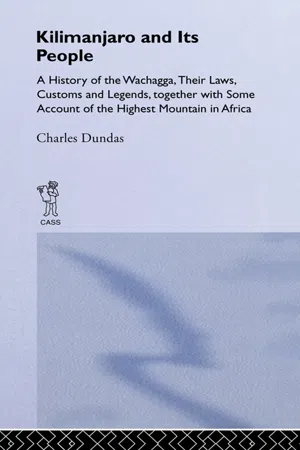
eBook - ePub
Kilimanjaro and Its People
A History of Wachagga, their Laws, Customs and Legends, Together with Some
- 384 pages
- English
- ePUB (mobile friendly)
- Available on iOS & Android
eBook - ePub
Kilimanjaro and Its People
A History of Wachagga, their Laws, Customs and Legends, Together with Some
About this book
First published in 1924, this account was written by a Senior Commissioner of the Tanganyika Territory.
Information
CHAPTER III
RELIGION
I—THE GOD RUWA
THE Chagga name for God is Ruwa, identical with their word for the Sun. But whether the God and the Sun are identical, or whether the Sun is the dwelling-place of the God, is a question they do not seem to be clear on themselves. Though the God takes little part in the lives of humans, he is yet supreme above all other powers and the ultimate arbiter of fate. Among supernatural beings he is singular for his mercy and tolerance, as is exemplified by the rôle he plays in many legends. Yet he permits the subordinate spirits to afflict men for their own purposes, for they cannot harm man without Ruwa’s consent, or at least not against his will. The truth is that Ruwa has long ago ceased to mingle with and care for his creatures, and they on their side seek succour from him only in extreme distress, sacrificing to him at rare intervals just such animals as he has provided them with for the purpose.
God Ruwa is not the Creator of the Universe.
If asked who made the Sun and the Earth, the Mchagga says that they always existed, but of the stars it is sometimes said that they are Ruwa’s children.
Moreover, Ruwa was not really the Creator of Mankind, he merely liberated the first human beings from some mysterious vessel by bursting it. On this account he is known as Ruwa mopara wandu, God who burst (out) men.
In recounting the Chagga myths I shall repeat them as they were told to me, for only so, I think, can they be given in their appropriate setting.
Ruwa having liberated mankind from confinement, provided for their subsistence. He gave them a banana grove, and in the grove of their principal elder he planted a great number of sweet potatoes and yams. And in the centre he planted a species of yam called Ula, or Ukaho, which is planted beneath large trees and trained up creeper vines.
Ruwa instructed the elder of the village in this wise, “I give you leave to eat all the fruit of the bananas, also all the potatoes in the banana grove. Eat all the bananas and potatoes, you and your people. But the yam which is called Ula or Ukaho, truly you shall not eat it. Neither you nor your people may eat it, and if any man eats it, his bones shall break and at last he shall die.”
Then Ruwa left the people and went his ways. And every morning and evening he came to greet the elder and his people. Now one day a stranger came and greeted the elder and begged for food. The elder said to the stranger: “Go into the banana grove to eat bananas and potatoes there, but the potato Ula do not eat at all. For Ruwa directed me and my people that we should not eat it, therefore do you not eat it.” The stranger said: “It is now noon, this morning early Ruwa bade me tell you to give me a cooking-pot that I might cook this Ula, to eat it with you and your people that we may rejoice.” The elder hearing that Ruwa had sent this stranger, gave him a cooking-pot. And the stranger took a digging stick and dug up the Ula and put it in the pot. The elder and the stranger cooked the Ula yams, and they started to eat.
As they were eating Ruwa’s Minister smelt the odour of cooking like to the odour of Ula. At once he came running and asked them: “What do you? What are you eating?” So the elder and the stranger were astonished and greatly afraid, they could find nothing to reply. Then the Minister of Ruwa took the pot with the yams and carried it to Ruwa. When Ruwa saw them he was very angry and sent his Minister a second time. And he went and spoke to the elder and his people: “Because you were deceived by a stranger and ate my Ula, I shall break (your bones) and burst your eyes, and at last you shall die.” So the Minister returned to Ruwa. Since that day they have not seen him again, and Ruwa has not sent word to them again, and people commenced to be broken, and their eyes to be closed, and afterwards they died. Thus the old men of the Wachagga tell and know.
When the Minister had gone to Ruwa, at once the people and their elder commenced to sicken in their bones and eyes. So the elder prayed to Ruwa for honey and milk. And Ruwa hearkened to him, and he sent his Minister again to tell the elder “Now I will have mercy on you and your people. Know henceforth that you shall grow to a great age, and when you die you shall cast your skin as a snake does, and afterwards you shall become as a youth again. But not one of your people may see you when you cast your skin, you must be alone at such time. And if your child or grandchild see you, in that hour you shall die altogether and not be saved again.”
So they lived until the elder became very aged. His children seeing this gave him his granddaughter to care for him, that he might not fall into the hearth and be burnt. Now the old man knew that the day was come for him to cast his skin as Ruwa had sent word to him by his Minister. And he considered how to be rid of the granddaughter to give him opportunity (to change his skin). And he said to the granddaughter: “Bring a gourd and fetch me water here.” And the granddaughter brought a gourd. The old man took a large needle and made small holes in the bottom of the gourd and gave it to the girl and instructed her to bring water. The old man knew she would not return quickly for the gourd was pierced with many holes. The granddaughter went quickly to draw water. But when the bowl was filled she saw that all the water leaked out because the gourd was pierced with many holes. And she made effort to plug the holes. When she had finished plugging the holes she filled the gourd. And she placed the gourd on her head and hastened home to her grandfather. As she entered the house she was startled, for the old man had cast half his skin. The old man stared at her in great amazement, and cried out aloud: “So be it, I have died, all of you will die, I have died, all of you shall die. For you, granddaughter, entered while I cast my skin. Woe is me, woe is you!” So the old man slowly wrapped himself up in his skin and died. And his children came with his grandchildren and they buried him. And that bad grandchild they drove away, and she went into the forest. And she became a wife and bore children, but not human children, she gave birth only to children with four legs and a tail. And these indeed are the baboons, and monkeys, and apes, and colobus monkeys. Thus the baboons and these others are the children of her who offended against her grandfather. For this reason the baboons and their like are called “People of the Forest” or “Children of the Curse.”
Now when the old man was dead, his first son had two children, both sons. The father gave goats to both. And every day they went into the forest to cut bush for their goats which they had been given by their father. The goats of the second son had twin kids always, and the goats of the first son bore only one kid at a time. The eldest son was angry and said to his father: “Exchange me my goats for those of my brother. Let him take mine and I his.” The father reproved him and said: “It is not well to deprive your brother of his goats. Do you feed your goats well and they likewise will bear twins!” But the eldest son was not pleased with this reply. In the morning they took their knives to cut bush for their goats as they did every day, he and his brother. When they were in the forest the eldest son killed his younger brother. As he was being killed he cried out as one who is being slain. At once the Minister of Ruwa heard the cries. When he reached the spot to see, he found him dead. Then the Minister sent word to Ruwa. And Ruwa spoke to him, “Return to the son who committed murder to reckon with him. Moreover fine him seven head of cattle and seven goats and one daughter. This property give to his father to use. And the daughter shall work for the mother until she dies.” Thus the Minister did as he was commanded. And he came and fined the murderer seven head of cattle, seven goats and one female child and gave them to the father. And the father received this property but in great sorrow. So from that day until now the people do thus (i.e., blood money is still determined at seven head of cattle, seven goats and one child).
Ruwa Destroys the People of the Earth
Long ago many people became idle and neglected their work and directed only poor and helpless folk to do their work. And the wealthier people refused altogether to work in any way. And they waited only until the poor and needy had harvested their crops, and no sooner had they harvested than the wealthy and those who were prosperous deprived them of their food and consumed it. Thus the men did year by year. But the young women and girls of the wealthy and prosperous prided themselves even more. Every day their work was to drum and dance and to molest the women and girls of the poor and helpless and to live in fornication with the youths of their own class.
Now Ruwa saw this and was greatly angered. And he sent his Minister to the people and told them: “Desist from these your bad ways, do good as you did before, or if it be not so I shall destroy you almost entirely, I shall make an end of you!” But the people did not listen to the counsel and command of the messenger sent by Ruwa, they only increased their evil doings.
In those days there was one girl who excelled all others in her pride. This one said: “I do not desire to be courted by any youth of this country, I shall search for a husband, one who has strength beyond all men, he indeed shall marry me.” So it became her business to search as she had said herself. And she searched in the forest and where the rivers make lakes. One day she found a great man who lived in a lake. But she did not see all his body, she saw only his head. This man asked the girl: “What is it you look for here?” “I search for my husband, one to court me that he may marry me, but I desire for my husband one of strength excelling all others.” The man of the lake said to her: “I indeed have strength surpassing all others. And my strength you shall see, you and your father, and your father’s huts and the -people of your country, and everything in your father’s country.” When the girl heard this she rejoiced to have a husband great above all others. So they agreed and arranged, and the girl returned home, and she told all her news to her mother. The mother said: “It is well, but let us see first your suitor who would court you, he whom you agreed with.” So the girl made it her business to cook food and to take it to her suitor whom she had agreed with. But when she took him the food, he swallowed it, cooking-pot and all. The girl was greatly surprised, and said in her heart: “What sort of husband is he who swallows food and cooking-pot together?” Then she said to her suitor: “My parents desire that you accompany me to my home that they may see you. Then indeed you will be given leave to marry me. To this end they have sent me to you.” The suitor of the lake answered: “Yes, but my time to come forth on the land is not yet. When the time has come I shall come to you as you desire.” The girl returned home and explained to her mother this matter. The mother said: “It is well. But assuredly we must see him.” The girl cooked food and took it to her suitor of the lake as on other days. The suitor received and swallowed it as before. The girl said: “Come, let us go to my home.” The suitor replied with this song:
“Hiya mangalawa lya Mchomba.
I am the canoe of the coast.
Ngakoya mndenyi ngiwemila.
When I get there and find your father I shall swallow him.
Ngakoya mmai ngiwemila.
If I meet your mother I shall swallow her.
Ngakoya Kisacha ngiwemila.
If I meet your brother I shall swallow him.
Hiya mangalawa lya Mchomba.
I am the canoe of the coast!”
Now both, the girl and the suitor of the lake, went together and the girl went ahead. And the suitor followed her. And lo! what an immense creature he was, he filled the whole country by his vastness. While they were on the way, the suitor said to the girl: “As for me my name is Rimu. I am sent to you and to all countries to destroy all things and the whole creation. Ruwa has commanded me to destroy all living human beings and animals, because the people have abandoned the ancient customs and adopted evil ways; and they have oppressed the poor, and have followed indolence and pride themselves daily. So first I shall swallow you and the house of your father, then I shall swallow all men of the Earth and all animals!”
And on this day was a feast day of dance. All the people had assembled together at the place of feasting to d...
Table of contents
- Cover
- Title
- Copyright
- Introduction
- Contents
- List of Illustrations
- I. Kilimanjaro
- II. History
- III. Religion
- IV. Magic
- V. Burial
- VI. Childhood and Youth
- VII. Matrimony
- VIII. Occupations and Industries
- IX. Constitution and Law
- X. Legends
- XI. Chagga Proverbs
- Index
Trusted by 375,005 students
Access to over 1.5 million titles for a fair monthly price.
Study more efficiently using our study tools.
Frequently asked questions
Yes, you can cancel anytime from the Subscription tab in your account settings on the Perlego website. Your subscription will stay active until the end of your current billing period. Learn how to cancel your subscription
No, books cannot be downloaded as external files, such as PDFs, for use outside of Perlego. However, you can download books within the Perlego app for offline reading on mobile or tablet. Learn how to download books offline
Perlego offers two plans: Essential and Complete
- Essential is ideal for learners and professionals who enjoy exploring a wide range of subjects. Access the Essential Library with 800,000+ trusted titles and best-sellers across business, personal growth, and the humanities. Includes unlimited reading time and Standard Read Aloud voice.
- Complete: Perfect for advanced learners and researchers needing full, unrestricted access. Unlock 1.5M+ books across hundreds of subjects, including academic and specialized titles. The Complete Plan also includes advanced features like Premium Read Aloud and Research Assistant.
We are an online textbook subscription service, where you can get access to an entire online library for less than the price of a single book per month. With over 1.5 million books across 990+ topics, we’ve got you covered! Learn about our mission
Look out for the read-aloud symbol on your next book to see if you can listen to it. The read-aloud tool reads text aloud for you, highlighting the text as it is being read. You can pause it, speed it up and slow it down. Learn more about Read Aloud
Yes! You can use the Perlego app on both iOS and Android devices to read anytime, anywhere — even offline. Perfect for commutes or when you’re on the go.
Please note we cannot support devices running on iOS 13 and Android 7 or earlier. Learn more about using the app
Please note we cannot support devices running on iOS 13 and Android 7 or earlier. Learn more about using the app
Yes, you can access Kilimanjaro and Its People by Charles Dundas in PDF and/or ePUB format, as well as other popular books in Sciences sociales & Histoire de l'Afrique. We have over 1.5 million books available in our catalogue for you to explore.