- 348 pages
- English
- ePUB (mobile friendly)
- Available on iOS & Android
eBook - ePub
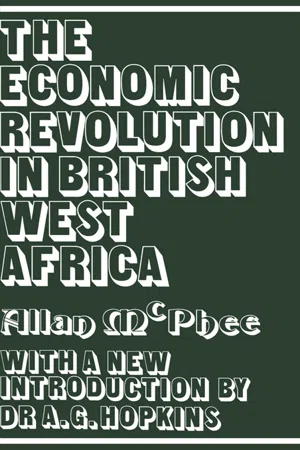
The Economic Revolution in British West Africa
About this book
Originally published in 1926, McPhee's work was the first to establish a framework for understanding the economic development between 1820-1920 in British West Africa.
CHAPTER II
TRADE
ACCORDING to legend, the Carthaginians discovered West Africa centuries before Christ, and exchanged their manufactured wares for the products of the region by means of the process of barter, called the “Dumb Trade.” After the Carthaginians disappeared from the stage of history, West Africa sank back into the mists of the unknown. For almost two thousand years all that was known of the region was derived from the faint echoes that came across the Sahara telling of powerful Moslem kingdoms, and from the faded traditions of a great river which flowed east to join the Nile. By the end of the fourteenth century the tide of Africans invading Europe had turned and was beginning to ebb. As a result of the Moorish Wars large areas of the Iberian peninsula had become waste and untilled, and the whole land was under-populated. There was land in plenty, but labour was scarce. Accordingly the landed proprietors began to purchase slaves on a large scale to cultivate their empty estates. Slaves were at first procured from the North African Moors, but as the supply was insufficient, efforts were made to tap more productive sources. To this end Dom Henrique of Portugal (1394-1460), latterly known as Prince Henry the Navigator, began sending ships southwards along the Atlantic coast of Africa in the hope of procuring slaves in large numbers. He shipped horses on board to enable the sailors to hunt down their human prey on the Saharan coast, and great was the rejoicing in Lisbon as each succeeding cargo of African natives was landed. The rejoicing was not merely mercenary, because the people of that day saw in the slaves, men and women once fettered in heathenism now offered the liberty of Christianity. In addition to slaves, the Moors of North Africa had purveyed gold and ivory and spices, and the desire to tap the sources of those commodities directly was another lodestone attracting the Portuguese ever southward. Dom Henrique seems also to have had the vague ambition of discovering the western Nile which was fabled to reach the land of the mythical Prester John and of the Eastern Christians, and thereby of turning the flank of the Moslem phalanx which was advancing into Europe by way of Asia Minor. Dom Henrique himself had little or no thought of reaching India. His utmost desire was to establish a Portuguese Empire on the Guinea coast, and in the second half of the fifteenth century this Empire was founded. After his death in 1460, great achievements led to higher ambitions, and finally Vasco da Gama rounded the Cape and reached India in 1497. Thereafter the Empire on the Guinea coast became a matter of secondary importance to the Portuguese.1
The nature of the West African trade continued for centuries as it had commenced. The most important export was that of slaves, then came that of gold, and thirdly came that of such commodities as ivory, spices, dye-woods, bees-wax and gum.2 As time went on the export trade in slaves grew to such an extent on account of the huge demand from America for strong, cheap and docile labour to run plantations that all other export items were dwarfed in comparison.3 This demand seemed, while the trade lasted, to be quite inexhaustible, since the New World was opened up more and more throughout the period under European auspices. It was the Slave Trade which made the importance of West Africa in the seventeenth and eighteenth centuries, and caused to be highly prized forts which would otherwise have been esteemed heavy liabilities. Naturally the Slave Trade was not a good preparation for the trade in inanimate commodities that was to follow. It must be remembered, however, that war and slavery existed in West Africa before and quite apart from any interference on the part of Europeans, whose function was to aggravate an existing evil. The demand for slaves diminished after the exploitation of tropical and sub-tropical America reached its climax, and with the legal abolition of the Slave Trade by the various civilised countries in the first half of the nineteenth century the export of slaves from West Africa gradually slackened.
While the Slave Trade was declining, but still long before it had fallen, another trade was springing up to take its place. The rising trade was that of palm oil.1 At first sight it seems strange that the trade in gold did not become important and take the place of being the leading export of West Africa. The lack of transport and the absence of security and of sanitation, however, forbade the extensive exploitation of gold at that time, and the export of gold became important only after the advent of railways and of the English administration. The positive reasons for the rise of the palm oil trade are various and apply both to the demand for and the supply of the product. On the side of demand there is a number of reactions from the Industrial Revolution. The great increase of population in England which accompanied and followed the Industrial Revolution meant a much enlarged demand for fats and oils for culinary and edible purposes which strained the resources of the old-established supplies from animal and fish sources. At the same time the situation was rendered still more difficult by the fact that the demand for oils and fats had grown per head of population. The reason for this increase in per capita consumption was the new vogues of cleanliness and of nocturnal illumination. Cleanliness meant the consumption of soap, and the expanding soap-industry drew its supplies of oils and fats increasingly from West Africa.1 Nocturnal illumination meant the use of candles in the first half of the nineteenth century, when as yet electric light was not thought of and gas was not popularised. The transition from animal to vegetable fats in the manufacture of candles came about in the ’Thirties of last century, and E. Price & Co. were the most famous pioneers.2 By the middle of the century it could be said that “palm oil had become one of the principal raw materials used in the manufacture of stearic cannles.” 3 Another source of demand for palm oil was a more direct reaction of the Industrial Revolution. The Industrial Revolution meant the substitution of metal for wooden machinery, and concomitantly the tremendous extension of the use of machinery in the processes of industry. This ever-growing industrial army of machines, which can run only by aid of the oil-can, necessitated a new supply of lubricating oil and fat, since the animal and fish supplies were neither adequate nor always suitable. An indication of the extent of this industrial demand may be guaged from the case of railways, which by 1865 required for truck-grease alone over 13,000 tons annually.4 So much for the demand for palm oil during the first half of the nineteenth century.
The reason for the rise of the export trade in palm oil on the supply side is more simple. The production of the palm oil needed but little labour, which meant that the cost of production, whether measured in cash or exertion, was small. Secondly, the transport factor was not on the whole important, since the oil palms grew within a day’s journey from the ocean and the ships. This consideration was momentous at a time when railways and motors were non-existant and the means of transport was confined to men’s heads or to tiny canoes which plied in the coastal creeks and lagoons. Such were the factors underlying the rise of the trade in palm oil.
Between 1772 and 1787 Liverpool, then as now the great West African port, imported small amounts of palm oil annually, the maximum being for the year 1785, 55 tons, worth about £2,224, which is altogether an insignificant amount out of the insignificant aggregate trade of West Africa of that day.1 The date of the abolition of the Slave Trade, 1807, marks the turning point in the history of the palm oil trade. Thereafter the figures of the imports into England leapt upwards, especially after the termination of the Napoleonic wars. The 1,000 ton mark was surmounted in 1810, the 2,000 ton mark in 1815, the 5,000 ton mark in 1821, the 10,000 ton mark in 1830, the 20,000 ton mark in 1842 and the 30,000 ton mark in 1851.2 The new trade rose obviously on the ruins of the old trade,3 and yet despite the phenomenal growth of the new trade from being worth very little at the beginning of the century to being worth nearly £2,000,00 in the middle of the century,4 the export of palm oil was a poor substitute for the export of slaves. Accordingly it was during the first half of the nineteenth century that West Africa approached its economic nadir. It had been worth while to maintain at great cost to human life and to the Exchequer the West African “pest-holes” so long as the lucrative Slave Trade ffourished. When the Slave Trade was replaced by a comparatively meagre palm oil trade, it seemed high time for the Government to retire from the Coast. Even in the middle of the century, however, West Africa had not plumbed its lowest depths.
The output of palm oil from West Africa had increased by regular leaps and bounds throughout the first half of the century, but thereafter the steady path of progress was interrupted. In 1855 the 40,000 ton mark was surpassed, but for the remainder of the century the annual average was less than 50,000 tons, while the price dropped steadily downward throughout the period.1 The fall in the price was not wholly borne by the West African producers, but is to be accounted for largely by the drop in ocean freight-rates during the period when steamers were carrying more and more of the West African trade. The lower freight-rates came most opportunely, since palm oil was beginning to undergo fierce competition from other quarters. About 1860 Colonel Drake tapped petroleum in Pennsylvania. In a very short time the European market was flooded with this cheap heating and lighting oil. The demand for the African palm oil fell off and the price diminished.2 At the same time India entered the oils and fats market as a producer of oil nuts and seeds. Still later the tallow of Australia began to supplement the tallow of Russia and to intensify the competition which the palm oil had to endure.3 Despite the fall in value of the palm oil and the smaller profits accruing from the trade, the output continued to maintain a high level. The falling price was not the only drawback. The palm oil trade was rendered abnormally speculative on account of the great annual fluctuations of the output, which were to be accounted for by the frequent native wars which held up trade, and by the occasional deficiency of rainfall which rendered the fruits “starved” and poor in oil.1 Just at the time that petroleum was delivering such a shattering blow, the supply of oil from West Africa received a valuable addition from the discovery of palm kernel oil.2 Palm kernels, which had hitherto been esteemed useless and had either accumulated as rubbish heaps or been employed to pave roadways and hut-floors, began to be exported in increasing quantities. When F. W. Loder made his great discovery of how to manufacture vegetable margarine, the demand for palm kernels increased enormously, for it was found that palm kernel oil could be used in the manufacture of margarine in the place of animal oleo.3 It was not so with palm oil, which had not the keeping qualities of palm kernel oil. Palm oil, however, obtained some compensation in the growth of the tinplate industry, where it was without a rival as a tinning ffux.4 This demand for palm oil was of great importance as the output of tinplate multiplied continuously until the ’Nineties, owing to the rise of the tinning and canning industries both at home and abroad.5 It helped to steady the market for palm oil through a transitional period, when prices dropped from £52 a ton to £18 10/- in the course of thirty or forty years.6 Before the war the trade in palm oil had grown steadily with the development of population and commerce, until the quantity imported into England from West Africa circled round about 80,000 tons and the price centred about £30 per ton.1 Long ere this the exports of palm kernels had exceeded in value that of palm oil, thanks to its more extended use in manufacture. Before the war the bulk of the palm kernels from West Africa went to Germany, where the...
Table of contents
- Cover
- Title
- Copyright
- Introduction
- Contents
- List of Contractions
- Preface
- I. Introduction
- II. Trade
- III. Transport
- IV. Land
- V. Finance
- VI. Currency
- VII. Natives
- VIII. Health
- IX. Conclusion
- Appendix A: Statistics for British West Africa showing that the nineties mark the advent of the economic revolution
- Appendix B: Summary of Health Returns for non-native officials
- Index
Frequently asked questions
Yes, you can cancel anytime from the Subscription tab in your account settings on the Perlego website. Your subscription will stay active until the end of your current billing period. Learn how to cancel your subscription
No, books cannot be downloaded as external files, such as PDFs, for use outside of Perlego. However, you can download books within the Perlego app for offline reading on mobile or tablet. Learn how to download books offline
Perlego offers two plans: Essential and Complete
- Essential is ideal for learners and professionals who enjoy exploring a wide range of subjects. Access the Essential Library with 800,000+ trusted titles and best-sellers across business, personal growth, and the humanities. Includes unlimited reading time and Standard Read Aloud voice.
- Complete: Perfect for advanced learners and researchers needing full, unrestricted access. Unlock 1.5M+ books across hundreds of subjects, including academic and specialized titles. The Complete Plan also includes advanced features like Premium Read Aloud and Research Assistant.
We are an online textbook subscription service, where you can get access to an entire online library for less than the price of a single book per month. With over 1.5 million books across 990+ topics, we’ve got you covered! Learn about our mission
Look out for the read-aloud symbol on your next book to see if you can listen to it. The read-aloud tool reads text aloud for you, highlighting the text as it is being read. You can pause it, speed it up and slow it down. Learn more about Read Aloud
Yes! You can use the Perlego app on both iOS and Android devices to read anytime, anywhere — even offline. Perfect for commutes or when you’re on the go.
Please note we cannot support devices running on iOS 13 and Android 7 or earlier. Learn more about using the app
Please note we cannot support devices running on iOS 13 and Android 7 or earlier. Learn more about using the app
Yes, you can access The Economic Revolution in British West Africa by Allan McPhee in PDF and/or ePUB format, as well as other popular books in Economics & Economic Theory. We have over 1.5 million books available in our catalogue for you to explore.