- 168 pages
- English
- ePUB (mobile friendly)
- Available on iOS & Android
eBook - ePub
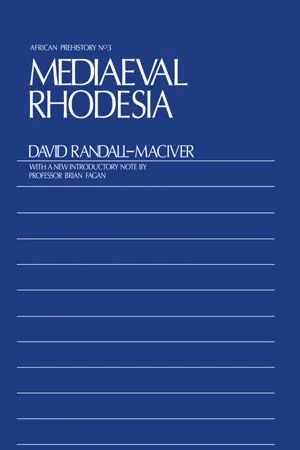
Medieval Rhodesia
About this book
First published in 1906, this archaeological examination of the ruins of Zimbabwe, Rhodesia's pre-historic monument, asserted that it was African in origin, belonging to the medieval period. The academic controversy still has echoes in the 21st century.
Information
Chapter I
Introductory—Inyanga
The East Coast of Africa.
THE most appropriate entrance into Southern Rhodesia is from the east coast of Africa, for the commercial development of the country has always been mainly dependent upon the roads leading into it from the ports between Mozambique and Sofala. Its history is therefore inextricably interwoven with that of the foreign settlements, whether Arab or Portuguese, which form a chain from Lourenço Marques almost to the Gulf of Aden.
But here at the very outset let me utter a note of warning. There is no historical warrant for ascribing any high antiquity to any one of these east-coast colonies. Magadoxo, the earliest and the nearest of any importance to its parent Arabia, is known, from the chronicle which the Portuguese conquerors found at Kilwa, to have been founded not earlier than the middle of the tenth century A.D. Kilwa itself, a Persian settlement, is seventy years younger. And whatever the probabilities that Arab traders established themselves in very early days on both sides of the Red Sea and the Gulf of Aden, there is good reason to suppose that they seldom adventured much farther south until at least the later days of the Roman Empire. For the misconceptions of so learned a geographer as Ptolemy suggest that even in the second century after Christ the coast south of Cape Guardafui was still very imperfectly known.
From the second century to the tenth, when some little documentary evidence becomes available with the first Arab geographers and the far more valuable chronicle of Kilwa, is a dark period, on which but little light is thrown by a solitary work of unknown authorship and date, the famous Periplus of the Red Sea. If, however, we may trust M. Guillain’s identifications of sites mentioned in the Periplus, we are led to the conclusion that at any rate some centuries before Mohammed an Arab Colony, Rhapta, had been planted as far south as the Rufiji, eight degrees beyond the equator. But this in itself suggests that the Zambesi was still unknown, since the author, who evidently derived his information from Arab sources, regarded Rhapta as his ultima Thule.1
The spade of some fortunate explorer may, in the future, bring to light traces of settlements on the east coast belonging to the centuries just before and after the beginning of the Mohammedan era, but we have no right to assume their existence until they are found. Unaided documentary evidence does not permit us to suppose that there was any Oriental traffic even with Sofala, the gate of the gold-bearing regions of the interior, prior to its establishment as a mart by the inhabitants of Magadoxo.
From Sofala westwards to the capital city of the Monomotapa was a journey of some three weeks for Duarte Barbosa and his contemporaries of the sixteenth century. The modern traveller may reach the Great Zimbabwe, which is generally identified with the place referred to, in a considerably shorter time, though by a more circuitous route. But he may be counselled not to hasten too much on the way; for there is much to interest the archæologist in the more outlying regions of that shadowy, but by no means mythical, dominion which the Portuguese writers describe with some exaggeration as an empire covering a great part of South-East Africa. The itinerary traced in these pages will lead the reader to sites which are not less interesting, even if they are less famous, than others which have often been described.
Umtali.
The dangers which once beset the first stages of the journey from the coast have disappeared now that a train takes but a few hours to traverse the fever-stricken low veldt; and the most bigoted of æsthetes may bless the railway when he finds himself, only a day after quitting Beira, in the healthy and beautiful mountains of Umtali. Situated over 3000 feet above the sea, in an amphitheatre surrounded by granite and diorite hills, Umtali reminds the new-comer from Britain of highland regions in his own home. It is the first town seen after crossing the Portuguese border; and, as this volume does not deal with the numerous and important ruins along the line of the Revue, the Busi, or the Sabi rivers, it is the first halt to be recorded in this tour of exploration. We may well spend a few days here in a preliminary visit to a site which will be described in fuller detail in a later chapter. A walk of three miles south from the lower end of the town leads out to a series of kopjes and tree-clad slopes trending upward to the higher hills which bound the horizon. Dense though the grass and undergrowth may be, rude walls of unhewn stone arrest the attention directly the path leaves the level ground. Examined more closely, they reveal more system than at first appears. Only a foot or two in height, they are built without mortar, and form circles, arcs of circles, or ellipses. It is difficult to distinguish ground-plans while the grass still stands shoulder-high, but when fires have bared the hillside in the winter months, the lines of stones may be traced and the design of the builders understood. Then it is seen that these constructions are isolated units, each complete in itself and independent of its neighbours. Either they are single rings or they are enclosures containing several rings surrounded by roughly-circular girdle-walls. Fresh from Europe and the Mediterranean, the sanguine archæologist will almost inevitably be reminded of the rude stone structures of Britain and France, North Africa, and Palestine; and may suppose that on the very first day of his explorations he has stumbled upon the goal of his ambitions, an ancient cemetery. But a little trial excavation brings disillusionment. These are not graves, nor is the secret of their purpose to be discovered in a day. It is only when other sites in different places have been studied that the Umtali ruins can be appreciated. So let us leave Umtali, to revisit it later when more experience has been gained, and travel in the direction of the Zambesi as far as Inyanga.
Inyanga.
It is only about sixty miles due north from Umtali to Inyanga, but the direct track is exceptionally rough and difficult, so that it is preferable to take the train as far as Rusapi, a journey of four hours, and to proceed thence for fifty-five miles on horseback or by wagon. The road from Rusapi climbs continually upwards, affording magnificent views of characteristic Rhodesian scenery. Now and again a Kaffir kraal is seen, then there will be a wide expanse of level veldt, studded with abrupt kopjes in the foreground and middle distance; behind these, again, lofty mountains, whose grandeur is impaired only by their roundness of contour and the absence of peaks or crags.
The homestead of Inyanga is in the middle of a fine estate of 100,000 acres, a favourite property of the late Mr. Cecil Rhodes and, now administered by his Trustees. Stock-raising, agriculture, and fruit-growing are the occupations of the hospitable managers of the farm, who yet found time to assist their guest in a thousand ways and to guide him to the chief points of interest in the neighbourhood. Standing no less than 6000 feet above the level of the sea, the farm is surrounded by grassy uplands, and there is pasture for sheep even on the higher ridges that during the winter are constantly wrapped in mist, through which the great Inyanga mountain (9000 feet) is scarcely visible. The whole countryside teems with the monuments of bygone ages, to a description of which the remainder of this chapter will be devoted. The antiquities of Inyanga were described to the writer before his arrival as consisting of hill-forts, slave-pits, water-furrows, and terraces for cultivation. They may here be treated in that order.
Hill-Forts.
There are four ancient forts on the estate, so situated that one might fancy they had been built for the express purpose of defending the Rhodes farm. Each is, roughly, three miles distant from it, and it would be easy to signal across the intervening space. The photographs in Plates I. and II. will give an idea of their character and construction; Plate I. a shows part of the exterior of the Northern Fort with its entrances; Plate I. b, the main wall of the Eastern Fort as seen from the inside, and Plate II. b, another part of the same wall, from the outside.
Plate I.

(a) ENTRANCES OF THE NORTHERN FORT, INYANGA. See page 4.

(b) MAIN WALL OF THE EASTERN FORT, INYANGA, FROM INSIDE. See page 7.
Plate II.

(a) PLAN OF EASTERN FORT, INYANGA. See page 6.

(b) MAIN WALL OF THE EASTERN FORT, INYANGA, VIEWED FROM OUTSIDE. See page 6.
The small Southern Fort stands in a commanding position at the top of a rather steep kopje, and is very roughly and carelessly constructed of large and small pieces of unworked granite, piled one upon the other, without mortar. In outline it is elliptical, and measures in greatest interior diameter 17 × 15 metres; there are no divisions or cross-walls of any kind inside. Where the wall is still standing, its average height is 2 metres, but it was never strongly built, and is ruined at several points. Its average width at the ground-level is 2 metres, or rather less, but half of this must be assigned to the rough banquette which runs round on the inside, a little below the top of the outer half of the wall. In several places there are loopholes; and there are three entrances, viz. on the North, North-west, and West, the character of which may be appreciated from the photographs in Plate I., where precisely similar entrances occurring in other forts are figured. These are simple gaps in the wall, just over 1 metre in height and 0.50 m. or 0.60 m. in width, roofed with large, flat, unhewn slabs of about 0.20 m. thickness. The Southern Fort is the most carelessly built and tumble-down construction in the whole of the Inyanga district; the fitting of the stones is very bad, and it is difficult to suppose that such a building, which could almost have been run up in a few hours, ever served as anything better than a mere temporary refuge in time of great need.
The Northern and North-Eastern Forts are similar in general character, and not very greatly superior in construction, but exhibit one or two features not found in the Southern. Thus, in the Northern Fort, though the walls and entrances are of the same kind, there are no loopholes; while, on the other hand, though there are no actual subdivisions in the interior, yet there are two small circles (2.50 m. in interior diameter) built up of two courses of boulders to a height of about 0.50 m. One of these is in the middle, and the other, abutting on it, is built against the inside of the southern wall. The fort is elliptical in outline, measuring 24 metres in maximum interior diameter; its wall is about 2 metres in height, and very variable in thickness. The kopje on which it is built is extremely steep, and intrenched with low lines of boulders from the bottom upwards.
The North-Eastern Fort, which stands in a most formidable position on a sheer cliff above the little Inyanga river, is, perhaps for that very reason, the most irregularly built of the four. In all the forts the outline of the wall is unsymmetrical, and adapts itself to every irregularity of the hillside, but in this case the plan is so formless that it can only be described as vacillating between an ellipse, a horse-shoe, and a rectangle, but approaching most nearly to the horse-shoe. Its maximum interior diameter is about 30 metres. The wall, which is not loopholed, stands in places as much as 2 metres high, averages 1.50 m. in thickness, and, as in the other cases, has a banquette on the inside. It is pierced with entrances of the usual kind, three in number Inside there are no less than six of the low rings of stones noted as occurring in the Northern Fort; one of them being in the centre, the others against the east, south, and west walls. They are rather horseshoe-shaped than circular or elliptical. It is interesting, as an indication of pit-dwellings being contemporaneous with forts, a view will be shown in the sequel to be confirmed by other evidence, to note that there is a group of them in immediate proximity; half a dozen pits, indeed, being sheltered almost under the very walls of the fort.
Far more elaborate and complex in design, though otherwise identical in character with the three which have just been described, is the large Eastern Fort. The writer cleared it of the encumbering undergrowth, made a plan of it, and excavated such parts of the interior as seemed to promise any results. It proved to be of sufficient interest to warrant a detailed account.
If one looks eastward from the top of the slope, just behind the Rhodes farm, a bold ridge, nearly three miles away, shows clear cut against the sky. At its highest point, upon a knoll overgrown with shrubs and flowering trees, is the fort. Strategically, no more admirable site could have been chosen, and it much resembles those which Romans and ancient British marked out for their hill-camps in our own land. From the highest part all the other forts are plainly visible, and the view ranges to distant points many a mile beyond them. On the western and northern sides almost precipitous slopes defend the approach; eastwards the ground sinks less sharply; to the south the slope at first descends gradually, then falls abruptly to the little valley. Here a streamlet, fed by several tributary brooks, runs down to join the main Inyanga river, and a trench opening off it close to the main source deflected water in old days at a high level along the hill.
The most natural approach is from the western side, and on the way thither from the farm may be seen many of these dwellings, which have been erroneously termed “slave-pits,” and will presently be more fully described. On the hillside itself these do not occur, but small circular enclosures are found within a few metres of the fort; as well as low walls which, so far as the tangled undergrowth admits of judging, were outworks or entrenchments like those observed round the Northern Fort.
The building itself is of irregular outline, as may be seen from the accompanying plan (Plate II. a). It is composed of six divisions, of which those lettered A and B stand on the level summit of the knoll, while the others are on the slopes, C in particular having a very sharp ...
Table of contents
- Cover
- Half Title
- Title Page
- Copyright
- Dedication
- Introductory Note
- Preface
- Contents
- Chapter I: Introductory—Inyanga
- Chapter II: The Niekerk Ruins
- Chapter III: The Niekerk Ruins (continued)—The Place of Offerings
- Chapter IV: Umtali
- Chapter V: Dhlo-Dhlo
- Chapter VI: Nanatali and Khami
- Chapter VII: Zimbabwe—Dating of the “Elliptical Temple”
- Chapter VIII: Zimbabwe—Description of the “Elliptical Temple”
- Chapter IX: Zimbabwe. The Valley Ruins. The Acropolis. Objects Found
- Chapter X: Conclusion
- Appendix I: Details of Trial-Sections in the “Elliptical Temple,” Zimbabwe
- Appendix II: Notes
- Index
Trusted by 375,005 students
Access to over 1.5 million titles for a fair monthly price.
Study more efficiently using our study tools.
Frequently asked questions
Yes, you can cancel anytime from the Subscription tab in your account settings on the Perlego website. Your subscription will stay active until the end of your current billing period. Learn how to cancel your subscription
No, books cannot be downloaded as external files, such as PDFs, for use outside of Perlego. However, you can download books within the Perlego app for offline reading on mobile or tablet. Learn how to download books offline
Perlego offers two plans: Essential and Complete
- Essential is ideal for learners and professionals who enjoy exploring a wide range of subjects. Access the Essential Library with 800,000+ trusted titles and best-sellers across business, personal growth, and the humanities. Includes unlimited reading time and Standard Read Aloud voice.
- Complete: Perfect for advanced learners and researchers needing full, unrestricted access. Unlock 1.5M+ books across hundreds of subjects, including academic and specialized titles. The Complete Plan also includes advanced features like Premium Read Aloud and Research Assistant.
We are an online textbook subscription service, where you can get access to an entire online library for less than the price of a single book per month. With over 1.5 million books across 990+ topics, we’ve got you covered! Learn about our mission
Look out for the read-aloud symbol on your next book to see if you can listen to it. The read-aloud tool reads text aloud for you, highlighting the text as it is being read. You can pause it, speed it up and slow it down. Learn more about Read Aloud
Yes! You can use the Perlego app on both iOS and Android devices to read anytime, anywhere — even offline. Perfect for commutes or when you’re on the go.
Please note we cannot support devices running on iOS 13 and Android 7 or earlier. Learn more about using the app
Please note we cannot support devices running on iOS 13 and Android 7 or earlier. Learn more about using the app
Yes, you can access Medieval Rhodesia by David Randall-Maciver in PDF and/or ePUB format, as well as other popular books in Social Sciences & African History. We have over 1.5 million books available in our catalogue for you to explore.