Published in 2004, Military Deception and Strategic Surprise! is a valuable contribution to the field of Military and Strategic Studies.
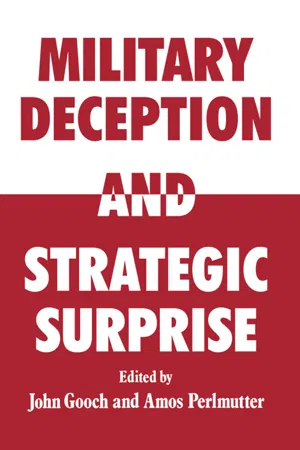
eBook - ePub
Military Deception and Strategic Surprise!
- 192 pages
- English
- ePUB (mobile friendly)
- Available on iOS & Android
eBook - ePub
Military Deception and Strategic Surprise!
Soviet Strategic Deception,
1955–1981
An evaluation of Soviet strategic deception must compare the stated objectives of Soviet policy with the development and deployment of weapons that the Soviets consider strategic. Unlike the information that has become available on Nazi Germany, little direct material has appeared on the strategic objectives that the Soviets have pursued in the post-war period. Therefore, we must infer Soviet strategic intentions by evaluating not only their statements, but also their actions and their preparations. In the strategic arena, we need to compare their actual forces and their deployment with public claims about their numbers and capabilities.
The debate over the pursuit of strategic superiority provides the backdrop for examining Soviet procurement of and claims about nuclear weapons and their accompanying delivery systems. Strategic superiority implies that one side can assure victory in a nuclear conflict. The Soviets have traditionally characterized the West and particularly the US as pursuing the chimera of superiority. Soviet claims about superiority seem to vary inversely with their capability (or with Western intelligence about that capability) and provide an important piece of evidence supporting the argument that the Soviets have engaged in systematic strategic deception since the end of the Stalin era.
Strategic Deception as Policy
Strategic deception occurs whenever a country continues over a period of time deliberately to mislead another regarding its strategic objectives or the forces designed to achieve those objectives. Deceptions of intent leave much less of a trace than deceptions about capabilities. Evidence that a country indicated that it intended one thing when it subsequently did another may simply reflect a shift in policy. Often statesmen disguise their true intent from others and memoirs after the fact often betray greater vision than the confusion of the actual moment suggested. Actual plans or programs for deception should have limited circulation and thus should rarely enter the public domain.
Limited evidence that the Soviets have engaged in or encouraged systematic strategic deception has appeared in the memoirs of a former head of the Czechoslovakian disinformation section, Ladislav Bittman:
For disinformation campaigns to be successful, they must at least partially correspond to reality or generally accepted views. A rational core is especially important when the recipient enemy or victim is a seasoned veteran in such matters, because without a considerable degree of plausible, verifiable information and facts it is impossible to gain his confidence. Not until this rational skeleton has been established is it fleshed with the relevant disinformation. In 1963 for example, the general staff of the Czechoslovak army, with the help of the intelligence and counter-intelligence services, developed a long-range military disinformation operation in order to deceive NATO countries about the military strength of the Czechoslovak army. It was in fact a part of the Warsaw Pact disinformation program, and it can be assumed that similar techniques have been used by other members of the pact as well.
The general staff supplied Czechoslovak media with purposely distorted information on the Czechoslovak military, assuming that NATO analysts would pick it up. At the same time hundreds of double agents on Czechoslovak territory working both for Czechoslovak counter-intelligence and Western intelligence services were supplied with disinformation material on the Czechoslovak military that would fit with the published information. It was a very costly operation because the general staff had to finance the construction of deceptive missile ramps and organize a false transfer of army units in order to support the correct mixture of disinformation.
After 1964, the Czechoslovak disinformation service helped to develop this long-range project further, without knowing, however, whether or not the desired effects had been achieved. The NATO military command had not reacted, but our department had at least one indication of success: the Russians insisted that we continue, it is quite possible that this operation is still being conducted
[Bittman:20–21].
This episode remains one of the few that directly implicates the Soviet Union in a plan systematically to deceive the West. The Soviet forgery offensive and the current disinformation efforts over the location of long-range theater nuclear weapons provide more tangible evidence of Soviet deception. However strong the evidence that the Soviets use deception to support their foreign policy, little has appeared to connect their strategic deployments and pronouncements directly to a program of deception. Nevertheless, a clear pattern of systematic deception emerges. The Soviets have consistently disguised the true strength of their strategic nuclear intercontinental forces: when weak, feigning strength; when strong, feigning parity.
Depending on the context, deception can serve a number of purposes. Hitler sowed confusion about the size of his military forces. Deception allowed Hitler to achieve what his rearmament program had not succeeded in doing, deterring intervention by third parties in his succession of diplomatic coups in the mid-to late 1930s. Deception may also serve peaceful purposes by deterring attack. Exaggeration can lead to reaction as the target feels a need to meet the threat posed by the enemy. In the late 1930s, the Germans, realizing that the inflated figures about German forces appearing in the British press were exerting pressure on the British to rearm, initiated a deception that indicated that the rate of German rearmament would just match the current British program. Thus, a deception campaign must not only succeed in achieving short-term goals, but it must also prevent a response which defeats the policy in the long run. Soviet strategic deception since 1955 shares the features of both boasting when weak and downplaying when strong.
THE CORE OF RATIONALITY, EVIDENCE AND DECEPTION
As Bittman notes, all deception must possess a kernel of truth. Any discussion of Soviet deception generally turns on protestations of US self-deception. Many seem more inclined to admit that the US has fooled itself than the Soviets have fooled the US. Such an attitude, of course, facilitates Soviet deception by providing a ready explanation for any Soviet behavior that appears deceptive. Reinforcing preconceived notions represents one of the easier tactics of deception. Homilies and half-truths about Soviet behavior also provide a ready basis for deception (for example, Soviet technological inferiority, Soviet ‘defensive’ posture, etc.). The pluralist nature of the American political process provides a ready market for virtually any Soviet deception, just as Churchill became an unwitting agent of exaggerated German claims in the mid-1930s. The leak and counter-leak system of bureaucratic infighting provides additional fertile ground for Soviet manipulation. Soviet attempts to disrupt the American political process may not necessarily reflect any conscious program other than confusion.
The true test of Soviet deception lies in their deployments and their public statements of intent and capabilities. Unfortunately much of the information about Soviet deployments must come from US public assessments of the threat posed by the Soviets, in part discredited by repeated Soviet attempts to fool US intelligence resources and by the many uses to which parts of the government put intelligence. Thus, the internal consistency of Soviet claims and military demonstrations must bear close scrutiny. Because the Soviets betray little about their strategic intentions (other than the general desire to deter an attack on their homeland, and Russian and Soviet historic expansionism), claims that they have made for their forces and their rationale in justifying them provide the best basis for evaluating Soviet deception.
Some deceptions possess elements that do not allow an easy distinction between strategic and operational. A government may disguise its forces to complicate the military planning of its opponents. For example, a country may construct dummy missile sites in an attempt to divert attacks on actual missiles. Such an operational deception assumes strategic implications if the country then argues that the number of missiles it has deployed conveys some advantage. If that country has engaged in some process with its major opponent in which quantity or quality, per se, has attained strategic significance, then that country need not even draw attention to the number of missiles in order for the deception to assume strategic status. The dialogue between the US and the Soviet Union has placed extraordinary importance on the quantity and quality of nuclear intercontinental systems. Thus, any attempt to disguise the quantity or quality of those systems, even without drawing attention to that disguise, represents strategic deception. Before the SALT process began, Soviet operational deceptions involving their nuclear intercontinental systems did not, ipso facto, constitute strategic deception. Now they do.
Some operational deceptions do not assume strategic importance because they have failed to enter the US-Soviet dialogue. For example, if the Soviets constructed dummy SAM sites or prepared camouflaged airfields for their interceptors to complicate US bomber route planning, they would not have engaged in a strategic deception. If the Soviets then made claims about the capability of their strategic air defenses that they did not believe, then they would have perpetrated a strategic deception. Sophisticated analyses have not appeared about the effectiveness of Soviet air defenses and even within the US controversy surrounds assessments because of the need to evaluate weapons programs. Unfortunately, the nature of the procurement process (at least in the United States) lends itself to deception directed more internally than externally. Occasionally, a vested interest will point with pride at (and exaggerate) current capabilities and view with alarm (and understate) future capabilities.
The controversy over major weapons decisions does not play itself out in the Soviet popular press as it does in the US. Nevertheless the Soviets may cite capabilities in vitro. Boasts in isolation may reflect the give and take of justifying a particular weapons program or the pride of technological development. Repeated references to a capability yet to appear indicate more than simply pride of parenthood; they reflect a conscious desire to trade prestige on that capability. Goebbels understood the dangers of boasting about untried capabilities in wartime. He threatened the British with the V-1 long before it had achieved an operational status. His propaganda backfired as the German people wondered why the state did not use the weapon and the British launched a counter campaign to embarrass the German government. In Soviet practice claims about future capabilities fade away as they fail to materialize or fail to strike a resonating chord in the West. (Johnson apparently asserted that the US possessed an ASAT capability at the time development began.)
Shifts in the capabilities of systems also pose a problem for identifying strategic deception, especially in the light of initial claims that later testing proves false or when the opponent adopts measures which effectively nullify the initial advantages of the system. For example, the Soviets may boast that no planes can effectively penetrate their air defense, as they did when they shot down the U-2. Tactics such as low-flying penetration may defeat an air defense designed to counter the high-flying threat. Similarly, a ballistic missile defense may succeed against a small number of re-entry vehicles which have low ballistic coefficients (that is, high drag so that the RV remains in the atmosphere longer) but become quickly saturated with large-scale attacks. As the threat changes so should claims about the capability of defenses. Isolated claims probably mean little. Claims sustained over a number of years without a corresponding capability suggest strategic deception.
Just as a system may fail owing to countermeasures, it may succeed owing to incremental technological improvement. Thus, a defense originally designed to cope with low beta RVs in small numbers may fail against high beta RVs in large numbers and beome relegated to a high altitude defense against aircraft. Gradual technological improvement may gain some capability against the high beta RV threat. In the absence of an arms control agreement that identifies ABM systems, a country need not tout its recently acquired capability and thus not perpetrate a strategic deception. If the arms control agreement does outlaw upgrades, then the upgrade does qualify as a strategic deception, especially because silence identifies a system as an air defense.
Preparations for breakout from an arms control agreement pose a special problem in identifying strategic deception. The Soviet Union presumably wishes to do as little as possible to limit its war-fighting capability. Therefore, the Soviets should design agreements that allow them maximum flexibility with respect to breakout. If the Soviets view war as inevitable, then the arms control agreement means little (since it was designed to manage the peace). To enhance their ability to achieve breakout does not violate the spirit of the agreement, per se. Unilateral statements about breakout by the other party to the agreement represent more naiveté and self-deception than Soviet strategic deception. Nevertheless, if the Soviets adopt measures that aid in the breakout process and also violate the letter of the agreement, then they engage in strategic deception.
OPPORTUNITIES FOR DECEPTION
The German pattern suggests that the Soviets should exaggerate their capabilities when low and downplay them when high. The specifics of the deception should depend on the dynamic between Soviet and US capabilities. Thus, the Soviets should pursue an overall program of deception with the specifics left to the interplay of technological progress and policy of the moment. The preconceptions of the US strategists and military should provide the most fruitful ground for deception.
I: Exaggeration to 1962
After the death of Stalin, the Soviets found themselves at a distinct strategic disadvantage. Stalin had left the Soviet military with a military doctrine illsuited to the technological changes already underway with nuclear weapons and the prospects of intercontinental ballistic missiles. Their major opponent possessed weapons and bases with which to strike deeply within the heart of the Soviet Union and yet remain unscathed itself. Apparent Soviet weakness could little serve a forward policy in Europe. Two paths seemed open: one, to forsake a capability against the United States, per se, and concentrate on the pressure that the Soviets could exert on Europe with local forces; the other, to expand the arena of conflict by pushing the new missile technology, realizing that geography and the massive industrial base of the US for producing bombers would lead the Soviets to the short end of the strategic competition.
Two doctrines presented themselves, one more consistent with the diversion of heavy industrial resources to broader economic purposes than simply military. The belief that nuclear war meant the end of mankind and that each side need possess only enough weapons to assure that destruction appeared early. The other view that technology did not fundamentally change the nature of warfare (and by extension, the class struggle) required forces sufficient to defeat the enemy. A minimalist approach to nuclear weapons would require merely that the Soviets guarantee that the US suffer if it should attack. Exaggeration of limited Soviet forces would help, but convincing the US of the need to restrict its nuclear capability would help even more. The maximalist approach required that the Soviets exaggerate their forces, because it admits that superiority conveys strategic advantage. Thus, the weakness of Soviet forces necessitated that Khrushchev pursue a policy of strategic deception to achieve his global forward policy. Hitler, faced with similar choices in the early 1930s, adopted a very similar policy-deception to compen...
Table of contents
- Cover
- Halftitle
- Title
- Copyright
- Contents
- Notes on Contributors
- Introduction
- Covert Rearmament in Germany 1919–1939: Deception and Misperception
- Soviet Strategic Deception, 1955–1981
- Military Deception, Strategic Surprise, and Conventional Deterrence: A Political Analysis of Egypt and Israel, 1971–73
- Intelligence and Deception
- Propositions on Military Deception
- Toward a General Theory of Deception
Trusted by 375,005 students
Access to over 1.5 million titles for a fair monthly price.
Study more efficiently using our study tools.
Frequently asked questions
Yes, you can cancel anytime from the Subscription tab in your account settings on the Perlego website. Your subscription will stay active until the end of your current billing period. Learn how to cancel your subscription
No, books cannot be downloaded as external files, such as PDFs, for use outside of Perlego. However, you can download books within the Perlego app for offline reading on mobile or tablet. Learn how to download books offline
Perlego offers two plans: Essential and Complete
- Essential is ideal for learners and professionals who enjoy exploring a wide range of subjects. Access the Essential Library with 800,000+ trusted titles and best-sellers across business, personal growth, and the humanities. Includes unlimited reading time and Standard Read Aloud voice.
- Complete: Perfect for advanced learners and researchers needing full, unrestricted access. Unlock 1.5M+ books across hundreds of subjects, including academic and specialized titles. The Complete Plan also includes advanced features like Premium Read Aloud and Research Assistant.
We are an online textbook subscription service, where you can get access to an entire online library for less than the price of a single book per month. With over 1.5 million books across 990+ topics, we’ve got you covered! Learn about our mission
Look out for the read-aloud symbol on your next book to see if you can listen to it. The read-aloud tool reads text aloud for you, highlighting the text as it is being read. You can pause it, speed it up and slow it down. Learn more about Read Aloud
Yes! You can use the Perlego app on both iOS and Android devices to read anytime, anywhere — even offline. Perfect for commutes or when you’re on the go.
Please note we cannot support devices running on iOS 13 and Android 7 or earlier. Learn more about using the app
Please note we cannot support devices running on iOS 13 and Android 7 or earlier. Learn more about using the app
Yes, you can access Military Deception and Strategic Surprise! by John Gooch, Amos Perlmutter, John Gooch,Amos Perlmutter, John Gooch in PDF and/or ePUB format, as well as other popular books in History & Military & Maritime History. We have over 1.5 million books available in our catalogue for you to explore.