eBook - ePub
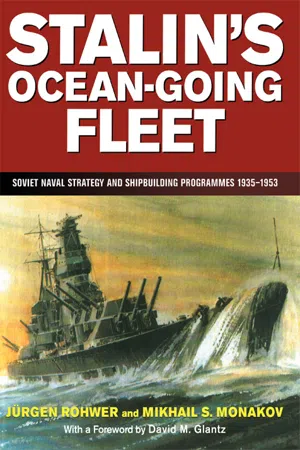
Stalin's Ocean-going Fleet
Soviet Naval Strategy and Shipbuilding Programs, 1935-53
- 368 pages
- English
- ePUB (mobile friendly)
- Available on iOS & Android
eBook - ePub
Stalin's Ocean-going Fleet
Soviet Naval Strategy and Shipbuilding Programs, 1935-53
About this book
A study of the development of strategic concepts in Stalin's Navy, in the context of his foreign/defence policy, using original archival documents translated from the Russian.
1
Introduction
Introduction
Planning for this book started in earnest when the authors first met during ‘Kieler Woche’ (Kiel Week) in June 1993 aboard the newest destroyer of the Russian Baltic Fleet, the Nastoichivyi. But this meeting had a long pre-history. Both of us had worked for a long time on the history of the Russian and Soviet Navy.
Jürgen Rohwer was for 30 years editor-in-chief of the German naval journal Marine-Rundschau, which since the early 1960s had published several articles by competent authors, such as Kapitan 1 Ranga V.I. Achkasov, Admiral V.F. Tributs, Admiral N.N. Amel'ko, and even Admiral of the Fleet of the Soviet Union S.G. Gorshkov.1 Jürgen Rohwer had also published many articles in German-language and foreign journals2 and edited Soviet publications in translation.3
As an officer in the Soviet and Russian Navy, Mikhail Monakov took a course at the Higher Naval College in 1971 and a Higher Naval Officer's Course in 1976, before becoming Chief of the Historical Branch in the Main Staff’ of the Russian Navy. He started publishing, together with several colleagues, a Naval Dictionary4 and articles in the journal Morskoi sbornik, of which he became a co-editor Most important was his series of articles about the ‘Doctrines and Fates’ in the journal from 1990–94.5
We were both for many years hampered to different degrees by the inaccessibility of the relevant archives in the Soviet Union. Up to about 1990 we were only able to count on the more or less official publications by Soviet authors, who used materials provided to them by the officials responsible, or on intelligence sources in Western archives and publications in Western countries. Even though Rohwer had had contact since 1975 with the then Director of the Institute of Military History of the Soviet Army, Lt-Gen. Prof P.A. Zhilin, during the annual meetings of the International Commission of Military History (ICHM), there was no real exchange of materials possible during this period of ‘stagnation’. This began to change when in 1988 General Polkovnik Prof D. Volkogonov and his assistant, Kapitan 1 Ranga LA. Amosov, became the Soviet representatives at the ICHM. During the International Congress of Historical Sciences held in Madrid in 1990 they arranged a meeting with the then head of the archives of the Soviet General Staff, Polkovnik I. Venkov, and his assistant, then Major O. Starkov. With their unconventional assistance Rohwer was allowed access for the first time to important documents on the shipbuilding plans of the Soviet Navy from 1926 to 1941. These became the source for several articles in Western journals and publications.6 They were also the basis for the presentation of a joint paper by Rohwer and Amosov at the Naval History Symposium of the US Naval Academy at Annapolis in 1993 on parallels between Stalin's and Hitler's naval programmes, published in a slightly different version in Germany.7
This was also the starting point for our meeting aboard the Nastoichivyi in preparation for our first joint article on our topic.8 Of great importance for our work was the close co-operation with Kapitan 2 Ranga S. Berezhnoi, an expert on the building dates of Russian and Soviet warships and submarines, who had already published some books with detailed documentation on the fate of all ships from 1917 to the present and who provided us with the dates for the appendices in this book.9 Sadly, Capt. Berezhnoi died in November 2000.
NOTES
1.VF. Tributs, ‘Die U-Bootoffensive der Baltischen Rotbannerflotte in der Ostsee 1942’, MarineRundschau, 60 (1963), pp. 80–107. V.I. Achkasov, ‘Die sowjetische Kriegsflotte im Verlauf des “GroBen Vaterländischen Krieges’”, Marine-Rundschau, 62 (1965), pp. 268–77. V.I. Achkasov, ‘Die der Baltischen Rotbanner-Flotte von Reval auf Kronstadt’, Marine-Rundschau, 64 (1967), pp. 26–44. VF. Tributs, ‘Die Räumung der Garnison von Hangö’, Marine-Rundschau, 64 (1967), pp. 103–10, 158–74. N.N. Amel'ko, ‘Der sowjetische Weg zur Sicherheit’, Marine-Rundschau, 79 (1982), pp. 458–9. S.G. Gorshkov, ‘Die Stärke der Seestreitkrafte des Sowjetstaates – ein wichtiger Faktor der Sicherheit der UdSSR’, MarineRundschau, 80 (1983), pp. 5–7.
2.Jürgen Rohwer, ‘Die sowjetische U-Bootwaffe in der Ostsee 1939–1945’, Wehrwissenschaftliche Rundschau, 6 (1956), pp. 547–68. Jürgen Rohwer, ‘Die sowjetische Flotte im Zweiten Weltkrieg’, fahresbibliographie 1959 der Bibliothek für Zeitgeschichte, 32 (1960), pp. 383–410. Jürgen Rohwer, ‘Esperienze tecniche e tattiche dell'arma subaquea Sovietica nel secondo conflitto mondiale’, Rivista Marittima, 7–8 (1967), pp. 39–83. Claude Huan, and Jürgen Rohwer, ‘La Marine Soviétique’, in Notes et Études Documentaires No. 4479–4480, Paris, 1978. Jürgen Rohwer, ‘Admiral Gorshkov and the Influence of History upon Seapower’, US Naval Institute Proceedings, May (1981), pp. 150–74. Jürgen Rohwer, ‘Das Ende der Ara Gorschkow’, Marine-Rundschau, 83 (1986), pp. 88–97. Jürgen Rohwer, ‘Alternating Russian and Soviet Naval Strategies’, in P. Gillette and W.C. Franks (eds). Sources of Soviet Naval Conduct, Lexington, MA, Lexington Books, 1990, pp. 90–120.
3.N.A. Piterskij, Die Sowjetflotte im Zweiten Weltkrieg, trans. Erich Pruck, ed. Jürgen Rohwer, Oldenburg, Stalling, 1966.
4.Voenno-morskoi slovar, ed. V.N. Chernavin, Moscow, Voenizdat, 1990.
5.Mikhail Monakov, ‘Sud'by doktrin i teorii’, Morskoi sbornik;, 11, 12 (1990), 3, 4(1991), 3 (1992), 3, 5 (1994). Mikhail Monakov, ‘Strategicheskiye zadachi VMF v posledniye 100 let’, Morskoi sbornik, 10 (1996). Mikhail Monakov, ‘Dolgoye echo voyny’, Morskoi sbornik, 8 (1997).
6.Jürgen Rohwer, ‘Les stratégies navales soviétiques et --les programmes de construction navale (1921–1941)’, in Dossier 47. L’évolution de la pensée navale III, Paris, 1993, pp. 171–208. Jürgen Rohwer, ‘Soviet Naval Strategies and Building Programs, 1922–1941’, Acta No. 19, XIXth International Colloquium of Military History, Ankara, 1994, pp. 421–50. Jürgen Rohwer, ‘I1 programma navale di Stalin’, Storia Militare, No. 20: III (May 1995), pp. 4–13. Jürgen Rohwer, ‘Stalin's Battleships and Battlecruisers’, The Northern Mariner, VII, No. 3 July 1997), pp. 1–11.
7.Jürgen Rohwer, ‘Weltmacht als Ziel? Parallelen in Stalins and Hitlers Flottenbau- Programmen’, in Politischer Wandel, organisierte Gewalt und nationale Sicherheit, Munich, Olden-bourg, 1995, pp. 161–80.
8.Jürgen Rohwer and Mikhail Monakov, ‘The Soviet Union's Ocean-Going Fleet 1935–1953’, The International History Review, 18, IV (1996), pp. 837–68.
9.Sergei S. Berezhnoi (ed.), Korabli i vspomogatel'nye suda Sovetskogo Voenno-morskogo flota (1917–1927), Moscow, Voenizdat, 1981. Sergei S. Berezhnoi, Korabli i suda VMF SSSR 1928–1945, Moscow, Voenizdat, 1988. Sergei S. Berezhnoi, ‘Sovetskii VMF 1945–1995. Kreisera, bol'sh'ie protivlodochnie korabli, esmintsy’, Modelist-Konstruktor, No. 1 (1995), pp. 1–32.
2
Historiography on the Soviet Navy
Historiography on the Soviet Navy
For a long time the history of strategic thinking and planning in the Soviet Navy between 1922 and the reconstruction of the government following the death of Joseph Stalin in 1953 has been obscured. Since the Second World War many publications have appeared in the Soviet Union about the history of the Soviet Navy since the revolution.1 These gave many details about general developments and the various conferences held but always followed the pre-set party line. Details of the internal discussions on strategies and shipbuilding programmes were seldom revealed. The information on persons involved was mainly restricted to those not prosecuted during the time of Stalin, and the accounts on shipbuilding were restricted to some unrelated details on several ship-types and summaries of the ships built or laid down during the first three Five-Year Plans. Yet no information on building dates was given. Western experts took great pains to sift out from the sketchy materials the truth about the shipbuilding programmes.2
With the onset of Perestroika and Glasnost in the 1980s many and far more detailed publications appeared in Russia,3 and since 1990 more details have been released from what had been up to then secret archives. Combining the earlier publications and the new materials, it is now possible to present a more accurate description of the development of naval thought in the Soviet naval, military and Party circles as well as an accurate tabulation of the reconstruction and building programmes of the years 1922–41 and some hints about the planning for the Fourth Five-Year Plan.4
Besides the books mentioned there are many articles in Russian journals and periodicals such as Morskoi sbornik, Sudostroenie, Gangut and others about the different ship and submarine types, not only the built and finished ones but also the uncompleted projects. Such articles will be mentioned when relevant developments are being described. We are very grateful for the assistance received from some of the authors of these books and other Russian colleagues, such as Kapitan 1 Ranga Igor A. Amosov, Polkovnik Igor Venkov, Podpolkovnik Oleg Starkov, Kapitan 2 Ranga Sergei Zonin, K.B. Strel'bitskii, and the late Col.-General Dmitrii Volkogonov. Western experts on the Soviet Navy also gave us much very interesting and helpful advice, such as Siegfried Breyer (Hanau, Germany), Rolf Erikson (Phoenix, USA), Professor Willard C. Frank Jr (Norfolk, USA), Dipl.-Ing. René Greger (Prague, Czech Republic), Capitaine de vaisseau Claude Huan (Paris, France), and Jürg Meister (Canowindra, Australia).
NOTES
1.Some of the more recent Soviet publications in this field are: Boevoi put’ Sovetskogo voennomorskogo flota, ed. N.A. Piterskii, Moscow, Voenizdat, 1964; 3rd edn, ed. V.I. Achkasov et al., Moscow, Voenizdat, 1974. Istoriya voenno-morskogo iskusstva, ed. S.E. Zakharov, Moscow, Voenizdat, 1969. Sergej G. Gorshkov, Morskaya moshch’ gosudarstva, Moscow, Voenizdat, 1970, 2nd edn, 1976.
2.The following are some of the many Western publications on the subject: Das deutsche Bild der russischen und sowjetischen Marine, Supplement 7/8 of Marine-Rundschau, September 1962; David Woodward, The Russians at Sea, London, Kimber, 1965; Robert W. Herrick, Soviet Naval Strategy: Fifty Years of Theory and Practice, Annapolis, MD, US Naval Institute, 1969; Donald W Mitchell, A History of Russian and Soviet Sea Power, London, Deutsch, 1974; Harald Fock, Vom Zarenadler zum Roten Stern, Herford, Mittler, 1985; The Sources of Soviet Naval Conduct, ed. Philip S. Gillette and Willard C. Frank Jr, Lexington, MA, Lexington Books, 1990. For documentary works about shipbuilding: Jürg Meister, Soviet Warships of the Second World War, London, Macdonald and Jane's, 1977; Marek Twardowski and Boris Lemachko, ‘Soviet Union’, Conway's all the World's Fighting Ships, 1922–1946, London, Conway's, 1980, pp. 318–46; Siegfried Breyer, Enzyklopädie des sowjetischen Kriegsschiffbaus: Vol. I: Oktoberrevolution und maritimes Erbe. Vol. II: Konsolidierung und erste Neubauten. Vol. III: Flottenbau und Plansoll, Herford, Koehler, 1987, 1989, 1991.
3.Aleksei V Basov, ‘Der Bau der Seekriegsflotte der UdSSR vor dem Zweiten Weltkrieg -1921–1941’, in The Naval Arms Race 1930–1941, ed. Jürgen Rohwer, Revue Internationale d'Histoire Militaire, No. 73, Bonn, Bernard & Graefe, 1991, pp. 119–35. Sergei S. Berezhnoi, Korabli i suda VMF SSSR 1928–1945, Moscow, Voenizdat, 1988. Vladimir I. Dmitriev, Sovetskoe podvodnoe korable-stroenie, Moscow, Voenizdat, 1990. E.A. Shitikov, V.N. Krasnov and V.V Balabin, Korable-stroenie v SSSR v gody Velikoi Otechestvennoi vojny, Moscow, Nauka, 1995.
4.V.N. Burov, Otechestvennoe voennoe korablestroenie v trete'em stoletii svoej istorii, St Pe...
Table of contents
- Front Cover
- Half Title
- Title Page
- Copyright
- Contents
- List of Plates
- List of Drawings
- Foreword
- Series Editor’s Preface
- List of Abbreviations
- 1. Introduction
- 2. Historiography on the Soviet Navy
- 3. The Reconstitution Phase, 1920–25
- 4. The Consolidation Phase, 1925–32
- 5. The Second Five-Year Plan, 1933–37
- 6. The Change to the Big High Seas and Ocean-Going Fleet
- 7. The Third Five-Year Plan
- 8. The Second World War: The First Two Years
- 9. The Great Patriotic War, 1941–45
- 10. From 1945 to the End of Stalin's Regime
- 11. Why Did Stalin Build his Big Ocean-Going Fleet?
- Appendices:
- Note on Soviet and Russian Sources
- Bibliography
- Index:
Trusted by 375,005 students
Access to over 1.5 million titles for a fair monthly price.
Study more efficiently using our study tools.
Frequently asked questions
Yes, you can cancel anytime from the Subscription tab in your account settings on the Perlego website. Your subscription will stay active until the end of your current billing period. Learn how to cancel your subscription
No, books cannot be downloaded as external files, such as PDFs, for use outside of Perlego. However, you can download books within the Perlego app for offline reading on mobile or tablet. Learn how to download books offline
Perlego offers two plans: Essential and Complete
- Essential is ideal for learners and professionals who enjoy exploring a wide range of subjects. Access the Essential Library with 800,000+ trusted titles and best-sellers across business, personal growth, and the humanities. Includes unlimited reading time and Standard Read Aloud voice.
- Complete: Perfect for advanced learners and researchers needing full, unrestricted access. Unlock 1.5M+ books across hundreds of subjects, including academic and specialized titles. The Complete Plan also includes advanced features like Premium Read Aloud and Research Assistant.
We are an online textbook subscription service, where you can get access to an entire online library for less than the price of a single book per month. With over 1.5 million books across 990+ topics, we’ve got you covered! Learn about our mission
Look out for the read-aloud symbol on your next book to see if you can listen to it. The read-aloud tool reads text aloud for you, highlighting the text as it is being read. You can pause it, speed it up and slow it down. Learn more about Read Aloud
Yes! You can use the Perlego app on both iOS and Android devices to read anytime, anywhere — even offline. Perfect for commutes or when you’re on the go.
Please note we cannot support devices running on iOS 13 and Android 7 or earlier. Learn more about using the app
Please note we cannot support devices running on iOS 13 and Android 7 or earlier. Learn more about using the app
Yes, you can access Stalin's Ocean-going Fleet by Mikhail Monakov,Jurgen Rohwer in PDF and/or ePUB format, as well as other popular books in History & Military & Maritime History. We have over 1.5 million books available in our catalogue for you to explore.