- 382 pages
- English
- ePUB (mobile friendly)
- Available on iOS & Android
eBook - ePub
About this book
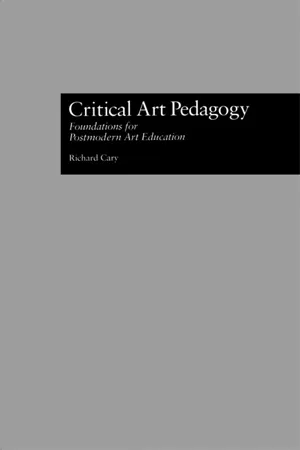
First published in 1998, this work identifies the possibilities, concepts, needs and strategies for radical reform of traditional art education by resituating it within the postmodern paradigm. It advocates continued research to inform theory and practice in art education, providing detailed summaries of new methodologies, such as semiotics and deconstruction. It is clearly sectioned and easy to use which provides an ideal foundation for postmodern art education.
Information
Chapter One
Critical Theory:
A Philosophy for Praxis in Art Education
A Place for Philosophy in Art Pedagogy
Art teachers often detect the gloomy specter of surreal complexity rising up over the prospect of commingling art education and philosophy. They consider philosophy a dark and dry miasma best left to whirl off in its own nebulous obscurities. They prefer that it leave them untouched and unperturbed enough to proceed with the daily routines and rituals of school art instruction. They ascribe to the sentiment attributed to abstract expressionist artist and critic Barnett Newman, “Aesthetics is to artists as ornithology is to birds,” and they gratefully apply it to the philosophy of art education (Hughes, 1971).
But Newman's statement is, of course, a self-fulfilling prophecy. For us art teachers, and especially for our anti-theoretic colleagues, the traditional theory-practice tension appears at first to dismiss the fussy irrelevance of philosophy and thereby invite a full engagement with practical realities. This appearance of engagement in practical reality is, however, a counterfeit pose separating us from layers of meaning and value in practical reality. Further, teachers who insist on this separation of theory and practice tend to occupy subordinate positions in the conclave of hierarchies that define education.
For philosophers, meanwhile, any union of philosophy and art becomes complicated by the overlay of education, a perspective often noted for its oddly intricate, maddeningly desultory generalities. The hybrid philosophy of art education can be a bewildering intellectual apparatus, and any of us who teach art let it hum and buzz quietly in the background, content that it remain just beyond our selective attention while we serve our time on task. We may cast furtive glances in its direction occasionally, hoping for reassurance that what we do as teachers is anchored in some solid intellectual foundation that has been carefully and persuasively laid out by a more knowledgeable ancient race.
The chasm between the philosophy of art education and the practice of teaching art is hardly news. While philosophers philosophize, art teachers teach, each working independently concentrating on matters at hand. The teacher twirls an index finger in loopy circles around one ear in thinly veiled contempt of the theoretician's casuistry. The philosopher-theorist sighs with regret over the waste of pristine concepts misapplied in the mundane classroom. Students in education classes endure perennial reenactments of this scenario so they can reconstruct it accurately when they become teachers.
We can bring some novelty, if not clarity, to this dysfunctional dichotomy by contesting its status as natural. We can suggest that teaching art and philosophizing about teaching art have been unfairly separated, perhaps reflecting by analogy the hiatus between theory and practice in science—as in lab work versus field work. Or, perhaps the philosophy-teaching distinction reflects the management-labor hierarchies in business and industrial organizations. In any event, the schism between teaching art and the philosophy of teaching art probably reflects and protects the typical power structure in schools. Principals, supervisors, curriculum specialists, textbook writers, and other anointed experts are superior; teachers and students are subordinate. A system that devalues the insights and reflections of teachers engaged in living practice consecrates those outside the classroom as Givers of Truth. Those who claim generalized, independent knowledge reify it as rules that govern practice. They also tend to occupy, under the cachet that knowledge provides, prestigious positions in the school bureaucracy over teachers and students who happen to create the particulars of the pedestrian, living knowledge of the classroom.
Education values one form of knowledge over others in education, and the difference creates and supports a hierarchy. Those at the top of the hierarchy want to maintain and, when necessary, flaunt the philosophy on which their power depends. It is easier to maintain this philosophy if it remains closed to question by those in the subordinate positions. One can achieve such a powerful silence in a variety of ways. The hierarchy proceeding from the theory-practice dichotomy appears to be the natural order of things, the common sense position impervious to argument. Or, its tenets can be advertised as so obvious as to lie beyond question: philosophers philosophize; teachers teach. Also, official access to any forum where a philosophy may be contested and changed may be declared off limits to subordinates. Finally, one can hide philosophy by couching it in obfuscating terminology. Professional lingoes confected by arrant jargonauts often serve to camouflage unseen assumptions and other intellectual tools of the trade.
Note in this description of the relationship between teaching art and philosophizing about teaching art, one of the major themes of this book: the underpinnings of the apparent dichotomy between theory and practice are unstable and open to analysis. One should resist accepting the dichotomy as the absolute truth or a fait accompli. Beliefs are postulates, choices, or personal interpretations susceptible to either adoption or rejection. They are subject to inquiry and change, as warranted. Belief and truth differ, even though school bureaucrats may muddle this distinction by presenting belief as truth, especially if it reinforces their power. They also expect subordinates to acquiesce.
We often find belief, truth and power closely associated, with one mistaken for another. The representation of belief as truth in the service of power occurs so often in human experience that we might use the term “truth claims” as more appropriate. It signals the vulnerability in glib testimony to presumed facts. An objective fact can prove to be, in actuality, a subjective insistence designed to achieve a certain end. Skepticism and inquiry about the basis of truth claims and purportedly obvious facts are fundamental rights and, indeed, professional obligations of teachers. After all, teachers and their students make knowledge, and they occasionally find representations of truth to be false as they live daily life in the academy and in all contexts around it.
Belief may have the aura of truth when it has been invested with power, but beliefs may be only strong proposals, heuristic suppositions individuals adopt as means to ends. By analogy, people involved in art usually understand questions of appearance versus illusion, and the ephemeral nature of aesthetic value. Like the relationship among power-belief-truth, the relationship between appearance, illusion, and aesthetic value is organic. A change in one part usually produces changes in the other two.
This book espouses the belief that teachers of art can teach art and philosophize about teaching art. In fact, not only can they philosophize about their practice, but they should do so as a professional obligation as well. Thinking about the reasons for certain practices, opening practices to new possibilities, revealing and redefining the rationales for art teaching practices, and questioning power-belief-truth relationships—all of these exercises can engage teachers of art. The right to reflect or philosophize on the nature of practice should not be an exclusive prerogative of power. But for too many art teachers, philosophizing about practice subverts the status quo. Simply to consider philosophizing is to question the roles and strictures the hierarchy imposes. Contesting versions of truth, belief, and power relations becomes a political act when those versions determine the allocation of resources, value, status, and legitimacy. By reflecting on their practices, art teachers challenge the privileged positions of anonymous, omniscient narrators authorized to dictate art teaching practices and to assign teachers the limited role of delivering instruction, but not the privileges of designing it, changing it, or reflecting on how it ought to be.
As suggested earlier, philosophy, like other disciplines, has developed a difficult, obscure jargon with which to transact its affairs. So has art. The language barrier has been instrumental in the apotheosis of philosophy as a discrete intellectual discipline instead of an essential intellectual activity applicable to all fields. The dynamics of power, belief, and truth operate in intellectual hierarchies just as they do in school bureaucracies. One way to gain access is to examine the traditional, romanticized idea of philosophy as an Olympian realm where some genius philosopher-gods conspire to intercede mysteriously in human affairs. Perhaps “theorizing” should become the word we use for reflecting on personal experience and practice as a way of acquiring and testing our beliefs, everyday decisions, and practices. But as a term for integrating the activity of teaching art with reflection about practices and possibilities of teaching art, “philosophy” seems especially appropriate given its etymology. “Love of knowledge” seems apt so long as we understand knowledge ultimately to be integrated with practice.
The idea of reflecting on practice as a professional responsibility of art teachers is hardly novel, but new perspectives on art and art education emerging from postmodern theories of culture give the idea a new energy. Postmodern thought advocates the provisional, constructed natures of belief, knowledge, and value. It recommends a suspicion of the arrogance inherent in regarding truth claims as objective and timeless. Postmodern thought also questions the implications for and tacit associations of such truth claims with various potentially oppressive power structures that influence human experience.
Note, meanwhile, that the current connotation of the term “philosophy” comes close to the concept of ideology. Historically, “ideology” has carried a pejorative connotation in intellectual circles, perhaps because “ideology” usually means a set of settled beliefs about cultural, social, or political applications—that is to say, the realms of the particular that lie beyond the realm of theory. For Marx, “ideology” meant a false consciousness about socio-political affairs (Colapietro, 1993). But nowadays, we use the word in a more general sense. Ideology addresses the present in an involved way whereas philosophy signals a more remote—and safer—enterprise for power interests. Ironically, the very term “ideology” itself is subject to the political dynamics of truth-power-belief relations.
If we want the work of forming, testing, and reforming the ideological foundations of art education to become a worthwhile component of practice, we must recognize that inventing a philosophy from the ground up may be an impractical alternative for teachers, supervisors, principals, and students. Thus, a useful approach to this project is to adopt contemporary ideologies that reflect concerns about power, belief and truth, while balancing our practical needs with desires to visualize possibilities and then to chart courses toward them. One contemporary philosophy, critical theory, is particularly well-suited for this project.
In the 1992 Handbook of Research on Curriculum, Elliot Eisner reviewed six prominent philosophies that shape the curriculum, one of which is critical theory. While the education community has yet to reach a consensus on its assessment of critical theory, many classroom teachers, professors in colleges of education, researchers, students, and other participants in the educational dialogue agree that critical theory can make important contributions to our understanding and educational practices. As a relatively new school of philosophy, critical theory provides one of the foundations for situating art's place in the schools of the postmodern era. It encourages a revitalized conversation about freedom, knowledge, power, and contemporary culture between participants in the institutions of the art world and art education.
But be warned: this book avoids presenting critical theory as a tightly prescriptive, exclusive philosophy on which to base a completely new form of art education. Instead, critical theory is a particularly useful new resource for enriching understanding and creating new possibilities. As applied to education, critical theory neither suggests nor promotes a specific, unified, instructional methodology or particular curricular content. Instead, a critical pedagogy is a flexible set of propositions aimed at education's function as a means to liberation and justice to be adopted by art learners and art makers in particular places at particular times. A critical arts pedagogy explores ways through which schools can engage the art world to promote these goals.
Meanwhile, all forms of pedagogy based on critical theory are unabashedly idealistic. Critical pedagogy is radical in its advocacy of the democratization of society through education and schooling. Critical pedagogy is, however, ultimately concerned with transforming practices to reach these idealistic ends in particular settings and times rather than building and defending a monolithic body of theory inscribed in erudite treatises then stored on polished bookshelves. It is a philosophy or ideology for teaching more than about teaching. It suggests a philosophical potential students and teachers can actualize in lived experience. Critical pedagogy is more or less compatible with a wide variety of instructional models, curricula and teachers, and is applicable in a wide variety of classrooms.
But the term “critical theory” needs clarification when used in relation to art and the art world. Several years ago, National Geographic ran an article on the frog-eating bat. The next issue included a letter to the editor from an observant reader pointing out that a few years earlier, National Geographic had published an article on the bat-eating frog. A similar twist can accompany discussions of critical theory in the context of art and art education. Critical theory does not refer directly to art criticism or to tasks associated with identifying aesthetic value or meaning in art. Instead, it promotes the search for justice and engages in the promulgation of social criticism with the objective of uncovering implicit sources of oppression in people's lives.
As a philosophy, critical theory engages in social critique as its primary dialogue. This critique develops increased understanding that, in turn, leads to action aimed at a greater realization of the ideals of justice. This very broad description reflects the fact that the scope of critical theory itself is broad. It is more a general theoretical perspective than a tightly constructed, specific methodology aimed at deriving progressively more precise descriptions of some objective truth. Although we can certainly call critical theory a philosophy, it exalts neither logic nor empirical observation as a means to test propositions or generate truth. Rather, it provides an apparatus for understanding social institutions like education and the ideas that surround them, like freedom and justice. In fact, it provides a whole set of tools for carrying out a critical analysis of the meanings and values of past and present human conditions and for exploring possibilities for emancipatory action.
Actually, however, the term “apparatus” might be an inappropriate descriptor for critical theory. We need a more humanistic term, so a better metaphor to describe its two major components might be “heart” and “mind.” The heart of critical theory is its concern for social justice through the empowerment and emancipation of the oppressed. The mind of critical theory has several central beliefs guiding its concerns. It accentuates openness to new and diverse forms of knowledge. It promotes awareness of hidden means of oppression. It rejects the culture of positivism and accepts the idea that facts and values are indivisible. It holds that knowledge is socially constructed and that knowledge and power are related.
The Heart of Critical Theory
To describe the idealism that informs the motives and objectives of critical theory, Peter McLaren (1989) appropriated the Hebrew symbol, tikkun, which means “to heal, repair, and transform the world.” Most critical theorists see our society's realities as starkly contrasted to our professed democratic ideals. Instead of functioning as an actualized democracy, our society is a complex hierarchy of groups formed by the uneven distribution of power. The interests of those with greater power compete with the interests of those with less, which results in the marginalization and oppression of the powerless. The heart of critical theory despises and hopes to change this asymmetrical social class structure. Further, critical theory addresses the problems of unequal social classes in an impassioned, often confrontational manner. Tension inevitably arises when one addresses the issue of power.
In her essay “Teaching the Rich,” critical art historian Carol Duncan (1993) challenged the elitist versions of art history and aesthetic value that the art curricula of prestigious liberal arts colleges—the so-called “good schools”—typically present. She noted that the practices of the good schools become models for other schools in a progression that finally presents art as insulated from social forces. The subsequent restriction placed on access to art education limits aesthetic consciousness and artistic knowledge as an intellectual privilege reserved for the elite. With biting sarcasm, Duncan critiqued elitist art pedagogies as sanctuaries from the vulgarities of a philistine society in which art represented sacred respite for the privileged. A primary function of elitist art pedagogies is to preserve this privilege by rigidly defining and vigorously defending the sanctuary walls.
Deborah P. Britzman discussed critical confrontation in her essay, “Decentering Discourse in Teachers Education: Or, the Unleashing of Unpopular Things,” (in Weiler and Mitchell, 1992). She reflected on the “scariness” critical pedagogy evokes as it identifies the distorting effects of authoritative discourse, contests power, crosses boundaries, and brings students to greater understanding by inviting them to actually experience these “unpopular things” firsthand. Critical pedagogy posits the classroom as a site where students and teachers can examine and question. Decentering the status quo can sometimes produce an uncomfortable classroom, a somewhat less than cozy place for politely discussing safe ideas within the schooling and art boundaries power interests draw.
It may appear that at its heart, critical theory lives on anger and fatalism. Anger, yes; fatalism, no. In critical theory-based considerations of social problems and their relationships to art and education, burns an unmistakable, entrenched anger. But this anger becomes hope when tempered by critical consciousness and understanding. Henry Giroux (1992) cautioned against focusing too narrowly on the reproduction element of critical theory. A new awareness of how schools and other institutions reproduce unjust social structures tells us what to oppose, but not what to embrace. Giroux believes that in pursuing a preoccupation with how the schools reproduce oppressive social structures, we risk a “discourse of despair.” He proposed a concept of teaching based on critical theory that includes the creation of a more hopeful dialogue focused on developing new possibilities.
Suzi Gablik's (1991) call for remythologizing art presented an excellent example of a language of hope and possibility for critical art pedagogy. In her book, The Re-enchantment of Art, she encouraged the development of a more socially and ecologically interactive context for art by reopening art to the realm of spirituality through engagement in rituals and myths that promote relatedness among people. Her new agenda for art would stress community over self interest, ecstasy over disinterested aesthetic contemplation, and contextualized value over autonomy of the art object. She underscored the important roles for compassion and concern as “tools of the soul” that in concert with the spirituality of myth and ritual will construct an art world characterized by an aesthetics of radical relatedness.
In addition to its dialogue of hope and possibility, critical pedagogy discourages fatalism by advocating focused action. As an alternative to fatalistic acquiescence to schooling's reproduction of repressive s...
Table of contents
- Front Cover
- CRITICAL ART PEDAGOGY
- Title Page
- Copyright
- Dedication
- Table of Contents
- Half Title
- Chapter One Critical Theory: A Philosophy for Praxis in Art Education
- Chapter Two A Critical History of Art Education: Dangerous Memories and Critical Consciousness
- Chapter Three Describing the Individual Art Student: Psychologies for Critical Art Pedagogy
- Chapter Four Creating Dangerous Knowledge: Semiotics, Deconstruction, and Qualitative Methodology
- Chapter Five Aesthetics for Critical Praxis
- Chapter Six Models for Practice: Prescriptive Grand Narratives or Potential Resources for Critical Art Pedagogy?
- Chapter Seven Disconnecting from Modernism, Connecting to Postmodernism
- Resources
- Index
Trusted by 375,005 students
Access to over 1.5 million titles for a fair monthly price.
Study more efficiently using our study tools.
Frequently asked questions
Yes, you can cancel anytime from the Subscription tab in your account settings on the Perlego website. Your subscription will stay active until the end of your current billing period. Learn how to cancel your subscription
No, books cannot be downloaded as external files, such as PDFs, for use outside of Perlego. However, you can download books within the Perlego app for offline reading on mobile or tablet. Learn how to download books offline
Perlego offers two plans: Essential and Complete
- Essential is ideal for learners and professionals who enjoy exploring a wide range of subjects. Access the Essential Library with 800,000+ trusted titles and best-sellers across business, personal growth, and the humanities. Includes unlimited reading time and Standard Read Aloud voice.
- Complete: Perfect for advanced learners and researchers needing full, unrestricted access. Unlock 1.5M+ books across hundreds of subjects, including academic and specialized titles. The Complete Plan also includes advanced features like Premium Read Aloud and Research Assistant.
We are an online textbook subscription service, where you can get access to an entire online library for less than the price of a single book per month. With over 1.5 million books across 990+ topics, we’ve got you covered! Learn about our mission
Look out for the read-aloud symbol on your next book to see if you can listen to it. The read-aloud tool reads text aloud for you, highlighting the text as it is being read. You can pause it, speed it up and slow it down. Learn more about Read Aloud
Yes! You can use the Perlego app on both iOS and Android devices to read anytime, anywhere — even offline. Perfect for commutes or when you’re on the go.
Please note we cannot support devices running on iOS 13 and Android 7 or earlier. Learn more about using the app
Please note we cannot support devices running on iOS 13 and Android 7 or earlier. Learn more about using the app
Yes, you can access Critical Art Pedagogy by Richard Cary in PDF and/or ePUB format, as well as other popular books in Education & Education General. We have over 1.5 million books available in our catalogue for you to explore.