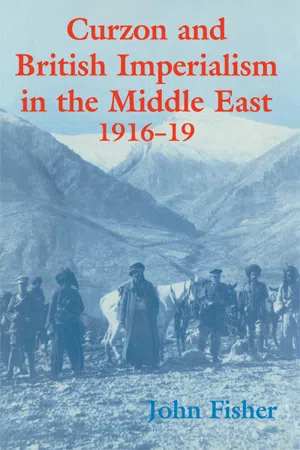
John Fisher explores the acquisitive thinking which, from the autumn of 1914, drove the Mesopotamian Expedition, and examines the political issues, international and imperial, delegated to a War Cabinet committee under Lord Curzon. The motives of Curzon and others in attempting to obtain a privileged political position in the Hejaz are studied in the context of inter-Allied suspicions and Turkish intrigues in the Arabian Peninsula. This is a penetrating study of war imperialism, when statesmen contemplated strong measures of control in several areas of the Middle East.
EARLY IN FEBRUARY 1915, a light cruiser of the British East Indies Station might have been observed dropping anchor off Alexandretta. In the following days landing parties would proceed to liaise with Turkish troops and with the British Consul and to execute various reconnaissance tasks. Among the party, acting in an intelligence capacity, was Captain Aubrey Herbert MP,1 a well-connected and linguistically gifted Turkophile of aristocratic stock. Although it was Herbert’s first experience of Ayas Bay, in mid-December HMS Doris had already undertaken operations there against Turkish communications.2
Writing in January, Herbert had recorded his belief that France should not be permitted to fulfil her traditional imperial aims in Syria but that Syria should instead be independent.3 If, however, as Herbert continued, Syria ‘chooses to come to Egypt offering herself as a satrapy’ then ‘well and good’.4 In any event Herbert felt that Britain should occupy Alexandretta. This conviction was strengthened by a rumoured French expedition to Syria and by suggestions that the Cilician Armenians who wanted British protection were, by default, turning to Russia.5 Herbert was convinced that Britain should immediately occupy Alexandretta, a ‘beautiful position’, and that Russia, who, according to the British Consul at Alexandretta, a Mr Catoni, was seen by Turks as the real enemy, might instead have Mersina.6 Herbert believed that the possession of Alexandretta was a vital calculation in St Petersburg, where, in all likelihood, it was realised that Constantinople would be hers anyway, and as developments might conspire to undermine her traditional preponderance in the Balkans.7 This, Herbert argued, would ‘produce a reactionary effect on Russian policy’, and encourage Russian expansion elsewhere.8 Whilst Constantinople could only ever be a ‘passive and defensive’ port for Russia, Alexandretta could not be surpassed as an ‘active and offensive’ Russian port.9 Russia’s difficulty was justifying its acquisition. For Britain, however, as Herbert remarked, ‘it is almost an essential part of British strategy to seize the key hole of the enemy’s door’.10 Failing an immediate British occupation while Turkish attacks on the Suez Canal persisted then, Herbert argued, ‘our opportunity is lost, for the occupation of Alexandretta would then become a move against Russia instead of a move against Turkey’.11 A temporary British occupation would, in Herbert’s view, at least afford Britain the requisite bargaining power to render Alexandretta neutral.12
The despatch of HMS Doris to Alexandretta was part of a broader strategy evolved at the end of 1914 by the Admiralty, undertaken concurrently with investigations on the possibility of sizeable landings at Alexandretta. These would aim ostensibly to disrupt Turkish communications but might also save face should the initial bombardment of the Dardanelles prove unsuccessful. Early in 1915 the General Staff estimated that 13,000 men would be required to capture the Bailan Pass and then secure field works in the surrounding area.13 Should it then be necessary to capture Aleppo, as a means of holding the Baghdad Railway, more than a division would be necessary.14
Herbert was not the only British officer with experience of the Middle East who enthused about the occupation of Alexandretta, yet there were others whose strategic analysis, though similar to Herbert’s, was more fully developed.15 To Ronald Storrs, Oriental Secretary at the British Agency in Cairo, it seemed, early in February 1915, that Britain must occupy Alexandretta to forestall the almost inevitable southward movement by Russia and the extension of French claims to areas outside the Lebanon.16 Although, as Storrs had previously acknowledged, France would be a better neighbour for Britain than Russia, he also recognised that the Entente might not last.17 At the end of 1914 Storrs felt that the inclusion within the Egyptian Protectorate of part of Palestine might provide some protection from potentially hostile interests, but he soon evolved more expansive desiderata.18 A British occupation of Alexandretta would be a legitimate undertaking by virtue of Turkish operations against Egypt and British operations in Mesopotamia. However, given French disinclination to substantiate her Syrian claims, Storrs believed that the permanent occupation of Alexandretta by Britain would also ‘ensure the settlement of the Syrian question to our advantage in due course of time’.19 Writing later in February, Storrs emphasised the importance of Syria to Britain, suggesting ‘it is not only a goal per se but also a necessity both with regard to Irak and the Arabian peninsula’.20 On 8 March, while feigning innocence amid warnings from Sir Edward Grey, the Foreign Secretary,21 that the encouraging of British ambitions in Syria would lead to ‘a break with France’, Storrs evidently cherished the idea of a ‘Near Eastern Vice-royalty’ under Kitchener, stretching from the Sudan to Alexandretta.22 With France ‘directed into channels of profit and consolidation in West Africa’ and Russia installed in Constantinople, Britain, in Storrs’s view, would have free scope for expansion.23
Taking up the cudgels at the War Council on 10 March, Kitchener opposed Grey’s sensibilities about French ambitions in Syria by arguing that Alexandretta lay beyond areas of traditional French claims.24 As Asquith, the Prime Minister, indicated, if, as was assumed, Russia was to obtain Constantinople, then there were, in the opinion of the Admiralty, strong reasons for a British Naval Base at Alexandretta.25 Besides the importance to Britain of maintaining naval supremacy Kitchener was emphatic that, with Alexandretta controlled by another power, Britain could neither count on holding Egypt nor could she maintain her new dependency in Mesopotamia.26 There was also, as suggested by Lord Fisher, First Sea Lord,27 the question of Alexandretta as the outlet for the oil supplies of Mesopotamia and Persia.28
Kitchener believed that the possession of Syria by France and Constantinople by Russia would not lead inevitably to a permanent peace with Britain. In particular, he was convinced that traditional schemes of Russian expansion towards the Persian Gulf would continue. Developing his thoughts in a note entitled ‘Alexandretta and Mesopotamia’, Kitchener argued that it was precisely with the thwarting of such expansionism in mind that Britain should occupy Alexandretta. Similarly, Kitchener felt that if Britain did not ‘take’ Mesopotamia then Russia would and this, as he continued, ‘would give them an outlet into the Persian Gulf, and enable them eventually to control the military situation and the greater part of its commerce’.29
Such a contingency arising on the division of the Ottoman Empire would, in Kitchener’s opinion, fatally undermine British prestige.30 Rather than ceding Mesopotamia to Russia, its possession by Britain was necessary for the creation of a great Arab kingdom ‘bounded on the north by the valley of the Tigris and Euphrates, and containing within it the chief Mahommedan Holy Places, Mecca, Medina, and Kerbala’.31 Precisely the same point about prestige or ‘moral ascendancy’ was developed in an Admiralty paper of 17 March. Given that Russia was being established ‘in the most famous seat of Empire in the East’ and that Britain was ‘allowing her to clothe herself in all the majesty of Rûm’, Britain, as the Admiralty paper suggested, must seek compensation elsewhere:
And where can such compensation be found in anything like so much force as in reviving the still more ancient seat of empire in the Middle East? We must play Babylon against Byzantium. But this cannot be done by merely occupying and bringing to life again the old Mesopotamia. The ancient empire must not only be restored to its wealth, it must be brought to the shores of the Mediterranean. The war is teaching us that the Mediterranean is still, as it always was, the centre of world politics, and it is there we must establish the gate of our new acquisition as a counterpoise to the new weight that Russia is acquiring in the dominant area.32
At the India Office, Sir Arthur Hirtzel,33 the formidable and highly regarded Secretary of the Political and Secret Department, though sharing Kitchener’s reluctant belief that Britain would probably have to be coterminous with Russia, also wished, ideally, to be able to hold the Alexandretta-Mosul line.34 A more realistic policy seemed to Hirtzel to attempt to control Alexandretta but not to contemplate the defence of that line.35 The main purpose of such control would be to prevent the construction of the section of the Baghdad Railway between Alexandretta and Mosul should Britain complete the line between Mosul and the Persian Gulf.36 This was vital not only with a view to preventing a Russian movement towards the Gulf but, as argued by Admiral Jackson, to impede both a revival of German designs on Persia and a hostile French movement on the Euphrates Valley.37 Furthermore, Hirtzel felt that British possession of Alexandretta or the creation of a free port there would provide an outlet for Northern Mesopotamian trade without affecting, disadvantageously, the traditional orientation of Indian trade in the Persian Gulf.38
Kitchener attached such importance to the acquisition of Alexandretta because he believed that its possession represented the lynchpin in a broader strategy evolved by himself and Storrs, whereby the Khalifate would be transferred to Arabia and a substantial Arab Empire would emerge under British auspices. This, as Kitchener argued at the War Council on 19 March, would prevent the Khalif from falling into Russian hands, something with potentially disastrous consequences for Bri...
Table of contents
Front Cover
Half Title
Title Page
Copyright
Contents
List of Maps
List of Illustrations
Abbreviations
Acknowledgements
Introduction
1 Playing Babylon against Byzantium
2 The Mesopotamian Administration Committee
3 Arabian Matters
4 Britain, Mesopotamia and the Middle East, 1918
5 The War for Mastery of Asia
6 From the Turkish Armistice to the Foreign Office: ‘All the Pieces on the Table’
Conclusion
Appendices
Bibliography
Index
Trusted by 375,005 students
Access to over 1.5 million titles for a fair monthly price.
Study more efficiently using our study tools.
Frequently asked questions
Yes, you can cancel anytime from the Subscription tab in your account settings on the Perlego website. Your subscription will stay active until the end of your current billing period. Learn how to cancel your subscription
No, books cannot be downloaded as external files, such as PDFs, for use outside of Perlego. However, you can download books within the Perlego app for offline reading on mobile or tablet. Learn how to download books offline
Perlego offers two plans: Essential and Complete
Essential is ideal for learners and professionals who enjoy exploring a wide range of subjects. Access the Essential Library with 800,000+ trusted titles and best-sellers across business, personal growth, and the humanities. Includes unlimited reading time and Standard Read Aloud voice.
Complete: Perfect for advanced learners and researchers needing full, unrestricted access. Unlock 1.5M+ books across hundreds of subjects, including academic and specialized titles. The Complete Plan also includes advanced features like Premium Read Aloud and Research Assistant.
Both plans are available with monthly, semester, or annual billing cycles.
We are an online textbook subscription service, where you can get access to an entire online library for less than the price of a single book per month. With over 1.5 million books across 990+ topics, we’ve got you covered! Learn about our mission
Look out for the read-aloud symbol on your next book to see if you can listen to it. The read-aloud tool reads text aloud for you, highlighting the text as it is being read. You can pause it, speed it up and slow it down. Learn more about Read Aloud
Yes! You can use the Perlego app on both iOS and Android devices to read anytime, anywhere — even offline. Perfect for commutes or when you’re on the go. Please note we cannot support devices running on iOS 13 and Android 7 or earlier. Learn more about using the app
Yes, you can access Curzon and British Imperialism in the Middle East, 1916-1919 by John Fisher in PDF and/or ePUB format, as well as other popular books in History & Middle Eastern History. We have over 1.5 million books available in our catalogue for you to explore.