eBook - ePub
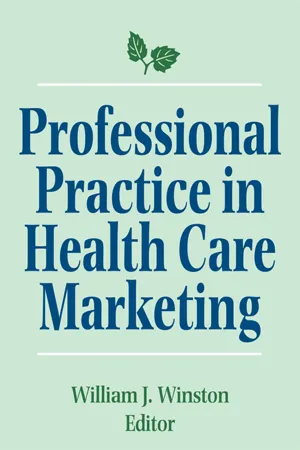
Professional Practice in Health Care Marketing
Proceedings of the American College of Healthcare Marketing
- 224 pages
- English
- ePUB (mobile friendly)
- Available on iOS & Android
eBook - ePub
Professional Practice in Health Care Marketing
Proceedings of the American College of Healthcare Marketing
About this book
This informative volume introduces the most current standards for practicality and professionalism in health care marketing. Major health marketers reveal state-of-the-art applications and activities that will keep you on the cutting edge of this growing specialty.
Information
Developing Effective Public Relations Activities
David R. Norcross
It's good to be with you folks today in such a beautiful setting.
My aim today is to help you understand how the public relations component within your organization can set the tone and carry the message and build the hospital's identity within its various target audiences.
I will be using case studies representative of recent campaigns and programs in Virginia hospitals. But before we begin, let's take a moment to look at the role of the PR practitioner within the hospital setting—it has changed quite a bit in recent years.
No longer is this person considered just the wordsmith and responsible for newsletters, press releases, or community speaking engagements. Just the same within the health care setting, there is often confusion as to what the role of the public relations practitioner is in today's competitive health care environment. Confusion between terminologies such as publicity, promotion, public relations, and marketing often exists. However, some basic definitions have now emerged:
- If you put up a sign about the circus coming to town, that's Advertising.
- If the circus arrives and you have the elephants parade through town, that's Promotion.
- If the elephants walk through the mayor's flower bed, that's Publicity.
- If you can make the mayor smile about it, that's Public Relations.
- Now, if you poll the community and identify the Governor as having the most draw to surrounding communities, thus maximizing return on concession sales—that's Marketing.
David R. Norcross is Director of Public Relations, The Alexandria Hospital, 4320 Seminary Road, Alexandria, VA 22304.
Now, on the serious side, what I hope to do today is to share with you some examples of the public relations and marketing practices that are currently going on in our Virginia hospitals. The case studies that I'm going to use for these illustrative purposes were selected from several hundred Virginia entries within the Measure of Excellence and Best in the East competitions of the Virginia Society for Hospital Public Relations and Marketing (VSHPRM). My regret is that I could not have shared more programs with you in the limited time that we have today. Indeed, Virginia hospitals are innovative in their approach to improving the hospital's image in a competitive marketplace through the development of programs and services which have a direct bottom line impact.
What I will be sharing with you is a medley, so to speak, of different types and intensities of public relations—marketing programs that range from basic identity campaigns to the repackaging of products and services to better meet consumer demands.
MARY IMMACULATE HOSPITAL
My first example is Mary Immaculate Hospital and its repackaging of a day surgery program to capture increased market share and improved utilization.
Now, Mary Immaculate had been very successful with its ambulatory surgery program. The number of procedures performed in 1982 had increased 33 percent over 1981 and represented 30 percent of the surgical procedures done at the hospital. This trend continued during the first quarter of 1983. On a market share basis, Mary Immaculate performed 11 percent of the outpatient surgery in the area even though they had only 8.9 percent of the available beds.
Given the moderating growth trend in utilization in other Mary Immaculate services, ambulatory surgery represented a critical segment of the hospital's business.
Problem: Then in March, 1983, circumstances changed. One of the investor-owned hospital chains announced its plans to establish a free-standing ambulatory surgery center, located in Mary Immaculate's primary service area. What's more, the center had the backing of a group of surgeons who were heavy users at Mary Immaculate, and they planned to capture 25 percent of the market share with outpatient surgery.
But it gets worse! Within a matter of weeks, Mary Immaculate's major competitor announced that they too would open a free-standing ambulatory surgery center.
However, with all problems come opportunities! Mary Immaculate chose to take a positive approach to this competitive situation. A multi-disciplinary team was formed and charged with taking advantage of the marketing opportunity. The chief executive officer at the time, Roger Neathawk, served as chairman for this task force which included administration, the public relations director, nursing, the chief financial officer, and admissions manager. Given the value and importance of physician input, the chiefs of surgery and anesthesia were named as advisors to the group.
The task force defined its job as four-fold—first, compile a data base including internal/external assessments, basic consumer market research, and industry trends; second, analyze the strengths, weaknesses, opportunities, and threats (S.W.O.T.s in marketing jargon); third, prepare a marketing plan; and fourth, implement the marketing plan.
Two primary marketing objectives were established. The primary objective was to achieve a 10 percent increase in the number of ambulatory surgery procedures. A secondary objective was to establish a solid position within the targeted audience, prior to the opening of the other free-standing centers. It meant Mary Immaculate would have to work fast, since the first competing hospital center was scheduled to open in November of that year.
An additional aim was to demonstrate that Mary Immaculate was taking positive action in reducing the rising costs of health care. Market research had clearly indicated concern by all consumer groups with the cost of health care, and these consumers indicated that charges would be one of the most important factors influencing their decisions in choosing the place for the surgery.
Who were the marketing targets? Physicians, Residents, Major Employers, Current Patients, and last but not least, the hospital's own staff and volunteers.
The market position was identified as the ambulatory surgery facility with the advantage of both free-standing and hospital based programs. Now let's focus on the strategy—following the four Ps model—Product, Place, Price, and Promotion.
With the Product, market research revealed the hospital already had an excellent product on which to build a new program, with the competency and cooperativeness of staff clearly identified as strengths by patients and physicians. This meant Mary Immaculate needed to focus on enhancements to the existing services. Changes made to the product predicted on a S.W.O.T. analysis (Strengths, Weaknesses, Opportunities, and Threats) included the following:
- The facility needed to be enlarged to eliminate crowded conditions, as well as to handle the increased utilization anticipated;
- The area needed to be divided into pre- and post-operative holding areas;
- The decor needed to be improved;
- Medical paperwork requirements needed to be simplified, and the physician scheduling process needed to be streamlined;
- The patient registration process needed to be improved, with upgraded information materials for patients.
A new feature added to the product was follow-up phone calls to patients on the day following surgery. A patient questionnaire was also distributed upon discharge.
The second P—Place—construction of a free-standing center was considered but ruled out due to lack of capital and time. Furthermore, market research had strongly supported Mary Immaculate's decision to utilize existing facilities. Population statistics demonstrated the hospital was already in the right place and the current operating rooms were not fully utilized.
And lastly, Mary Immaculate had an advantage that the freestanding centers could not provide—the safety and assurance provided by a full service hospital.
Our next P—Price—as noted earlier, consumer groups had indicated charges would be one of the most important factors influencing their decisions. No matter what changes were made to the other components of the marketing mix, price had to be aggressively addressed if outpatient surgery was to prove successful. A new pricing methodology was adopted which had two important features: (A) a flat fee (all inclusive) for each outpatient surgery procedure; and (B) the fee on the average was 25 percent less than previously charged by the hospital for outpatient surgery.
And lastly, our final P—Promotion—with the product, place, and price components of the marketing mix determined, Mary Immaculate then moved to design an aggressive promotion program. To distinguish the product from the competitors, a new handle or name was created—Daysurgery—with its own distinctive logo. Each target audience was identified separately. The promotional program under the direction of Susan Dubuque, Director of Public Relations, was targeted to specific audiences.
With physicians and their office staffs, Mary Immaculate had a head start. Throughout the planning process, physicians had been kept informed. Each office staff member received a physician manual explaining specific components of the program as well as a supply of patient brochures—these were delivered individually by designated hospital representatives.
And as a final touch, each physician who used the service during the inaugural month received a personalized acknowledgment letter for his support.
Promotional efforts to consumers would allow Mary Immaculate to capitalize on a reduced charges strategy and set their tone as the hospital concerned with health care costs. The news media and related publications were chosen as the vehicle for carrying this message.
Besides releases, a series of three advertisements were designed and run in print media following the opening of the revitalized service. A testimonial approach was taken in that each ad featured a former Mary Immaculate ambulatory surgery patient—a protestant minister, a local fireman, and a child (whose parents were both physicians).
The copy highlighted the advantage of the outpatient surgery and stressed the reasons for selecting Mary Immaculate. An additional component for the communications strategy to the community was the development of “point of sale” literature racks to hold DaySurgery brochures.
With major employers, promotion was handled on an individual basis. Hospital representatives were asked to make contact at medical business coalition meetings and secure appointments with company representatives.
For the patients using the service, the hospital relied on the patient brochure explaining the personalized service at a reduced price, a follow-up phone call to each patient, and a patient questionnaire.
The last target audience for promotion was the hospital staff and volunteers. Both a procedure manual and orientation program assisted in making the employees salespersons for the service and avoided having a patient arrive at the information desk and encountering an individual unfamiliar with DaySurgery.
In summary, Mary Immaculate's new ambulatory surgery service was made known to the targeted audiences in a well-planned, coordinated, and comprehensive promotion program.
What we've discussed so far has focused on the initial marketing research, the program—product development and refinement—and lastly, the communication tools used. I'm sure you'll be interested in knowing how successful the program was.
In the first eleven months following the introduction of the repackaged product, there was a whopping increase of 116 percent over the previous full year's ambulatory surgery. This far exceeded the primary objective of 10 percent.
Other than increased utilization, there is an additional measure of patient satisfaction with the service. A tabulation of the patient questionnaires resulted in showing a patient satisfaction level of 4.8 on a scale of 5. Employer reception to the program has provided one of the most gratifying and successful outcomes for Mary Immaculate. For example, Newport News Ship Building, located in the same area as the hospital, employs 28,000 people. In an unprecedented action, they sent a letter to each of their employees endorsing the DaySurgery program and encouraging its use.
And lastly, from a budget perspective, the total promotional expenditures were only $16,000. This expenditure was far surpassed by the additional revenues generated. Mary Immaculate's DaySurgery program serves as an excellent illustration of how a multi-disciplinary task force can focus on repackaging a product to meet competitors’ threats and successfully introduce the newly designed product into the marketplace.
ALEXANDRIA HOSPITAL
I would now like to share with you a public relations program aimed at “problem prevention” or, perhaps, “crisis prevention.” This program is special because it demonstrates the importance of involving your P.R. people from the very beginning for any programmatic or organizational change that affects the public.
The Problem: In 1983, the Alexandria Hospital Board of Directors began to examine the possibility of restructuring the legal organization of the hospital with the eventual goal of diversifying hospital revenues. By early 1983, the Board was committed to reorganization in concept, and set about developing a proposal that would be presented to the Corporate Membership for adoption.
From the outset, the Public Relations Department participated in a task force assigned to formulate new bylaws and pave the way for their acceptance. In particular, the Public Relations Department was called upon to coordinate a communications campaign to inform various hospital audiences as to the “whys and wherefores” of corporate restructuring and to smooth the way for adoption of the proposal. Specifically, Public Relations was to address two primary fears regarding restructuring and diversification: (1) Community control of the private, not-for-profit hospital would be diminished or abolished; (2) The hospital and patient care would become incidental to, rather than the central focus of, the diversified organization.
Objectives: The P.R. Department identified four internal target audiences and three external audiences which would be affected by the proposed reorganization. Since the relationship of each audience with the hospital is distinct, objectives were developed for each.
Internal Target Audiences
Corporate Membership: This group of almost 700 residents of Alexandria and surrounding communities, represent a spectrum of outlooks and professions—businessmen, professionals, educators, homemakers, retirees. A substantial number are physicians, who sometimes view issues from their perspective as a private practitioner rather than a community resident and consumer.
Thru its powers to elect the Board of Directors and to vote on articles of incorporation and bylaws, the Corporate Membership represents the community as the driving force and poli...
Table of contents
- Front Cover
- Half Title
- About the Editors
- Title Page
- Copyright
- Contents
- Professional Practice in Health Care Marketing
- Preface
- Mission and Future Applications of the Proceedings
- Health Care Marketing—A Service Marketing Approach
- Integrating the Marketing Function: A Model for Strategic Management
- Fostering Organizational Synergy for Marketing: Practical Issues and Perspectives
- “Nothing Happens Unless Someone Buys Something” Identifying and Responding to Your Customers’ Communication Style
- Developing a Marketing Function in a Multi-Hospital System: How to Define Your Job
- Internal Marketing for Hospitals
- Physician Manpower Development: How, When and Where to Grow Your Medical Staff
- Hallmarketing Patients
- Health Services Marketing Accountability = Tracking Your Marketing Efforts
- The Healthcare Account Executive—A Sales Approach to Healthcare Marketing
- The Marketing Audit—A Strategic Necessity: Marketing Management for the Mature Non-Profit
- Knowledge Is Power: How to Develop Effective Market Surveys
- Hospital Advertising: Pitfalls to Avoid Opportunities to Seize
- Promoting Your Function as Well as Your Product: How to Become Your Own Ad Agency
- What They See Is What You Get: Marketers Perspective on Hospital Advertising
- Planning and Executing a Successful Emergency Medical Card Campaign
- A Case Study of a Successful Ambulatory Surgery Marketing Program
- Marketing Medicine Through a Major Event
- Freestanding Imaging Centers: Friend or Foe?
- The Direct Marketing of Physician Services to the Public
- How to Become Local Businesses’ Favorite Hospital
- Community Education as a Marketing Tool for Your Hospital
- Developing Effective Public Relations Activities
Trusted by 375,005 students
Access to over 1.5 million titles for a fair monthly price.
Study more efficiently using our study tools.
Frequently asked questions
Yes, you can cancel anytime from the Subscription tab in your account settings on the Perlego website. Your subscription will stay active until the end of your current billing period. Learn how to cancel your subscription
No, books cannot be downloaded as external files, such as PDFs, for use outside of Perlego. However, you can download books within the Perlego app for offline reading on mobile or tablet. Learn how to download books offline
Perlego offers two plans: Essential and Complete
- Essential is ideal for learners and professionals who enjoy exploring a wide range of subjects. Access the Essential Library with 800,000+ trusted titles and best-sellers across business, personal growth, and the humanities. Includes unlimited reading time and Standard Read Aloud voice.
- Complete: Perfect for advanced learners and researchers needing full, unrestricted access. Unlock 1.5M+ books across hundreds of subjects, including academic and specialized titles. The Complete Plan also includes advanced features like Premium Read Aloud and Research Assistant.
We are an online textbook subscription service, where you can get access to an entire online library for less than the price of a single book per month. With over 1.5 million books across 990+ topics, we’ve got you covered! Learn about our mission
Look out for the read-aloud symbol on your next book to see if you can listen to it. The read-aloud tool reads text aloud for you, highlighting the text as it is being read. You can pause it, speed it up and slow it down. Learn more about Read Aloud
Yes! You can use the Perlego app on both iOS and Android devices to read anytime, anywhere — even offline. Perfect for commutes or when you’re on the go.
Please note we cannot support devices running on iOS 13 and Android 7 or earlier. Learn more about using the app
Please note we cannot support devices running on iOS 13 and Android 7 or earlier. Learn more about using the app
Yes, you can access Professional Practice in Health Care Marketing by William Winston in PDF and/or ePUB format, as well as other popular books in Commerce & Commerce Général. We have over 1.5 million books available in our catalogue for you to explore.