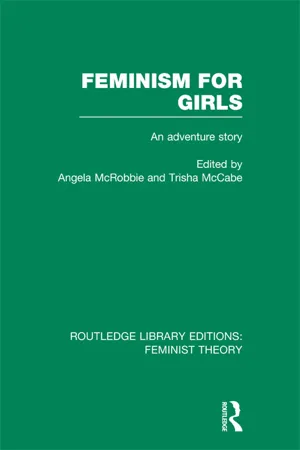
Feminism for Girls presents feminist perspectives on aspects of adolescence which have been chosen for their special relevance to the lives and experiences of girls and young women today. Illustrated throughout, chapters cover themes and topics which include romance and sexuality, girls' magazines, careers and the reality of being a black girl in society today. Housewives look back at their youth and a sixteen-year-old girl writes vividly about what it's like trying to break out of the mould that parents and others so often expect for girls. This book is written for girls and young women themselves and for people who are, like the contributors, currently teaching or working with girls.
eBook - ePub
Feminism for Girls (RLE Feminist Theory)
An Adventure Story
- 224 pages
- English
- ePUB (mobile friendly)
- Available on iOS & Android
eBook - ePub
About this book
Information
1 Introduction
Angela McRobbie and Trisha McCabe
Illustrated by Phil Goodall
Dangerous girls!
To the world at large it might seem a bit strange, linking the Women's Liberation Movement and feminism with ideas of adventure. Hardly surprising, when most of the mass media do their best to reduce anything to do with women's liberation to the antics of a minority fringe group. As far as they are concerned, we are all dull, boring, and quite united in our lack of humour. With this kind of publicity to contend with, it does indeed take an adventurous girl to give feminism more than a second thought. But what exactly is the basis of this war waged on women who refuse to conform to society's image of how women should look and act and be? This is a question that touches on the whole way in which sex and gender are understood in our culture. It also relates to the way in which any challenge to the patriarchal status quo is greeted with fear and dismay if not outright terror. In this sense it is possible to interpret these stereotypical characterisations of feminism and feminists (bearing grudges, unpopular with the boys) as something which is created right across a range of institutions, precisely as a response to this threat, and as a clearcut defence of patriarchy — the power of men over women. If the women who challenge this power, who question the inevitability of their own subordination and the ‘naturalness’ of their inferiority, are reduced to a group of eccentrics, then half the battle is won. The threat is deflected and diluted — what woman in her right mind would want to join with this mob? Yet such unrelenting ridicule suggests something deeper. The fears, perhaps, of a patriarchy which is somehow beginning to lose its grasp, but doesn't know quite where to put the pressure on. The easiest way to deal with it is to hit back wildly, caricature it, trivialise it . . . and then hope it goes away. This anti-feminist promotional campaign depends then on transforming some of its representatives, those women who are no longer captured by suave masculinity, by machismo and charisma and charm (‘your sex life complications are not my fascination’ as the song by Grace Jones puts it), into ‘unfeminine’ oddballs, women who are going against nature.

The problem for us is that these vindictive images do feed into popular (mis)conception, they do penetrate consciousness and create prejudices. Two recent examples of this will suffice. At an interview for a job, one gentleman thought he was paying me a compliment: ‘You don't look like someone who bears grudges,’ he said, ‘do you have a happy personal life, are you a’ (nervous cough) ‘a, women's libber?’ Even more obvious was the uproar surrounding newsreader Anna Ford's claim that ‘body fascism’ was virulent in television and ensured that only young and attractive women got jobs and succeeded, where such criteria simply were not relevant for men. The popular press took this comment, made at a Women In The Media conference, as an insult to men and to themselves as indeed it was intended. They responded in terms of ‘how dare she bite the hand that feeds her’, and then resorted to suggesting that ‘she's got a nerve to speak’, and then the usual, ‘She's got extremely large hands and a big bottom.’ So she's not really so ‘feminine’ after all! Later that week on television Robert Robinson mocked her, ‘Whatever next?’ he said, ‘Plain women reading the news!’
But there is something more to this than just a childish ritual exchange of insults. For so many years any kind of media recognition, any kind of visual publicity, has been the epitome of success for a woman. ‘Getting your picture in the paper’; whether as actress, model, television presenter or pop singer, the result has been the same. Made-to-measure images, glamour, smiles and ‘thank you very much, I owe this all to my manager, my producer, or to the talent scout who saw me on “Opportunity Knocks” ‘, and so on. Women have been so flattered to succeed in these spheres that they have rarely dared to voice any complaints that they may have. Until recently they haven't ever publicly challenged the authority which has kept them in their places and which continually reminds them that there is always a large army of eager young women just dying to take their place. So when one of these figures does articulate her exasperation, not only is she risking her career, she is also directly accusing all those men who work around her. And she can be assured of having a far from easy future with them. Fortunately, she's not quite alone. The fact that Anna Ford made these statements at a Women In The Media conference, and that she has the support of this group behind her, is evidence enough of this. So perhaps patriarchy, in this case the media, really does have something to fear. For example, the tabloids may resist it wherever they can, but women's magazines have changed. They have been influenced by ideas from the Women's Movement and they no longer depict women as only housewives, only dolly birds. Controversial issues, previously avoided by magazines like Woman and Woman's Own, can now be discussed with some frankness. Careers are recognised as worthwhile and important, and there is life beyond House and Gardens. Magazines like Cosmopolitan are clearly not feminist, but at least they have jettisoned completely the idea that happiness for a woman lies only in housework and childcare. Of course, what they offer instead, the new Superwoman, is as much a myth as any other. Some women argue that this is just another male fantasy, a view of women who are ever-available sexually and unhampered by domestic responsibility. Quite true, except that it at least provides its readers with the idea that there are alternatives and that marriage and settling down are not the only possibility for women. Recent issues have carried strongly feminist pieces written by increasingly sympathetic women journalists, so perhaps the rest of the mass media has good reason to flex its patriarchal muscles.
Our aim in putting together this collection is not so much to create new and feminist myths, but rather to demolish those which flourish so freely in everyday life. We want to unmask the fears they hide, and expose their rationale. But in carrying out this work we will not be suggesting that seeing through such representations and understanding their basis is enough to rid ourselves of them. Patriarchy is about power relations and never in history has power been redistributed without a bitter struggle. Even trying to live apart from, and in opposition to, society's myths about women is hard, to say the least. This is because these notions have, over history, become built into the very fabric, the cement, of Western society. They provide people with ‘basic common sense’. When real life seems a great deal less reliable, less certain, these values are referred to for support: ‘It's only natural after all isn't it?’ The saying ‘a woman's place is in the home’, plays a similar kind of role as the Royal Family or Hollywood movies. Happy families and happy endings. Until, that is, housework becomes insufferably boring, the baby's cries intolerably endless, and the husband's absence (football, work, drinking, friends) simply unacceptable. Only then does the myth begin to crumble, the glamour fade and the resentment mount.
It is our belief that alternative myths have little to offer in terms of finding ways of struggling against women's oppression. Myths are circular, they foreclose discussion because they're complete, coherent and polished. They take the easiest route to the simplest answer. One of the most familiar and damaging to women goes something like this: women are physically weaker than men; they bear children and are responsible for feeding them; men have always been aggressive; they have provided for their families whilst the women have stayed at home and looked after the young. This pattern has been seen to serve as the very basis of society, from the earliest stages onwards. It is therefore natural and consequently right. (A crude summary of a well-worn argument.) Biology is destiny, whisper these myths, just below the surface. ‘Really?’ we ask. Yet if women are so weak how come they have for centuries managed to combine back-breaking hard work (tedious and repetitive — carrying water, fuel, washing, scrubbing, cleaning) with childcare, child education, with care of the family, the husband, with servicing him and his needs, with paid work in factory, office, or shop? If women really were that weak then the species would have died out centuries ago, and anybody who needs further convincing of women's strength need look no further than those first-hand accounts collected in Sheila Rowbotham's and Jean McCrindle's book, Dutiful Daughters.
Of course, other factors do come into play. Rich, middle-class women have not had to work and struggle just to make ends meet in this way. Biology, far from being a static quality, in fact seems to be an exceptionally elastic quantity. Or maybe it's just more accurate to recognise that biology is so tightly tied up with culture and its oppressions that it's virtually impossible to separate the two. We learn to become girls; we learn femininity just as boys learn to be men. And society invests a great deal of energy in ensuring that these processes don't go wrong.
If we're not interested in feminist mythology, where does the adventure start? We can't promise that struggling for women's rights is the stuff that glamorous movies are made of. So where does the adventure come into it? In fact we use the word loosely. Adventure is founded on initial confusion, even fear. It demands enterprise and ingenuity. It necessitates tactics and manoeuvres. Unlike myths, adventures are open-ended, there are no foregone conclusions. We won't be offering a step-by-step guide to the feminist ‘Good Life’. We prefer to deal with clues, suggestions and ideas, all of which are based on a number of basic assumptions. First, that girls and young women are capable of a great deal more than they're ever allowed to imagine (this being one of the ways in which they are oppressed). Second, that they need space and autonomy from men to work out the hows, whys, and wherefores of this situation, and third, that this process of exploration and discovery can be fun. Challenging authority, questioning what seem to be God-given rights and undermining patriarchy can bring about change, they can also be rewarding and exciting experiences. And just like a good story, when the picture falls into place, the relief is great, it makes you smile.
There is, however, a limit to the usefulness of the analogy. Everyday life goes on where fiction ends, and the adventure is invariably partly of the girl's or woman's own making. This book, a collection of pieces written from different feminist perspectives, cannot possibly provide all the clues, never mind answer all the questions. And this is how we want it. We offer neither a manifesto nor a set of demands or statements and we would be doing an injustice to the Women's Movement in trying to summarise all its aims, all its points of tension. As a result, this introduction is itself a little unconventional. What we want to do is actively to apply one of the central tenets of feminism. The claim that the personal is political. We will try to interlace parts of our own personal histories with this particular project on adolescence, with our work outside this volume and with our commitment to the pieces inside it. We'll describe how and why the book came about and what kind of problems are inevitably experienced in such an attempt. And we'll try to deal, briefly, with some of those issues which seem to us to be of fundamental importance to women. What we'll hopefully avoid is the patronising attitude often adopted by people writing about adolescence. We don't consider ourselves grown up — wise and adult as the word is commonly meant. This is because ‘growing up’, as it is presented to girls, is about becoming settled in outlook, stable in disposition. ‘Maybe some day you'll get those silly ideas out of your head,’ my mother used to say. But growing up for girls is little more than preparation for growing old prematurely. Real life is more complicated than the stages and the phases which psychologists so willingly label us with. Getting into the Women's Movement can mean learning to reinterpret our past as well as re-assess our present. It means holding onto some images and abandoning others, even if we still remain complex and possibly muddled persons.
Amidst such speculation and hesitation, what can we hope for? First, a realisation that women and girls can work together, that they can overcome the obstacles which society puts in their way and which aim at keeping them apart. Mutual help and support have characterised women's culture for centuries, even though its official history is only beginning to be written. Second, a confidence that has to be fought for. Without seeing everything in society as a conspiracy against women, it is none the less easy to see that it hasn't been in society's and men's interests for girls to be frank and outspoken about their needs, their desires; about what they want and what they can do (particularly in times of high youth unemployment — but more on this later). Third, access to knowledge and information and to those channels which encourage such exchange in a free and democratic way. We need to know more about other women's situations, more about our rights, about contraception, about power and politics and even about nuclear power. We have to know what we need before we can hope to find ways of getting it. Maybe this is where a new kind of adventure starts.
Angela Mc Robbie
What is feminism?
Considering that this is obviously a crucial question for a book like this, it seems a bit odd to say that we don't really know the answer. But then you've already been warned that this book is about clues and questions, not answers. Feminism is a word you may be familiar with, though feminists are more often called, or rather put down, as ‘women's libbers’ — or something even less polite. The image of ‘women's libbers’ that we all get from the media, and from most other people, tends to be of ‘bra burning’, ugly (or at least unattractive), screaming women who only cause trouble and make a fuss over nothing because they can't get a man. Hopefully, it will be clear from this book that in fact feminism is about women, all women; it's about the way we live our lives, the things that happen to us and the things we make happen, being able to talk together, act together, and support each other. It's not about what you look like, how you have your hair cut, whether you wear Doc Martins or high heels, dresses or trousers. It is about having choices, about not having to wear high heels because you're small, not having to wear flat shoes because you're tall. Feminism is about being who you want to be — and finding out who you are in the first place.

Some of us find the idea of women's liberation frightening, off-putting, fascinating, exciting, intimidating. None of us felt confident about it when we first got involved. For young women it's probably more difficult. Have you ever sat in a meeting, or in a room full of older women, and not known what they were talking about? Or been bored out of your head? Or felt out of it because they didn't notice you? Or felt intimidated because it seemed as if everyone but you understands — about childbirth, marriage, sex, children, relationships? Feminism can often seem as if it's for older women, it's got nothing to do with your life.
There is one basic reason why, although most of us have felt like this at some time, this can't be the case. There's no single feminism. Because feminism is about all women, and for all women, it means different things to all of us. It takes different forms, it's concerned about different things. If you're having a relationship with a man, the most important thing to you could be getting hold of decent contraception. If you're pregnant, it could be getting an abortion, or good ante-natal care. If you have kids, it could be nurseries or childcare. If you go to a youth club, it could be getting a go on the pool table, or getting events or space just for girls. If you're at school, it could be learning woodwork or learning how to cook for yourself — not always for a family. If you're black, it could be stopping the school from treating you as less important than the white girls. If you're married, it could be forcing people to see you in your own right. If you're a lesbian, it could be stopping other people from always assuming you're heterosexual, being able to say you're not. If you're low paid, it could be equal pay and training that matter most to you. We're all in very different situations and at every point in our lives our priorities, the issues that affect us most, are different too. But we also care about other women, and know that every struggle by any group of women makes us all stronger. So we've got the right to demand support and to get it — something that young women need to fight for, even from other women. We do think that young women and older women can work together, but it has to be on your terms, since girls often have different needs and are seen as less ‘grown up’ than adult women, with fewer rights and never taken seriously. I remember adolescence as probably the most difficult period of my life so far, not because I was disturbed, but because of boys, parents, teachers!
On top of all this, if you read through the lines in this book, you'll see that the different chapters, though they're all written by feminists, have different perspectives. The fact that we're all women doesn't mean we agree with each other all the time. So different chapters will be arguing different things. Within the WLM (Women's Liberation Movement) there are lots of different politics and women put their energy and time into the areas that they see as the most important, or relevant, to them. We have big disagreements, not to mention rows. Women aren't nice to each other all the time! Our ideas can be so different that it can make it difficult, or impossible, to always work together. And feminists outside of the WLM may have different ideas again. But that doesn't mean we shouldn't listen to each other, or that we aren't all fighting for the same thing. The however-many thousands of women that are involved in the WLM in this country (and there are millions more, in every country of the world) obviously don't agree on how to end women's oppression, or exactly what kind of society we want to build. The WLM is a movement, not a political party or a social set, precisely because it can encompass so many different political positions. The movement has broad aims — not a political programme — and what we have in common is th...
Table of contents
- Cover Page
- Half Title page
- Title Page
- Copyright Page
- Original Half Title page
- Original Title Page
- Original Copyright Page
- Contents
- 1 Introduction
- Part I Experience
- 2 Little women, good wives: is English good for girls?
- 3 The golden pathway
- 4 Schools and careers: for girls who do want to wear the trousers
- 5 ‘They call me a life-size Meccano set': Super-secretary or super-slave?
- 6 ‘Now that I'm married…'
- 7 Just like a Jackie story
- 8 Resistances and responses: The experiences of black girls in Britain
- Part II Making changes
- 9 Romance and sexuality: Between the devil and the deep blue sea?
- A Note on Lesbian Sexuality
- 10 Learning to be a girl: girls, schools and the work of the Sheffield Education Group
- 11 Working with girls: write a song and make a record about it!1
Trusted by 375,005 students
Access to over 1.5 million titles for a fair monthly price.
Study more efficiently using our study tools.
Frequently asked questions
Yes, you can cancel anytime from the Subscription tab in your account settings on the Perlego website. Your subscription will stay active until the end of your current billing period. Learn how to cancel your subscription
No, books cannot be downloaded as external files, such as PDFs, for use outside of Perlego. However, you can download books within the Perlego app for offline reading on mobile or tablet. Learn how to download books offline
Perlego offers two plans: Essential and Complete
- Essential is ideal for learners and professionals who enjoy exploring a wide range of subjects. Access the Essential Library with 800,000+ trusted titles and best-sellers across business, personal growth, and the humanities. Includes unlimited reading time and Standard Read Aloud voice.
- Complete: Perfect for advanced learners and researchers needing full, unrestricted access. Unlock 1.5M+ books across hundreds of subjects, including academic and specialized titles. The Complete Plan also includes advanced features like Premium Read Aloud and Research Assistant.
We are an online textbook subscription service, where you can get access to an entire online library for less than the price of a single book per month. With over 1.5 million books across 990+ topics, we’ve got you covered! Learn about our mission
Look out for the read-aloud symbol on your next book to see if you can listen to it. The read-aloud tool reads text aloud for you, highlighting the text as it is being read. You can pause it, speed it up and slow it down. Learn more about Read Aloud
Yes! You can use the Perlego app on both iOS and Android devices to read anytime, anywhere — even offline. Perfect for commutes or when you’re on the go.
Please note we cannot support devices running on iOS 13 and Android 7 or earlier. Learn more about using the app
Please note we cannot support devices running on iOS 13 and Android 7 or earlier. Learn more about using the app
Yes, you can access Feminism for Girls (RLE Feminist Theory) by Angela McRobbie,Trisha McCabe in PDF and/or ePUB format, as well as other popular books in Social Sciences & Sociology. We have over 1.5 million books available in our catalogue for you to explore.