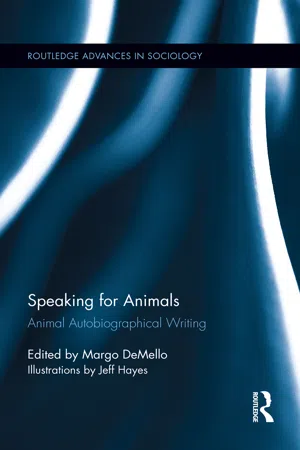
For thousands of years, in the myths and folktales of people around the world, animals have spoken in human tongues. Western and non-Western literary and folkloric traditions are filled with both speaking animals, some of whom even narrate or write their own autobiographies. Animals speak, famously, in children's stories and in cartoons and films, and today, social networking sites and blogs are both sites in which animals—primarily pets—write about their daily lives and interests. Speaking for Animals is a compilation of chapters written from a variety of disciplines that attempts to get a handle on this cross cultural and longstanding tradition of animal speaking and writing. It looks at speaking animals in literature, religious texts, poetry, social networking sites, comic books, and in animal welfare materials and even library catalogs, and addresses not just the "whys" of speaking animals, but the implications, for the animals and for ourselves.
- 274 pages
- English
- ePUB (mobile friendly)
- Available on iOS & Android
eBook - ePub
About this book
Information
Part I (Mis) Representing Animals
The Limits and Possibilities of Representation
DOI: 10.4324/9780203085967-2


1 What Do We Want from Talking Animals?
Reflections on Literary Representations of Animal Voices and Minds
DOI: 10.4324/9780203085967-3
In 2007, CBS news featured a short segment on “dogs who talk,” prompted by Barbara Walters’report that her dog had said “I love you.” It is still available on their web site. The dogs in the segment, when cued by their human companions, all produce sounds—howls, yowls, yips, and even something close the voice of the Wookie in Star Wars —that ever-so-slightly resemble the English words “I love you.” Viewing this grotesque performance is, needless to say, painful for anyone critical of anthropomorphism or concerned about respecting canine difference. It crystallizes some of the worst tendencies within our culture when it comes to the desire to hear what other animals might have to tell us: we only recognize communication when it comes in the form of human speech, and the only message we want to hear is that we are inherently lovable. While ostensibly establishing a connection between humans and dogs (both through their love for us and their ability to “talk” like us), this segment powerfully confirms human superiority over other animals (look how imperfectly they do what we do!), measuring their abilities by the yardstick of our own. Thus, they are held at a distance from us through their incapacities, while the many things they can do that we cannot—such as smell cancer—are erased. We are left with the image of slavishly devoted, imperfect versions of ourselves rather than capable beings with their own lives, perspectives, and abilities.
While talking animals on television are a relatively recent phenomenon, they grow out of a much older tradition in literature. In Melancholia’s Dog: Reflections on Our Animal Kinship, Alice Kuzniar notes that what she calls the “cynomorphic tale,” the story featuring a dog gifted with human speech, is an ancient one, going back to Lucian’s Dialogues of the Dead in the second century A.D. But today, literature that features talking animals garners little respect: as the writer Ursula Le Guin points out, works that give voice to nonhuman animals are usually relegated to the category of “Kiddilit”1 and even serious writers risk contempt when they create a nonhuman narrator (1987, 10). Consider New York Times reviewer Brigette Frase’s ultimate evaluation of King: A Street Story, Booker Prize-winning writer John Berger’s 1999 novel narrated by a dog who is the companion of a homeless couple: “It’s just too hard to believe in a poetic dog” (1999, 21). The magazine Dog Fancy includes just one prohibition for would-be authors in its Writer’s Market entry: “No stories from the dog’s point of view.”
It’s true that fiction featuring talking animals can be terrible: both terrible as literature, using the nonhuman perspective as an easy gimmick, and terrible for human relations with other animals, relying on the grossest anthropomorphism, lapsing into worn-out (and often destructive) stereotypes about all species involved, and confirming a sense of humanity’s ultimate superiority over other creatures. And yet, stories featuring animal voices seem to be everywhere—not just in children’s literature, but also in the realm of adult fiction. In 2008–2009 alone, new fiction narrated by nonhuman animals ranged from the Booker prize-nominated Me Cheeta to the very popular The Art of Racing in the Rain to the rather silly Bad to the Bone: Memoir of a Rebel Doggie Blogger.
Why is the talking animal such an enduring motif in literature? What needs does it fulfill for human readers? Not surprisingly, different approaches to the talking animal seem to perform different functions. In the cynomorphic tale that Kuzniar mentions, speaking dogs act as mouthpieces for philosophical commentary on human society. No doubt because of their important contributions to social critique, cynomorphic tales, which I would argue include twentieth-century works like Kafka’s “Investigations of a Dog” and Paul Auster’s Timbuktu, tend to be relatively well-respected within literary circles. In a related vein, Garth Stein’s The Art of Racing in the Rain really tells the story of a human life, using the canine narrator Enzo to provide an “outsider” perspective much like that of Nick Carraway in The Great Gatsby. Needless to say, animal narrators also seem to provide an entertaining and unusual way for the famous (or their biographers) to tell their own life stories or to provide a new twist on an old topic; think of Barbara Bush’s Millie’s Book or the recently published The Life and Opinions of Maf the Dog, and of His Friend Marilyn Monroe, by Andrew O’Hagan.
Other books seem to take the question of how a nonhuman animal might experience the world more seriously, using omniscient narrators to provide the perspective of animal protagonists; classics in this vein include Jack London’s The Call of the Wild, Virginia Woolf’s Flush: A Biography, and Barbara Gowdy’s The White Bone. And there are versions of the animal-narrated celebrity memoir that seem genuinely interested in the nonhuman perspective, such as well-known author Peter Mayle’s delightful A Dog’s Life: the voice of narrator, Boy, is quite anthropomorphized, the tone is humorous, but the novel is resolute in confronting us with the least civilized aspects of a dog’s nature. Straightforward animal autobiographies like Black Beauty and Beautiful Joe take animal life seriously in a different way, not so much by striving to represent animal consciousness or behavior accurately but rather by working to generate compassion for nonhuman animals and thus improve their treatment. This genre was incredibly popular in the late nineteenth century and played a significant role in the humane movement.
It could be that the appeal and persistence of talking animals in literature is merely a symptom of how much we like the most anthropocentric messages of the form, as illustrated in the CBS news segment. But is it not possible that, running through every poem, novel, film, and silly news segment featuring talking animals, there is at least a trace of a desire to know and better understand the real otherness of animals, to uncenter from our human perspective and—in whatever limited way we can—open ourselves to the nonhuman? This desire to understand other animals certainly exists elsewhere: in the wide viewership for nature shows and animal documentaries on channels like National Geographic and Animal Planet, in the popularity of books like Stanley Coren’s How to Speak Dog (which teaches readers how “read” dog behavior and body language), and even in the development of various machines that translate dogs’barks into human language.2 Now that people in more developed nations encounter fewer and fewer animals in their daily lives, it seems likely that we miss the ongoing contact with other animal species on some level—as Paul Shepard emphasizes, they were a critical part of the environment in which we evolved—and it doesn’t seem too much of stretch to imagine that this desire informs the ongoing interest in artistic and media representations of animal voices as well.
In this essay, my hypothesis will be that a yearning to genuinely know the otherness of nonhuman animals runs through most, if not all, talking animal stories,3 as well as the motivations of their readers, even if this desire is sometimes almost completely overshadowed by or absorbed back into the human tendency to gaze—whether lovingly or critically—at our own reflection when we look at other animals (or, more properly, to hear our own voices when we listen to them). My question will be how the field of criticism currently emerging out of the conjunction of animal studies and literary/cultural studies can nurture and support that desire; in particular, I will look at various critical approaches to the issue of representing animal voices and minds in literature and ask what the most helpful approaches to these stories might be. Taking these literary representations of animal voices seriously, I will argue, is one way animal studies can respond to the challenge posed by Cary Wolfe in the March 2009 issue of PMLA :his charge is that attempts at posthumanism within animal studies have been hobbled by the persistence of the humanist subject, which has traditionally been defined in opposition to the animal; as he puts it, “just because we are studying nonhuman animals does not mean that we are not continuing to be humanist—and, therefore, by definition, anthropocentric” (2009, 568). Instead of simply expanding the ream of critical consideration to non-human animals, he argues, animal studies must radically reconceptualize “the human” by unmasking the trace of the animal/nonhuman at its core: “‘We’ are not ‘we’Rather, ‘we’ are always radically other, already in- or ahuman in our very being” (ibid., 571).
In the author’s introduction to a collection that includes several talking animal stories, Ursula Le Guin makes (perhaps surprisingly) a similar point, explaining our cultural disdain for such stories as a symptom of the nature of Western civilization, which maintains itself by banishing its Others (nature, animals, women, children) to the margins and maintaining a self-imposed deafness to all that these Others have to say. But, for all its efforts, she points out, Western civilization has not been able to eradicate these stories, only to marginalize them: “there will always be stories, in which the lion’s mother scolds the lion, and the fish cries out to the fisherman, and the cat talks; because it is true that all creatures talk to one another, if only one listens” (1987, 12). The animal otherness that the Western tradition has worked so hard to deny and exclude is, as Wolfe might say, part of who “we” are. He goes on to explain that if critics open up our notion of the human, we can then re-examine our disciplinary practices “so that, for example, the place of literature is radically reframed in a larger universe of communication, response, and exchange, which now includes manifold other species” (2009, 571). And what better way to begin this reframing than, as Le Guin suggests, to listen to the animal voices in literature?
CURRENT TRENDS IN CRITICISM OF ANIMAL REPRESENTATIONS
Until recently, though, most literary and cultural critics didn’t listen at all. Either they ignored representations of animals in literature (talking or otherwise), or they approached them in ways completely uninterested in the animals as animals. As Charles Bergmann describes in a 2001 article in the Chronicle of Higher Education, humanities scholars “tend to treat animals as little more than allegories of human fear and desire, or as fundamentally unknowable” (2001,15). Take, for example, the critical response to Virginia Woolf’s 1933 novel Flush: A Biography. Woolf is one of the most highly regarded writers of the twentieth century, a major contributor to the practice of literary modernism, and a significant force in the development of feminist thought. Some of her novels, such as To the Lighthouse and Mrs. Dalloway, are firmly established elements of the literary canon. And yet few students or scholars of literature have ever heard of Flush, her fictionalized biography of the poet Elizabeth Barrett Browning’s spaniel, narrated from a third-person point of view that communicates the dog’s perspective to the readers. With just a few exceptions, the critics who have examined Flush read it as a critique of the social position of women in Victorian society, in which the dog functions merely to comment on the situation of Barrett Browning. As Craig Smith, one of the few critics to treat the novel as a serious attempt to “map canine subjectivity”, explains, the assumption has been that Flush can be accepted as a legitimate “object of study only to the extent that it may be represented as being not really about a dog” (2002, 349).
But this sort of assumption is changing with the development of animal studies approaches to literary and cultural criticism. For example, in “Toward a Critical Theory of Animal Issues in Fiction”, Kenneth Shapiro and Marion Copeland argue that critics should pay attention to the degree to which texts “present the animal ‘in itself,’ both as an experiencing individual and as a species-typical way of living in the world” and that they should ask what implications literary animals hold for human-animal relations (2005,345). As Shapiro and Copeland note, animal studies critics tend to agree that works that use animals purely as symbols or other reflections and projections of human concerns erase animal lives, thus functioning as yet another way humans exploit other animals for their own purposes. Marion Scholtmeijer is one such critic, writing in Animal Victims: From Sanctity to Sacrifice that “The very use of animals within products of culture can be seen as a variant of the acts of appropriation which humankind practices in reality over the natural world” (1993, 6). Talking animals are particularly likely to function as literary ventriloquist acts, with heavily anthropomorphized animals voicing purely human perspectives.4
Now that critics have started asking questions about how such representations relate to the lived reality of nonhuman animals, the talking animal raises the issue of exactly how challenging it is for a writer (or anyone else) to imaginatively put him or herself in the place of another type of animal. In his famous essay “What is Like to Be a Bat?”, philosopher Thomas Nagel makes a powerful case that it is impossible to know or imagine exactly what it is like to be a member of another species because our bodies and brains are physically too different. The sense that this gap between species cannot be bridged has convinced some writers to avoid ever trying to do so. A notable example is South African Nobel Prize-winner J.M. Coetzee, whose works, such as Disgrace and Elizabeth Costello, often take nonhuman animals and our relationship to them very seriously; in an interview, he explained that the extreme difficulty (or even impossibility) of imaginatively inhabiting the consciousness of a member of another species means that it is too easy to project human thoughts and feelings onto the animal and to favor animals easiest for us to empathize with.5 Critic Erica Fudge confirms how often literary animals who speak simply tell us what we want to hear: “Lassie tells us she wants to come home. Beautiful Joe tells us how grateful he is for human omniscience” (2008, 52). In addition, she argues, texts that represent animals without giving them voice or providing access to their minds bespeak “a certain humility about human powers” ...
Table of contents
- Cover Page
- Half Title Page
- Title Page
- Copyright Page
- Dedication
- Table of Contents
- List of Figures
- Introduction
- Part I (Mis) Representing Animals: The Limits and Possibilities of Representation
- Part II Animals in Human Traditions
- Part III Animal Self, Human Self
- Part IV Interspecies Communication and Connection
- Part V Speaking and Knowing: Accessing Animal Subjectivity
- Part VI The Ethics and Value of Speaking for Animals
- Contributors
- Index
Trusted by 375,005 students
Access to over 1.5 million titles for a fair monthly price.
Study more efficiently using our study tools.
Frequently asked questions
Yes, you can cancel anytime from the Subscription tab in your account settings on the Perlego website. Your subscription will stay active until the end of your current billing period. Learn how to cancel your subscription
No, books cannot be downloaded as external files, such as PDFs, for use outside of Perlego. However, you can download books within the Perlego app for offline reading on mobile or tablet. Learn how to download books offline
Perlego offers two plans: Essential and Complete
- Essential is ideal for learners and professionals who enjoy exploring a wide range of subjects. Access the Essential Library with 800,000+ trusted titles and best-sellers across business, personal growth, and the humanities. Includes unlimited reading time and Standard Read Aloud voice.
- Complete: Perfect for advanced learners and researchers needing full, unrestricted access. Unlock 1.5M+ books across hundreds of subjects, including academic and specialized titles. The Complete Plan also includes advanced features like Premium Read Aloud and Research Assistant.
We are an online textbook subscription service, where you can get access to an entire online library for less than the price of a single book per month. With over 1.5 million books across 990+ topics, we’ve got you covered! Learn about our mission
Look out for the read-aloud symbol on your next book to see if you can listen to it. The read-aloud tool reads text aloud for you, highlighting the text as it is being read. You can pause it, speed it up and slow it down. Learn more about Read Aloud
Yes! You can use the Perlego app on both iOS and Android devices to read anytime, anywhere — even offline. Perfect for commutes or when you’re on the go.
Please note we cannot support devices running on iOS 13 and Android 7 or earlier. Learn more about using the app
Please note we cannot support devices running on iOS 13 and Android 7 or earlier. Learn more about using the app
Yes, you can access Speaking for Animals by Margo DeMello in PDF and/or ePUB format, as well as other popular books in Ciencias sociales & Antropología cultural y social. We have over 1.5 million books available in our catalogue for you to explore.