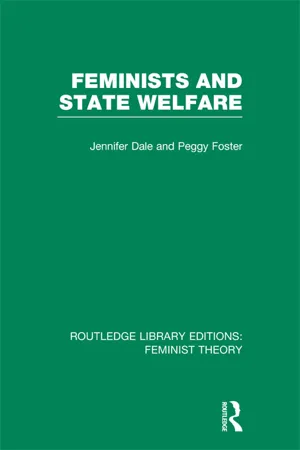
Designed for students of social policy and women's studies, this text gives a readable account of the wide range of feminist ideas about women and welfare. The authors draw on feminist theory, research and analysis to explore women's experiences of welfare, and the debates within feminism on how and why the welfare state oppresses women. In an original contribution they discuss women's impact on the development of the welfare state both as feminist campaigners and as pioneers of new welfare professions. The book concludes by reviewing contemporary feminist strategies to transform the welfare state to meet women's needs. Whilst the authors put forward their own evaluation of these different feminist approaches, they aim to leave readers with plenty of scope to make up their own minds on the issues.
- 195 pages
- English
- ePUB (mobile friendly)
- Available on iOS & Android
eBook - ePub
Feminists and State Welfare (RLE Feminist Theory)
About this book
Information
Part I:
Feminists and the historical development of the Welfare State
1
Feminism and the Welfare State: the formative years
1 Introduction
What impact did feminism have on the development of the Welfare State? If we were to pose this question to a group of feminists active in today's liberation movement we might expect them to reply that feminism had been marginal to the development of the Welfare State, and as a result the Welfare State in many respects oppresses women. If we had put the same question to a group of feminists in the late 1940s, the years when the Labour Government was giving shape to a comprehensive system of welfare provision, we might have received a rather different answer. Most, although not all, feminists welcomed the post-war welfare reforms as improving women's material position and status in society. In the early 1950s, for example, Vera Brittain, a feminist since her youth in the years around the First World War, argued that the ‘women's question’ had been transformed into the substance of the Welfare State.
... in it women have become ends in themselves and not merely means to the ends of men. The welfare state has been both cause and consequence of the second great change by which women have moved ... from rivalry with men to a new recognition of their unique value as women. (Brittain, 1953, p. 224.)
For Brittain, feminism and the Welfare State were two sides of the same coin. Without the campaigns of the women's movement for the needs of mothers and children to be recognized and for the values of caring to be given social recognition, there would have been no Welfare State. For women, the establishment of the Welfare State was the culmination of their struggle for equality and dignity. Women's needs and interest were no longer ignored in the political system, or treated as the opportunity for jokes and masculine titillation. Women had achieved the right to be treated as equals to men, whilst retaining a sense of their special qualities which had received public recognition in social policies which put need above economic and political power.
In this chapter we shall look at the ideas and activities of feminists during the formative years of the contemporary Welfare State, from the turn of the century to the Second World War. We shall seek to understand how and why their ideas differed from those of feminists today, and what impact they had on the development of social legislation. Did earlier feminists simply not challenge many of the sexist assumptions embodied in social policy? Or did they struggle to change policies, only to be defeated?
2 Early twentieth century feminists
Dale Spender argues in the title of a recent book that There's Always Been a Women's Movement This Century (Spender, 1983b). Indeed, there has always been a women's movement, because there have always been organizations of women campaigning to promote women's interests in society. However, many of the older feminists whom Dale Spender interviewed for her book were sympathetic, yet slightly puzzled, or almost shocked by some aspects of today's movement compared with that of their youth. This is hardly surprising, since the two movements differ in a range of ways, in particular, in their understanding of ‘women's interests’, their methods of organization, the range of women involved.
Early twentieth century feminists were mainly concerned with the public sphere, and unlike contemporary feminists, tended to take the private sphere of the home for granted. They concentrated on two types of activity: gaining access for women to education, employment and political influence, and campaigning for public provision of welfare to meet the needs of non-working women. The vast majority of feminists did not see the sexual division of labour in the home as necessarily oppressive, and many glorified women's role as mother.
These campaigning priorities are associated with a second contrast with the women's movement today, their method of organizing themselves. Almost all the earlier women's groups favoured the traditional pressure-group type of organization which typically had a formal constitution, and elected national or central committee, with quite formal and elaborate rules of procedure. Their activities might include demonstrations, but they concentrated on peaceful persuasion, building alliances with (male) MPs, other organizations and lobbying patiently behind the scenes.
The exception to this generalization is, of course, the militant suffragettes of the Women's Social and Political Union, who broke away from their more staid sisters in the early years of the twentieth century and gradually moved towards a militant campaign beginning with window breaking, and culminating in arson. In the process, they abandoned constitutional organization, for a form of charismatic leadership.
The third difference between past and present is the social composition of the movement. Taken together, women's organizations represented a very wide spectrum from single, middle class career women to working class housewives. The sheer number of women who were members of some women's organization or another is quite striking compared with today. On the other hand, this breadth meant that the organizations might have very different priorities. In particular, the social class division within the movement was very pronounced.
We shall explore these differences further by looking at two strands of feminism active during the first half of the twentieth century, namely liberal feminism and what Banks refers to as ‘welfare feminism’ (Banks, 1981). Our focus on only these two groups of women is justified by the fact that they encompassed the main women's organizations which campaigned around welfare issues during the years after 1906 when the most important and enduring foundations of today's Welfare State were being laid. A study of their ideas, and their successes and failures should therefore give us important clues as to why the Welfare State developed in ways which contemporary feminists regard as oppressive. We do not pretend to give a comprehensive picture of earlier feminist movements and readers wishing to know more about other strands of feminism should consult the works of historians such as Olive Banks (1981), Sheila Rowbotham (1973a) and Barbara Taylor (1983).
Liberal feminism refers to that strand of feminism which was and indeed still is concerned with ending legal discrimination against women and removing all barriers which prevent their entry into the public sphere on equal terms with men. During the last three decades of the nineteenth century a series of campaigns emerged to improve women's legal and economic position. In particular, women campaigned to remove the legal disabilities of married women which denied them the right to own property, or to take custody of their children after separation or divorce, and which sanctioned a double standard of morality in divorce. They also opened up secondary and higher education to women by establishing women's schools and colleges and gaining women the right to sit for degrees, and to enter certain of the professions which previously barred women from membership. Many of these campaigns were waged by individual women, or small networks rather than by an identifiable movement. The cause which can truly be said to have created a women's movement was the campaign for the vote.
The campaign for the vote emerged in the last decades of the nineteenth century and took organizational shape with the formation of the National Union of Women's Suffrage Societies (NUWSS), led by Millicent Garrett Fawcett, in 1897. By the Edwardian period many battles in other spheres were won, or the major breakthrough had been achieved: women could take degrees and practise medicine; married women could own property. The struggle for the vote was to become the cause which, for liberal feminists, dominated all others. Ray Strachey for example, editor of the Common Cause the NUWSS newspaper, could write her history of the women's movement up to 1928 (Strachey, 1978) without reference to developments in social policy, despite the fact that, from 1906 onwards, the modern Welfare State was beginning to take shape.
Most liberal feminists concentrated on the issue of the vote because they believed it would give women more political influence. Many also tended not to interest themselves greatly in the extension of social welfare before the First World War because they supported a liberal approach to economic policy which is suspicious of state intervention. Anna Martin, a contributor to Common Cause opposed both free school meals and child allowances on the grounds that they would weaken fathers’ responsibility to maintain their wives and children and tend to lead to a fall in wages (Martin, 1911). Before we dismiss Martin as reactionary, however, it is worth pointing out that she did not oppose all state intervention – she favoured a minimum wage policy for example – and she accurately reflected some of the views of working class women who also might be suspicious of state intervention:
... the women have a vague dread of being superseded and dethroned. Each of them knows perfectly well that the strength of her position in the home lies in the physical dependence of husband and children upon her, and is suspicious of anything that could tend to undermine it. (Martin, 1911, p. 30.)
After the First World War, attitudes amongst liberal feminists changed. The NUWSS changed its name to the National Union of Societies for Equal Citizenship (NUSEC), and began to campaign for equal rights for women in social and economic matters. From the late 1920s, this shift became more pronounced and feminists such as Eleanor Rathbone began to talk of the ‘new feminism’ which instead of seeking equality with men, was more concerned with women's specific needs and aspirations (Rathbone 1929). In 1927 NUSEC split on the issue of protective legislation – i.e. laws which limited the hours and type of work in which women could engage. To equal rights feminists, all protective legislation was a form of discrimination against women, whilst the ‘new feminists’ argued that it should be considered from the point of view of the well-being of the community and whether workers affected supported it. Underlying this split was a deep difference as to the aims of feminism: was it about equal rights, or about welfare issues such as family allowances and birth control. To Rathbone, the older feminists were becoming somewhat irrelevant, whereas to equal rights feminists there was, in the words of Elizabeth Abbott: ‘a grave danger of the National Union becoming a society among many for promoting social reforms – instead of a living instrument for the liberation of women’. (NUSEC, 1927, p. 2.)
During the 1930s, NUSEC (from 1932, the National Council for Equal Citizenship) became increasingly absorbed in welfare issues, whilst the liberal feminist approach was kept alive by smaller feminist organizations such as the Women's Freedom League, the Six Point Group and the Open Door Council.
Discussion of the changing attitude of NUSEC brings us to the second strand of feminism, which we describe as ‘welfare’. NUSEC moved in this direction in the 1920s but it had existed since the turn of the century as a movement of labour movement women in trade unions and organizations such as the Women's Co-operative Guild formed in 1883 as an offshoot of the co-operative movement. We have described this strand of feminism ‘welfare’ rather than socialist because of its emphasis on immediate social reform rather than the wider horizons of socialist transformation. Socialist women who were also feminists, such as Sylvia Pankhurst, identified less and less with the women's movement as they became caught up in the wider debates surrounding revolutionary strategy in the aftermath of the Russian Revolution.
Unlike liberal feminists, welfare feminists tended to prioritize the immediate material interests of women over and above abstract notions of equal rights, and were less likely to place gender interests above class interests. This difference of priority could lead to a direct conflict in demands. During the campaigns for the vote, for example, before the First World War, labour women such as Margaret Bondfield and the Women's Co-operative Guild argued against giving women the vote on the same terms as men, on the grounds that the existing franchise for men included a property qualification. Bondfield did not oppose middle class women seeking the vote, but warned: ‘don't let them come and tell me that they are working for my class.’ (WFL, 1908 p. 15.)
An even deeper division existed in relation to the issue of protective legislation. As a result of such divisions, labour movement feminism remained somewhat separate from the main women's movement before the First World War. In the 1930s however, the increasingly welfarist orientation of NUSEC meant that it often worked closely with the Guild.
Finally, we must mention a whole range of organizations which attempted to draw women into public life through emphasizing the responsibilities of citizenship, in particular the National Council of Women and the local Women's Citizenship Committees. These organizations are perhaps not truly feminist, but they played a role in articulating women's interests, and many women who regarded themselves as feminists were active in them. We shall therefore include them in our account.
This review of feminist movements raises a number of points which are relevant to understanding the impact of feminism on the Welfare State before 1945. In the first place, the feminist movement was divided along class lines which weakened its impact on the labour and trade union movement and hence on the Labour Party. The equal rights tradition of feminism could all too easily be dismissed as ‘middle class’, having little relevance to working class women.
In the second place, the campaign which highlighted women's unequal position in society was the struggle for the vote. This campaign served as a focus for a whole range of women's grievances about their lack of political and economic power, and the way they were treated by men. Once the vote had been won the feminist movement seemed to lose its sense of identity and purpose. The militant suffragettes tended to disappear, or pressed for an equal rights programme which was irrelevant to most women – amongst the key demands of the Women's Freedom League, for example, were women's right to sit in the House of Lords, and the opening of the Consular and Diplomatic Service to women! The constitutionalists became more and more involved in welfare issues, and seemed to lose any specifically feminist approach.
The third striking feature of the first generation of feminists is their apparent acceptance of many crucial aspects of the gender system which modern feminists regard as oppressive: in particular their stance towards the family, and sexual norms.
The majority of feminists saw nothing inherently wrong in women being economically dependent on men so long as they received some protection. Many feminists saw the solution to married women's economic vulnerability in wives gaining the legal right to a share of their husband's income. When Ada Nield Chew, a working class socialist feminist argued against this in the Common Cause and unequivocably for the right of mothers to work outside the home, the editor felt compelled to publish a disclaimer pointing out that articles represented the views of authors alone. (Common Cause 6 March 1914)
Raising the status of motherhood and laying the basis for companionate marriage were central to both strands of feminism. Most feminist organizations had a specific set of demands relating to the status of married women, and in 1938 the Married Women's Association was founded as an offshoot of the Six Point Group with the aim of creating a legal and financial partnership in marriage. This is important when we come to analyse the way a dominant family ideology has come to be embodied in social policy. We cannot argue that it was simply ‘foisted’ on women: those who took a more radical stance against the sexual division of labour in the home were few and far between.
The acceptance of the ideology of motherhood and the family often took on a nationalist and eugenic slant. Margaret Bondfield, a labour movement woman argued that: ‘The nurture of children is a race matter, a question in which the strength and survival of the community is involved, and in which women must take the leading part assigned them by nature.’ (Bondfield, 1949, p. 135 emphasis in original.)
Similarly, feminists generally adopted a conventional attitude towards sex morals. In part this was a question of respectability: at a time when women were judged by their sexual probity, any scandal might have impeded the reforms in other areas which women achieved. Hence, the NUWSS distanced itself from Josephine Butler's campaigns against the state regulation of prostitution, not because suffragist women were unsympathetic, but because they feared the taint of scandal. More fundamentally, however, feminist women tended to adopt a view of women as victims of a predatory male sexuality. The attack on the double standard was essentially a demand that men live up to the standard of morality they set for women rather than an argument for sexual freedom for women. As a result, feminists were ambivalent towards issues such as birth control and only supported the birth control campaign after the First World War. Even then, it was pursued within a social democratic discourse of ‘hardship to mothers’ resulting from unnecessary pregnancies. Single women were seen by the majority of feminists as having no choice but to remain celibate.
All these factors shaped the nature and extent of feminism's impact on the emerging Welfare State. In the next section, we shall look in more detail at the main feminist campaigns around welfare in the years prior to the Second World War.
3 Feminist campaigns
Feminists campaigned around many issues during the years between 1906 and 1939. Three issues, however, dominated others: the inclusion of women in the developing system of national insurance; economic assistance to mothers through maternity benefits and some form of family allowances; and finally, maternal and child health. We shall look at the aims and impact of feminists in these three areas.
The introduction of national insurance in 1911 raised a whole range of issues concerning women's position in the social security system. In the first place, the very concept of insurance disadvantages women who give up work to have children and are therefore unable to build up sufficient contributions to receive adequate benefits in their own right.
Second, however, the original Act and much subsequent legislation have compounded this disadvantage by treating men and women workers differently, in particular by requiring women to pay lower contributions and in return paying considerably reduced benefits.
By 1911, the suffrage societies were well organized, and in their newspapers Common Cause and Votes for Women they highlighted the inequalities and injustices in the scheme. There is a sense, however, in which their concerns about national insurance were subordinate to the demand for the vote. For example, a meeting in July 1911 protested against the treatment of women in the Bill but concluded that:
they regard the blindness of the Bill to the interests of women as an instance of that political negligence which is ...
Table of contents
- Front Cover
- Half Title
- Title Page
- Copyright
- Half Title
- Title Page
- Copyright
- Contents
- Acknowledgments
- Introduction
- Part I: Feminists and the historical development of the Welfare State
- Part II: Contemporary feminism and the critique of welfare
- Part III: Feminist strategies to change welfare
- Bibliography
- Index
Trusted by 375,005 students
Access to over 1.5 million titles for a fair monthly price.
Study more efficiently using our study tools.
Frequently asked questions
Yes, you can cancel anytime from the Subscription tab in your account settings on the Perlego website. Your subscription will stay active until the end of your current billing period. Learn how to cancel your subscription
No, books cannot be downloaded as external files, such as PDFs, for use outside of Perlego. However, you can download books within the Perlego app for offline reading on mobile or tablet. Learn how to download books offline
Perlego offers two plans: Essential and Complete
- Essential is ideal for learners and professionals who enjoy exploring a wide range of subjects. Access the Essential Library with 800,000+ trusted titles and best-sellers across business, personal growth, and the humanities. Includes unlimited reading time and Standard Read Aloud voice.
- Complete: Perfect for advanced learners and researchers needing full, unrestricted access. Unlock 1.5M+ books across hundreds of subjects, including academic and specialized titles. The Complete Plan also includes advanced features like Premium Read Aloud and Research Assistant.
We are an online textbook subscription service, where you can get access to an entire online library for less than the price of a single book per month. With over 1.5 million books across 990+ topics, we’ve got you covered! Learn about our mission
Look out for the read-aloud symbol on your next book to see if you can listen to it. The read-aloud tool reads text aloud for you, highlighting the text as it is being read. You can pause it, speed it up and slow it down. Learn more about Read Aloud
Yes! You can use the Perlego app on both iOS and Android devices to read anytime, anywhere — even offline. Perfect for commutes or when you’re on the go.
Please note we cannot support devices running on iOS 13 and Android 7 or earlier. Learn more about using the app
Please note we cannot support devices running on iOS 13 and Android 7 or earlier. Learn more about using the app
Yes, you can access Feminists and State Welfare (RLE Feminist Theory) by JENNIFER DALE,PEGGY FOSTER in PDF and/or ePUB format, as well as other popular books in Social Sciences & Sociology. We have over 1.5 million books available in our catalogue for you to explore.