The Chinese in Indonesia form a significant minority of about three percent of the population, and have played a disproportionately important role in the country. Given that Chinese Indonesians are not seen as indigenous to the country and are consistently defined against Indonesian nationalism, most studies on the community concentrate on examining their ambivalent position as Indonesia's perennial "internal outsider." Chinese Indonesians Reassessed argues for the need to dislodge this narrow nationalistic approach and adopt fresh perspectives which acknowledge the full complexity of ethnic relations within the country. The focus of the book extends beyond Java to explore the historical development of Chinese Indonesian communities in more peripheral areas of Indonesia, such as Medan, the Riau Islands and West Kalimantan. It reveals the diverse religious practices of Chinese Indonesians, which are by no means confined to "Chinese" religions, and celebration of "Chinese" ethnic events. Presenting a rich array of historical and contemporary case studies, the book goes beyond national stereotypes to demonstrate how Chinese Indonesians interact with different spaces and environments to establish new Chinese Indonesian identities which are complex and multi-faceted. The book engages with a larger global literature concerned with diasporic Chinese identities and practices and offers sophisticated and empirically grounded insights on the commodification of ethnic cultures and religions.
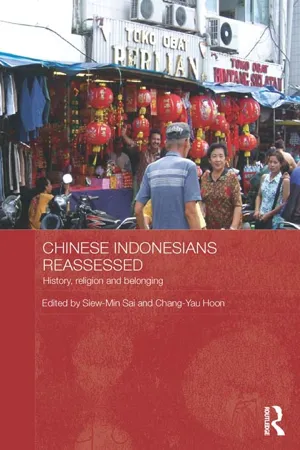
eBook - ePub
Chinese Indonesians Reassessed
History, Religion and Belonging
- 226 pages
- English
- ePUB (mobile friendly)
- Available on iOS & Android
eBook - ePub
Chinese Indonesians Reassessed
History, Religion and Belonging
About this book
Information
1 The Tiong Hoa Hwee Koan School
A transborder project of modernity in Batavia, c. 1900s
Education would be dynamite for the rigid caste systems of colonies.
(Kennedy 1945: 311)
It is to be remembered that the members of the Tiong Hoa Hwe Koan are among the most intelligent and progressive of the Chinese people.
(Denyes 1911: 30)
This chapter focuses on the kaoem moeda or the “enlightened Chinese” in Java at the turn of the twentieth century. For hundreds of years, the Chinese prospered economically in the colonial Dutch East Indies, since they successfully served as mediators between the Dutch colonizers and the local native population. However, in their daily lives they experienced discrimination in legal matters and it was not easy for their children to receive a European education. Toward the end of the nineteenth century, reacting against their legal marginalization, several elites within the Chinese community led the way to urging the Dutch and the other communities in the Indies to consider the Chinese as “modern subjects” of the Dutch Crown. These efforts at updating their status were accompanied by parallel efforts in modernizing or reforming the community. One of the most important modernizing endeavors was the establishment of a “modern Chinese” school, complete with a “modern” curriculum, teaching methods and, of course, teachers. What remains remarkable was that they achieved their goal without the help of the colonial government, but by cleverly developing their transborder trade network into one that purveyed new knowledge and cultural products.
The kaoem moeda or “kaoem moeda bangsa Tjina,” which can be rendered literally in English as the “youth of the Chinese nation,” was a term used by a group of Chinese to describe themselves at the turn of the twentieth century in Java.1 I have translated this term as “enlightened Chinese” because members of this group often described themselves as the carrier of “the light” (Ml.: terang) of progress, in contrast to those whom they described as living in conservatism or an “age of darkness” (Ml.: djaman kegelapan).2 The kaoem moeda consisted predominantly of men and women who saw themselves as progressive in their outlook. Many of them had been successful in business and were journalists, writers or community leaders who had some form of education, often in a private home environment or some exposure to “Western” or “European” education, for instance in schools established by Christian missionaries. While many of the kaoem moeda were born in the Indies and came from families that were long settled there, there were kaoem moeda who were newly arrived immigrants from China. In general, the kaoem moeda can be defined not so much by education, family background or immigrant history as by a common purpose. They were not satisfied with their position as second-class citizens in the new world of the twentieth century and believed that only by embracing modernity could they reach a “civilized” status in colonial Indonesia.
This chapter features what was probably the most remarkable yet controversial achievement of the kaoem moeda: the establishment of the Tiong Hoa Hwee Koan (literally, the Chinese Association, henceforth THHK) school which was founded in Batavia on 17 March 1901. Although there have been several studies of THHK, much remains to be clarified.3 The existing literature on the THHK movement tends to overlook the importance of the kaoem moeda's transborder connections in the establishment of the THHK school in Batavia.4 For example, Mona Lohanda provided interesting analyses of the THHK officers' occupations, dialect backgrounds and their importance for the organization, but she did not comment on how these drew on a wider transborder network (Lohanda 1996: 110–26). This chapter maps the transborder connections of the kaoem moeda that provided inspiration and enabled them to establish the school.
“Modernity” in the Dutch East Indies context has often been seen as mainly “Dutch” in origin. In this chapter, I argue that the kaoem moeda were not just inspired by Dutch modernity but drew inspiration from a range of non-Dutch sources. Drawing on their global trade networks, they were able to obtain resources, especially teachers and teaching materials for the THHK school. Thus, the kaoem moeda succeeded in this initial attempt at circumventing Dutch authority to build their own schools, prompting the Dutch to reconsider the wisdom of not providing any education for their Chinese subjects in the Indies.
The existing literature also regards the THHK school as the first attempt to build a modern school for the Chinese in Java. Recent writings indicate, however, that there were earlier schools built by the Chinese in Java that experimented with a modern curriculum. A recent essay by Claudine Salmon reveals the existence of a “modern” Chinese school named Nanyang Xunmeng Guan (literally, the “South Seas Training School”). This Confucian school was established by Tjioe Ping Wie, who came from a prominent local Chinese family in Surabaya and who studied in China, where he obtained a licentiate degree. Tjioe then returned to his hometown and established this new school (Salmon 2009: 48–49). Another example is the establishment of a Singapore-oriented school in Batavia in 1892. The origin of this school lies in the visit in 1887 of a Manchu envoy who was actually an overseas Chinese from Penang. While this school turned out to be unsuccessful, it showcased the transborder networks of Chinese communities in Java which connected them to Singapore, Penang and China, underscoring how Java's Chinese utilized these ties for the betterment of their children's education. Nine years later, the same story was repeated as the THHK appeared in Batavia. The main difference was that the network supporting the THHK school was much more global in scope (Nio 1940).
On the kaoem moeda and being “modern” in colonial Java
The new age of the twentieth century offered many novelties to Asians living in colonial Java. The main inspiration, especially for educated people, regardless of their ethnicity, was the advent of a Europe-centered modernity. Takashi Shiraishi, for example, uses the term kaoem moeda in a non-racialized way to describe the generation of Dutch-educated youth at the turn of the twentieth century. In the Dutch East Indies, according to Shiraishi, Dutch modernity was all the rage and it was exemplified by the popularity of Dutch words used by Dutch-educated youth, such as vooruitgang (progress), opheffing (uplifting), ontwikkeling (development) and opvoeding (upbringing).These words signified forms of progress (Shiraishi 1990: 27). There was also a strong association of modernity with being “civilized,” which was also understood in Dutch terms. In the eyes of the Dutch colonizers, a perfect Chinese was “a highly civilized, Dutch-speaking and Christian Chinese” (Anon. 1909: 5).
It was not surprising that Western knowledge found admirers among the Chinese, such as one Peranakan Chinese from Makassar who sent a letter to the Governor General. He had exclaimed that “the science of the Dutch nation, who rule over us here in the Indies, is the perfect learning, as it is used around the world by various nations.”5 As Shiraishi argues, mastery of the Dutch language was “the key to open the modern world and age” (Shiraishi 1990: 90). The language provided “access to the Dutch world in the Indies” and the Dutch “exemplified modernity” (Shiraishi 1990: 90). Therefore, anyone educated in the Dutch system would strive to master Westersche beschaving (Western civilization) because being considered a beschaafd (civilized) person was one of the ultimate goals in life. The struggle to be “civilized” and, thus, equal to the Dutch and other Europeans was a common phenomenon in Asia at the turn of the twentieth century (cf. Winichakul 2000 and Hirano 1993). Because of their pariah status, the Chinese of Java were even more exposed to this pressure to strive for a civilized status than the Javanese. In the late nineteenth century, due to criticisms from Dutch politicians and journalists who witnessed extreme poverty among the Javanese, the Dutch government adopted an “ethical policy” to improve the lives of the Javanese. These critics put a large share of the blame for the poverty and misery of Javanese on the Chinese, calling them “the bloodsuckers of the Javanese” (bloedzuigers der Javanen) (see also Lohanda 2003: 22–30).
Another significant factor contributing to the striving to be “modern” among the kaoem moeda was the widespread “evil” image of the Chinese in the nineteenth- century Indies. In the mid-nineteenth century, during the pacification of West Borneo, the Dutch military commander called the Chinese “the most immoral of all immoral nations,” who would “only listen to force” to mend their ways (Moor 1989: 59). Another officer admitted the importance of the Chinese, but at the same time was derogatory toward them: “If it weren't for the Chinese, we would have missed out on a lot of things, but still we despised those dog eaters” (Dharmowijono 2001: 226). Dutch authors enhanced this negative image through their novels about life in the Indies. The “miscreant” (aterling) and “cunning” (sluw) Chinese were among the common stereotypes of the Chinese in Dutch Indies novels from the late colonial period (Dharmowijono 2004). It is not surprising that the ethical policy supporters deliberately painted a “negative picture about the Chinese involvement in a wide range of economic activities” (Dharmowijono 2004: 171). It is related to their role as middlemen in economic life, in which the Chinese were active in trade, money lending, opium and tax farming, and other “pariah” activities, considered “dirty jobs” by the Javanese and Europeans (see Carey 1984).
Therefore, the late nineteenth century was not a good time for the Chinese. The Dutch put severe restrictions on Chinese children entering European schools; they had to live in ghettos and apply for travel passes if they wanted to go anywhere. The long-time source of colonial government income, the revenue farm, was abolished and changed into a government monopoly. The rising Japanese, fellow Asians, were given European legal status in 1899, leaving the Chinese to experience themselves as second-class “foreign orientals.” How could they then achieve “civilized” status and, at the same time, be “modern”?
The kaoem moeda and the establishment ...
Table of contents
- Cover
- Half Title
- Routlege Contemporary Southeast Asia Series
- Full Title
- Copyright
- Contents
- List of Illustrations
- Notes on Contributors
- Acknowledgments
- Introduction: A critical reassessment of Chinese Indonesian Studies
- 1 The Tiong Hoa Hwee Koan School: A trans border project of modernity in Batavia, c. 1900s
- 2 The Nanyang diasporic imaginary: Chinese school teachers in a transborder setting in the Dutch East Indies
- 3 Chineseness, belonging and cosmopolitan subjectivities in post-Suharto independent films
- 4 Materializing racial formation: The social lives of confiscated Chinese properties in North Sumatra
- 5 The translocal subject between China and Indonesia: The case of the Pemangkat Chinese of West Kalimantan
- 6 The Chinese of Karimun: Citizenship and belonging at Indonesia's margins
- 7 The spirit-mediums of Singkawang: Performing “peoplehood”
- 8 “By race, I am Chinese; and by grace, I am Christian”: Negotiating Chineseness and Christianity in Indonesia
- 9 Expressing Chineseness, marketing Islam: The hybrid performance of Chinese Muslim preachers
- 10 A controversy surrounding Chinese Indonesian Muslims' practice of Imlek Salat in Central Java
- Index
Trusted by 375,005 students
Access to over 1.5 million titles for a fair monthly price.
Study more efficiently using our study tools.
Frequently asked questions
Yes, you can cancel anytime from the Subscription tab in your account settings on the Perlego website. Your subscription will stay active until the end of your current billing period. Learn how to cancel your subscription
No, books cannot be downloaded as external files, such as PDFs, for use outside of Perlego. However, you can download books within the Perlego app for offline reading on mobile or tablet. Learn how to download books offline
Perlego offers two plans: Essential and Complete
- Essential is ideal for learners and professionals who enjoy exploring a wide range of subjects. Access the Essential Library with 800,000+ trusted titles and best-sellers across business, personal growth, and the humanities. Includes unlimited reading time and Standard Read Aloud voice.
- Complete: Perfect for advanced learners and researchers needing full, unrestricted access. Unlock 1.5M+ books across hundreds of subjects, including academic and specialized titles. The Complete Plan also includes advanced features like Premium Read Aloud and Research Assistant.
We are an online textbook subscription service, where you can get access to an entire online library for less than the price of a single book per month. With over 1.5 million books across 990+ topics, we’ve got you covered! Learn about our mission
Look out for the read-aloud symbol on your next book to see if you can listen to it. The read-aloud tool reads text aloud for you, highlighting the text as it is being read. You can pause it, speed it up and slow it down. Learn more about Read Aloud
Yes! You can use the Perlego app on both iOS and Android devices to read anytime, anywhere — even offline. Perfect for commutes or when you’re on the go.
Please note we cannot support devices running on iOS 13 and Android 7 or earlier. Learn more about using the app
Please note we cannot support devices running on iOS 13 and Android 7 or earlier. Learn more about using the app
Yes, you can access Chinese Indonesians Reassessed by Siew-Min Sai, Chang-Yau Hoon, Siew-Min Sai,Chang-Yau Hoon in PDF and/or ePUB format, as well as other popular books in Social Sciences & Ethnic Studies. We have over 1.5 million books available in our catalogue for you to explore.