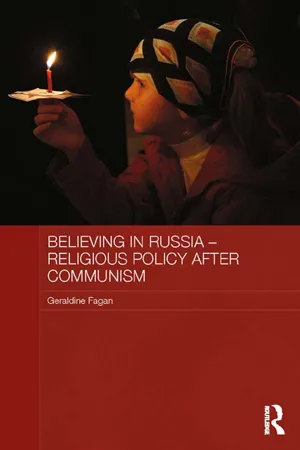
This book presents a comprehensive overview of religious policy in Russia since the end of the communist regime, exposing many of the ambiguities and uncertainties about the position of religion in Russian life. It reveals how religious freedom in Russia has, contrary to the widely held view, a long tradition, and how the leading religious institutions in Russia today, including especially the Russian Orthodox Church but also Muslim, Jewish and Buddhist establishments, owe a great deal of their special positions to the relationship they had with the former Soviet regime. It examines the resurgence of religious freedom in the years immediately after the end of the Soviet Union, showing how this was subsequently curtailed, but only partially, by the important law of 1997. It discusses the pursuit of privilege for the Russian Orthodox Church and other 'traditional' beliefs under presidents Putin and Medvedev, and assesses how far Russian Orthodox Christianity is related to Russian national culture, demonstrating the unresolved nature of the key question, 'Is Russia to be an Orthodox country with religious minorities or a multi-confessional state?' It concludes that Russian society's continuing failure to reach a consensus on the role of religion in public life is destabilising the nation.
- 304 pages
- English
- ePUB (mobile friendly)
- Available on iOS & Android
eBook - ePub
Believing in Russia - Religious Policy after Communism
About this book
Information
1 Russia's religious freedom tradition
On 12 July 1805 a tradesman and two peasants took the risky step of coming before Tsar Alexander I and asking for the freedom to practise their faith. For more than a century, the Molokans had worshipped in secret and in fear:
As soon as we would gather, the Priests would report to the Police where we were and in whose house our gathering was taking place. Immediately people are handcuffed, shackled, beaten without mercy, put into prison, chained to the wall without food, put into dark cells and sentenced to hard labor with daily punishment.1
The Molokans were pariahs because they found no injunction to pray to Orthodox icons or saints in the Bible, ‘this great treasure, which was hidden in past ages, and is now available in our Russia for diligent study’.2 Despite their apparent similarity to Western Protestants, however, they rejected water baptism as an Old Testament custom rendered obsolete by baptism in the Holy Spirit, calling themselves simply ‘Spiritual Christians’.3 Wider society distinguished them as Molokans — from the Russian for ‘milk’ — due to their non-observance of an Orthodox ban on dairy products during fasts such as Lent.4 Once Molokans had found suitable scriptural foundation for it in the New Testament exhortation to ‘love the milk of the Word’, this nickname stuck.5
Prince Mikhail Kutuzov gave the first response to the Molokans' petition at a 15 July 1805 meeting of the imperial Committee of Ministers: ‘Is it possible to stop anyone from reading the Word of God in the Holy Bible, whether Orthodox Christians or anyone else?’ Amvrosy (Podobedov), St Petersburg's Orthodox archbishop, confirmed it to be ‘as impossible to stop the sun from traversing the sky’. Acknowledging that the Molokans suffered harsh persecution under his late grandmother, Catherine the Great, Alexander then proclaimed a different course: ‘We Orthodox Christians should act with the humility of Christ … with tolerant measures.’ His 22 July 1805 decree legitimized the Molokans, upholding their right to read the Bible freely and prohibiting Orthodox clergy from entering their homes.6
Two centuries later, the memory of the 1805 petitioners spurs on the council chair of Moscow's Molokan community in his decade-long battle for the right to build a prayer house in the Russian capital. Through protracted correspondence with an array of state departments, octogenarian Yakov Yevdokimov secured municipal approval for construction three times — only for it to be successively overturned by lower bureaucrats. Four petitions to President Vladimir Putin ended up on the desk of the junior official responsible for obstructing the project. Yevdokimov's reflex, however, is to continue to demand what the 1997 law On Freedom of Conscience and Religious Associations states is his community's right.7 While there was nothing like that law or Russia's 1993 Constitution in 1805, he recalls, ‘it took the tsar just ten days to sort out our problem’.8
Yevdokimov bears a family legacy of state oppression. Among Molokans exiled to Armenia by Catherine the Great, his great-great-great-great-grandfather was ‘slaughtered like a goat’ by police on the road from Samara gubernia. His father was arrested as a Molokan in 1938 and sentenced to ten years' hard labour in the Gulag; he did not return. This and his own life under Soviet rule have not cowed Yevdokimov into accepting such treatment as a given, however. Even the modern Russian state's ten-year disregard of the Moscow Molokans' petition to build, he believes, is ‘an outrageous way to deal with people’.9
Russian national identity is classically regarded as inseparable from mainline Orthodox Christianity. As a protagonist in Dostoyevsky's novel Demons uncompromisingly puts it, ‘He who is not Orthodox cannot be Russian.’10 To both its supporters and sceptics, religious freedom is therefore alien to Russian culture. Latterly, it has come to be understood as part of a Western-inspired human rights package exported to assist an arduous post-Soviet transition from authoritarianism to democracy.11 ‘People think that there are no Russian democratic traditions, that something in the air or climate makes us prone to totalitarianism,’ opines Old Believer Denis Lupekin.12 In order to assess Russia's religious policy we must revisit the assumption that religious freedom is a non-Russian value.
For in fact it is the Molokans and Old Believers — two quintessentially Russian faiths traditionally at least indifferent to the West — who have taken historic stands for religious freedom in Russia. Both still display an instinctive openness towards the right of others to determine their beliefs. Elder presbyter of the core Molokan community on the southern Russian steppe, Timofei Shchetinkin (Figure 1, p. 51) recalls his response to an Orthodox village priest who asked his attitude towards Jehovah's Witnesses:
I said, ‘Well, I don't agree with them. I don't agree when they say that the Kingdom of Heaven is on Earth. I don't agree with them that Jesus Christ isn't Saviour but just a person or a prophet. But God hasn't given me the right to ban them. He hasn't given that right.’13
In the north of modern-day Belarus, a similar view is held by Pyotr Orlov, elder of some 30 priestless Old Believer communities whose forebears fled the Russian heartland from the late 1600s onwards. ‘If God continues to permit everyone on this one sinful Earth to exist’, he reasons, ‘then we can't insist that they be all of the same faith.’14
A thin but wiry thread running through their nation's history, Russians' pursuit of religious freedom is a tradition visible at intervals that have proved all too brief, however. The 1805 decree forgotten, Shchetinkin's great-great-grandfather was among Molokans exiled to the South Caucasus from the 1830s onwards.15 Russia's state suppression of homegrown religious dissent was even more pronounced in the case of the Old Believers.
Even before their emergence in the mid-seventeenth century, Russian civilization was widely considered guardian to the purity of Orthodox Christianity. On founding the Moscow Patriarchate in 1589, Patriarch Jeremia s II of Constantinople proclaimed that, since the original Rome had fallen to Catholic heresy and the second, Constantinople, to the Turks, ‘your great Russian kingdom, the Third Rome, has surpassed all other kingdoms in piety’.16 By the 1650s, however, there were two notions of Russia's messianic role. Moscow Patriarch Nikon envisaged his Church as the hub of a wider Orthodox empire, requiring that liturgical texts and practices be stripped of allegedly uncanonical accretions born of isolation from the rest of the Orthodox world. Others saw meticulous devotion to Russia's old beliefs and rites as essential to Orthodoxy's preservation. As Old Believer champion Archpriest Avvakum protested to Church hierarchs, ‘Rome fell long ago and lies prone … and your [non-Russian] Orthodoxy has been mottled by Turkish savagery.’17
To the Old Believers, Nikon's numerous, now seemingly trifling reforms — the sign of the cross made with three fingers instead of two (Figure 2, p. 51), or a change in the spelling of ‘Jesus’ from Isus to Iisus — were thus a renegade strike at the very body of the Church that not even a patriarch could rightfully make.18 The 1666 Church council that branded opponents of reform ‘schismatics’ was particularly ominous, for the Book of Revelation had identified 666 with the Antichrist, and corruption of Russian Orthodoxy, it was thought, would precipitate his coming.19 Many Old Believers continued to trust in the validity of a church hierarchy in principle, but in Nikon's no longer.
As the Nikonian camp gained the upper hand, its opponents were viciously persecuted. In his epic nineteenth-century painting Boyarina Morozova, Vasily Surikov depicts an Old Believer noblewoman defiant, her right hand aloft in the form of a two-fingered sign of the cross as a sleigh draws her to the monastery prison where she will be slowly starved to death. Unknown numbers of humbler figures — including monks who held out under siege against tsarist forces for more than seven years within their far northern island monastery of Solovki — were tortured, hanged, drowned, hacked to pieces or beheaded; more often burnt.20
The ancient piety survived the succeeding centuries undimmed, however: Old Believers still retain a presence in the ‘Third Rome’. Now squeezed between shimmering new office blocks, St Nicholas' Church in downtown Moscow shelters an apparent oasis of pre-Petrine Russia: full-bearded men in flaxen smocks, women beneath loose shawls pinned precisely at the chin. On the main door, a sign warns non-Old Believers not to walk into the central part of the church during services, venerate icons, make the sign of the cross, or bow. Such closed ritualism typically leads observers to assume that all Old Believer attitudes are stilted. But while theologically archconservative, the Russian Orthodox Old Believer Church21 is unexpectedly dynamic in its ecclesiastical organization. Women became full members of its ruling body, the Old Believer Church Council, in the eighteenth century.22 At the 2007 Council over a quarter of the 220 delegates directly elected by parishioners were women, or men under 25.23
Like the Molokans, the Old Believers experienced a relaxation in state policy under Alexander I. Persecution resumed in earnest with the accession of Nicholas I in 1825, however. An 1827 decree banned Old Believer priests from travelling from one region to another; transgressors were to be ‘dealt with like tramps’. The military evicted thousands of Old Believer monks and nuns from their monasteries. Tens of thousands of Old Believer icons, books and relics were confiscated and even burnt. An 1838 decree sanctioned the separation of Old Believer children from their parents and forced their incorporation into the dominant Russian Orthodox Church. Old Belief ducked back underground.24
During a brief thaw under Alexander II, an 1856 decree permitted open worship at Rogozhskoye, the Old Believer settlement then on the outskirts of Moscow. Many of the 6,000-strong congregation wept for joy at the first open Sunday liturgy there in January of that year. Under pressure from Metropolitan Filaret (Drozdov) of Moscow, however, officials and police sealed Rogozhskoye's church altars just months later.
The Old Believers' response was to lobby for their religious freedom, submitting numerous petitions for the altars to be unsealed over subsequent decades.25 By the late 1800s they had become a force to be reckoned with. While a small fraction of the population, a fortuitous combination of industrial progress and the staunch Old Believer work ethic meant their stake in Russia's trading capital was disproportionately high.26 Their ritual traditionalism did not exclude entrepreneurship and innovation in other spheres of life. In 1904 Art Nouveau architect Fyodor Shekhtel incorporated a hidden attic chapel into his bold design for a Moscow mansion commissioned by Old Believer Stepan Ryabushinsky, a prominent banker and co-founder of Russia's first car factory.27
Similar magnates, steamship owner Dmitri Sirotkin and merchant Mikhail Brilliantov, convened the first All-Russian Old Believer Congress in Moscow on 14 September 1900, encou...
Table of contents
- Cover
- Half Title
- Routledge Contemporary Russia and Eastern Europe Series
- Full Title
- Copyright
- Contents
- List of illustrations
- Map
- Preface and acknowledgements
- Note on transliteration, translation and titles
- Introduction
- 1 Russia's religious freedom tradition
- 2 ‘Native land protected by God’
- 3 Rites of spring
- 4 Law unto itself
- 5 Fight thine enemy
- 6 In search of tradition
- 7 Extreme measures
- 8 Alternative scenarios
- Conclusion
- Notes
- Index
Trusted by 375,005 students
Access to over 1.5 million titles for a fair monthly price.
Study more efficiently using our study tools.
Frequently asked questions
Yes, you can cancel anytime from the Subscription tab in your account settings on the Perlego website. Your subscription will stay active until the end of your current billing period. Learn how to cancel your subscription
No, books cannot be downloaded as external files, such as PDFs, for use outside of Perlego. However, you can download books within the Perlego app for offline reading on mobile or tablet. Learn how to download books offline
Perlego offers two plans: Essential and Complete
- Essential is ideal for learners and professionals who enjoy exploring a wide range of subjects. Access the Essential Library with 800,000+ trusted titles and best-sellers across business, personal growth, and the humanities. Includes unlimited reading time and Standard Read Aloud voice.
- Complete: Perfect for advanced learners and researchers needing full, unrestricted access. Unlock 1.5M+ books across hundreds of subjects, including academic and specialized titles. The Complete Plan also includes advanced features like Premium Read Aloud and Research Assistant.
We are an online textbook subscription service, where you can get access to an entire online library for less than the price of a single book per month. With over 1.5 million books across 990+ topics, we’ve got you covered! Learn about our mission
Look out for the read-aloud symbol on your next book to see if you can listen to it. The read-aloud tool reads text aloud for you, highlighting the text as it is being read. You can pause it, speed it up and slow it down. Learn more about Read Aloud
Yes! You can use the Perlego app on both iOS and Android devices to read anytime, anywhere — even offline. Perfect for commutes or when you’re on the go.
Please note we cannot support devices running on iOS 13 and Android 7 or earlier. Learn more about using the app
Please note we cannot support devices running on iOS 13 and Android 7 or earlier. Learn more about using the app
Yes, you can access Believing in Russia - Religious Policy after Communism by Geraldine Fagan in PDF and/or ePUB format, as well as other popular books in Politica e relazioni internazionali & Politica. We have over 1.5 million books available in our catalogue for you to explore.