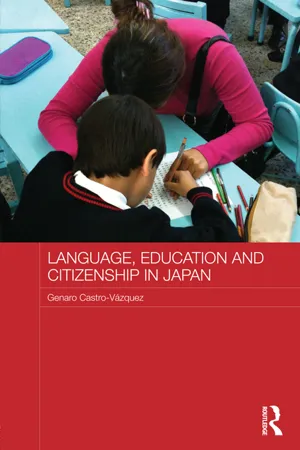
Based on extensive original research, this book explores the early educational experiences of foreign children in Japan. It considers foreign children's experiences of Japanese schools, examines the special tutoring such children often have to improve their language proficiency, and explores the role of mothers in encouraging their children's education. It contrasts the experiences of foreign children with those of Japanese children and sets out the extensive difficulties foreign children encounter in becoming fully accepted by and integrated into Japanese society. The book concludes by discussing the nature of citizenship in Japan and the importance of education, including early education, in shaping Japanese citizenship.
This chapter reviews the circumstances of foreigners in Japan to frame a discussion of education and language acquisition among non-Japanese children. The situation of foreign citizens is presented within the official master narrative that clearly distinguishes foreigners (gaikokujin) in opposition to nationals (kokumin). This narrative does not include any reference to ideas of immigrants (imin) and/or minorities. The distinction is chiefly grounded on the policy that grants Japanese nationality and civilian rights according to parental citizenship, which has resulted in groups of foreigners who, despite having been born in the country, cannot acquire Japanese nationality because their parents do not have Japanese ancestry.
In an attempt to show that official categories do not reflect the reality of foreigners in Japan, the chapter draws on the views of civilians and academics who have put in an effort to provide a nuanced and rather accurate reading of the lives of non-Japanese in the country. The categories of ‘oldcomers’ and ‘newcomers’ are discussed to emphasize that a simple dichotomy that separates locals from foreigners is equivocal. In official documents, oldcomers are identified as special permanent residents (tokubetsu eij
sha) and newcomers are included under the legal status of permanent residents (eij
sha) and long-term residents (teij
sha).
Oldcomers are most likely the descendants of Korean and Chinese populations who were brought into the country to supply the labour force before and during the Second World War. Newcomers are largely foreigners with Japanese ancestry (nikkeijin) who entered during the economic boom in the 1990s. Despite the descendants of oldcomers having been born in Japan, their existence in the country is still acknowledged in terms of their length of ‘stay’. In the eyes of officials, both oldcomers and newcomers will eventually return to their country of origin when they complete their sojourning (dekasegi). As such, the option for them is either to keep their legal status as foreigner or seek naturalization and become ‘Japanese’.
Although oldcomer and newcomer are classifications that offer a rather comprehensive view of foreigners in Japan, the categories do not necessarily refer to two homogeneous groups of people. Generation, ethnicity, social class, citizenship and legal status are variables that impinge on their views, potentially creating division and sometimes irreconcilable positions that prevent group cohesion among foreigners living in the country.
To conclude, the chapter underscores the circumstances of Latin Americans in Japan and the role of civil society organizations in shedding light on the issues newcomers face, campaigning to promote full citizenship for them and preventing human rights violations. The social visibility of newcomers largely hinges on groups of Japanese citizens who are willing to ‘help’ foreigners.
The right of blood
The idea of ‘foreigner’ in Japan ought to be contextualized within the government's attempt to erect the national spirit and the history of colonialism in the region. Cultural and historical proximity to China and Korea has always made it difficult to sustain an idea of racial purity. Therefore, ethnic traits have underpinned a master narrative, which has helped detach Japanese identity from East Asians, creating feelings of uniqueness and separateness from their neighbours. The narrative mainly incorporates language, religion and behavioural patterns as well as dietary and culinary habits that are meant to be ‘crucial factors’ in the construction of the Japanese ‘sense of identity’ (Forman 2006: 129). Evidence of Japanese uniqueness has been chiefly sustained by a range of commercially viable publications that has attested to the existence of the narrative popularly known as ‘theories on the Japanese’ (Nihonjinron). Although methodologically, empirically and ideologically questionable, the narrative still retains and attracts popular appeal (Sugimoto 2003).
In addition, the social and legal policy of ‘right of blood’ known as jus sanguinis to confer nationality and civilian rights based on ‘blood ties’ has reinforced the idea of difference. Japaneseness, despite being ‘mutable and contingent, allows dangerous notions of purity’ (Forman 2006: 111) because Japanese citizenship is granted according to parental citizenship.
A major consequence of the nationality policy of the right of blood is the fact that despite having been born in the country, descendants of Korean, Chinese and Taiwanese populations who were brought to Japan during the era of colonization in the first part of the twentieth century have remained foreigners because of not having Japanese bloodlines. National statistics of registered foreigners (gaikokujin t
rokusha) include them as ‘special permanent residents’ (tokubetsu eij
sha). In 2010, they accounted for 41.4 per cent of the total number of permanent residents (399,106), which includes 395,234 North and South Koreans, and 2,668 Chinese (H
mush
Ny
koku 2010: 16).
Special permanent residents have been instrumental in the construction of Japanese national identity as representation and a lived reality of the Other in the country. As Jews have historically played the role of ‘the internal “Other” in Western societies’ (Forman 2006: 111–12), oldcomers have been part of the ‘Others inside’ Japan (uchi Others) as Creighton (1997) names them. In addition to the ‘well-established though by no means fully integrated populations of Ainu, “outcast communities” (Burakumin) and Okinawans’ (Weiner 1997: xvii), oldcomers have been incorporated into the ‘Japanese self’ through a process of ‘Othering’. Internal Others have been largely used to refer to what non-Japanese means. While the identities of internal Others have revolved around notions of distance, uncertainty and inferiority, Japanese identity has represented proximity, certainty and superiority.
In this light, similar to Orientalism, ‘Japanizing’ or the process of ‘becoming’ Japanese to assimilate into society has turned into a form of ‘dominating, restructuring and having authority over’ internal Others (Said 1979: 3). Japanizing was thoroughly enforced as a strategy of colonization prior to and during the Second Wold War; however, historical evidence suggests that while assimilation was imposed on foreigners during this time, assimilation in the post-war period has become an optional matter. Through the implementation of a laissez-faire approach, the government has conferred a ‘sense of autonomy’ to oldcomers that allows the creation of enclaves of internal Others. They do not have to assimilate as long as they live within their enclaves. The existence of China towns in Yokohama, Kobe and Nagasaki, and Korean towns in Osaka and Tokyo brings a colourful outlook to the cities that produces a sense of multiculturalism, which ‘celebrates diversity’. Certainly, living in an enclave of foreigners does not confer Japanese citizenship.
Diversity celebrated
Multiculturalism understood as a celebration of diversity acknowledges the existence of a full range of differences between locals and outsiders that results in the ‘colonization of diversity’ (Blackmore and Sachs 2007: 227) and leaves aside the issues of the equality and citizenship of foreigners who were born in Japan. Indeed, celebration of diversity entails a veiled form of colonization. Enclaves of internal Others result in an efficient method of management of diversity by ‘confining’ difference within the borders of a particular geographical location. Consequently, assimilating into Japanese society appears to be a matter of ‘personal choice’ because foreigners do not have to take on any Japanese cultural characteristics and can enjoy and preserve their language, religion and habits within the margins of an enclave. In this light, citizenship denial and marginality is largely an individual decision.
Enclaves of foreigners become a real teaching device that permits Japanese citizens to observe the rich tapestry of human ethnic differences while fully appreciating the uniqueness and ‘ascendancy’ embedded in their Japanese identity. Expressions such as ‘coexistence’ (ky
sei) and ‘multicultural coexistence’ (tabunka ky
sei) help justify the existence of territorial divisions where internal Others can express their cultural and ethnic differences. As Kibe (2011) contends, the Japanese understanding of multiculturalism tends to present locals and foreigners as harmoniously sharing the same country, which, in line with Chapman (2008), disguises the obligation to recognize difference and the resulting tensions that are manifest in such contexts. Consistent with Kellers (2001), multiculturalism à la Japonaise presents an intriguing parallel with the multicultural approach illustrated in Disney films. This form of multiculturalism tends to sanitize historical memory, minimize and simplify class, race and gender differences, and convey a ‘conflict free image of society’ (Kellers 2001).
On the other hand, in line with Gottlieb (2006), enclaves of foreigners remind us that the dichotomy of insider (uchi) versus outsider (soto) is alive and well, and while ethnic diversity applies to outsiders, the identity of insiders is regulated and controlled by public discourses on homogeneity. Social imagery depicts Japanese-ness as ‘one and unique’ and naturalization policies help sustain this by erasing any trace of ethnic diversity from naturalized foreigners. References to immigrant (imin) and/or ethnic minority (shos
minzoku/mainoriti) do not exist in any form of official rhetoric or policy (Weiner 1997; Kashiwazaki 2011). As Okano (2011a: 29–30) contends, the actual population size of
the long-existing minority groups … [remains uncertain] … because Japanese census does not collect information on descent from Japanese citizens, unlike in some countries where the census seeks self-categorisation of a person's ethnic background […] [As such,] […] domestic diversity is framed in the discourse of ‘foreigners in Japan’ (zainichi gaikokujin).
In this light, although settlements of internal Others seem to indicate multiplicity and diversity, in rhetorical terms their multicultural nature is reduced to the expression of ‘foreigners in Japan’. Such a term amalgamates foreigners into a unit that helps construct the outsider versus insider binary. As Chapman (2008), in line with Ryang (1997), posits, the category of foreigners in Japan helps sustain the dyadic relationship between locals and aliens. It is a category that simplifies and neglects social complexity by grappling together foreigners as if they were part of a single group without generational differences nor diverse political and ideological affiliations.
Despite official tagging, differences within foreigners of the same ethnic group are apparent. Kondo (2002) states that current changes in naturalization policies mirror prevalent ideological divisions and dissimilar understandings about what an ethnic identity encompasses among oldcomers. For instance, Maher and Kawanishi (1995) identify an increasing tendency of marriages between Korean residents and Japanese nationals that translates into an equally growing number of children with dual nationality. Legal amendments permit Japanese children with one foreign pa...
Table of contents
Cover
Half Title
Japan Anthropology Workshop Series
Full Title
Copyright
Contents
About the author
Preface
Acknowledgements
Introduction
1 Foreigners in Japan
2 Foreigners, schooling and language
3 Research on language tutoring
4 Views of education personnel
5 Foreign households and schooling
6 Japanese mothers and foreign children
7 The educated citizen
Conclusion
Bibliography
Index
Trusted by 375,005 students
Access to over 1.5 million titles for a fair monthly price.
Study more efficiently using our study tools.
Frequently asked questions
Yes, you can cancel anytime from the Subscription tab in your account settings on the Perlego website. Your subscription will stay active until the end of your current billing period. Learn how to cancel your subscription
No, books cannot be downloaded as external files, such as PDFs, for use outside of Perlego. However, you can download books within the Perlego app for offline reading on mobile or tablet. Learn how to download books offline
Perlego offers two plans: Essential and Complete
Essential is ideal for learners and professionals who enjoy exploring a wide range of subjects. Access the Essential Library with 800,000+ trusted titles and best-sellers across business, personal growth, and the humanities. Includes unlimited reading time and Standard Read Aloud voice.
Complete: Perfect for advanced learners and researchers needing full, unrestricted access. Unlock 1.5M+ books across hundreds of subjects, including academic and specialized titles. The Complete Plan also includes advanced features like Premium Read Aloud and Research Assistant.
Both plans are available with monthly, semester, or annual billing cycles.
We are an online textbook subscription service, where you can get access to an entire online library for less than the price of a single book per month. With over 1.5 million books across 990+ topics, we’ve got you covered! Learn about our mission
Look out for the read-aloud symbol on your next book to see if you can listen to it. The read-aloud tool reads text aloud for you, highlighting the text as it is being read. You can pause it, speed it up and slow it down. Learn more about Read Aloud
Yes! You can use the Perlego app on both iOS and Android devices to read anytime, anywhere — even offline. Perfect for commutes or when you’re on the go. Please note we cannot support devices running on iOS 13 and Android 7 or earlier. Learn more about using the app
Yes, you can access Language, Education and Citizenship in Japan by Genaro Castro-Vázquez in PDF and/or ePUB format, as well as other popular books in Social Sciences & Ethnic Studies. We have over 1.5 million books available in our catalogue for you to explore.