
- 240 pages
- English
- ePUB (mobile friendly)
- Available on iOS & Android
eBook - ePub
About this book
Rapanui, the language of Easter Island, is in danger of extinction. A Polynesian language, closely related to Maori, it is spoken by less than 2000 people. This description, based on recordings made in the 1980s and on information provided by the islanders, represents Veronica De Feu's determination to recored the language before it dies out.
All linguistic aspects are covered; the syntax, morphology, phonology and lexicon of the language. Just as importantly, it has been structured in such a way as to facilitate cross-language comparisons. There are over 800 illustrative sentences, each accompanied by interlinear grammatical analysis and translation. It also contains a Rapanui folk tale; in both the original and English.
This descriptive grammar provides a new look at the whole structure of Rapanui. As a source of vocabulary it goes beyond any previously available dictionaries.
Information
Chapter 1
Syntax
1.1. General Questions
(i) Summary of sentence structures
Statements can be simple or compound. Neither coordination nor subordination is systematically marked; demonstratives with appropriate juncture features – pause and intonation – can serve for both, although, under the influence doubtless of Spanish in this bilingual community, the younger generation is increasingly formalizing some of these strategies.
Questions – the yes/no type differ from statements in their intonation. In Q-questions (that is those containing an interrogative particle) the Q-phrase is fronted.
Positive orders and obligations are expressed in a variety of ways. Obligations are signalled by prepositive e, the marker of ‘state’, sometimes reinforced with the benefactive particle mo/ma; an unfulfilled obligation is marked by fronted S preceded by a and the past tense with the particle i. The ‘imperative’ is signalled by the prepositive verbal particles ka and ki which also serve to express momentary/contiguous actions.
Negations – the use of the particles eko, kai, ‘o, ‘ina depends on the tense and aspect of the verb and also on the presence or absence of a verbal group.
Modals – possibility, realization, wish are also expressed by particles, mostly ana and mo associated with the verbal frame; the affix ŋa that forms nouns also has modal meanings.
Emphasis in the broadest sense, including topic and focus, affects supraseg-mentals, wordorder and/or the determinants of the noun; it may also be expressed by emphatic particles or by duplication of the first vowel.
(ii) Wordorder in simple statements
VSO – this is the neutral order. Where all three constituents are present the subject is zero marked and the object marked by the relational particle i for all except the verbs of sensing.

In sentences with verbs of sensing the object is zero marked and the subject is marked by the agentive particle e. The association of the agent marker with the subject of verbs of sensing is probably to be explained by the fact that the two common verbs of this category: tikea – ‘see’ and ŋaro’a – ‘hear, smell’ are, historically, reflexes of passive forms [PPN – C((c)i)a] with which the particle would have been a marker of the oblique subject (V. Krupa, personal communication).
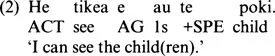
VS – there is no structural marker of an intransitive construction; the V is followed by S which has a zero determinant.

V(S)(O) – the structure of a stateme...
Table of contents
- Cover
- Half Title
- Title Page
- Copyright
- Dedication
- Contents
- Map of Rapanui
- Introduction
- Chapter 1. Syntax
- Chapter 2. Morphology
- Chapter 3. Phonology
- Chapter 4. Ideophones and Interjections
- Chapter 5. Lexicon
- Appendix: The Story of the Yellow Fish
- References
- Index
Trusted by 375,005 students
Access to over 1.5 million titles for a fair monthly price.
Study more efficiently using our study tools.
Frequently asked questions
Yes, you can cancel anytime from the Subscription tab in your account settings on the Perlego website. Your subscription will stay active until the end of your current billing period. Learn how to cancel your subscription
No, books cannot be downloaded as external files, such as PDFs, for use outside of Perlego. However, you can download books within the Perlego app for offline reading on mobile or tablet. Learn how to download books offline
We are an online textbook subscription service, where you can get access to an entire online library for less than the price of a single book per month. With over 1.5 million books across 990+ topics, we’ve got you covered! Learn about our mission
Look out for the read-aloud symbol on your next book to see if you can listen to it. The read-aloud tool reads text aloud for you, highlighting the text as it is being read. You can pause it, speed it up and slow it down. Learn more about Read Aloud
Yes! You can use the Perlego app on both iOS and Android devices to read anytime, anywhere — even offline. Perfect for commutes or when you’re on the go.
Please note we cannot support devices running on iOS 13 and Android 7 or earlier. Learn more about using the app
Please note we cannot support devices running on iOS 13 and Android 7 or earlier. Learn more about using the app
Yes, you can access Rapanui by Veronica du Feu in PDF and/or ePUB format, as well as other popular books in Languages & Linguistics & Linguistics. We have over 1.5 million books available in our catalogue for you to explore.