- 200 pages
- English
- ePUB (mobile friendly)
- Available on iOS & Android
eBook - ePub
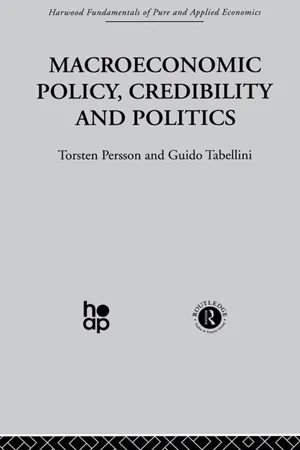
Macroeconomic Policy, Credibility and Politics
About this book
Uses a game theoretic approach to explore which economic policies are 'credible' and 'politically feasible', questions that had eluded traditional macroeconomic approaches.
Information
Publisher
Taylor & FrancisYear
2012Print ISBN
9780415510967
9780415269254
Edition
1eBook ISBN
9781135645595
Macroeconomic Policy, Credibility and Politics
1. Economic Policy as a Game
1.1. Introduction
Until very recently, the theory of macroeconomic policy dealt with the economic consequences of given policy rules. Knowing these consequences and the policy objectives, one would then select the optimal policy rule. Implicit in this approach to policy design is a particular view of the policymaker, namely that he is a passive agent that can be programmed like a machine. Once the optimal rule is identified, the policymaker implements it and the private sector adapts to it.
This approach to the analysis of economic policy contrasts sharply with the way in which policy is carried out in practice. The policymaker is typically a rational and maximizing agent, or collection of agents, who respond to incentives and constraints just like the rest of the economy. A theory of economic policy that neglects these incentives in policy formation is incomplete and is bound to yield misleading prescriptions. For this reason, the recent literature on the theory of economic policy has changed focus. At the core of the research program—together with the study of the consequences of alternative policy rules—is now the analysis of the policy formation process.
At an abstract level, the new approach can be described as the analysis of a principal-agent problem, with many principals and possibly more than one agent. The individual citizens are the principals. They operate as political as well as economic actors. In their political role, they delegate the formulation of economic policy to an agent (or to several agents), the policymakers(s). The agent in turn selects a policy that maximizes his objectives, subject to the relevant constraints. These constraints include the private economic responses to the policy that the principals choose in their role as economic actors. The normative problem is how to design such incentives that the agent implements a policy that maximizes the collective interests of the principals.
Thus, this theory incorporates both positive and normative elements. From a positive point of view, the theory describes the policymaker’s behavior under alternative incentive constraints. From a normative point of view, it suggests how to embed desirable incentive constraints in the existing political and economic institutions, through appropriate institutional reform.
In this section we do three things. First we introduce intuitively some of the important concepts upon which we will heavily rely in the following arguments. In the later sections, these concepts will be defined more precisely and will be related to notions familiar from game theory. Second, we introduce two economic models that will form the basis for much of the analysis in the monograph and use the models to illustrate the discussion about equilibrium policy. Third, with these two models as stepping stones, we outline the contents of the remaining sections.
1.2. Credibility and Politics
We can distinguish between two types of incentive constraints on the policymaker’s optimization problem. First, those relating to a possible conflict of interest between the agent (the policymaker) and his principals in their political role. We call these the political constraints on economic policy. Second, those incentive constraints that correspond to a conflict of interest between the policymaker and the principals in their economic role. Since these constraints are related to the expectations of the economic actors, we call them credibility constraints.
In macroeconomics, the analysis of the policymakers’ incentives originated with the pioneering work of Kydland and Prescott and Calvo on credibility. We also start from there.
1.2.1. Credibility Constraints
Let us suppose for now that there is no conflict of interest between the political actors and the policymaker. Thus, we neglect all political constraints: the policymaker has objectives which coincide with the collective interests of society as a whole. Kydland and Prescott and Calvo were the first to point out that, even in this case, the policymaker may be subject to a binding incentive constraint. Following earlier work on consumer theory by Strotz, they defined a policy plan to be time inconsistent if—given that it is expected by the private sector—the optimal plan made for period t + j at time t is different from the optimal plan made for that period at time t + j. Hence, if a policy is time inconsistent, the government would like to deviate from it during its implementation. Time inconsistency may thus imply lack of credibility.
Clearly, an equilibrium policy must be optimal for the government as well as credible to the private sector. For the private sector would not expect a policy which leaves incentives for policy surprises to be carried out. To determine what we should require from an equilibrium policy, we have to discuss two questions. First, does the policymaker possess the technical possibility of generating policy surprises? Second, does he have an incentive to generate policy surprises? The answers to these questions decide whether credibility imposes a binding constraint on policy.
Timing When does the policymaker have the possibility of generating policy surprises? Clearly, the answer depends on the timing of policy relative to private actions. Specifically, we can think of two different rules for playing the policy game. These rules correspond to alternative institutional environments.
In the first policy environment, policy is chosen once-and-for-all before any private sector decision, and the private sector chooses having observed policy. For example, we can think of the decision of joining a fixed exchange rate system (such as the EMS or Bretton Woods) as being taken in this way: once the decision is made, it is costly to reverse it because of political or economic sanctions that would be imposed by the international community. These costs of reneging then provide a commitment technology. The timing assumption can thus be thought of as capturing the costs of changing a given policy decision.
Even if incentives to surprise exist, no policy surprises are carried out in this setup, by virtue of the commitment technology in the economico-political decision process. Therefore, credibility is not a binding constraint in this case and the equilibrium policy rule maximizes the policymaker’s objective at an initial point in time. This setup was in fact implicit in the analysis of policy rules in the early rational expectations literature.
In the second policy environment, the timing is reversed. Or, put differently, the immediate costs of deviating from a preannounced policy are relatively small. At least some policy instruments can therefore be chosen after (or at the same time as) private economic decisions and after earlier policy decisions. In the terminology used in the literature, policy is chosen under discretion. Here, the capacity to surprise exists, since the private sector has to make some economic decisions before observing policy, and hence on the basis of expectations about what policy is going to be. Whether these private expectations impose a binding credibility constraint on the policymaker, depends on the incentives for policy surprise.
Incentives to Surprise Under what general circumstances does the policymaker have an incentive to surprise the private sector by deviating from a preannounced policy rule? Clearly, this incentive arises only if there is some conflict of interests between the policymaker and the rest of the economy. If there was no conflict of interests, the policymaker and the private individuals in the economy would form a team: They would choose their actions to achieve a common goal, and nobody would have anything to gain by surprising the rest of the team.1
Since we are assuming no political disagreement, a conflict of interests between the policymaker and the private citizens can only arise if there are economic externalities: It is individually rational for an atomistic representative consumer to ignore the externalities, whereas it is rational for the policymaker to internalize them. The next subsection discusses other possible sources of conflict between the policymaker and the rest of the economy, due to political disagreement over the ultimate goals of policy.
But even in the presence of conflict, the policymaker has no incentive to surprise if he has enough policy instruments. With enough instruments, the policymaker can achieve a first-best situation relative to his preferences. That is, he is only bound by the aggregate resource constraint. And therefore, policy surprises cannot bring about any gains at all. But if there is a lack of policy instruments, the policymaker finds himself in a second-best (or worse) situation. Then, policy surprises can be viewed as providing additional policy instruments, and hence there may be an incentive to use them.
To summarize, an incentive to surprise exists in second-best situations, which arise when: (i) there is some conflict of interest between the policymaker and the rest of the economy, and (ii) the policymaker lacks some policy instrument. While it may be a useful analytical abstraction to assume that policy can move the economy to a first-best allocation, that is very unrealistic. In most actual policy situations the policymaker has discretion over some or all of his policy instruments and the first best is unreachable. Therefore the credibility requirement will generally impose a binding constraint on equilibrium policy. Since adding a binding constraint normally leads to a worse outcome, we realize that equilibrium policy in a discretionary regime will typically yield a worse outcome to the government than equilibrium policy in a commitment regime. In line with the argument we have just made, we shall focus mostly on discretionary policy environments throughout the monograph. Regimes with commitments will be analyzed as a benchmark for welfare comparisons.
1.2.2. Political Constraints
Next, suppose there are no credibility constraints, but instead there is a conflict of interests between the policymaker and the citizens because of disagreement over the final goals of policy. Ultimately, the source of this disagreement must derive from heterogeneity among the citizens that leads them to evaluate differently the effects of particular policies. The role of political institutions is to, somehow, aggregate these conflicting interests into actual policy decisions. Typically, different political institutions are not neutral in that they induce different equilibrium policy choices. That is to say, different institutions impose different incentive constraints on policymakers. We call these incentive constraints political constraints. Analyzing the political constraints becomes essential for a positive understanding of policymaker behavior as well as for making normative prescriptions about institutional reforms.
An example of political institutions that modify the policymaker’s incentives is the appointment of government through democratic elections. Elections matter for at least two reasons. First, they may induce policymakers to pay more attention to how the policy appears to the voters than to the policy itself. If the voters are not perfectly informed, this incentive may give rise to electoral policy cycles. Second, elections may create alternation of policymakers with different goals. This ‘political instability’—that is, instability in the policymakers preferences—may a...
Table of contents
- Cover
- Half Title
- Title Page
- Copyright
- Contents
- Introduction to the Series
- Preface
- 1. Economic Policy as a Game
- Part I
- Part II
- Bibliography
- Index
Trusted by 375,005 students
Access to over 1.5 million titles for a fair monthly price.
Study more efficiently using our study tools.
Frequently asked questions
Yes, you can cancel anytime from the Subscription tab in your account settings on the Perlego website. Your subscription will stay active until the end of your current billing period. Learn how to cancel your subscription
No, books cannot be downloaded as external files, such as PDFs, for use outside of Perlego. However, you can download books within the Perlego app for offline reading on mobile or tablet. Learn how to download books offline
Perlego offers two plans: Essential and Complete
- Essential is ideal for learners and professionals who enjoy exploring a wide range of subjects. Access the Essential Library with 800,000+ trusted titles and best-sellers across business, personal growth, and the humanities. Includes unlimited reading time and Standard Read Aloud voice.
- Complete: Perfect for advanced learners and researchers needing full, unrestricted access. Unlock 1.5M+ books across hundreds of subjects, including academic and specialized titles. The Complete Plan also includes advanced features like Premium Read Aloud and Research Assistant.
We are an online textbook subscription service, where you can get access to an entire online library for less than the price of a single book per month. With over 1.5 million books across 990+ topics, we’ve got you covered! Learn about our mission
Look out for the read-aloud symbol on your next book to see if you can listen to it. The read-aloud tool reads text aloud for you, highlighting the text as it is being read. You can pause it, speed it up and slow it down. Learn more about Read Aloud
Yes! You can use the Perlego app on both iOS and Android devices to read anytime, anywhere — even offline. Perfect for commutes or when you’re on the go.
Please note we cannot support devices running on iOS 13 and Android 7 or earlier. Learn more about using the app
Please note we cannot support devices running on iOS 13 and Android 7 or earlier. Learn more about using the app
Yes, you can access Macroeconomic Policy, Credibility and Politics by T. Persson,G. Tabellini in PDF and/or ePUB format, as well as other popular books in Business & Business General. We have over 1.5 million books available in our catalogue for you to explore.