For years, research concerning masculinities has explored the way that men have dominated, exploited, and dismantled societies, asking how we might make sense of marginalized masculinities in the context of male privilege. This volume asks not only how terms such as men and masculinity are socially defined and culturally instantiated, but also how the media has constructed notions of masculinity that have kept minority masculinities on the margins. Essays explore marginalized masculinities as communicated through film, television, and new media, visiting representations and marginalized identity politics while also discussing the dangers and pitfalls of a media pedagogy that has taught audiences to ignore, sidestep, and stereotype marginalized group realities. While dominant portrayals of masculine versus feminine characters pervade numerous television and film examples, this collection examines heterosexual and queer, military and civilian, as well as Black, Japanese, Indian, White, and Latino masculinities, offering a variance in masculinities and confronting male privilege as represented on screen, appealing to a range of disciplines and a wide scope of readers.
eBook - ePub
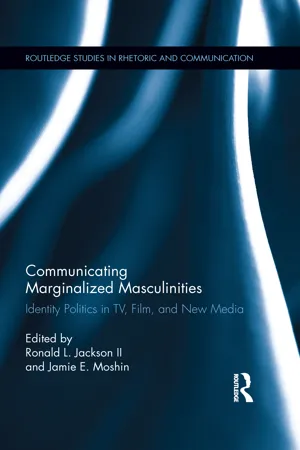
Communicating Marginalized Masculinities
Identity Politics in TV, Film, and New Media
- 254 pages
- English
- ePUB (mobile friendly)
- Available on iOS & Android
eBook - ePub
Communicating Marginalized Masculinities
Identity Politics in TV, Film, and New Media
About this book
Information
1 Kairos, Kanye and Katrina
Online Meditations on Race and Masculinity
“It seems we living the American dream/But the people highest up got the lowest self esteem”—Kanye West (2005)
W.E.B. DuBois is justly famous for his formulation of Black struggles to reconcile an American identity intent on denying the humanity of the Negro, or “double consciousness.” Rawls (2000) revised DuBois’ (1904) articulation to argue that “doubleness” arises from Whites’ and Blacks' mismatched expectations of conversational norms and topoi; although both groups may share the same geographic space, they never occupy the same interactional space. To acclimate to my geographic isolation here in the rolling hills of the Mississippi River Valley, I spend much of my time in a different interactional space: the Internet. My web browsing draws from my ever-present awareness of how I differ from—yet resemble—cultural expectations of Black masculinity.
In the slowly integrating schools of my adolescence, I was mocked for “acting White” and being “soft” because I loved to read, loved school and “talked proper.”1 As a graduate student I was intensely uncomfortable in the constraints of being an “exceptional” Black male placed upon me by my liberal professors. I was aware that by labeling me as such, they sought to separate me from my working-class origins, speech patterns, and cultural perspectives so as to make me palatable for their consumption and indoctrination. Thus, my online travels rejuvenate me by reassuring me that Black masculinity can be articulated from many perspectives: sexuality, politics, class, religion or artistic creativity.
My younger brother, in one of the innumerable sessions of the dozens we play to show affection to one another, once quipped, “When you were in high school, you used to try so hard to be White … but now that you in grad school you've turned into ‘Super Nigga!’” I laughed when he said this, but I couldn't argue with his analysis. In his pithy fashion, he had identified my personal and academic response to multiple crises of representation:
- Stereotype: How does one display the complexity of their Black identity to a world intent on fixity?
- Interiority: How much of our professed Black identity is shaped by what we think the world expects of us?
- Exteriority: How much of our Black identity is shaped by the contexts in which we find ourselves?
Spending as much time on the Internet as I do, I have come to understand that the default Internet identity is White, male, and middle-class, and, as with other media forms, Whiteness on the Internet is often bounded by stereotypes of Black identity. I contend that the Internet is a cultural structure, in which representations of identity are shaped through code, practices and norms. For this chapter, I analyzed Black-authored blogs to see how online authors use the Internet to express their beliefs about Black identity.
RACE, REPRESENTATION AND THIRD PLACES
In the online spaces I frequent and study, Black web users are often interested in the U.S. political process and its effect on their daily lives. The most popular Black cultural online sites, however, engage in a lively discourse centering around a credo akin to “the personal is political.” By this, I mean that if political activity is the negotiation for ideological resources among individuals and between groups, then Black online communities spend a fair amount of time working through the internal and external ideological constraints of being a low-status American subculture.
Conversations on the Internet are often framed through references to Habermas’ public sphere, where groups come together to generate deliberative discourse in pursuit of political goals (Byrne, 2008; Nelson, 2002). Unfortunately, the rise of the Internet as a discursive space where the public can participate in racial commentary without fear of reprisal has led to a rise in online incivility. Many online conversations in mainstream spaces traffic in monolithic perceptions of Black deviance driven by political criticisms of the nation's first African American president. These discussions suggest that American political discourse is inextricably linked to racist and racial ideologies, rather than deliberation around rational principles.
Instead of a public sphere, then, consider the blogs analyzed in this chapter as “third places” (Oldenburg, 1999). Third places have the following features:
- They operate as a neutral space where conversation is the main activity
- They are free of external social hierarchies
- They are inclusive and accessible
- They expand possibilities for association by like-minded souls
- They offer psychological comfort and spiritual support.
Third places are a much more fertile framework from which to understand online discourses. They serve a regenerative function for their regulars; they can reconstitute themselves as “people” apart from their kinship and work networks, as well as from the vicissitudes of everyday life. Before the Internet penetrated deeply into everyday life, conversations like the ones analyzed later in this chapter were limited to Black-orientated venues, to Black discussants, and were often conducted in African American Vernacular English as a way of creating a safe space, or “hush harbor” (Nunley, 2011). The experiences of Blacks in American civic life—de facto segregation and de jure equality—ensure that conversations about how to be “proper” Americans, “real” Black people, gender roles and sexuality are prime topics of conversation in private spaces where Blacks have time to congregate and talk. Conversely, the presence of racist ideologies in mainstream online spaces not only mirrors the offline world, but suggests that racist discourse is regenerative for those who deploy it.
Where DuBois’ double consciousness was enacted within the souls of Black folk, the Internet has exposed that internal discourse for all to see. From my subject position as a Black Internet user and my isolation in the Midwest, I can read and participate in online spaces that test, expand or affirm aspects of my racial and gendered identity. Online responses such as the ones below to crises of public representation highlight the heterogeneity of Black identity formation while also demonstrating the accompanying discursive and rhetorical commonplaces. In the following section, the online authors navigate racial ideologies as they apply their understanding of kairos to Kanye West's Katrina benefit speech, interpreting hip hop, masculinity and a politics of respectability to analyze West's words.
BLACKNESS ON AIR AND ONLINE
I gathered a cross-section of bloggers discussing Kanye West's Katrina relief monologue to analyze the heterogeneity of Black identity. My identification of their Blackness came from a number of data points—profi le descriptions, website design, network linkages (e.g., blogrolls) and discursive markers within their texts. I conducted a computer-mediated discourse analysis (Herring, 2004), framed by critical race theory, to understand how online spaces mediate the expression of racial ethos and identity. Computer-mediated discourse analysis views online behavior through the lens of language by examining online interactions. By applying a critical race perspective, I can then address macro-level questions such as community and identity based on articulations of power relations in discourse.
My analysis found conservative, Christian, female, young, gay, Republican, straight, male and liberal viewpoints on the rhetorical significance of hip hop as a public avatar of Black culture and masculinity. Driven by a rhetorical situation featuring Black men at a moment of extreme import, these writers drew from their racial identities to analyze the importance of kairos for Blacks when being critical of mainstream America in public spaces.
Alliteration in the title aside, kairos is the ideal term to describe Kanye's moment of infamy during the hurricane's aftermath. The classical definition of kairos—the appropriate time (and manner) to speak—highlights an important element of Black discursive identity formation: a love of wordplay in the form of “signifying” (Gates, 1988). Although signifying is usually publicly understood as a game of insults (the “dozens”), it is better understood as a celebration of invention, timeliness and delivery in a discourse style intended to speak truth to power. When issued to an institution (or the wrong person), however, the possibility exists of severe and even deadly personal or civil retribution; this possibility is one of the underlying rationales driving a politics of Black respectability.
West's criticisms of the government's efforts and allegations of presidential racism sparked a firestorm of commentary from many Black online writers. The blogs examined in this chapter, all published in the days immediately following Kanye's speech, highlight a number of reactions to the kairos (my term, not theirs) of West's critique. One set of responses centered on whether Kanye West, the rapper, was the best representative of the Black community to the world at a moment of crisis. Some authors ruminated upon the ethos of rap and its performers as avatars of Black culture. Others considered the staging of the speech, West's delivery and the political significance of Black criticisms of American racial attitudes.
These conversations, and others like them, regularly take place offline in Black communal third places. Through their publication online, these discourses became a part of the public cultural spectacle produced by Kanye West's actions. They also signaled the emergence of Black online culture's evolution towards a “third place,” where for the first time, outsiders could observe the heterogeneity of Black identity. The common factor in these responses was a measured, critical online articulation of Black masculinity within the structure of American public culture.
THE “LOUIS VUITTON DON”: KANYE WEST
When it comes to Black public figures, Kanye West is an anomaly. As a lyricist, West's topical choices differ from more prominently disseminated hip hop tropes of “bitches, bling and blunts”2 by focusing on his own personality quirks. This doesn't absolve West from objectifying women or fetishizing commodities, but for many, his production talents deflect attention from his more outrageous lyrics. Thus, the man who performed “Jesus Walks,” a song detailing his belief in Christ, also won a Grammy award for “Gold Digger”—a song about women who chase men for money.
West's 2005 album Late Registration was awarded a Grammy for Rap Album of the Year and was nominated for Album of the Year. Of late, West's production and artistry have moved away from sample-driven, soul-influenced tunes to synthesizer (and Auto-Tune3) powered, emotionally evocative tracks. This is especially true of his 2008 album 808's and Heartbreak, which was penned following the death of his mother from medical malfeasance.
Stylistically, Kanye is an indifferent rapper—he is not particularly rhythmic, strains to complete rhymes on occasion and has an uneven, slurring diction at times. However, what Kanye does brilliantly is capture the contradictions of being young, Black, male and affluent. In “All Falls Down,” West rhymes about the excess of his conspicuous consumption then brags about his purchase of an exclusive Louis Vuitton luxury item. His popular appeal can be traced to rap's origins as an American art form and its representation of many of the emotional and ideological beliefs driving American identity. Dyson (2004a) describes rap “as a source of racial identity, permitting forms of boasting and asserting machismo for devalued Black men suffering from social degradation, allowing commentary on social and personal conditions in un-censored language and fostering the ability to transform hurt and anguish into art and commerce” (p. 405). West's music typifies Dyson's comments in nearly every dimension, while eschewing the “ghetto” perspective for a middle-class consumerist approach to art. This is doubly ironic, as Dyson notes that many “gangsta” rappers turn out to be middle-class Blacks faking homeboy roots (2004b, p. 413). West has been known for public displays of egotism and narcissism; his litany of concern and caring for others is both symptomatic and surprising for the bloggers examined in this chapter.
Blackness and Whites’ control over it is fertile ground for American popular culture. Violent, oversexed Blacks are staples of American arts and media, serving as delimiters for White identity. Like other American art forms, rap often employs violent imagery, the objectification of women, expressions of hypersexuality and hypermasculinity, drug use and consumer culture as tropes for expression, in the service of a commentary on social oppression and a celebration of a male-privileging Black identity. Jackson (2006) notes that frequent references to “thugs” in today's hip hop refer to a “myth of a socially sanctioned Black male warrior, who, by mere coincidence, is also sexually charged” (p. 111), later arguing that the antithesis of “thug life” would portray the male as “weak or soft as sensitive, loving, nurturing, and monogamous” (p. 112). In this, rap reflects American culture in terms that Americans are ideologically comfortable with—the moral and intellectual degeneracy of Black culture.
Kelley (1997) argues that rap is often publicly articulated as a devaluating influence on Black identity and culture, or conversely that rap is proffered as an authentic expression of a ghetto youth culture filled with violence, crime and drugs. The authors examined in this chapter employ these perspectives to articulate their identity while interpreting Kanye's music and artistry. Kelley adds, however, that rap should also be understood in terms of the pleasure it affords its creators, instead of solely as a political statement or essentializing cultural narrative. Rap should be analyzed with respect to its fulfillment of stylistic and aesthetic conventions that “render the form and performance more attractive than the message” (1997, p. 39) to the practitioners and their audiences. This approach acknowledges that there may well be liberatory or degenerative possibilities within rap, but that it is best understood as an aural and kinesthetic art form, rather than a lyrical or moral one.
KANYE SPEAKS HIS MIND
As a show of support for the victims of Hurricane Katrina's aftermath, NBC broadcast a “Hurricane Relief Benefit” telethon on Friday, September 3, 2005. West performed and later was tapped to read prepared text asking for donations. Instead of following the script, West delivered a heartfelt, impromptu plea that shocked the audience and polarized the nation:
I hate the way they portray us in the media. You see a Black family, it says, “They're looting.” You see a White family, it says, “They're looking for food.” And, you know, it's been five days [waiting for federal help— AB...
Table of contents
- Cover
- Half Title
- Routledge Studies in Rhetoric and Communication
- Full Title
- Copyright
- Dedication
- Contents
- Acknowledgements
- Preface: Communicating Marginalized Masculinities
- 1 Kairos, Kanye and Katrina: Online Meditations on Race and Masculinity
- 2 “Is that a PC in Your Pocket, or is it Something More?” The Newton PDA and White-Collar Masculinity
- 3 Competing South Asian Mas(k)ulinities: Bollywood Icons versus “Tech-N-Talk”
- 4 Color and Movement: The Male Dancer, Masculinity and Race in Film
- 5 A Gendered Shell Game: Masculinity and Race in District 9
- 6 The Evolution of an Identity: G.I. Joe and Black Masculinity
- 7 A “Vocabulary of Feeling”: Japanese American Masculinity in Conscience and the Constitution
- 8 Fat, Sass and Laughs: Black Masculinity in Drag
- 9 Narrating the Presidential “Race”: Barack Obama and the American Dream
- 10 The Man in the Box: Masculinity and Race in Popular Television
- 11 White Masculinity and the TV Sitcom Dad: Tracing the “Progression” of Portrayals of Fatherhood
- 12 From Album Novel to Cowboy Soap Opera: Melancholia, Race and Carnival in the Multi-Media Works of Mario Prata
- 13 Smooth and Latin: Reflections on Mario Lopez, Ballroom Dancing, and Latino Masculinity
- 14 “State Property” and Friends: Black Men's Performances of Masculinity and Race in Prison
- Contributors
- Index
Trusted by 375,005 students
Access to over 1.5 million titles for a fair monthly price.
Study more efficiently using our study tools.
Frequently asked questions
Yes, you can cancel anytime from the Subscription tab in your account settings on the Perlego website. Your subscription will stay active until the end of your current billing period. Learn how to cancel your subscription
No, books cannot be downloaded as external files, such as PDFs, for use outside of Perlego. However, you can download books within the Perlego app for offline reading on mobile or tablet. Learn how to download books offline
Perlego offers two plans: Essential and Complete
- Essential is ideal for learners and professionals who enjoy exploring a wide range of subjects. Access the Essential Library with 800,000+ trusted titles and best-sellers across business, personal growth, and the humanities. Includes unlimited reading time and Standard Read Aloud voice.
- Complete: Perfect for advanced learners and researchers needing full, unrestricted access. Unlock 1.5M+ books across hundreds of subjects, including academic and specialized titles. The Complete Plan also includes advanced features like Premium Read Aloud and Research Assistant.
We are an online textbook subscription service, where you can get access to an entire online library for less than the price of a single book per month. With over 1.5 million books across 990+ topics, we’ve got you covered! Learn about our mission
Look out for the read-aloud symbol on your next book to see if you can listen to it. The read-aloud tool reads text aloud for you, highlighting the text as it is being read. You can pause it, speed it up and slow it down. Learn more about Read Aloud
Yes! You can use the Perlego app on both iOS and Android devices to read anytime, anywhere — even offline. Perfect for commutes or when you’re on the go.
Please note we cannot support devices running on iOS 13 and Android 7 or earlier. Learn more about using the app
Please note we cannot support devices running on iOS 13 and Android 7 or earlier. Learn more about using the app
Yes, you can access Communicating Marginalized Masculinities by Ronald L. Jackson II,Jamie E. Moshin in PDF and/or ePUB format, as well as other popular books in Media & Performing Arts & Communication Studies. We have over 1.5 million books available in our catalogue for you to explore.