- 298 pages
- English
- ePUB (mobile friendly)
- Available on iOS & Android
eBook - ePub
About this book
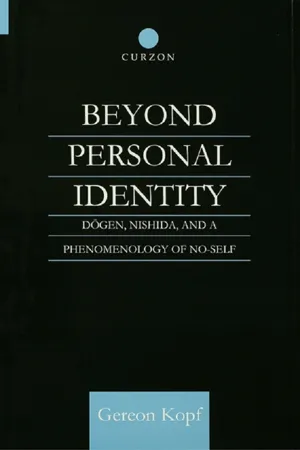
Applies Dogen Kigen's religious philosophy and the philosophy of Nishida Kitaro to the philosophical problem of personal identity, probing the applicability of the concept of non-self to the philosophical problems of selfhood, otherness, and temporality which culminate in the conundrum of personal identity.
Information
Part One
Personal Identity Revisited
Chapter One
The Problem of Personal Identity
Introduction
The philosophical discussion of the notion of personal identity, that is, the question of how we can conceive of the continuity of persons over time, seems to have reached a pivotal phase. Derek Parfit’s radical denial of the notion of personal identity and the subsistence of any personal essence over time, which he first formulated in his essay “Personal Identity” (1971) and later stratified in his ingenious Reasons and Persons (1984), has left the contemporary philosopher with the uneasy choice between reliance on the almost untenable notion of an inconceivable substratum of selfhood or the seemingly unthinkable, unethical (in the eyes of some of Parfit’s opponents) and, definitely, counter-intuitive rejection of personal identity. After all, we claim our identity with a past self every day in our self-presentation through stories, curricula vitae, and credit histories as well as through relationships to family relations, friends, and colleagues. Parfit’s rejection of the traditional conception of personhood and selfhood has received even more weight since it finds support in recent claims of leading cognitive scientists, such as Ray Jackendoff, and researchers of Artificial Intelligence (AI), such as Marvin Minsky (1985), that the cognitive processes of the mind do not necessitate an underlying, permanent self or Ego.1 If true, the dictum of human selflessness would have implications beyond the realm of philosophy, influencing psychology, cognitive science, and, most of all, ethics because of the importance of the concept of personal identity to the questions of ethical accountability, responsibility, property rights, and the delineation of human life. These questions are central not only to general ethical theories but also to the evaluation of ethical and psychological consequences of contemporary technology and science, such as brain tissue transplants,2 and real as well as possible achievements in the realm of AI, highlighted by popular entertainment à la Hollywood. It also affects the evaluation and treatment of special psychopathological cases such as Multiple Personality Disorder (MPD). In addition, the notion of personal identity carries significant soteriological implications in that it seems to constitute a necessary condition for a belief in an afterlife, whatever form it may take. However, the main question that concerns me in this book can be summarized as follows: How is it possible to talk about persons, selves, and minds in the face of a theory of selflessness? Assuming that the dictum of selflessness, advanced not only by Parfit but also by David Hume, Jackendoff, Minsky, and, most importantly for the present enterprise, Buddhism, is viable, how is it possible to articulate and solve questions concerning the identity, continuity, personhood, and selfhood of the human individual? The present chapter will analyze the conception of personal identity as well as Parfit’s rejection of it and propose a way to talk meaningfully about the issues of personhood, selfhood, and the human experience of temporality without presupposing or even necessitating the notion of personal identity. Part Two will explore the notion of selfhood and temporality as advanced by Zen Master Dōgen and the philosopher NISHIDA Kitarō.
At this point, an important clarification seems necessary. While it is my main interest here to examine the metaphysical structure of the concept “personal identity,” I am less concerned with negotiating the arguments supporting and/or refuting the various conceptions of personal identity, which focus on the criteria for personal identity – Andrew Brennan (1988), Harold W. Noonan, (1989) and John Perry (1975) have already provided comprehensive overviews of the existing theories within the tradition of analytical philosophy – but rather with probing the assumptions underlying such conceptions and their implications. What are the contributions and implications of the most prevalent theories of personal identity? In particular, I am interested in the criticism, which has been advanced to varying degrees by Richard G. Swinburne (1984), Roderick M. Chisholm (1976), and especially by Paul Ricoeur (1992), that the discourse on the criteria of personal identity within analytical philosophy tends to overlook the subjective dimension characteristic of the formation of personal identity.3 Who is the “I” who announces his/her identity in stories and curriculum vitae? What is the significance of the subjective function, which John Searle (1992) labels first-person-ontology, for the construction of personal identity and for the discussion of its criteria? More specifically, I am interested in the description and examination of the existential sense of continuity and constancy and the concomitant construction of personal identity in narratives and philosophical theory. Contrary to the claims of Swinburne and Chisholm, however, I believe that such a criticism does not necessitate the notion of personal identity and an underlying and unchanging Ego.
The Concept of Personal Identity
The concept of personal identity arose arguably within the European intellectual tradition. It has its etymological roots in the colloquial Greek term prosopon and its Latin equivalent persona, signifying “the mask worn in comedy or tragedy” or “the character an actor plays – dramatis personae.” (Chadwick 1981, 193). As early as the sixth century, Boethius (480–524 C.E.), a Latin philosopher and Christian theologian, formulated the concept of personal identity as a synthesis of the Aristotelian concept of substance and the notion of an eternal soul, which early Christian theology had inherited from Neoplatonist philosophy. In the context of the early Christian debates on Christology,4 Boethius developed his now famous definition of persona as “individual substance of rational nature” (Lat.: naturae rationabilis individua substantia) (193). The foremost function of this formula was to express that Jesus the Christ, despite his dual nature – divine and human – was unified and one in numero. Nevertheless, the formula additionally identified the “incommunicable quality of the individual within the human species” (194) which functions as the self-identical and individual essence of the human being. Boethius’ definition of the concept “persona” radically differs from its original meaning “mask” in that it, now, denoted that which persisted over time, despite changes and transformations that might occur in its attributes and accidents,5 be they physical or psychological in character. It is important to note that Boethius’ usage of “persona” implies unity, endurance, and, most importantly, rationality, thus distinguishing the essence of Mensch-sein not only from the mask that can be arbitrarily and deliberately utilized or discarded by any given actor, but also from inanimate, insensible, and irrational entities. However, it was not until the notion of the individual had developed in the thought of the Italian Renaissance, the Protestant Reformation, and the European Enlightenment that the conception of personal identity as an individual-over-time became the subject of general philosophical debate, involving eminent thinkers such as Gottfried W. Leibniz, John Locke, Hume, Joseph Butler, and Thomas Reid.6 By then, the synthesis of Aristotelian and Neoplatonist thought within the Christian theological tradition had given rise to the notion of an individual and enduring core, which clearly demarcates and identifies an individual, human person. During the periods of the Enlightenment and Modernism, this notion of the individual person-overtime was adopted as the general theory of Mensch-sein, underlying most philosophical, psychological, and ethical systems in the West. For all these theories (with the exception of the theories of Hume, Parfit, and some cognitive scientists), the notion of a real, enduring, and conscious agent, namely personal identity, functions as a necessary condition, addressing the issues of ethical responsibility and accountability as well as the continuity of experience. Today, personal identity is defined as persistence-over-time, suggesting that there is one enduring individual which persists through a multitude of different and separate moments in time and which possesses a multitude of experiences.
In some sense, the theory of personal identity emerges from the attempt to explain and conceptualize the sense of continuity characteristic of the existential predicament of the experiential “I.” Awakening to itself, the experiential “I,” that is, the self-conscious agent, finds itself thrown, as Martin Heidegger would say,7 into a particular situation and context of historicity. To give an example, every morning I wake up knowing who I am, who my relatives, colleagues, and friends are, what my social function and professional responsibility is, etc. In short, I experience myself continuous and identical with a past self; at the same time, this identity is being reinforced by the community in which I find myself, by the people who meet me, recognize me, and, in some sense create who-I-am in their stories, expectations, and prejudices. The lack of such an experience of identity and the shortage or even negative reinforcement of an assumed identity would create a comical or haunting scenario as exploited in novels such as Joy Fielding’s See Jane Run. This everyday experience of continuity and assumption of identity translates into the contention that the person P exists at, and persists through, diachronically diverse moments such as t1, t2, t3, t4, etc. For the sake of clarity, I would like to identify “P at t1” as P1 and “P at t2” as P2. Any theory of personal identity inquires into the following questions: What is it that continues from t1 to t2? What warrants the attribution of two experiences P1 and P2 to one “person” P? What privileges the relationship between P1 and P2 over the relationship between P1 and, for example, Q2 in the understanding of personal identity? Why is it possible for me to claim identity with the person who graduated from Temple University in 1996 (P2) but not with the person who won the election for the American presidency in the same year (Q2), or with the person who authored the Tao te Ching more than 2000 years ago (R3)?
The colloquial usage of the term “person” is highly ambiguous, signifying both the diachronic person-over-time such as P and individual persons-at-the-moment such as P1 and P2. The notion of the person-over-time designates a set of diachronically separate experiences such as being born at t1, entering high school at t2, and attending college at t3, if and only if at any given time t0 one diachronical, personal unity corresponds to one and only one person – at-the-moment. The term “person-at-the-moment,” on the contrary, signifies one particular experience of a given person-over-time. Assuming the differentiation between person-over-time and person- at-the-moment, Noonan distinguishes between diachronic identity and synchronic identity: the former addresses the relationship between two diachronically disparate person-stages, P1 and P2, while the latter investigates the relationship between one person-stage, P3, and the diachronic stream of experiences called “person,” namely P (Noonan 1989, 104–5). Diachronic identity is expressed in statements of the form “the person who wrote Steppenwolf (P1) and the person who wrote Siddhartha (P2) are identical,” synchronic identity in statements such as “Hermann Hesse (P) is identical to the author of Steppenwolf (P1).” In addition, personal identity does not only require such a diachronic identity relationship between the two persons-at-the-moment P1 and P2 and a synchronic identity relationship between the atemporal person P and person stage P1 but, to be more specific, their exclusive identity in that, at any given time t0, P is synchronically identical to but one person-stage P0 and that person-stage P1 at t1 is diachronically identical with but one P0 at any given time t0. Personal identity thus defined is a clear-cut matter of yes-or-no – tertium non datur.
Thus, the theory of personal identity investigates three central questions: How is it possible to identify a person (myself and others) as an individual human being? How is it possible to distinguish between two individual persons? What guarantees the constancy and identity of an individual person over time? These questions are designed to identify the fundamental characteristics of an individual and to isolate that which makes an individual human being unique. In this sense, the theory of personal identity defines continuity of experience solely as the persistence and preservation of one individual person. As mentioned before, such an enterprise is of utmost importance since its practical implications cover a wide range of problems that include memory, recognition (how is it that I recognize an individual human being whom I have met before?), ethical responsibility and accountability (what are the conceptual conditions to make an individual human being accountable for what s/he has done ten years ago?), and legal problems such as the attribution of property (who is the referent of possessive pronouns?). In short, all these dilemmas hinge on the fundamental question “What are the criteria which identify a human individual-over-time beyond doubt?” At the same time, these questions map out the complexity of the issue, which is reflected in the breadth of approaches to personal identity and the emerging interdisciplinary character of the discourse on personal identity. Recognition evokes the social aspect of human existence, while the delineation of human individuals involves the considerations of communicability of mental content in interpersonal interaction and the exchangeability of human organs in transplants as well as the clarification and definition of “content” and “delineation.” In addition, concepts such as “identity,” “substance,” and “continuity” have metaphysical and, for the most part, logical implications. Most of all, however, it has to be examined how the various theories of personal identity reflect the human experience of identity and difference, endurance and transformation. Finally, and this point is often overlooked within the discourse on personal identity, the quest for personal identity suggests two methodologies, a first-person-approach and a third-person-approach: The former inquires “How do I define myself?” and “How can I identify what is intrinsically me?” while the latter defines and recognizes an other’s personal identity from the outside.
Three Theories of Personal Identity
Introduction
Traditional responses to the problem of personal identity have varied significantly in the past three hundred years. The prevalent theories of personal identity can be roughly divided into three groups: First, there are the essentialist theories, which, following Leibniz’ principium identitatis indiscernibilitium, conceive of personal identity as an unchanging constant in the flux of time reflective of Boethius’ naturae rationabilis individua substantia. With the challenge to, and the undermining of, the essentialist paradigm, which began (in the European philosophical tradition) with Hume, a rethinking of the notion of personal identity has become necessary. The post-Humean philosopher concerned with the question of personal identity finds her/himself in the dilemma of either subscribing to the mysterious, as well as questionable, concept of a substance or forsaking the ethically crucial and seemingly empirical, self-evident notion of personal identity. Faced with this alternative, the criteriologist8 establishes personal identity by identifying the necessary and sufficient criteria that constitute personal identity. This approach discloses two possible solutions, namely, the attribution of personal identity to bodily continuity or to psychological continuity. Such an alternative, however, warrants two immediate observations. First, this dichotomy obviously arises from and is reminiscent of the mind-body dualism, which has received its ultimate philosophical expression in the European philosophical tradition by René Descartes, and, thus, reflects the Cartesian legacy. I believe that this revival of the Cartesian dichotomy reveals some of the fundamental issues and metaphysical assumptions involved in the criteriological controversy. Second, the discussion of the physical and the psychological criteria raises the question whether these approaches actually substitute the notion of substance with a bodily or a psychological continuity or whether they simply substantialize the human body or the psychological complex involving memory and consciousness. On first sight, this question might appear to be splitting hairs, but, as will become clear in the course of the present chapter, it uncovers the most fundamental concern of the philosophical quest for personal identity.
Personal Identity Qua Substance
The essentialist approach conceives of personal identity as a substance,9 that is, an underlying, unchanging unity, which has a certain set of attributes subject to change, and which is different from the physical body, memory, and consciousness. The latter phenomena comprise the transient attributes of Mensch-sein, while personal identity constitute its unchanging core and essence. Thus defined, personal identity is the very principle which enables me to identify myself with various stages (person-stages, if you will) in my life and with the infant in my photo-album and a believer in transmigration with a previous existence. In this sense, the essentialist conception of personal identity echoes the everyday notion of a person as someone who has a beginning, namely, birth, persists through change, despite the changes in her/his life and the general transient nature of the phenomenal world, corresponds to one, unique person-at-the- moment at any given time to, and dies at the end of her/his life. To explore the tension between the sense of continuity and constancy, which is so important to the conventional world constructed by the human community, and the obvious physical and psychological changes human individuals undergo during a life span, the defenders of the essentialist hypothesis employ thought experiments such as Heraclitus’ river and “Theseus’ ship.” Leibniz, one of the first champions of the essentialist understanding of personal identity, uses these thought experiments to exemplify the concept of personal identity as substance. Heraclitus’ river, to Leibniz, remains the same, one river, despite the constant flux of water particles which comprise the river. While the flux of water merely indicates a change in the river’s attribute, that is, the water, the essence of the river, that is, what establishes the river as such, remains constant and unchanging. By the same token, Leibniz attributes the identi...
Table of contents
- Cover
- Half Title
- Title Page
- Copyright
- Contents
- Preface
- Introduction
- Part One: Personal Identity Revisited
- Part Two: Zen Buddhism and Phenomenology on Self-Awareness
- Part Three: Zen Conceptions of Indentity
- Notes
- Glossary of Japanese Terms
- Key to Texts by Dōgen and Nishida
- Works Cited
- Index
Trusted by 375,005 students
Access to over 1.5 million titles for a fair monthly price.
Study more efficiently using our study tools.
Frequently asked questions
Yes, you can cancel anytime from the Subscription tab in your account settings on the Perlego website. Your subscription will stay active until the end of your current billing period. Learn how to cancel your subscription
No, books cannot be downloaded as external files, such as PDFs, for use outside of Perlego. However, you can download books within the Perlego app for offline reading on mobile or tablet. Learn how to download books offline
Perlego offers two plans: Essential and Complete
- Essential is ideal for learners and professionals who enjoy exploring a wide range of subjects. Access the Essential Library with 800,000+ trusted titles and best-sellers across business, personal growth, and the humanities. Includes unlimited reading time and Standard Read Aloud voice.
- Complete: Perfect for advanced learners and researchers needing full, unrestricted access. Unlock 1.5M+ books across hundreds of subjects, including academic and specialized titles. The Complete Plan also includes advanced features like Premium Read Aloud and Research Assistant.
We are an online textbook subscription service, where you can get access to an entire online library for less than the price of a single book per month. With over 1.5 million books across 990+ topics, we’ve got you covered! Learn about our mission
Look out for the read-aloud symbol on your next book to see if you can listen to it. The read-aloud tool reads text aloud for you, highlighting the text as it is being read. You can pause it, speed it up and slow it down. Learn more about Read Aloud
Yes! You can use the Perlego app on both iOS and Android devices to read anytime, anywhere — even offline. Perfect for commutes or when you’re on the go.
Please note we cannot support devices running on iOS 13 and Android 7 or earlier. Learn more about using the app
Please note we cannot support devices running on iOS 13 and Android 7 or earlier. Learn more about using the app
Yes, you can access Beyond Personal Identity by Gereon Kopf in PDF and/or ePUB format, as well as other popular books in Social Sciences & Ethnic Studies. We have over 1.5 million books available in our catalogue for you to explore.