First published in 1931, this is an attempt by the great economist J. A. Hobson to analyse the relations between economics and religion. After considering the origins of the conflicts and compromises between God and Mammon in the life of primitive man, the author concerns himself primarily with medieval and modern Christianity and the business climate and ethos corresponding with these periods. In particular he focuses upon Catholicism and Protestantism, before considering the attitude of the church towards modern economic movements.
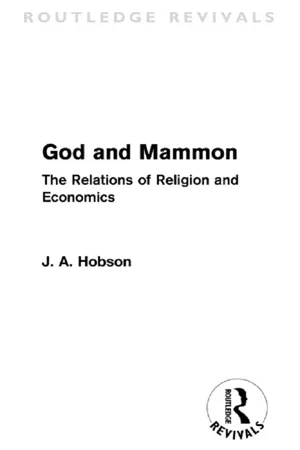
- 58 pages
- English
- ePUB (mobile friendly)
- Available on iOS & Android
eBook - ePub
CHAPTER III
Protestantism and Business
I
THE sixteenth century was an age of new and stirring adventure in many fields of human activity. The mariner's compass had given a freedom of the seas to adventurous traders. The discovery of the Cape route to India and of the American continent had destroyed the trading and maritime supremacy of the Italian cities. First Spain and Portugal, later England and Holland, established commercial relations along the African and American coasts and with the islands of the Pacific. Europe, hitherto stinted in the precious metals, which flowed to the East in payment for spices and other Eastern luxuries, was now nourished financially with gold and silver from the American mines. Spanish treasure-ships bearing the plunder of Mexico and Peru became the prey of British or Dutch pirates, much as the rum-runners and bootleggers in America to-day are prey of the highjackers and the racketeers.
This new flow of the precious metals played into the hands of early capitalism, both on its financial and industrial sides. It brought the development of a money-market, with the financing not only of great foreign trading companies, but also of new mining and textile trades. In England the ruin of the old feudal aristocracy in the Wars of the Roses and the passage of the Church lands into the hands of new business men were transforming the old routine of feudal custom, and industrializing large sections of rural England. These distinctively economic changes coincided with the great new revival and expansion of learning, literary, artistic, scientific, known as the Renaissance. The flood of fresh thought and speculation which burst first in Italy, and then flowed north and west, was not merely a revelation of the art and literature of Hellas. It was a new free stir in the mind of educated man throughout Europe, exhibiting itself in scepticism and revolt against dogmas and accepted standards, religious, scientific, political, and ethical. The mingled rationalism and imaginative enterprise of this spiritual revival come home best to us in the literature and the adventure of the Elizabethan days. It was a sense of liberty in the world of thought and matter, on every plane of activity; new worlds to conquer and the stirring of a free spirit for the task of conquest.
The urges of this new economic and intellectual life were bound to come into conflict with the conservatism and the vested interests, material and moral, of the Catholic Church. The tide of new learning, sweeping through the Universities of Europe from Italy and reaching England first through scholars like Grocyn and Linacre, afterwards raised to the level of enthusiasm by the Dutch visitor Erasmus and his disciples More and Colet, was not with any clear intent an attack upon orthodox religion. But none the less it carried the seeds of a Protestant revolt. A definite anti-clericalism already lay slumbering in the growing resentment against the powers, privileges, and possessions of the Church, before any plain doctrinal divergences were manifested. The combination of a revived Lollardry and Bible-reading and the new learning among the growing lay educated class undoubtedly helped Henry VIII in his substitution of clerical nationalism for the rule of Rome. The printing press was the most revolutionary weapon ever placed in the hands of man. It enabled him to test the authority of the Church and to put his own judgment on the evidences of his faith.
This brief survey of leading influences and events may help us in considering how far economic forces produced or moulded Protestantism and its Puritan distillation. The Roman Church, as a Catholic institution autocratically overriding the new institution of the national state, claiming both spiritual and temporal supremacy, and a supremacy enforced by innumerable economic suckers, aroused deep hostility among the self-respecting burghers of the growing cities of Germany, Holland, and England. Not the doctrines or the rites of the Church, but the exactions and restrictions it imposed were the roots of this discontent. In this sense and to this extent the causes of Protestantism may be said to have been economic. The central and local parasitism by which a large proportion of the product of the industry of the people passed to the support of local monasteries, chantries, and churches, and through them, or directly, to swell the papal treasury, was felt as a growing grievance even among the religious-minded laity. The new nationalism of the Tudors, with their centralized state government, intensified these usurpations of a foreign master, and greatly aided Henry in his schemes of monarchical aggrandisement. In one quite definite way the plunder of the monasteries and abbeys helped the cause of Protestantism.” That unhallowed booty,” writes Disraeli, “created a factitious aristocracy, ever fearful lest they might be called upon to disgorge their sacrilegious spoil. To prevent this they took refuge in political religionism, and paltering with the disturbed consciences or the pious fantasies of a portion of the people, organised them into religious sects. These became the unconscious Pretorians of their ill-gotten domains. At the head of these religionists, they have continued ever since to govern, or powerfully to influence, this country.”1
Though there is an element of fantastic exaggeration in this imputation of continuous Whig politics to the new Tudor gentry, the dispersion of Church lands undoubtedly helped to build up a solid country block which co-operated with the new bourgeoisie against every attempt to restore Catholicism during the sixteenth and seventeenth centuries. Most of the purchasers of the Church lands probably remained faithful adherents of the Church of England, but a not inconsiderable number of their descendants in the Stuart days were found among the Independents and other sectaries that furnished Cromwell's armies with men and funds.
It would also be true to say that in England, as also in the continental countries subject to the new commercial and financial influences and opportunities, the constant drainage of wealth passing to the Roman Church was felt as a grave impediment to economic progress. Moreover, the diversion of this wealth from the care of the poor and other charitable uses to the support of idle, luxurious, and evil-living monks and clerics was a growing scandal in all Catholic countries, and especially in Rome itself, where it was associated with a widespread disbelief in the basic doctrines of Christianity and the reduction of religion to a profitable formalism.
It is no wonder that pious pilgrims to Rome from other Catholic lands were shocked by what they saw and heard, and that their reports on their return helped to feed the anticlericalism of countries like Germany, the Netherlands, Scandinavia, and Britain. Genuine moral disapproval thus came to be blended with economic discontents.” Loose from Rome” meant a sounder religion, national or local in its organization, and with full control of its own resources and offices.
* * *
The Protestant churches, however, were not in their first intent disposed to relax any of the spiritual authority exercised by organized religion over the moral and economic conduct of their members. It is not true to represent the new sectarian teaching of Lutherans, Calvinists, Independents, as the substitution of the authority of the Book for that of the Church, and of the private judgment of the individual for priestly authority. Though the Bible, now translated, was made accessible to the minority who were capable of reading, the authority of the reformed Church of England was never based, and is not now based, upon the authority of the Bible, but upon the continuous inspiration of the Church: the right of private judgment is in all matters of faith and doctrine subject to the authority of that Church. Nor was there in this matter any substantial difference in the attitude of the Protestant churches. Their founders and early spiritual leaders claimed for their several Churches an authority of doctrinal interpretation and of moral regimen as real as, and in the case of Calvinism more rigorous than, that exercised by the Roman Church.
Luther's intention and personal influence were not directed to release the economic or business conduct of men from the rule of spiritual life exercised by the Christian community. His earlier attitude during his reforming activities was a disparagement of material gain, an indifference towards the economic life. “The pursuit of material gain beyond personal needs must thus appear as a symptom of lack of grace, and since it can apparently only be attained at the expense of others, directly reprehensible.”1 His later views led him to value more highly the work of the world. It was the familiar attitude of spiritual conservatives. Divine Providence had placed men in their proper “calling,” and it was their duty to adapt themselves to this appointed “station in life.” The early Lutheran Church, thus inspired, cannot be regarded as friendly to capitalism. Luther's own repudiation of usury, or indeed interest of any kind, involves a definitely reactionary attitude towards the rising commercial and financial capitalism of his time.
Mr. Tawney makes the following interesting comments upon the position taken, not only by the Lutherans, but also by other important Protestant sects: “If it is true that the Reformation released forces which were to act as a solvent of the traditional attitude of religious thought to social and economic issues, it did so without design, and against the intention of most reformers.” “In the sixteenth century religious teachers of all shades of opinion still searched the Bible, the Fathers, and the corpus juris canonici for light on practical questions of social morality, and as far as the first generation of reformers was concerned, there was no intention, among either Lutherans, or Calvinists, or Anglicans, of relaxing the rules of good conduct which were supposed to control economic transactions and social relations. If anything, their tendency was to interpret them with a more rigorous severity, as a protest against the moral laxity of the Renaissance, and in particular, against the avarice which was thought to be peculiarly the sin of Rome.”1
Thus, in estimating the influence of Protestantism upon economic theory and conduct, we must distinguish the intention of the Reformers from what may be termed the natural consequences of their reforms, and the precepts of the early enthusiasts of reform from the practices of the succeeding generations of their adherents. The early reformers did not abandon the idea of a Church-civilization in which all departments of individual and social conduct should be regulated in acordance with the law of God, as interpreted and administered by the Church.
The severance of “business” from the moral control of the Christian community, and the adoption of a laissez-faire individualism had no place whatever in early Protestantism. How the severance was actually achieved, how the Protestant virtues and valuations became the nutriment of capitalistic energy and enterprise, is best studied in Calvinism and the sects which its teaching inspired.
Calvinism was characterized by its spiritual isolationism. A man's communication with his God was not through the organization of his Church, important as that was to his religious life, but a directly personal one. And yet, as numberless records indicate, Church discipline was remorselessly imposed upon every branch of personal and social conduct.
Calvinism, alike in the country of its origin, Switzerland, and in those of its early penetration, Holland, Scotland, France, England, and later America, was brought into close contact with the changes of a bustling urban life. Luther's economic attitude remained that of a countryman. But Geneva, Antwerp, Amsterdam, London, and Edinburgh were filled with men occupied with industry, commerce, and finance. Did Calvinism take hold in these countries because of the more independent and self-reliant stock that were born in or gravitated to these centres of progressive business? Was it the religion that suited this type of men in this economic environment, a process of natural selection? Or did the Calvinist faith, with its unflinching logic, its lack of emotionalism, its severe rules of personal ethics, supply the forces and conditions of success in the new competitive system that was everywhere beginning to displace the narrowly ordered customary processes of guild life? Mr. Tawney goes so far as to assert that “it is perhaps the first systematic body of religious teaching which can be said to recognize and applaud the economic virtues.”1
A society of hard, thoughtful, industrious men and women, bent upon their personal salvation, to be achieved, under Divine predestination, by conduct conducive to the glory of God, was easily led to regard its occupations and “callings” as chief instruments in the spiritual life thus conceived. Every business activity, not expressly sinful, was regarded by them as conducive to the glory of God. The qualities that made for business success in the new economic order were qualities valued on their own account as contributory to a godly life, and the regulations of their churches gave them the social approval.
What, then, were these useful economic qualities? Some were positive—viz., industry, initiative and enterprise, honesty, foresight, calculation. Others were negative, the ascetic virtues of temperance and continence, the avoidance of pleasures and amusements; thrift and accumulation of capital. Now, as we shall observe, this way of life was more or less common to all Protestant sects, at any rate in their early stages. But Calvinism was peculiarly adapted to their encouragement and effective practice. It did not keep the mind concentrated upon the next world to the neglect of this. It eschewed “enthusiasm,” a disturbing emotionalism hostile to sound business enterprise and orderly work. Its doctrine of predestination relieved the saint of the brooding anxiety of spirit which was apt to sap the energy otherwise available for money-making. Above all, disregarding the express teaching of Christ about the dangers of riches, it regarded them with favour as the natural fruit of business ingenuity and toil, condemning only their misuse for self-indulgence and ostentation. Mammon, in fact, was taken into the service of God as a junior partner. This crude ...
Table of contents
- Front Cover
- Halt Title
- Title Page
- Copyright
- Title Page
- Copyright
- Preface
- Contents
- I. Economics in Primitive Religions
- II. Catholicism and Economic Life
- III. Protestantism and Business
- IV. The Churches and Modern Economic Movements
Trusted by 375,005 students
Access to over 1.5 million titles for a fair monthly price.
Study more efficiently using our study tools.
Frequently asked questions
Yes, you can cancel anytime from the Subscription tab in your account settings on the Perlego website. Your subscription will stay active until the end of your current billing period. Learn how to cancel your subscription
No, books cannot be downloaded as external files, such as PDFs, for use outside of Perlego. However, you can download books within the Perlego app for offline reading on mobile or tablet. Learn how to download books offline
Perlego offers two plans: Essential and Complete
- Essential is ideal for learners and professionals who enjoy exploring a wide range of subjects. Access the Essential Library with 800,000+ trusted titles and best-sellers across business, personal growth, and the humanities. Includes unlimited reading time and Standard Read Aloud voice.
- Complete: Perfect for advanced learners and researchers needing full, unrestricted access. Unlock 1.5M+ books across hundreds of subjects, including academic and specialized titles. The Complete Plan also includes advanced features like Premium Read Aloud and Research Assistant.
We are an online textbook subscription service, where you can get access to an entire online library for less than the price of a single book per month. With over 1.5 million books across 990+ topics, we’ve got you covered! Learn about our mission
Look out for the read-aloud symbol on your next book to see if you can listen to it. The read-aloud tool reads text aloud for you, highlighting the text as it is being read. You can pause it, speed it up and slow it down. Learn more about Read Aloud
Yes! You can use the Perlego app on both iOS and Android devices to read anytime, anywhere — even offline. Perfect for commutes or when you’re on the go.
Please note we cannot support devices running on iOS 13 and Android 7 or earlier. Learn more about using the app
Please note we cannot support devices running on iOS 13 and Android 7 or earlier. Learn more about using the app
Yes, you can access God and Mammon (Routledge Revivals) by J. A. Hobson in PDF and/or ePUB format, as well as other popular books in Economics & Economic History. We have over 1.5 million books available in our catalogue for you to explore.