eBook - ePub
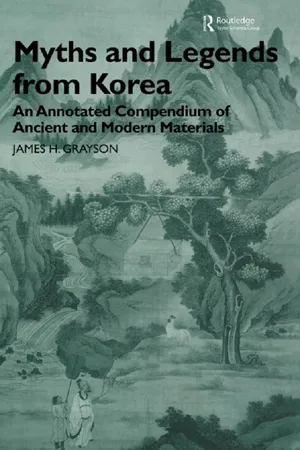
Myths and Legends from Korea
An Annotated Compendium of Ancient and Modern Materials
- 454 pages
- English
- ePUB (mobile friendly)
- Available on iOS & Android
eBook - ePub
Myths and Legends from Korea
An Annotated Compendium of Ancient and Modern Materials
About this book
This book contains 175 tales drawn equally from the ancient and modern periods of Korea, plus 16 further tales provided for comparative purposes. Nothing else on this scale or depth is available in any western language. Three broad classes of material are included: foundation myths of ancient states and clans, ancient folktales and legends, modern folktales. Each narrative contains information on its source and provenance, and on its folklore type, similarities to folklore types from China, Japan and elsewhere.
Information
Chapter IV
Folktales from the Modern Period
In this section, there is a selection of representative modern Korean folktales which have been drawn from the Type Index of Korean Folktales created by Ch’oe Inhak. A list of the abbreviations used for the sources of each tale are given in Appendix Four. Each folktale will be compared with parallel types from other international folktale indexes, especially the Aarne-Thompson Type Index of Folktales,1 the index for Chinese folktales devised by Wolfram Eberhard,2 and the Type and Motif Index of Japanese Folk-Literature created by Ikeda Hiroko.3 The Aarne-Thompson Index will be identified as AT plus the type number, the Chinese index by the phrase Eberhard plus the type number, and the Japanese index as Ikeda plus the type number. An outline of the Aarne-Thompson, Eberhard, Seki, Ikeda and Ch’oe systems is given in Appendices Six through Ten along with the standard titles for individual tale types mentioned in the text. An outline of the Thompson Motif Index is given in Appendix Five along with frequently cited motif types.
The earliest known recordings of individual tale types will be given along with as much precise information as is available about the translated tale. Information on an individual tale will be provided in the following format following the translation – notes on the tale, textual source for the translation of the particular version of the tale, the history of the recording of the tale type, the Korean tale type number and name, international parallel types and names, and a commentary on the meaning and function of the tale. Locations of the place of the recounting of the tale refer to the placename at the time of the transcription of the tale and are not necessarily the modern placename.
It is important for the reader to remember that the date given for the earliest known transcription of a particular tale does not mean that the tale dates from that time. In most cases, folktales were transcribed long after they were well known in the oral culture of Korea. In a few instances, the folklore researcher used himself as a source which makes the dating of the tale somewhat more difficult. In some cases, information was not available about the actual transcription of the tale. In such cases, I have given the earliest known date for the publication of the tale. In a few instances, certain tales are found only in a Western language record without other recorded references. In such cases, this fact has been noted. Recorded references are identified by a set of abbreviations which are explained in Appendix Four.
I have personally translated all the tales in this book which are attributed to a Korean language source. The earliest version of some tales were recorded in Japanese because these tales had been collected by Son Chint’ae during the Japanese colonial occupation of Korea (1910–1945) and had to be published in the language of the colonial ruler. These latter tales were translated into English by two post-graduate students at the Centre for Japanese Studies of the University of Sheffield, Robert Johnson and Maura Kelly.
The commentary to the tales will focus on three aspects of a folktale: its function as defined by Bascom, the structure of its narrative, and the principal theme or themes of the tale. The four possible functions of a folktale represent the oral expression of the underlying existential concerns of a people. These functions of folktales are, again, 1) amusement or the escape through fantasy from the oppressive circumstances of contemporary society, 2) the validation of the fundamental existential postulates of the culture, 3) the maintenance of conformity to the social standards of the culture, and 4) education, the provision of information about the origin of the world, people, state, natural circumstances of the people, general natural phenomenon, and social customs. Each folktale will be examined to determine its principal functions and their relation to its principal themes. Comparison will be made between tales from the ancient period, or from China, Japan, or Europe when these parallel tales are known.
Folktales from the modern period have been divided into eight different classes based on the purpose of the tale or some striking narrative motif. Aetiological and etymological tales describe the origin of the natural world and its features, the origin of the social world, and the origin of words, phrases, ideas and social practices. Heroic tales take as their principal motif feature the struggles and adventures of a hero or heroine against great odds. Edifying or moral tales are the means by which social precepts and values – the existential postulates of the culture – are conveyed to younger members of the culture or are reinforced amongst the older generation. Tales of magic are a specific form of adventure story in which magic objects or skills are used to bring about some desired end. Adventurous and amusing tales generally have no didactic purpose but only serve to entertain the listeners of the tale. Three other classes of stories have been added here. Stories about animals constitute a very high per centage of the corpus of Korean folktales, in particular tales which feature tigers or foxes as their principal actors. Special examples of these tales have been included here. Stories about bears, however, are relatively rare amongst the corpus of Korean folktales. I have collected here all the stories with the bear as its principal actor which I have been able to find.
As many of the folktales recorded here constitute a criticism of ‘traditional’ society, it will be useful for the reader to understand the cultural tradition of premodern Korea. Although knowledge of Confucianism in Korea dates back to the fourth century or beyond, it was only with the advent of the Chosŏn dynasty in 1392 that Korea became a thoroughly Confucianised society. Rejecting the relationship of complementarity which had existed between Buddhism and Confucianism during the previous dynasty, the architects of the new dynasty wanted to transform the nation into a thoroughly Confucian society. Prior to the Chosŏn period, the considerable influence which Confucianism had exercised on Korea had been confined to the areas of politics and government, and culture (a writing system, literature, painting, and education). From the fifteenth century onward a radical policy was pursued of social transformation – the attempt to make Korean social mores conform with Confucian ideology.
Central to Confucian thought was the concept of the ‘Five Relationships’, the five dyadic social relationships in which all people participated. These relationships are the relations between ruler and ruled, child and parents, spouse and spouse, older and younger sibling, and friend and friend. These relationships were hierarchical and mutual. The hierarchical nature of the relationships was determined first by age and then by social status. Each member of the relationship had a particular responsibility toward the other. In the relationship between the ruler and the ruled, the ruler governed with ‘benevolence’ and the ruled responded with ‘loyalty’. The parent/child relationship was similar except that the child’s response was ‘filial piety’ which included the element of love. The core social responsibility of a person living in a Confucian society was ‘filial piety’ and the principal form of its expression was the performance of the ancestral memorial ritual. From a very early period, the Chosŏn government attempted to instill these concepts through various measures, most notably the ‘village covenants’ in which the village elders bound the members of their villages to live according to Confucian principles.
Korea had been a hierarchical, aristocratic society for many centuries before the advent of the Chosŏn dynasty. The combination of an aristocratic society with a policy for its radical Confucianisation meant that the social structure of Chosŏn became even more hierarchical and stratified. During the Chosŏn period, society was divided into four classes, the yangban or aristocracy, the chungin or petty official class, the peasantry, and the ch’ŏnmin who were largely slaves. Although there was some movement between social classes, the class structure was very rigid. The metaphysical form of Confucianism adopted in Korea at the foundation of the Chosŏn state was used to equate the prevailing social order with the order of the cosmos. Thus errors and differences of opinion could be interpreted as being contrary to the very nature of the universe. Because this dynasty remained on the throne until the early part of the twentieth century, Korea became the most Confucianised society in East Asia.4
The folktales translated here reflect the Confucianised and aristocratic nature of a society where younger people are supposed to obey their elders, daughters-in-law suffer under tyrannical mothers-in-law, grown men and women worry about their aged mothers, and where the powerful but silly aristocrats and magistrates are mocked for their foolishness. Beyond this, we are introduced to a world where the relationship humans and spirits is close, where the spirits of young, unmarried men and women could wreak havoc on their families if not appeased, where spirits of the deceased will help their family’s descendants if they are in need, and where even the mountain spirit must obey the orders of a local magistrate.
Notes
1 Thompson, Stith, The Types of the Folktale: A Classification and Bibliography: Antti Aarne’s ‘Verzeichuis der Märchentypen’ (1955–1958).
2 Eberhard, Wolfram, Typen Chinesischer Volksmärchen (1937). A more recent typology has been created by Ting Nai-tung, A Type Index of Chinese Folktales: In the Oral Tradition and Major Works of Non-Religious Classical Literature (1978).
3 Ikeda, Hiroko, A Type and Motif Index of Japanese Folk-Literature (1971).
4 Martina Deuchler in The Confucian Transformation of Korea: A Study of Society and Ideology (1992) discusses the origins and development of the process of the Confucianisation of Korean society throughout the Chosŏn dynasty.
A Aetiological and Etymological Tales
1 The World
Tale 96 The Creation of the Universe
Part One
When earth and Heaven came into being, it was Mirŭk1 who made them. Heaven and earth were stuck together; they were not separated. Heaven was separated to the north; at the four corners of earth, [he] erected copper pillars. At that time, there were two suns, and there were also two moons. [He] broke up one moon and made the seven stars of the North Pole and the seven stars of the South Pole. [Mirŭk] broke up one sun. He made large stars. The little stars he made to be the stars of destiny for the people.2 The big stars he created as the stars of destiny for the king and the great officials of state. As Mirŭk had no clothes, he wove [some]. He had no cap.
On this mountain, on that mountain, there were arrowroot plants growing [everywhere]. [He] dug them up, cut them in strips, wound and bound them together. Beneath Heaven, he wove [the strands]. In the midst of the clouds, he wove the threads together. Weaving back and forth, he wove [the cloth]. The arrowroot plant he made into hemp-like clothing. The large portion was the body, the small portions the sleeves. The body was five cha3 wide, and the collar was three cha wide.
He made a cowl [for himself]. When he made it one cha and three ch’i4 it didn’t go beneath his eyes. When he made it two cha and three ch’i, when he put it on his head, it didn’t go beneath his ears. When he made it three cha and three ch’i, when he put it on his head, it went beneath his chin. When Mirŭk was born, in Mirŭk’s Time, he ate things raw. He didn’t put things on the fire; he ate rice raw. He ate a sŏk5 of rice raw. He ate a mal6 of rice raw; he couldn’t do anything else. “Since I came to be, there is no water; there is no fire. I am alone. I must use [these things].”
He caught Grasshopper. Putting him on the place of justice, he began to beat him about the knees. “See here, Grasshopper! Do you kn...
Table of contents
- Cover
- Half Title
- Title Page
- Copyright
- Dedication
- Contents
- Preface
- I. Introduction
- II. Foundation Myths
- III. Legends and Tales from the Ancient Period
- IV. Folktales from the Modern Period
- Bibliography
- Appendices
Trusted by 375,005 students
Access to over 1.5 million titles for a fair monthly price.
Study more efficiently using our study tools.
Frequently asked questions
Yes, you can cancel anytime from the Subscription tab in your account settings on the Perlego website. Your subscription will stay active until the end of your current billing period. Learn how to cancel your subscription
No, books cannot be downloaded as external files, such as PDFs, for use outside of Perlego. However, you can download books within the Perlego app for offline reading on mobile or tablet. Learn how to download books offline
Perlego offers two plans: Essential and Complete
- Essential is ideal for learners and professionals who enjoy exploring a wide range of subjects. Access the Essential Library with 800,000+ trusted titles and best-sellers across business, personal growth, and the humanities. Includes unlimited reading time and Standard Read Aloud voice.
- Complete: Perfect for advanced learners and researchers needing full, unrestricted access. Unlock 1.5M+ books across hundreds of subjects, including academic and specialized titles. The Complete Plan also includes advanced features like Premium Read Aloud and Research Assistant.
We are an online textbook subscription service, where you can get access to an entire online library for less than the price of a single book per month. With over 1.5 million books across 990+ topics, we’ve got you covered! Learn about our mission
Look out for the read-aloud symbol on your next book to see if you can listen to it. The read-aloud tool reads text aloud for you, highlighting the text as it is being read. You can pause it, speed it up and slow it down. Learn more about Read Aloud
Yes! You can use the Perlego app on both iOS and Android devices to read anytime, anywhere — even offline. Perfect for commutes or when you’re on the go.
Please note we cannot support devices running on iOS 13 and Android 7 or earlier. Learn more about using the app
Please note we cannot support devices running on iOS 13 and Android 7 or earlier. Learn more about using the app
Yes, you can access Myths and Legends from Korea by James H. Grayson in PDF and/or ePUB format, as well as other popular books in Ciencias sociales & Estudios étnicos. We have over 1.5 million books available in our catalogue for you to explore.