eBook - ePub
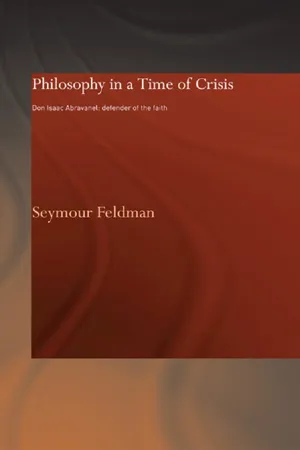
Philosophy in a Time of Crisis
Don Isaac Abravanel: Defender of the Faith
- 224 pages
- English
- ePUB (mobile friendly)
- Available on iOS & Android
eBook - ePub
About this book
The expulsion from Spain did not only result in the destruction and dispersion of Spanish Jewry but led to a crisis in Jewish faith. Don Isaac Abravanel provided a systematic treatment of the main philosophical and theological beliefs of Judaism in an attempt to resolve the inner doubts of his co-religionists. In their Italian exile his son Judah too recognized that Jews were now living in a new cultural world, but he forged a different road for Jews to pursue in their entry into the culture of the Renaissance. This book presents a picture of one family facing the challenges of a new era in Jewish history.
Information
Part I
Introduction
1 Abravanel’s life and works
Life
Since the biographical facts and course of Abravanel’s multifarious life have been adequately treated by several authors, most notably Bentzion Netanyahu,1 it will be sufficient for our purpose merely to present a summary of the salient features of the life of this most versatile and yet ambivalent figure. I shall do so by dividing his life into three distinct periods according to geography, more specifically the three countries where he lived and wrote: Portugal, Spain and Italy.
Abravanel was born in Lisbon, Portugal in 1437. Yet, his family was of Spanish origin. Less than a century earlier his grandfather had fled Spain as the result of persecution and took refuge in Portugal. In Spain the family had already attained prominence in finance; in Portugal the Abravanels continued to occupy an important place in the Portuguese economy, so much so that Isaac’s father Judah became one of the more important figures in the royal financial circle. Throughout Isaac’s life in Portugal he was intimate with the monarchy and the aristocracy, acquiring great wealth and influence. Although we do not know too much about his early education, it is clear that he amassed an enormous erudition in both Jewish and non-Jewish literature. As we shall see, he is at home in the traditional literary sources of Judaism, biblical and rabbinic; he had deep knowledge of the medieval philosophical Hebrew literature; he even had some acquaintance with the mystical documents of the Qabbalah. But most interesting was his familiarity with the Latin authors of ancient Rome and the Christian exegetes and theologians of the Latin medieval tradition. We shall say more about this topic in the later chapters; but it is important to note at the outset that Abravanel probably had the most Latinity of any Jew prior to the middle of the sixteenth century. How and when he acquired this learning we do not know; that he had it is evident throughout his works.2
Isaac spent a little more than half his life in Portugal enjoying prosperity and prominence, eventually becoming an important financial figure and advisor to the king, Alfonso V. But this was to come to an abrupt end with the death of Alfonso in 1481 and the ascendency of his son Joao II. At this time internal struggles between the new king and the nobles became more frequent and violent. Joao was especially concerned to reduce the power of the aristocracy, a tendency that was evident throughout western Europe. Although some of the details of this episode in Portuguese history are still unclear, it would seem that Isaac found himself trapped in a conflict between Joao II and the powerful Duke of Braganza, whose family the Abravanels had befriended earlier. The king suspected the Braganzas of conspiring against him and found Abravanel “guilty by association”.To what extent Abravanel was involved in these matters is not known. However, fearing for his life, he fled Portugal alone on 31 May 1483 and took refuge in Spain, close to the Portuguese border, believing that he would soon return. This was never to take place. It became clear to him that his life in Portugal was over and that his first priority was to get his family out of Portugal into Spain, which he did not too long afterward. He and his family were now in “Spanish Exile”.
While trying to figure out his next move Abravanel took a respite from his financial activities and turned to his other dominant interest – literature. This was to be a recurrent pattern in his life: financial and government occupation, which comes to an end as the result of external forces, and then immersion in scholarly pursuits. Already in Portugal, Isaac had composed two treatises: The Forms of the Elements (Tzurot Ha-Yesodot) and The Crown of the Elders (‘Ateret Zeqenim). He had also started on his most important scholarly undertaking – a commentary on the Bible – by beginning his commentaries on the Books of Joshua, Judges, Samuel and Deuteronomy. But one cannot live by books alone, and soon Abravanel had to earn some money. Fortunately for him the political–economic situation in Spain was ripe for his financial acuity and intervention. The newly united kingdoms of Aragon and Castille, under their recently married monarchs Ferdinand and Isabella, wanted to expel the Moors from southern Spain and needed money for this purpose. Isaac saw his opportunity and seized it: he proposed a financial plan for raising funds for this military undertaking and was summoned by the monarchs for advice. Eventually, he became closely associated not only with the royal family and administration but also with some of the more important noble families. Indeed, he became one of the major tax-farmers in Spain, a position that his ancestors had held over a century earlier.
Nevertheless, this position and wealth proved to be of no avail when in 1492 Ferdinand and Isabella decided to expel the Jews from Spain. At this point it is relevant to ask, as does Netanyahu, how was it possible for Abravanel not to see what was happening to the Jews in Spain?3 Ever since 1391 the situation and status of the Spanish Jewry was deterioting radically. How could a person of Abravanel’s government experience not perceive that the “Golden Age of Spanish Jewry” was over, indeed that there was no future at all for the Jews in Spain? It would seem that Abravanel thought he could avert “the wicked decree” by buying off the King, a manouver that had worked for many Jewish communities throughout the Middle Ages. But this was not to be: Ferdinand and Isabella were firm in their resolve to cleanse Spain from all non-Christians, Jews as well as Muslims. With the defeat of the Spanish Moors in early 1492 the fate of the Jews was sealed; only Abravanel did not see it. Although Abravanel’s tax-farmer colleague Abraham Senior availed himself of the option of conversion, Isaac refused and had to prepare for exile. The question was, where?
Although historians are still debating various questions concerning the Spanish Exile, especially the motivations of the Spanish monarchs and the precise number of Jews opting for exile, it is clear that Jews contemplating exile had few options. Most of the nations of western Europe had already expelled their Jews centuries earlier; the situation in Northern Africa was uncertain; the Ottoman Empire was far away. Moreover, going into exile cost money, and the Spanish Jews were not allowed to take much with them. It is no wonder then that a lot of Jews chose to stay in Spain even if this meant conversion. Nonetheless, this was not Abravanel’s choice, and he decided to leave Iberia, where he had lived all his life. His plan was evidently to make his way to the Ottoman world; but on the way he would find refuge in the Kingdom of Naples, whose rulers, although Spanish, were not unfriendly to the Jews and to Abravanel in particular. It did not take long for Isaac to do what he was always able to do – make himself valuable to those in power. He became an intimate to the King of Naples Ferrante and his son Alfonso, serving unofficially as an advisor.
Unfortunately, this repose was not to last too long. In 1494, the King of France invaded Italy and eventually conquered Naples, causing the royal family to escape to Sicily. The Abravanels accompanied him. Although the Napolitan monarchy attempts to regain control of Naples, they fail, and Abravanel goes into exile again, this time to Corfu, which was a Venetian colony. Evidently, it was Isaac’s intention to go to Salonika, where one of his sons was studying. But the tide had turned again in Naples; this time in the favor of the Napolitan monarchy. Isaac leaves Corfu, whose small Jewish community was neither culturally or economically advanced sufficiently to satisfy his talents in either field, and returns to the Italian mainland, but not Naples. Instead, in the late fall of 1495 he takes up residence in a small seaport on the Adriatic, Monopoli, which had been occupied by the Venetian navy. Weary and exhausted Isaac decides to stay out of the struggle between Naples and France and remains in seclusion on the Adriatic, where he resumes his literary activities. During this period of about eight years, Abravanel manages to complete nine works, including some of his most important treatises.
Meanwhile, back in Naples, things again change. The French are defeated, but only momentarily. Abravanel was not confident that the situation would be stabilized in favor of his former patrons. And he was proved right. Soon the Napolitan kingdom was defeated, and Spain contended with France for control over southern Italy. Spain won in the spring of 1503. Although one of Isaac’s sons Judah, about whom we shall learn more later, joins the Spanish general and governor in Naples Gonsalvo as his personal physician, Abravanel decides to go to Venice with another of his sons Joseph, who was also a physician. His stay in Venice was to be his last resting place – his personal exile came to an end.
In Venice history repeated itself, at least in the sense that Abravanel soon established contact with the Venetian rulers and offered his financial advice to the ever important Venetian trading interests. He helped draw up a plan to resolve a commercial dispute between Venice and Portugal, his former homeland, in which he never lost interest. Most likely his familiarity with the Portuguese government and trading groups made his advice attractive to the Venetians. Although the plan failed, Isaac’s services were appreciated and he was able to live in Venice in peace until he died. Despite failing health and eyesight he composed several treatises, including his most important commentary on the Pentateuch and his commentary upon Maimonides’ Guide of the Perplexed. During this period Isaac witnessed in 1503 the publication of three of his books in Constantinople: The Inheritance of Fathers (Nachalot Avot), The Passover Sacrifice (Zevach Pesach) and The Principles of Faith (Rosh Amanah), to which his son Judah wrote prefatory poems. Isaac died in December 1508, at the age of seventy-one. There is no doubt that he lived a most interesting life, full of accomplishments, disappointments, and exile, not just once but several times. Nevertheless, he managed to bequeath to posterity a large body of distinguished scholarly works, whose significance will be the subjects of the following chapters.
Abravanel’s literary works
Although it is possible to arrange and discuss Abravanel’s prodigious literary output in several different ways, we shall follow the geographical–chronological schema adopted in the previous section. Despite the various shifts in Abravanel’s career in finance and politics, he managed, almost miraculously, to find the time and the energy to undertake scholarly projects in each of the countries where he resided. Some of them he completed on the spot; others he had to complete elsewhere and later. Unfortunately, as we noted before, some works were never completed or if completed lost. Yet, his pen was never idle for long, and in spite of all the tribulations of his life, Isaac gave us a lot to read and reflect upon.
Portugal
Abravanel lived a little more than a half of his life in the land of his birth. Most of his life in Portugal was spent in the world of finance: making money and giving advice to others on financial matters. Nevertheless, he did manage to find enough leisure to compose several treatises, two of which he completed.
Abravanel’s first literary work was the The Forms of the Elements, written while in his early thirties. In retrospect it is a curious work in so far as it is wholly philosophical, containing no religious references or implications. In this relatively short essay Isaac takes up a question debated in medieval Aristotelian physics concerning the four fundamental elements: fire, air, water and earth – are these really the most primitive features of matter or are they derivative of some more basic properties? After distinguishing and discussing three different views on this topic, Isaac adopts the Aristotelian position that these are indeed the “first qualities” of matter; all other properties, such as heavy and light, are derived from them.4 In this essay in “physics”, Abravanel appears as a typical Aristotelian natural philosopher, a guise that he shall very soon abandon.
Composed some time during 1465–70 The Crown of the Elders, a much longer treatise, marks a radical shift in or different set of concerns in Abravanel’s thinking. It was his first attempt in biblical exegesis, a field that he was to pursue as his main scholarly undertaking throughout his life. Ostensibly the monograph is concerned with an apparently minor episode in Exodus, chapter 23, where the elders of Israel are described as having experienced a special theophany of their own. Abravanel uses this story to discuss the whole issue of divine revelation, especially the Sinaitic theophany. As will be his subsequent practice, indeed obsession, he will take Maimonides as his point of departure and move on from what the “Master of the Guide” said. Although respectful, indeed reverent, Abravanel is nevertheless critical and adopts a more traditional position on the issues of prophecy and providence than that presented by Maimonides. This treatise has been recently given a comprehensive treatment by Eric Lawee in his doctoral dissertation and several articles.5
Not too long after the completion of The Crown of the Elders, Abravanel began his project of a complete commentary on the Torah and the Prophets. Since he never wrote on any book from the Writings (Hagiographa), except the Book of Daniel, it would seem that it was never his intention to comment upon these books. He began with the Book of Deuteronomy and the Former Prophets. However, he did not complete either of them in Portugal.
Perhaps, while still in Portugal, Abravanel began to compose a book on prophecy entitled The Vision of the Almighty (Machazeh Shadai). Unfortunately, this work is no longer extant, although Abravanel says explicitly that it was completed. It could have been lost in transit from Portugal to Spain or from Spain to Italy. A later version of this treatise was planned entitled The Band of Prophets (Lahaqat Nevi’im); but this work is also not extant; indeed, it is not certain that it was ever written.6 In these works Isaac was to have presented his theory of prophecy, containing a critique of the Maimonidean theory. Fortunately, his criticisms of the Maimonides’ account of prophecy appear in his biblical commentaries as well as in his Commentary on the Guide of the Perplexed.
Spain
Abravanel’s stay in Spain turned out to be a not very productive period in his scholarly career, and this is no wonder. First, the flight from Portugal with its concomitant loss of possessions, including his library. Then the need to earn a living, which when pursued required all his time and energy. Yet, he did resume his work on the Commentary on the Former Prophets and managed to complete it during the first year of his “Spanish Exile”. It has been suggested that while in Spain Isaac began what was to be his second main preoccupation – a Commentary on the Guide of the Perplexed.7
Italy
It was in Italy that Abravanel was to compose and complete most of his works. Even though he had to move from Naples to Sicily, and then back to Naples, and then to Corfu, back to Monopli, and finally to Venice, he was able to write quite a number of new treatises as well as finish some that he had started previously. Although he was not entirely uninvolved in practical affairs, he no longer had any official position in the Napolitan or Venetian government. He used his leisure well.
Naples
While in Naples, Isaac completed his Commentary on Kings, which contains some biographical material and discussion of the recent tragedy of Spanish Jewry. He also composes a treatise on reward and punishment and immortality of the soul entitled Eternal Righteousness (Tzedeq Olamim). Unfortunately, this work was destroyed by French soldiers in their invasion of Naples. In 1494 Isaac composed a treatise on Jewish dogma The Principles of Faith (Rosh Amanah). It is not certain, however, where it was written. Menahem Kellner maintains that Abravanel wrote it while still in Naples; Netanyahu claims that he wrote it during his brief stay in Corfu. Regardless of its place of origin, it turned out to be one of his more widely read and influential books. In this treatise Abravanel enters into a debate that had started with Maimonides’ attempt to formulate a creed. Maimonides’ famous Thirteen Articles of Belief was the focal point of debate during the latter part of the fourteenth century amongst Spanish theologians, and had elicited in particular critical responses from Hasdai Crescas and Joseph Albo. Although somewhat sceptical of the whole enterprise o...
Table of contents
- Cover
- Halftitle
- Title
- Copyrights
- Contents
- Part I Introduction
- Part II Isaac Abravanel’s philosophy of Judaism
- Part III Judah Abravanel – “An inheritance for your children”
- Notes
- Bibliography
- Index
Trusted by 375,005 students
Access to over 1.5 million titles for a fair monthly price.
Study more efficiently using our study tools.
Frequently asked questions
Yes, you can cancel anytime from the Subscription tab in your account settings on the Perlego website. Your subscription will stay active until the end of your current billing period. Learn how to cancel your subscription
No, books cannot be downloaded as external files, such as PDFs, for use outside of Perlego. However, you can download books within the Perlego app for offline reading on mobile or tablet. Learn how to download books offline
Perlego offers two plans: Essential and Complete
- Essential is ideal for learners and professionals who enjoy exploring a wide range of subjects. Access the Essential Library with 800,000+ trusted titles and best-sellers across business, personal growth, and the humanities. Includes unlimited reading time and Standard Read Aloud voice.
- Complete: Perfect for advanced learners and researchers needing full, unrestricted access. Unlock 1.5M+ books across hundreds of subjects, including academic and specialized titles. The Complete Plan also includes advanced features like Premium Read Aloud and Research Assistant.
We are an online textbook subscription service, where you can get access to an entire online library for less than the price of a single book per month. With over 1.5 million books across 990+ topics, we’ve got you covered! Learn about our mission
Look out for the read-aloud symbol on your next book to see if you can listen to it. The read-aloud tool reads text aloud for you, highlighting the text as it is being read. You can pause it, speed it up and slow it down. Learn more about Read Aloud
Yes! You can use the Perlego app on both iOS and Android devices to read anytime, anywhere — even offline. Perfect for commutes or when you’re on the go.
Please note we cannot support devices running on iOS 13 and Android 7 or earlier. Learn more about using the app
Please note we cannot support devices running on iOS 13 and Android 7 or earlier. Learn more about using the app
Yes, you can access Philosophy in a Time of Crisis by Seymour Feldman in PDF and/or ePUB format, as well as other popular books in Teologia e religione & Teologia ebraica. We have over 1.5 million books available in our catalogue for you to explore.