- 192 pages
- English
- ePUB (mobile friendly)
- Available on iOS & Android
eBook - ePub
About this book
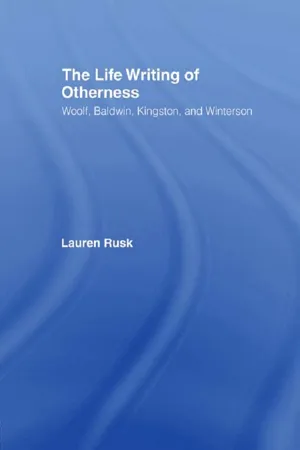
Focusing on innovative works by Woolf, Baldwin, Kingston and Winterson, the author analyzes how they each represent the self as unique, collectively "other," and inclusively human, and how these conflicting aspects of selfhood interact.
Information
CHAPTER ONE
Reading the Life Writing of Otherness
A Critical Synthesis
This book concerns innovative personal writing by those the dominant in society define as “other” than themselves. Such life writers set out to recreate experience that has been erased, falsified, and devalued by the construction of otherness. Since experience is the way factual life plays in the mind's theater, experiential truth springs from the imagination, and must speak to it. Yet the life writing1 of otherness confronts a culturally divided audience, which complicates the process of recreation. Moreover, otherness engenders a divided sense of self as well as a divided audience. All these factors can make the writer's strategies especially intriguing. This is particularly the case, I believe, with the autobiographical works on which this book focuses: Virginia Woolf's A Room of One's Own, James Baldwin's Notes of a Native Son, Maxine Hong Kingston's The Woman Warrior: Memoirs of a Girlhood Among Ghosts, and Jeanette Winterson's Oranges Are Not the Only Fruit. Intermingling fact with fictive elaboration, fantasy, and cultural critique, these hybrid works challenge their various readers to work through puzzles in ways that mirror the writers' own struggles to wrest sense from the contradictions they've faced.2 Thus the books strive to transform how their readers perceive one another and, ultimately, how they act.
Critical writing about autobiography, writes Sidonie Smith, “over the last hundred years has moved generationally” from “the life (bios), to the self (autos), to the text (graphe)” (“Impact” 1, citing Spengemann); that is, from the world, to the authorial self, to the work itself, which, as James Olney reminds us, encompasses both writing and reading (“Autobiography” 27). In the first stage, nineteenth-century critics were concerned with the merits of the author's life in the world and the truthfulness of its record. In the second, Smith summarizes, “With the turn of the century and the turn to modernism, autobiography became interesting as one expression of a person's psychological posture toward the past. Consequently, critics began to read autobiography as a creative, interpretive act….” Scholars of the genre examined “its history … its paradigmatic structures [and] thematic issues such as the tension between self and society enacted in the text” (“Impact” 1). As many have noted, sincerity rather than truth became the touchstone. In the third stage, Smith continues, since postmodernism has “challenged the referentiality of language and the authenticity of the self, rejecting notions of intentionality, truth, meaning, and authority,” emphasis has moved to the text as “locus of the play of signification” and “artifice of identity” (“Impact” 1). Often, in this stage, critics have considered the work as the interaction of the text and the reader—and, recently, various readers.3 In practice, though, these viewpoints are not mutually exclusive but rather a matter of emphasis.
It is the character of the relationship with the audience that distinguishes autobiography for me. Paul John Eakin identifies autobiography by its claim to the reader that it is “a version of the author's own life, anchored in verifiable … fact,” allowing for the autobiographer's use of fictive techniques (Fictions 185, my emphasis). The first part of that claim—“a version of the author's own life”—refers to what Philippe Lejeune calls the autobiographical pact. This implicit contract is established with signs which give us to understand that the author, speaker, and protagonist are aspects of the same person, with the same name (5, 12–14).4 This definition applies, Shirley Neuman explains, “whether we grant the “self” ontological status or whether we theorize a “subject” as the product of discursive and ideological structures—whether we see the reference of autobiography as to a self already existent in the world or as to a subject brought into being through the act of writing …” (213). The second part of Eakin's definition—the text's claim to be “anchored” in fact—corresponds to Lejeune's referential pact, which is “coextensive with the autobiographical pact” and indicates, often implicitly, “the field of the real” the text refers to and the “degree of resemblance” it promises. To audience-oriented critics, autobiography “is a mode of reading as much as it is a type of writing” (Lejeune 22, 30).5 From this perspective, a single criterion enables one to focus on a work's autobiographical relation to its audience: that work must, by some sort of autobiographical/referential pact, signify that it concerns the writer's own experience.6 It is certainly the case, however, that the sort of hybrid works this book examines—which include fictive, meditative, and rhetorical elements as well as accounts of the author's visible life—work against, or play upon, traditional expectations of what autobiography does. Indeed, that interplay is an important part of the works' relation to their audience. To refer to these unconventional variations on autobiography, I prefer the more inclusive and euphonious term life writing.7 In her introduction to Essays on Life Writing, Marlene Kadar specifies as life writing “texts that are written by an author who does not continuously write about someone else, and who also does not pretend to be absent from” the work (10).8 Life writing, in this sense, denotes writing that is from as well as about the subject's life.
I've chosen the life writing treated herein not only for its personal approach to social problems but also for the aesthetic complexity and freshness that enliven its concerns. Woolf, Baldwin, Kingston, and Winterson call for and reward close attention. Their works are, to use Richard Miller's translation of Roland Barthes's term, writerly. Writerliness aims to make reading work-intensive, thereby affording the reader the intense pleasure of creation. “[T]he goal,” Barthes says, “of literary work (of literature as work) is to make the reader no longer a consumer, but a producer of the text” (S/Z 4). In one sense, privileging writerliness can be viewed as elitist, because writerly works require skillful, devoted readers and take time. However, it is that very difficulty which offers readers who persevere an experiential understanding of another's life. This process can be radicalizing when the subject is one whom the reader's society has dismissed. In the essay “Is Writerliness Conservative?”, Barbara Johnson suggests that writerliness can involve “attention to the trace of otherness in language … to the way in which there is always more than one message. …” She concludes that “writerliness itself is conservative only in the sense that it is capable of inscribing and conserving messages the radicality of which may not yet have been explored” (31).
The life writing of otherness9 represents the self in a variety of dimensions. As with most prior Western autobiography, these dimensions include the uniquely personal and the inclusively human. However, works that concern otherness also represent the self collectively, as a subject shaped by those forces that designate the less powerful as “other.” These three views of the self—which I call, in order of increasing breadth, the unique, collective,10 and inclusive—manifest the competing claims of individuality, social difference, and hoped-for common ground. Although I consider mainly these three aspects of selfhood, two others also enter into the discussion—the communal and the familial. Communal, in contrast to collective, selfhood is a matter of affinity within a group, rather than awareness of prejudice against the group. Communality comes into play as an aspect of the protagonist's sense of self especially in Oranges Are Not the Only Fruit. Familiality, of course, is also crucial to personal experience—as we'll see with Baldwin, Kingston, and Winterson—influencing how the other dimensions of selfhood develop.
Innovative, writerly autobiography of otherness has flourished in the twentieth century and beyond. Its practitioners are members of groups that are not dominant in their society. Heterosexual men of European origin who enjoy relative economic security generally also enjoy “the luxury of forgetting” (Friedman, “Autobiographical Selves” 39) the social parameters that define them. Hence, in mainstream literature “the social milieu,” as Gilles Deleuze and Félix Guattari observe, usually “serve[s] as a mere environment or a background” for the writer's “individual concern.”11 By contrast, the writing of the dispossessed perforce “takes on a collective value.” “The individual concern” is “magnified, because a whole other story is vibrating within it”—the story of the group. “[W]hat each author says individually already constitutes a common action—even if others [in the group] aren't in agreement” (17). This is partly because the expressive power of the group as a whole has been “muted,” to use the anthropologist Charlotte Hardman's term. Elaborating, her colleague Edwin Ardener explains that the muted group's experience is not “articulated” through “the dominant communicative system of the society—expressed as it must be through the dominant ideology” (22). Thus, life writing from a muted milieu, by its very act of bursting into the dominant discourse, speaks collectively.
The collective self, as chapters two through four show, can be articulated in the life writing of otherness by a harking back—in structure, theme, or style—to orality. The invoking of orality may reflect a subculture's ethnic roots, its history of exclusion from the dominant media, or its members' need to cluster together and gain strength by talking among themselves. On the other hand, invoking orality can also express the inclusive aspect of self, since dialogue brings us together, and since sound—unlike books, which make us solitary readers—unifies its audience (Ong, Orality 74).12 To adapt orality does not detract from writerliness, because the two are not opposites; rather, the use of oral tropes—particularly by Woolf and Kingston—contributes to the writerly complexity of the text.
The dimensions of selfhood this book treats are aspects of the textual self. I do not suggest that people have “inside” them an essential, discrete, coherent self. People do, however, put together self-conceptions; they tell stories about and characterize themselves. The ways they can imagine themselves depend, of course, on the cultural and historical concepts of personhood that they have been steeped in.13 These concepts vary widely, as Eakin points out, especially in his overview of relevant research in cultural anthropology (Touching 90–97).14 My generalizations about self-conceiving thus refer only to European and American cultures in which autobiography has emerged.15 Within this context, I agree with Paul Smith's more general assertion that “the subject/individual exists in a dialectical relationship with the social but also lives that relationship alone as much as interpersonally or as merely a factor within social formations: alone at the level of the meanings and histories which together constitute a singular history.”16 People in these cultures live, he writes, with “reference to an imaginary singularity” that comprises a “set of images, identifications, and narratives” (6).17 And those who write autobiography, Leigh Gilmore observes, “wrap[] up the interrupted and fragmentary discourses of identity (those stories we tell ourselves and are told, which hold us together as “persons”) and present[] them as persons themselves” (17). These “self-inventions,” as Eakin calls them (Fictions), give autobiographers “the illusion of becoming [their life's] author by writing it,” Lejeune says. Autobiography also, he continues, gives its writers and readers “the opportunity to believe” that they are “complete and responsible” beings (Lejeune 192). If we then act upon such a self-concept,18 whether written or simply imagined, it takes on a certain agency in the world. In the words of Amelie Oksenberg Rorty, “Humans are just the sorts of organisms that interpret and modify their agency through their conceptions of themselves” (323).19
For those in muted groups, reconceiving themselves is crucial to increasing their agency in society. Through the “dominant communicative system” (Edwin Ardener 22), they are both delineated in ways that do not answer to their experience and ignored as inconsequential.20 To achieve consequence, they must recast “the self as different from cultural prescription” (Friedman, “Autobiographical Selves” 39).21 Their life writing asserts the selfhood they have been denied—in its uniqueness, which those who stereotype them cannot see; its collective experience of being treated as “other”;22 and its kinship within the family of humanity.
Critics who study the life writing of “the disesteemed,” to use James Baldwin's phrase (Notes 165), have striven mainly to describe and valorize its collective difference from that of the privileged. For example, feminist critics such as Estelle Jelinek and Mary Mason find certain patterns throughout the unheralded tradition of women's life writing. Jelinek observes that women have long written personal, searching, disjunctive works, rather than the more public, progressive, linear accounts that have predominated in the masculine tradition of autobiography (15, 17, 19). She also recognizes exceptions on both sides, and recently, more instances of personal and formal openness in men's life writing (7, 20). Mason examines four notable women's autobiographies, from the fourteenth to the seventeenth centuries, that she sees as paradigmatic.23 She demonstrates that in these works the woman's sense of herself develops in relation to the “presence and recognition of another consciousness” (22).
Qualifying the valuable observations of such critics are caveats like Nancy K. Miller's caution against “the temptations of a feminist reuniversalization” (Subject 5). In the same vein, Linda H. Peterson contests the idea of a separate female autobiographical tradition, citing seventeenth-century Quaker women's works in the Augustinian mode and also the pressure of Victorian editors upon women to write relational, domestic autobiography. Nonetheless, as Gilmore writes, “For the most part, feminist critics of autobiography have agreed there is a lived reality that differs for men and women and accounts for much of the difference between” their life writing (x). In her preface to Autobiographics, Gilmore recalls her own engagement with these issues “in an effort to...
Table of contents
- Cover
- Full Title
- Copyright
- Dedication
- Contents
- ACKNOWLEDGMENTS
- CHAPTER ONE. READING THE LIFE WRITING OF OTHERNESS
- CHAPTER TWO. THE COMMON LIFE OF UNCOMMON WOMEN
- CHAPTER THREE. THE PERSONAL PASSION OF COLLECTIVE SELFHOOD
- CHAPTER FOUR. THE HARD-WON HARMONICS OF SELFHOOD
- CHAPTER FIVE. THE REFUSAL OF OTHERNESS
- NOTES
- WORKS CITED
- INDEX
Trusted by 375,005 students
Access to over 1.5 million titles for a fair monthly price.
Study more efficiently using our study tools.
Frequently asked questions
Yes, you can cancel anytime from the Subscription tab in your account settings on the Perlego website. Your subscription will stay active until the end of your current billing period. Learn how to cancel your subscription
No, books cannot be downloaded as external files, such as PDFs, for use outside of Perlego. However, you can download books within the Perlego app for offline reading on mobile or tablet. Learn how to download books offline
Perlego offers two plans: Essential and Complete
- Essential is ideal for learners and professionals who enjoy exploring a wide range of subjects. Access the Essential Library with 800,000+ trusted titles and best-sellers across business, personal growth, and the humanities. Includes unlimited reading time and Standard Read Aloud voice.
- Complete: Perfect for advanced learners and researchers needing full, unrestricted access. Unlock 1.5M+ books across hundreds of subjects, including academic and specialized titles. The Complete Plan also includes advanced features like Premium Read Aloud and Research Assistant.
We are an online textbook subscription service, where you can get access to an entire online library for less than the price of a single book per month. With over 1.5 million books across 990+ topics, we’ve got you covered! Learn about our mission
Look out for the read-aloud symbol on your next book to see if you can listen to it. The read-aloud tool reads text aloud for you, highlighting the text as it is being read. You can pause it, speed it up and slow it down. Learn more about Read Aloud
Yes! You can use the Perlego app on both iOS and Android devices to read anytime, anywhere — even offline. Perfect for commutes or when you’re on the go.
Please note we cannot support devices running on iOS 13 and Android 7 or earlier. Learn more about using the app
Please note we cannot support devices running on iOS 13 and Android 7 or earlier. Learn more about using the app
Yes, you can access The Life Writing of Otherness by Lauren Rusk in PDF and/or ePUB format, as well as other popular books in Letteratura & Critica letteraria. We have over 1.5 million books available in our catalogue for you to explore.