eBook - ePub
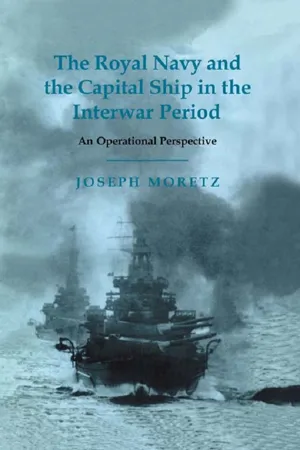
The Royal Navy and the Capital Ship in the Interwar Period
An Operational Perspective
- 324 pages
- English
- ePUB (mobile friendly)
- Available on iOS & Android
eBook - ePub
About this book
Joseph Moretz's innovative work focuses on what battleships actually did in the inter-war years and what its designed war role in fact was. In doing so, the book tells us much about British naval policy and planning of the time. Drawing heavily on official Admiralty records and private papers of leading officers, the author examines the navy's operational experience and the evolution of its tactical doctrine during the interwar period. He argues that operational experience, combined with assumptions about the nature of a future naval war, were more important in keeping the battleship afloat than conservatism in Navy.
1
The Experience of the Late War
I wish to express to the Flag Officers, Captains, Officers and Men of the Grand Fleet my congratulations on the victory which has been gained over the sea power of our enemy.The greatness of this achievement is in no way lessened by the fact that the final episode did not take the form of a Fleet Action …1Admiral Sir David BeattyThroughout these four years every sane Englishman’s mind has rested in confidence on the Navy, and now when the end has come the British Navy is more clearly than ever the saviour of the country and the destroyer of the Central Powers. How true it is and how often forgotten that the final collapse is the direct result of our command of the seas!2Sir Walter Runciman
For Britain, the Navy was viewed as the nation’s first line of defence, and as an island nation it recognised that communications with its empire were only possible while its maritime routes remained open. With the rise of the German Navy, the Service had long considered that it might have to contest command of the sea with the High Sea Fleet and sought to maintain its superiority over the Imperial German Navy. Primarily, this was measured in the number of capital ships, but no less important in maintaining this superiority was the manning of the Fleet, the development of dockyard and supporting bases, and the courting of naval partners to facilitate the concentration of its ships in home waters. A treaty reached with Japan in 1902, and aimed at addressing a threat from Russia, was renewed in 1911 with an eye towards Germany.3 Similarly, Great Britain reached agreement with France in February 1913 that the French Navy would assume primacy for the Mediterranean area.4 With these steps, by 1912 the Service was able to reduce its ships on overseas stations from 160 in 1902 to 76.5
In the event of war the Royal Navy would impose a blockade against Germany, defeat in detail ships found outside the blockade zone, and seek a fleet action with the High Sea Fleet under terms most favourable to the main striking arm of the Royal Navy — the Grand Fleet. In practice, this meant a resolve not to accept battle close to the Heligoland Bight, where the numerical superiority of the Grand Fleet could be neutralised by German defensive mining. In a fleet action close to Germany proper, damaged ships might have to be abandoned or sunk owing to the distance the Grand Fleet would have found itself from its main anchorages at Scapa Flow, Rosyth, and Cromarty. It has been said that the initiative for any fleet action resided primarily with the Germans. This is only partly correct. With the rise of wireless telegraphy as a means of controlling naval movements and the corresponding development of signals intelligence to divine the pending actions of an opposing naval force, the Admiralty’s attack on German naval ciphers allowed it to refuse battle if it so desired.
Still, it is important to remember that fleet action has rarely existed as an end in itself, but, rather, has more frequently been the result of one navy responding to an ongoing operation of another, such as an amphibious landing or the escorting of a convoy.6 Thus, if the Grand Fleet was intent on forcing a fleet action, it could have advanced the issue by threatening an amphibious landing on the German coast — a plan that was close to the heart of Admiral of the Fleet Lord Fisher. That it never attempted such an assault highlights the fact that the British aim of maintaining command of the sea was not dependent on securing a victory over the main fleet units of the Imperial German Navy. As the geographic position of the British Isles lay astride the sea lanes of the North Sea, Germany faced the immediate problem that any shipping destined for it must perforce pass through areas under British control. This was a problem that could be discounted in a short war, but which assumed a greater importance if the German Army could not deliver a quick military decision.
Given the proximity of its main naval rival and the command arrange-ments established with its allies, the French and the Italians, for the Mediterranean area, the main theatre for the Royal Navy was the North Sea.7 Nevertheless, both in response to Central Power naval actions, and in pursuit of its own strategic aims, operations in the Mediterranean, the Atlantic, the Near East, and the Pacific Ocean areas featured prominently during the course of the First World War for the Service. Although of a secondary nature, it would belittle these efforts to view them as of no consequence. At times, these peripheral theatres witnessed operations of a most considerable scale. Such was the case during the Gallipoli campaign of 1915–16, and the ramifications of these out of area events were at times most pronounced. While much of prewar naval thought and planning centred on a potential clash of battlefleets, technology had fostered new weapons, such as the aeroplane, the mine, and the submarine that moved naval warfare into the realm of the three-dimensional. The Navy was alive to the new tools of war and a discussion of their development up to the end of the war is in order.
AVIATION IN THE ROYAL NAVY
Even prior to the First World War, the Service had begun using aircraft in support of fleet operations. Flying instruction began in March 1911, and the first naval air unit was formed at Eastchurch in November. In July 1914, Naval Wing of the Royal Flying Corps was redesignated the Royal Naval Air Service (RNAS),8 and in July 1915 the Admiralty formally established the RNAS as an integral component of the Naval Service.9 When hostilities opened the RNAS had roughly 50 serviceable aeroplanes and 50 officers and 500 ratings;10 by the time of its absorption into the Royal Air Force in April 1918, the RNAS stood at 55,066 officers and men and 2,929 aircraft.11 Yet, if British naval airpower had grown appreciably, it had grown haphazardly. During its expansion it had found itself responsible for the antiaircraft defence of Great Britain, strategic bombing, and even armoured cars.12 Yet, progress there was and capital ships were fitted with platforms for flying off aircraft, and employed kite balloons to assist in reconnaissance and gunnery observation. Moreover, tenders and the first aircraft carriers, rudimentary as they were, joined the fleet, so that by September 1918 the Navy possessed 3 large aircraft carriers, 9 smaller carriers, 1 kite balloon ship, and 24 seaplane lighters.13 Certainly, however, the official assessment on the naval air arm’s performance was guarded:
Work with the Grand Fleet has been useful rather than spectacular. The principle of flying aeroplanes off the turret or decks of ships has been steadily developed which enables flights to be made in weather which would preclude the use of seaplanes….14
This view was shaped by the difficulties of operating aircraft in the demanding environment of the sea and by the limitations of the aeroplanes of the day.
Nevertheless, it is no exaggeration to assert that the Service embraced the aeroplane and wasted little time in attempting to employ it in operations. So much so, that an attack on the Zeppelin sheds of Cuxhaven in late October 1914 was attempted.15 Serving in the cruiser HMS Arethusa as a junior officer, Hugh Miller recorded:
We have just carried out a most hazardous operation which turned out a complete failure. If it now succeeded England would probably have been singing our praises, but it was unsuccessful and so no one will hear about it. We ran a great risk and carried out our part to the letter, but the other part failed.We left Harwich at 5.30 a.m. on Saturday with UNDAUNTED, 16 destroyers and HM Waterplane Carriers RIVIERA and ENGADINE. By Sunday morning we were creeping along the Schleswig-Holstein Coast of Germany. At 4.48 a.m. we were within 12 miles of Heligoland to the Northward and here we stopped. The riviera and engadine commenced to get out their waterplanes (6 in all) and completed the operation before 6.a.m. The plan was to fly to Cuxhaven (50 miles off) and blow up the Zeppelin sheds there with bombs … It was soon obvious that all was not well. Three waterplanes were taxiing all over the place, like flies trying to get off fly paper, but only one was in the air, and 2 were doing nothing at all … apparently the rain had made them too heavy to fly.16
Ultimately, ‘Plan Y’, as the attack on Cuxhaven was styled, was carried out in December 1914, but the results were meagre and the risks taken great. Again, Miller’s impression in Arethusa is worth noting for the insight it provides on the dangers and limitations of early twentieth-century naval air warfare:
We were an easy bag for the German Battle Cruisers if they would only dare to pass our line of submarines t...
Table of contents
- Cover
- Half Title
- Cass Series: Naval Policy and History
- Full Title
- Copyright
- Contents
- List of Illustrations
- Series Editor's Preface
- Acknowledgements
- List of Abbreviations
- Introduction: The Postwar Capital Ship Controversy
- 1 The Experience of the Late War
- 2 Imperial Naval Policy and the Capital Ship Controversy
- 3 The Influence of Arms Control and the Treasury on the Interwar Royal Navy
- 4 The Evolution of the Capital Ship
- 5 British Interwar Naval Strategy
- 6 The Operational Employment of the Capital Ship
- 7 The Development of Battlefleet Tactics
- 8 Reconsideration
- Appendices: I Naval Estimates of the Period
- Bibliography
- Index
Trusted by 375,005 students
Access to over 1.5 million titles for a fair monthly price.
Study more efficiently using our study tools.
Frequently asked questions
Yes, you can cancel anytime from the Subscription tab in your account settings on the Perlego website. Your subscription will stay active until the end of your current billing period. Learn how to cancel your subscription
No, books cannot be downloaded as external files, such as PDFs, for use outside of Perlego. However, you can download books within the Perlego app for offline reading on mobile or tablet. Learn how to download books offline
Perlego offers two plans: Essential and Complete
- Essential is ideal for learners and professionals who enjoy exploring a wide range of subjects. Access the Essential Library with 800,000+ trusted titles and best-sellers across business, personal growth, and the humanities. Includes unlimited reading time and Standard Read Aloud voice.
- Complete: Perfect for advanced learners and researchers needing full, unrestricted access. Unlock 1.5M+ books across hundreds of subjects, including academic and specialized titles. The Complete Plan also includes advanced features like Premium Read Aloud and Research Assistant.
We are an online textbook subscription service, where you can get access to an entire online library for less than the price of a single book per month. With over 1.5 million books across 990+ topics, we’ve got you covered! Learn about our mission
Look out for the read-aloud symbol on your next book to see if you can listen to it. The read-aloud tool reads text aloud for you, highlighting the text as it is being read. You can pause it, speed it up and slow it down. Learn more about Read Aloud
Yes! You can use the Perlego app on both iOS and Android devices to read anytime, anywhere — even offline. Perfect for commutes or when you’re on the go.
Please note we cannot support devices running on iOS 13 and Android 7 or earlier. Learn more about using the app
Please note we cannot support devices running on iOS 13 and Android 7 or earlier. Learn more about using the app
Yes, you can access The Royal Navy and the Capital Ship in the Interwar Period by Joseph Moretz in PDF and/or ePUB format, as well as other popular books in History & Military & Maritime History. We have over 1.5 million books available in our catalogue for you to explore.