- 366 pages
- English
- ePUB (mobile friendly)
- Available on iOS & Android
eBook - ePub
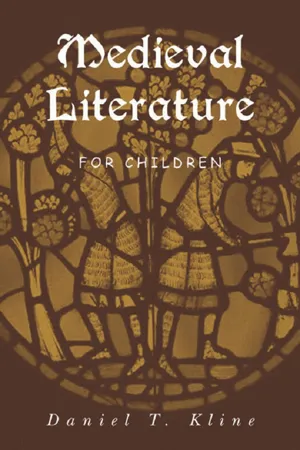
Medieval Literature for Children
About this book
This volume will be a critical anthology of primary texts whose main audience was children and/or adolescents in the medieval period. Texts will include theoretical and interpretative introductions and commentary.
Information
1
The Fables of Avianus
WILLIAM F. HODAPP
This chapter offers an introduction to and translation of selections from a late antique collection of forty-two fables, written in Latin elegiac couplets and attributed to a fourth-century poet named Avianus. This particular collection of fables served an important purpose in the Latin Middle Ages, for many medieval educators used these fables in part to instruct youths in Latin grammar. Although not the only collection so used, Avianus’s Fables were extremely popular in European schools from the Carolingian period until the eighteenth century. In addition to the fables themselves, this introduction explores briefly the genre of fable and its history in classical and medieval cultures the use of fables in medieval education, particularly Avianus’s Fables; and the imitation of Avianus in the Middle Ages. It concludes with a note on the translations.
History: Classical and Medieval
In the ancient Greek poem “Works and Days,” Hesiod (ca. 800 B.C.) offers to a certain Perses a compilation of rustic wisdom and prophetic statements, discussions of the seasons, advice on marriage, and suggestions on how to avoid offending the gods. Relatively early in the poem, Hesiod includes a fable. He states:
And here’s a fable for kings, who’ll not need it explained:
It’s what the hawk said high in the clouds
As he carried off a speckle-throated nightingale
Skewered on his talons. She complained something pitiful,
And he made this high and mighty speech to her:
“No sense in your crying. You’re in the grip of real strength now,
And you’ll go where I take you, songbird or not.
I’ll make a meal of you if I want, or I might let you go.
Only a fool struggles against his superiors.
He not only gets beat, but humiliated as well.”
Thus spoke the hawk, the windlord, his long wings beating. (235–45)1
It’s what the hawk said high in the clouds
As he carried off a speckle-throated nightingale
Skewered on his talons. She complained something pitiful,
And he made this high and mighty speech to her:
“No sense in your crying. You’re in the grip of real strength now,
And you’ll go where I take you, songbird or not.
I’ll make a meal of you if I want, or I might let you go.
Only a fool struggles against his superiors.
He not only gets beat, but humiliated as well.”
Thus spoke the hawk, the windlord, his long wings beating. (235–45)1
Presumably the oldest recorded fable in European literature, Hesiod’s tale of the hawk and the nightingale, which follows a discourse on the five ages of humankind, clearly illustrates the genre and its didactic context. Although kings may not need the fable explained, the poet knows his audience does, so he offers a long discourse on justice and concludes:
Perses, you take all this to heart. Listen
To what’s right, and forget about violence.
The Son of Kronos has laid down the law for humans.
Fish and beasts and birds of prey feed on
Each other, since there’s no justice among them.
But to men he gave justice, and that works out
All to the good…. (316–22)
With the fable, then, Hesiod offers a view of the natural world in which the strong control the weak; he counters that view, however, with another in which the principle of justice, divinely inspired by Zeus, governs human interaction. Macrobius Ambrosius Theodosius, writing some 1,200 years later (ca. A.D. 400), seems to have had in mind just such a fable when articulating his literary theory.
In his influential commentary on Cicero’s Dream of Scipio, Macrobius argues for the philosophical value of certain types of fables. He writes, “Fables…serve two purposes: either merely to gratify the ear or to encourage the reader to good works” (1.2.7). Fables that serve the latter purpose, he continues, “draw the reader’s attention to certain kinds of virtue” (1.2.9). This didactic aim most often comes to mind when we think of fable as genre. As suggested by Hesiod’s hawk and the nightingale, the fable is typically a brief narrative in verse or prose that either implicitly or explicitly offers a moral or pithy message. Characters are usually animals, inanimate objects, or personifications that behave like humans, or they are human types, such as the Old Man or the Youth.
Medieval fable collections, in both Latin and various vernaculars, are rooted in the Greek tradition of fable stretching back at least to the eighth century B.C. and Hesiod’s fable of the hawk and the nightingale. The better-known fabulist of early Greek culture, however, is Aesop, who as legend has it was a freed slave from Samos living in the sixth century B.C. (Blackham, 5; Handford, xiv–xv). While Aesop, if he was indeed an actual person, probably never wrote down his stories, several later Greek writers published fable collections that purported to be from him. In particular, Demetrius of Phalerum, writing in the fourth century B.C., composed a collection of fables in Greek prose that, according to H. J. Blackham, “seems to have been Aesop for the classical world” (7).
With their interest in things Greek, the Romans, of course, also picked up on the fable. Horace, for instance, alludes to fables in several Satires and Epistles and, like Hesiod, incorporates a fable in a poem when he tells the tale of the country mouse and the city mouse (Satires,2.6.77–117). In this fable, a city mouse visits a country mouse and, after seeing its poor den and eating its simple food, invites the country mouse to dine in the city. The latter accepts and is initially impressed with a sumptuous meal at a palace; soon, however, ferocious dogs chase them from the hall. Upon barely escaping, the country mouse declares it has no use for such a life, preferring instead the simplicity of the country, free from fear. Horace uses the fable to underscore his central point in the poem; that is, the merits of country living far outweigh those of city living.
While Horace integrated this Aesopean fable into a larger poem, it was not until the first century A.D. that a poet composed a sequenced verse collection of fables based on Aesop. Phaedrus (d. ca. A.D. 50), an otherwise minor author, is, according to Gian Biagio Conté, “one of the greatest glories of Latin literature …[for] he is the first author in Greco-Roman culture to give us a collection of fables conceived as an independent poetic work and intended for reading” (433). Writing over ninety fables in iambic senarii (i.e., six iambs per line), Phaedrus divided his collection into five books and, in addition to the Aesopian stock of tales, invented fables with contemporary allusions (Rubin and Sells, 400). Another poet likewise composed a collection of fables. Writing in the second century A.D., the Greek-speaking poet Babrius, drawing on the same stock of Aesopian fables as Phaedrus, and developing his own emphases in favor of satire, composed the first collection of fables in Greek verse (Blackham, 13–14; Rubin and Sells).2Babrius’s collection served as a key source for the fifth-century poet Avianus, whose collection of forty-two fables is the primary subject of this chapter.3
While neither Phaedrus nor Babrius directly influenced the fable tradition in the Latin west during the Middle Ages, Avianus and the Romulus collection inspired several medieval writers to use fable for both instruction and delight. Walter of England, for example, writing in the twelfth century, composed a collection of sixty fables in Latin elegiac couplets, based on the Romulus collection (A. Wright, 2–3). Also writing in the twelfth century, Marie de France, like her contemporary Walter, drew on the Romulus tradition when she wrote 102 fables in French octosyllabic couplets: a collection that was quite popular in the Middle Ages, as suggested by its manuscript tradition (Burgess, 573). Nor did the interest in fables wane in the later Middle Ages; for example, Robert Henryson, a fifteenth-century schoolmaster, composed a collection of fables in lowland Scots entitled Moral Fabillis of Esope, again derived in part from his predecessors (Wright, 5).
From Hesiod to Henryson, then, various authors were drawn to the fable as a vehicle for storytelling. Similarly, whether part of larger texts, as with Hesiod and Horace, or collected in anthologies, as with Romulus and Avianus, fables appealed to readers who sought both entertainment and philosophical insight. Indeed, the genre held an important position in literary culture in the West, from its origin in classical Greece until well into the early modern period of European history. In part, this position was secured through the educational system that used fables for grammar instruction.
Uses in Medieval Education
Grammarians used fable collections, among other texts, such as Cato’s Disticha and Maximianus’s Elegiae, to instruct students who had mastered the basic grammar in Donatus’s Ars minor and Ars maior and Priscian’s Institutio grammatica(Curtius, 42–43, 48–54), but who were not yet ready for poets such as Horace, Virgil, and Ovid. Beginning during the Carolingian era (eighth and ninth centuries), Avianus’s Fables became a standard curriculum text used with youth for grammar instruction. When one works with the Latin poems, it becomes clear why teachers and students favored this collection of fables: for students, it offers a series of brief, entertaining narratives; for teachers, it presents engaging material for teaching vocabulary and grammar, as well as metrics and interpretation.4For instance, Avianus’s choice of meter, the elegiac couplet, offered medieval students metrical complexity for grasping the quantitative values of Latin syllables—that is, the length of the syllable, which is either long or short. Briefly, the elegiac couplet consists of a dactylic hexameter line (six feet) followed by a...
Table of contents
- Cover
- Half Title
- Full Title
- Copyright
- Contents
- Dedication
- Acknowledgments
- INTRODUCTION
- CHAPTER 1: THE FABLES OF AVIANUS
- CHAPTER 2: SELECTIONS FROM THE GESTA ROMANORUM
- CHAPTER 3: SELECTIONS FROM GOWER’S CONFESSIO AMANTIS
- CHAPTER 4: THE “ABC OF ARISTOTLE”
- CHAPTER 5: THE BABEES BOOK
- CHAPTER 6: SELECTIONS FROM THE BOOK OF THE KNIGHT OF THE TOWER
- CHAPTER 7: ÆLFRIC’S COLLOQUY
- CHAPTER 8: LE TRETIZ OF WALTER OF BIBBESWORTH
- CHAPTER 9: A SCHOOLCHILD’S PRIMER (PLIMPTON MS 258)
- CHAPTER 10: CHAUCER AS TEACHER: CHAUCER’S TREATISE ON THE ASTROLABE
- CHAPTER 11: THE ECLOGA THEODULI
- CHAPTER 12: “THE CHILD SLAIN BY JEWS” AND “THE JEWISH BOY”
- CHAPTER 13: YPOTIS: A MIDDLE ENGLISH DIALOGUE
- CHAPTER 14: OCCUPATION AND IDLENESS
- CHAPTER 15: SELECTION FROM MATH SON OF MATHONWY, FROM THE MABINOGI
- CHAPTER 16: SIR GOWTHER (ADVOCATES MS. 19.3.1)
- Bibliography
- Index
Trusted by 375,005 students
Access to over 1.5 million titles for a fair monthly price.
Study more efficiently using our study tools.
Frequently asked questions
Yes, you can cancel anytime from the Subscription tab in your account settings on the Perlego website. Your subscription will stay active until the end of your current billing period. Learn how to cancel your subscription
No, books cannot be downloaded as external files, such as PDFs, for use outside of Perlego. However, you can download books within the Perlego app for offline reading on mobile or tablet. Learn how to download books offline
Perlego offers two plans: Essential and Complete
- Essential is ideal for learners and professionals who enjoy exploring a wide range of subjects. Access the Essential Library with 800,000+ trusted titles and best-sellers across business, personal growth, and the humanities. Includes unlimited reading time and Standard Read Aloud voice.
- Complete: Perfect for advanced learners and researchers needing full, unrestricted access. Unlock 1.5M+ books across hundreds of subjects, including academic and specialized titles. The Complete Plan also includes advanced features like Premium Read Aloud and Research Assistant.
We are an online textbook subscription service, where you can get access to an entire online library for less than the price of a single book per month. With over 1.5 million books across 990+ topics, we’ve got you covered! Learn about our mission
Look out for the read-aloud symbol on your next book to see if you can listen to it. The read-aloud tool reads text aloud for you, highlighting the text as it is being read. You can pause it, speed it up and slow it down. Learn more about Read Aloud
Yes! You can use the Perlego app on both iOS and Android devices to read anytime, anywhere — even offline. Perfect for commutes or when you’re on the go.
Please note we cannot support devices running on iOS 13 and Android 7 or earlier. Learn more about using the app
Please note we cannot support devices running on iOS 13 and Android 7 or earlier. Learn more about using the app
Yes, you can access Medieval Literature for Children by Daniel T. Kline in PDF and/or ePUB format, as well as other popular books in Literature & Literary Criticism. We have over 1.5 million books available in our catalogue for you to explore.