The Celtic World is a detailed and comprehensive study of the Celts from the first evidence of them in the archaeological and historical record to the early post-Roman period. The strength of this volume lies in its breadth - it looks at archaeology, language, literature, towns, warfare, rural life, art, religion and myth, trade and industry, political organisations, society and technology. The Celtic World draws together material from all over pagan Celtic Europe and includes contributions from British, European and American scholars. Much of the material is new research which is previously unpublished.
The book addresses some important issues - Who were the ancient Celts? Can we speak of them as the first Europeans? In what form does the Celtic identity exist today and how does this relate to the ancient Celts?
For anyone interested in the Celts, and for students and academics alike, The Celtic World will be a valuable resource and a fascinating read.
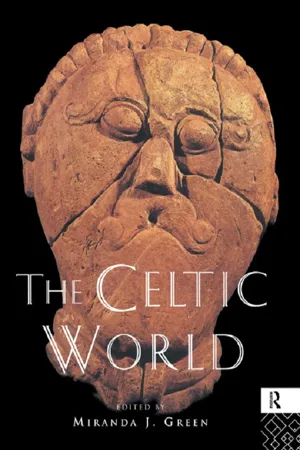
- 864 pages
- English
- ePUB (mobile friendly)
- Available on iOS & Android
eBook - ePub
The Celtic World
About this book
Information
PART I
CELTIC ORIGINS
CHAPTER ONE
INTRODUCTION
Who were the Celts?

The decision to produce an international exploration of the Celtic world between 600 BC and AD 600 rests upon the premiss that the ancient Celts existed in some manner, whether self-defined or as a group of peoples who were classified as such by communities who belonged to a separate cultural – and literate – tradition. The area of temperate Europe north of the Alps and beyond the Mediterranean littoral generally referred to as Celtic was virtually non-literate until it came fully within the orbit of the classical world at the end of the first millennium BC. It was observers from the Mediterranean lands of Greece and Rome who called their northern neighbours Celts. But are we, as modern investigators, justified in speaking of the ancient inhabitants of ‘barbarian’ Europe as Celts? Who were the Celts? How should we define this term? It is interesting that the same questions do not tend to be asked of – say – the Roman world. We are secure with Romans because they identified themselves as such: Civis Romanus sum (‘I am a Roman citizen’). We cannot tell whether a comparable Celtic consciousness ever existed.
It is pertinent to pose these questions in a survey such as this because the existence of Celts in any meaningful sense in antiquity continues to be a focus of controversy and debate. Many prehistorians (including some contributors to this volume) argue that it is spurious to identify iron age Europeans as Celts. Other investigators are more comfortable with this nomenclature, as long as its meaning is specifically defined. On the opposite pole to the sceptics are the committed Celticists who perceive a genuine continuity of tradition between the ancient peoples of northern Europe and the modern inhabitants of Ireland, Scotland, Wales, Cornwall, the Isle of Man and Brittany. The debate is active and well-nourished, and present contributors exhibit its diversity in both methodology and approach. No attempt has been made on the part of the editor to ‘iron out’ controversy or to present a unidirectional approach. It is important to reflect academic debate as it exists.
The problem of defining what is (or should be) meant by the terms ‘Celt’ and ‘Celtic’ centres around the relationship, if any, between material culture, ethnicity and language. Any construction of later prehistoric Europe is based upon information which is both fragmentary and ambiguous. The evidence is (like many Celtic gods) triple-headed and consists of archaeology, documentary sources and linguistic material. These three categories of evidence combine to present us with a Celtic world which, by the last few centuries BC, appears to have stretched from Ireland to eastern Europe and beyond, to Galatia (see map p. XXIV). The term ‘Celts’ is one to which we are introduced by Greek and Roman observers of their ‘barbarian’ neighbours north of the Alps. But did these people think of themselves as Celtic? Did they have an ethnic consciousness of themselves as possessing any kind of homogeneity within ancient Europe? With what degree of precision did Mediterranean commentators apply this descriptive label? Some scholars would argue that ‘Celt’ was maybe little more than a loose term for people different from those of the classical world: ‘foreign’, ‘less civilized’, ‘marginal’, ‘fringe’, ‘other’ people. Was there more to Celticness than that? In my opinion, this is an interesting but rather too extreme viewpoint: the Greek historian Herodotus made a clear distinction between those non-Greek peoples whom he called Celts and others, such as Scythians and Ethiopians. But the precision with which the term ‘Celt’ was used by writers from the Mediterranean world may well have varied widely: Herodotus, Livy and Caesar may well all be speaking of different groups even though they used the same word.
Classical commentators on the Celts reflected a school of thought in the Graeco-Roman world which appears to have recognized a group of peoples to their north as possessing sufficient cultural features in common to justify their endowment with a common name, the ‘Celts’. We need to raise the question of how far we can trace this commonality of tradition in both archaeological evidence for material culture and in language. But for the moment let us remain with the contemporary documentary sources. Allusion is first made to Celts by name in the writings of such Greek historians as Hecataeus of Miletus in about 500 BC and Herodotus in the fifth century BC. These authors speak of Keltoi. Later Mediterranean writers such as Livy and Polybius chronicle the expansion of the Celts during the fourth and third centuries. These writers inform us that by the later third century BC the Celts were heavily defeated by the Romans and thereafter suffered a series of setbacks and reversals, until the Celtic heartlands of Gaul were annexed by the Romans in the mid-first century BC. Britain is never referred to by ancient authors as Celtic but Caesar recognized the similarities between Britain and Gaul. Tacitus and other Roman authors record the conquest of Britain, which was more or less complete by the later first century AD.
Early linguistic evidence for the Celts is extremely sparse before the Roman period because northern Europe was virtually non-literate during most of the first millennium BC. When writing was adopted in the Celtic world in the late first millennium, it appeared almost entirely in Greek or Latin. Early Celtic linguistic evidence, such as it is, consists of inscriptions, coin legends and the names of people and places contained within classical documents. These early sources suggest that by the time of the Roman occupation, at the end of the first millennium BC, Celtic languages were spoken in Britain, Gaul, north Italy, Spain, central and eastern Europe.
Material culture perhaps offers the best hope of approaching and identifying the ancient Celts. In archaeological terms, Celtic Europe is distinguished from previous prehistoric cultures by the adoption of iron as a commonly utilized metal. The archaeological record of later European prehistory suggests that the historical Celts (those named as such in documentary sources) may have had their origins within the cultures of the later Bronze Age. In terms of their archaeological presence, it does not make sense to think of the Celts as suddenly appearing on the European stage in the mid-first millennium BC. It is more likely that groups of people living in Europe became ‘Celtic’ by accretion, through process of time.
The material culture of central and northern Europe in the later Bronze Age of the mid-late second millennium BC is known to archaeologists as the ‘Urnfield’ tradition, a term derived from a distinctive burial rite in which some members of the population were cremated, their burnt bones being interred within pots, in flat cemeteries. In addition, this Urnfield tradition is characterized by the new ability of metalsmiths to fashion bronze into thin sheets which were formed into vessels, body-armour and shields. The new technology may have been stimulated by the collapse of the great hegemonies of southern Europe, namely the Mycenaean and Hittite Empires, the demise of which perhaps released onto the market large supplies of metal for central European use. The Urnfield tradition occurred widely in regions later occupied by iron age Celts and some scholars would go so far as to apply the label of ‘proto-Celts’ to the people to whom this Bronze Age culture belonged.
During the eighth century BC, new elements in material culture began to manifest themselves in central Europe. New metal types associated with horse-gear and riding are indicative of the presence of warrior-horsemen, who might be regarded as the antecedents of the Celtic equites, the horse-owning knights alluded to by Caesar in his Gallic War. These early iron age cavalrymen used long slashing swords, sometimes made of bronze, sometimes of iron. This new material culture has been called ‘Hallstatt’, after the so-called type-site, a great cemetery at Hallstatt in Austria, which housed the bodies of local people involved in salt-mining, trading and the control of the ‘Salzkammergut’ (salt-route) of the region around modern Hallein. This cemetery was first used during the later Bronze Age, but also produced large quantities of rich metalwork belonging to the earliest Iron Age. The same distinctive artefact-types found at Hallstatt have been recognized over wide areas of Europe. The bronze age material from the site has been designated Ha A and B and that of the Early Iron Age, Ha C and D. It is the material culture of the later Hallstatt, Iron Age, phases which is often considered to be the earliest evidence of the European Celts. This Hallstatt tradition is distinctive in the archaeological record for its wealth and its clear evidence for close trading links with the classical world. The upper echelons of society in the seventh and sixth centuries BC are represented by rich inhumation burials, like those of Hohmichele and Hochdorf in Germany and Vix in Burgundy, the dead often being interred in wooden mortuary houses, accompanied by four-wheeled wagons, weapons and luxury goods, including jewellery and feasting equipment, some of which came from the Mediterranean world. Little is known of the smaller settlements inhabited by these early iron age communities, but large fortified centres, like the Heuneburg near the Hohmichele grave and Mont Lassois near Vix, are presumed to have been the dwelling-places, and perhaps the power bases, of the high-ranking individuals buried nearby.
Archaeological evidence suggests that, by the early fifth century BC, the centres of power and wealth had shifted north and west to the Rhineland and the Marne. This may have occurred because, at a time when Etruria was becoming a major power, the trade-routes were perhaps reorientated to facilitate direct trading between the Celts and the Etruscans. This geographical shift is marked by the appearance of new elements in material culture, which archaeologists call La Tène, after the metal-work from the site of the same name on Lake Neuchâtel in Switzerland. Precious items of war-gear and other implements, together with animals, were deliberately deposited in the water over a long period, presumably as a series of votive acts. The La Tène phase of the European Iron Age demonstrates the presence of a warrior-aristocracy, some of whom were still buried with vehicles, but now with a light, two-wheeled cart or chariot replacing the heavy wagon of the later Hallstatt period. The La Tène tradition is above all characterized by a fine art, essentially an aristocratic art which was employed principally for the embellishment of metalwork. La Tène artists owed much to their Hallstatt forebears but they were also heavily influenced by themes and art forms from both the classical world and the Near East. Celtic art was dominated by abstract, geometric designs, but images from the natural world – foliage, animals and human faces – were often incorporated as integral components of these designs. The material culture of the La Tène phase represents the floruit of Celtic civilization. The archaeological record presents us with a picture of a heroic society in which war, feasting and display were important, a society which is recognizable as that alluded to by classical chroniclers of their ‘Celtic’ neighbours.
Celtic culture per se is generally considered to come to an end around the...
Table of contents
- Cover Page
- Half Title page
- Title Page
- Copyright Page
- Contents
- List of illustrations
- List of contributors
- Preface
- Part I Celtic Origins
- Part II Warriors and warfare
- Part III Society and Social Life
- Part IV Settlement and Environment
- Part V The Economy
- Part VI Technology and Craftsmanship
- Part VII The Art of the Celts
- Part VIII Pagan Celtic Religion
- Part IX The Celts in Europe
- Part X On The Edge of the Western World
- Part XI Celtic Britain Post Ad 400
- Part XII The survival of the celts
- Index
Trusted by 375,005 students
Access to over 1.5 million titles for a fair monthly price.
Study more efficiently using our study tools.
Frequently asked questions
Yes, you can cancel anytime from the Subscription tab in your account settings on the Perlego website. Your subscription will stay active until the end of your current billing period. Learn how to cancel your subscription
No, books cannot be downloaded as external files, such as PDFs, for use outside of Perlego. However, you can download books within the Perlego app for offline reading on mobile or tablet. Learn how to download books offline
Perlego offers two plans: Essential and Complete
- Essential is ideal for learners and professionals who enjoy exploring a wide range of subjects. Access the Essential Library with 800,000+ trusted titles and best-sellers across business, personal growth, and the humanities. Includes unlimited reading time and Standard Read Aloud voice.
- Complete: Perfect for advanced learners and researchers needing full, unrestricted access. Unlock 1.5M+ books across hundreds of subjects, including academic and specialized titles. The Complete Plan also includes advanced features like Premium Read Aloud and Research Assistant.
We are an online textbook subscription service, where you can get access to an entire online library for less than the price of a single book per month. With over 1.5 million books across 990+ topics, we’ve got you covered! Learn about our mission
Look out for the read-aloud symbol on your next book to see if you can listen to it. The read-aloud tool reads text aloud for you, highlighting the text as it is being read. You can pause it, speed it up and slow it down. Learn more about Read Aloud
Yes! You can use the Perlego app on both iOS and Android devices to read anytime, anywhere — even offline. Perfect for commutes or when you’re on the go.
Please note we cannot support devices running on iOS 13 and Android 7 or earlier. Learn more about using the app
Please note we cannot support devices running on iOS 13 and Android 7 or earlier. Learn more about using the app
Yes, you can access The Celtic World by Miranda Green in PDF and/or ePUB format, as well as other popular books in Social Sciences & Archaeology. We have over 1.5 million books available in our catalogue for you to explore.