eBook - ePub
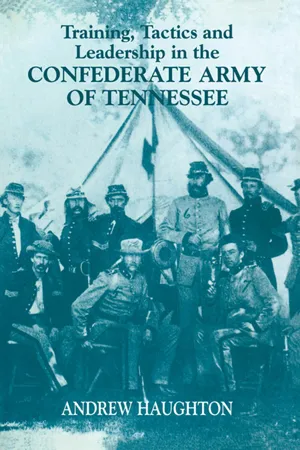
Training, Tactics and Leadership in the Confederate Army of Tennessee
Seeds of Failure
- 280 pages
- English
- ePUB (mobile friendly)
- Available on iOS & Android
eBook - ePub
Training, Tactics and Leadership in the Confederate Army of Tennessee
Seeds of Failure
About this book
This assessment of the performance of the southern soldiers in the American Civil War of 1861 deals with every aspect of an army from its senior officer to the lowliest private, following every process as the soldier tried to adapt to military life, train, and overcome the enemy.
1
The Southern Martial Tradition
When the Civil War broke out in 1861 few Southerners had any formal military experience. The new Confederate states had a few hundred officers trained at West Point or appointed direct to the US Army, or with combat experience from the Mexican War of 1846–48. There were others who had gained experience in the ranks of the US Army or as volunteers in Mexico. A small number of European immigrants had received some form of training in the armed forces of their former homelands. Yet no citizen soldier is entirely a tabula rasa, and many Southerners believed themselves blessed with an innate talent for war. The stereotype of the violent and martial Southerner, summed up in the words of Wilbur J. Cash as a conviction in every man that ‘nothing living could cross him and get away with it’, was popular throughout the United States before the Civil War and has survived in the history of the conflict ever since.1 The historiography of the ‘martial Southerner’ has split, by and large, into two schools, based on the conception of Southern society as being divided between planter-aristocrats and poor whites. Historians of the South such as Cash, Frank Owsley and Blanche Henry Clark have focused on the ‘plain folks’ of the South, concerning themselves with the aggressiveness and fighting qualities of poor whites, rather than the genteel South of popular fiction.2 In contrast to this frontier, yeomen-dominated image, historians such as Ulrich B. Philips, Eugene Genovese and Raimondo Luraghi have characterised the South as a seigneurial, planter-dominated region of polarised classes. From this perspective the leadership abilities of Robert E. Lee, Joseph Johnston, Wade Hampton and others arose from their aristocratic upbringing, and their consequent habit of command on the plantation.3 The qualities of Nathan Bedford Forrest, meanwhile, might be accredited to his extensive experience with slaves, and thus a command style suitable for leading men in battle. Many Southerners were closely associated with command and leadership in the eyes of their contemporaries and in the view of historians. Robert May described General John A. Quitman, a Southern officer during the Mexican War, as ‘the stereotypical martial Southerner – more than a militia enthusiast, soldier, and filibuster. He also liked to hunt, ride horses, fight and duel. His whole personality was suffused in a militant aura.’ The martial, or at least violent, nature of Southerners was another widely accepted stereotype even before the Civil War. George Templeton Strong, for example, remarked in 1851 on a ‘South still clamorous, querulous, and absurd’, and likened Southerners to the ‘savage Gaelic race of the Highlands’ which fought with the neighbouring English in the time of William and Mary. Daniel R. Hundley meanwhile, a Southern Whig who would later lead a regiment in the Confederate Army, likened Southerners to the Crusaders of the Middle Ages and to an earlier generation of Americans, ‘those unerring riflemen who, at the Battle of New Orleans, made such havoc in the ranks of Packenham’s [sic] veterans’.4
The perceived martial prowess of the Southerner was inextricably linked to his social and cultural environment. The South was considered unique in its culture, a region set apart from the rest of the United States, and it is in this cultural environment that any examination of the Southern martial tradition must begin. One of the first writers to seriously examine the contention that the social or class structure of the South was exceptional was the famous landscape architect Frederick Law Olmsted. Olmsted, a Northern writer, travelled extensively in the South during the politically turbulent years before the secession crisis, writing for the New York Daily Times. He was concerned primarily with what he perceived to be the basis of Southern society – slavery, and the part it played in both the economy and the society of the South.5 Olmsted divided Southerners into three social categories: the planter, the slave and, between the two, the poor white, arguing that the moral corruption of slavery degraded those whites and promoted apathy and lethargy among them, thus contributing to poverty in the South rather than promoting general wealth.6 The focus of Olmsted’s work was, however, on the relationship between the planters and the slaves, wherein he emphasised the authoritarian and violent manner in which the planters treated their slaves. Olmsted’s high estimation of discipline on the plantations, the fear he believed he saw in Southerners of slave insurrection, and the measures – such as patrols – that Southerners took to counter these threats, led him to the conclusion that the planters were pretentious, peremptory and violent. More than that, he believed that this would inevitably lead to serious repercussions for the nation as a whole.7
In the 1960s and the 1970s Eugene D. Genovese adapted and built upon the work of Olmsted to produce an image of the South which was far more thorough and convincing than Olmsted’s, but which maintained that the planters had been able to dominate the Southern economy to such an extent that the slaveholders constituted a ruling class.8 This, Genovese argued, was what allowed ‘the world view’ of Southern slaveholders to become the world view of Southerners: ‘Slavery gave the South a social system and a civilisation with a distinct class structure, political community, economy, ideology, and set of psychological patterns and – as a result, the South increasingly grew away from the rest of the nation and from the rapidly developing sections of the world.’9 This thesis, based upon what Genovese considered the fundamental mode of production in the South, slavery, led him to postulate that the planters’ political, economic and social dominance allowed them to carry the other sections of society into the Civil War.10
Genovese recognised that there was, however, a key problem in the acceptance of planter domination of Southern culture and politics. The proposition that the planters were the economically dominant class in Southern society and that they led the South into the Civil War assumes that the rest of white society in the South had no effective will or influence, that they would follow the planter-aristocracy even into a bloody war to defend the interests of the planters.11 ‘Yet we know’, Genovese conceded, ‘that those nonslaveholders were touchy, proud people who hardly specialised in grovelling and who were as quick as the planters to shed blood over questions of honour.’12 As a solution to this paradox Genovese developed the hypothetical tale of ‘Ole’ Jefferson Venable, the planter, and Josh Venable, his poor, nonslave-holding kin. Genovese suggested that Josh, and the class of Southerner which he represented, ‘either aspired to become slaveholders or to live as marginal farmers under the limited protection of their stronger neighbours’. It was the natural course, as a result, for non-slaveholding whites to ride in slave patrols, help to discipline the slaves and to participate in the politics of the slave regime, ‘in short, to think and act like slaveholders even before becoming one’.13 By creating the image of Jefferson Venable, and the familial, cross-class structure of life in the South, Genovese moved away from the more authoritarian, duelling, martial image of Southern planters which had featured in the work of Olmsted. The picture evolving in Genovese’s work, then, was of a stratified society without clear class divisions and with common bonds between those who had previously been classed as planter-aristocrats and the rest of white society.
The economic historian Gavin Wright offered support to this school of thought by suggesting that non-slaveholders’ decision-making was based upon a ‘safety-first’ approach of ensuring that enough land and labour were given for food production in order to guarantee that they had enough food to live on. Wright argued that, rather than distinct class divisions, there was a spectrum of farmers stretching from cash- crop planters through to those making just enough food to live on. In the middle of this spectrum there existed a large number of ‘yeomen’ farmers involved in a corn/cotton crop mix. The yeomen farmers, in trying to make profits and so rise up the economic and social ladder, were closely tied to (and supportive of) the planter-led economic system.14 Thus a depiction of the South emerged which integrated the traditional images of planter society and ‘plain folks’. Social fluidity, a concept developed in studies of Northern society, was also incorporated into analyses of Southern society and lent further support to the idea that North and South had more in common, with regard to their societal structure, than had been previously imagined.15
Yet many, perhaps most, antebellum Americans appear to have believed that Southern society was different from and more martial than any other geographic region.16 That in itself has important implications for our understanding of the attitudes Civil War soldiers brought to the camps and battlefields of 1861–62. The inaccuracies in the contemporary image of Southern society meant that Northerners tended towards overestimating the qualities of Southern soldiers, while many Southerners who lacked any real military experience failed to recognise their own military deficiencies.17
Antebellum perceptions of Southern exceptionalism were, however, based on much more than slavery and social structure. If those factors formed the framework for the debate, they were supported by a number of additional images which lent flesh to the stereotype of the pre-war Southerner. For most Northerners, those less interested in the slavery question than Frederick Law Olmsted and less concerned with social structure than Genovese and Wright, the images of Southern gentlemen, poor farmers and violent backwoodsmen were more real, and more potent, than intellectual questions over the effects of slavery.18 This image was fostered in the press, in novels and in works of a more factual nature such as Daniel Hundley’s Social Relations in Our Southern States.19
Hundley was a particularly strong advocate of the idea that the South enjoyed a peculiar martial spirit, inculcated in its citizens from a young age by the agrarian environment in which Southerners were raised. The ‘Southern Gentleman’, for example, owed his ‘good size and graceful carriage – to his out-of-doors and a-horse-back mode of living’.20 The rural environment forced Southerners to become accustomed to riding, hunting and using weapons. In Hundley’s opinion, it was their environment which produced a peculiarly martial talent among Southern planters and yeomen: ‘Indeed, take them all in all, and we doubt if the world can produce a more reliable citizen soldiery than the yeomen of our Southern States.’21 With the planter elite already accustomed to command, the implication in the work of Hundley and Olmsted is that the Southern male population was all but an army in waiting. In the case of both the elite and the wider populace, Hundley and others argued that the Southern environment and class structure promoted other peculiarly military talents – a habit of command among the officer class; a willingness to take risks; a familiarity with violence; and a psychology based upon manhood and honour, which indicated the aggressiveness of the Southern male. If accurate, the Confederates began the Civil War with a significant advantage in terms of training and experience. Whatever its accuracy, the perception itself would have an effect on the attitudes of Northerners and Southerners in the first months of the war, determining how they approached their training and how they thought about their part in the war.22
At the most basic level, Southerners were expected to command their slaves, much as officers would later command troops, and to work under conditions in which there was always a potential threat of violence. Indeed, sectional tension heightened a fear already prevalent in Southern society that the black population would, ultimately, rise against them in violent rebellion. ‘The presence of the black population increased Southerners’ devotion to order and stability’, according to Dickson Bruce, and it was widely accepted that, while non-violence was preferable, ‘violence might be necessary in some situations’.23 John Hope Franklin went further, arguing that Southerners were constantly involved in the ‘military activity’ of suppressing the slaves, that it was merely another part of their daily lives as hunters, horsemen and riflemen. This made the Southern male ‘almost naturally trained to war’.24 With the benefit of hindsight, Franklin’s proposition might be further strengthened by reference to the South’s successful officers, such Lee, P. G. T. Beauregard and J. E. B. Stuart, who seemed to adapt rapidly to command. However, if these men enjoyed a ‘habit of command’ learned through their dealing with slaves, less successful officers such as Braxton Bragg and Sterling Price had also gained extensive experience in dealing with slaves before the war but without winning similar rewards in battle.25 Moreover, to borrow from Marcus Cunliffe’s argument, there is no clear division in performance between Northern and Southern officers which could be linked direct to a ‘habit of command’ fostered through proximity to slavery. Indeed, in terms of man-management, those who had dealt with factory or railway workers might claim better or equal qualification to command.26
The most convincing part of the argument that the existence of slavery contributed to a Southern martial tradition relates to slave patrols and the other measures taken by Southerners to preclude and to deal with slave insurrections. The patrols were usually made up of slaveholders and non-slaveholders and seemed, superficially at least, to offer military experience to all Southern males who took part. However, in many areas the patrols were irregular and strong enough to capture only friendless, unarmed slaves.27 In comparison to the discipline and physical requirements of life in an infantry regiment, occasional excursions into the Southern countryside in the pursuit of runaway slaves would not seem to be especially beneficial. The exaggeration of the benefits of slave patrols is similar to that for hunting. For example, Daniel Hundley and John Hope Franklin believed that the Southerners’ experience of using weapons for hunting would be an advantage in battle.28 Yet this argument not only neglects the fact that hunting was popular throughout America and an intrinsic part of life for farmers from all states, it assumes that fire-power alone would determine battles and that familiarity with weapons would automatically guarantee battlefield competence. In point of fact, the individual and free nature of hunting would seem anathema to the rigid discipline and group cohesion of nineteenth-century tactics. This contrast and contest between the individual rifleman and the disciplined firing line appears again and again in the actions of Confederate soldiers, as will become evident.29
Dealing with slaves, operating within the Southern social system and participating in the violence common in Southern life (particularly in the west), some historians have suggested that an attitude developed – more important than experience itself – which disposed Southerners towards violence and recklessness. This disposition, in turn, promoted the idea of a martial South because it elevated events such as duels to a realm of respectability. Robert Weir, in an assessment of South Carolinian volatility, suggested that the attitude held by South Carolinians before the Civil War was tantamount to ‘an ethic of failure’.30 Finding it difficult to view themselves as representative of republican virtue, thanks to the ...
Table of contents
- Cover
- Title
- Copyright
- Contents
- Acknowledgements
- Series Editor’s Foreword
- List of Abbreviations
- Introduction
- 1 The Southern Martial Tradition
- 2 Antebellum Military Theory and Experience
- 3 The South Goes to War
- 4 The Battle of Shiloh
- 5 Training in the Heat of a Mississippi Summer
- 6 The Kentucky Campaign
- 7 The Battle of Stones River
- 8 Training in the Light of Experience
- 9 The Chickamauga and Chattanooga Campaigns
- 10 Training for the Atlanta Campaign
- 11 Joseph E. Johnston and the Atlanta Campaign
- 12 Desperation and Destruction in the Final Year of the War
- Conclusion
- Appendix: Examinations for Artillery Officers
- Notes
- Bibliography
- Index
Trusted by 375,005 students
Access to over 1.5 million titles for a fair monthly price.
Study more efficiently using our study tools.
Frequently asked questions
Yes, you can cancel anytime from the Subscription tab in your account settings on the Perlego website. Your subscription will stay active until the end of your current billing period. Learn how to cancel your subscription
No, books cannot be downloaded as external files, such as PDFs, for use outside of Perlego. However, you can download books within the Perlego app for offline reading on mobile or tablet. Learn how to download books offline
Perlego offers two plans: Essential and Complete
- Essential is ideal for learners and professionals who enjoy exploring a wide range of subjects. Access the Essential Library with 800,000+ trusted titles and best-sellers across business, personal growth, and the humanities. Includes unlimited reading time and Standard Read Aloud voice.
- Complete: Perfect for advanced learners and researchers needing full, unrestricted access. Unlock 1.5M+ books across hundreds of subjects, including academic and specialized titles. The Complete Plan also includes advanced features like Premium Read Aloud and Research Assistant.
We are an online textbook subscription service, where you can get access to an entire online library for less than the price of a single book per month. With over 1.5 million books across 990+ topics, we’ve got you covered! Learn about our mission
Look out for the read-aloud symbol on your next book to see if you can listen to it. The read-aloud tool reads text aloud for you, highlighting the text as it is being read. You can pause it, speed it up and slow it down. Learn more about Read Aloud
Yes! You can use the Perlego app on both iOS and Android devices to read anytime, anywhere — even offline. Perfect for commutes or when you’re on the go.
Please note we cannot support devices running on iOS 13 and Android 7 or earlier. Learn more about using the app
Please note we cannot support devices running on iOS 13 and Android 7 or earlier. Learn more about using the app
Yes, you can access Training, Tactics and Leadership in the Confederate Army of Tennessee by Andrew R.B. Haughton in PDF and/or ePUB format, as well as other popular books in History & Military & Maritime History. We have over 1.5 million books available in our catalogue for you to explore.