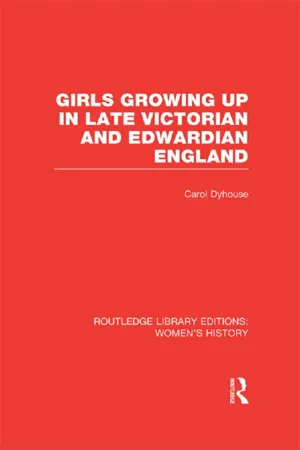
Girls learn about "femininity" from childhood onwards, first through their relationships in the family, and later from their teachers and peers. Using sources which vary from diaries to Inspector's reports, this book studies the socialization of middle- and working-class girls in late Victorian and early-Edwardian England. It traces the ways in which schooling at all social levels at this time tended to reinforce lessons in the sexual division of labour and patterns of authority between men and women, which girls had already learned at home. Considering the social anxieties that helped to shape the curriculum offered to working-class girls through the period 1870-1920, the book goes on to focus on the emergence of a social psychology of adolescent girlhood in the early-twentieth century and finally, examines the relationship between feminism and girls' education.
- 240 pages
- English
- ePUB (mobile friendly)
- Available on iOS & Android
eBook - ePub
Girls Growing Up in Late Victorian and Edwardian England
About this book
Trusted by 375,005 students
Access to over 1.5 million titles for a fair monthly price.
Study more efficiently using our study tools.
Information
Subtopic
19th Century HistoryIndex
History1 First lessons in femininity: the experience of family life
DOI: 10.4324/9780203104101-2
Any understanding of the education of girls in the nineteenth century must commence with some study of family life. The family is the primary and most powerful agency of socialisation. Its role in the socialisation of girls, in particular, was even more important in late-Victorian and early-Edwardian society than it is today. It was then much more able to determine and control the influence of other social groups and institutions especially the impact of schooling on the growing girl. Up until the first world war, a significant proportion of upper middle-class girls never went to school at all, being educated at home under the aegis of governesses. Most of the middle-class girls who did go to school attended private schools over which the state had no control and the choice of which was entirely in the hands of their parents. In working-class families, in spite of moves towards compulsory elementary education in the 1880s and later attempts to lengthen the period of school life, girls’ schooling remained a fairly short-term experience; judged by the majority, perhaps, as rather ‘unreal’, and commonly bitten into and ultimately curtailed by the much more real and pressing needs of the family.
Inside the family, relationships between parents and the organisation of domestic life constituted first lessons in the sexual division of labour, and if these relationships conformed to the patterns the child perceived in a widening world around her they were likely to be accepted as ‘normal’, part of the given order of things. Mothers provided small girls with their first models of feminine behaviour; fathers their first examples of paternalism distance, indifference or benevolence, perhaps. They commonly appeared invested with authority or power. Where there were children of both sexes girls would be quick to perceive differences in treatment: even if they resented it they would have no choice but to realise that their parents entertained different expectations of and ambitions for their children according to sex. Then, if the household included servants, the growing understanding of social relationship and authority would be amplified by a class, as well as a sexual dimension. In this chapter I want to explore the ways in which girls learned about the sexual division of labour characteristic of their society; to see how patterns of authority were presented to them, and how they were encouraged to conceive of ‘femininity’ and to define themselves as ‘feminine’, from their childhood onwards in the family. I shall then move on to consider some of the conflicts of emotion and personality this learning implied.
Late-Victorian middle-class society had developed a very marked sexual division of labour. Men went outside the home to earn money to maintain the household. Their wives, on the whole, stayed in the home and were economically dependent on the male breadwinner. From mid-century onwards, particularly following the establishment of a railway system, urban growth had taken a distinct form which emphasised the sexual division of labour by widening the physical gap between home and workplace. Well-to-do, middle-class businessmen migrated in large numbers to leafy residential suburbs remote from the pollution and griminess of central commercial and industrial districts. Daily they travelled into work on commuter trains, leaving their women-folk and children stranded in suburbia. Katharine Chorley, growing up in Alderley Edge, a prosperous suburb of Manchester, late last century recalled that:
After the 9.18 train had pulled out of the station the Edge became exclusively female. You never saw a man on the hill roads unless it were the doctor or the plumber, and you never saw a man in anyone’s home except the gardener or the coachman.1
The pattern was repeated in suburbs characterised by greater or lesser degrees of affluence, all over urban England. Children of suburban households grew up in a world where they expected their fathers to be absent all day; seeing them briefly, perhaps, in the evenings, otherwise only at weekends. The distinction between mother’s world the private, comparatively leisurely routine of the home and neighbourhood activities; and father’s world distant, invisible a public world of regular time-keeping and rather vague but decidedly important activities, was abundantly clear.
In working-class families the sexual division of labour might be less clear cut. For those who remained in the central areas of large towns there was less separation of home and workplace. In the metal-working districts of Birmingham and Sheffield, for instance, families might still live alongside small workshops. Children would have seen their fathers working and fathers did not necessarily automatically absent themselves from the daily life of the family. In areas where work was organised in larger factories, fathers might disappear regularly, but the kind of work they did might still have been more visible and familiar to their children. In some parts of England such as the textile districts of Lancashire or the Potteries a sizeable proportion of married women even those with small children remained in fairly regular, full-time employment. Further, working-class mothers almost everywhere were very likely to supplement the family income with some form of home or neighbourhood-based casual employment. In rural areas this might have taken the form of casual, seasonal work on the land: gleaning at harvest time, stone picking, or gathering fruit. In the towns women ran corner shops, or even set up shop in their front rooms. They often went charring or took in washing for other families. Sometimes there were lodgers to be seen to, or babies to mind for other working mothers.
All these factors served to blur the distinction between a father’s world of paid work and a mother’s world dependent, and in the home that most middle-class children took for granted. But it is important not to exaggerate the picture: working-class children were also presented with a society in which there were important differences between ‘men’s work’ and ‘women’s work’. To begin with, the categories themselves were distinct: that is, there were certain trades in which men worked, others dominated numerically by women. In trades which employed both sexes, there tended to be certain processes defined as women’s work and different processes employing men. And women’s work tended to be less secure and, of course, markedly less remunerative, than men’s. Most important of all we should remember that if we take the figures for the country as a whole, the proportion of married women who remained in full-time employment outside the home was relatively small. One cannot know the precise figure. The 1901 census for England and Wales recorded that 917,509 out of a total of 6,963,944 married or widowed women were returned as having a full-time occupation.2 However, several historians have pointed out that this is probably an under-estimate: many women, aware of social opposition to married women’s work outside the home, may have preferred not to declare themselves as ‘occupied’. The figure cannot indicate the extent of casual labour amongst women in working class areas.3 At the same time, we are left with the impression that most married women did give up full-time paid work outside their homes. This was particularly likely when there were very young children at home: it should be pointed out that the figure of 13 per cent mentioned above would have included married or widowed women who were childless, as well as those whose children were no longer fully dependent on them.
The 1901 General Report of the Registrar-General suggested that the proportion of occupied married women had decreased over the country as a whole since 1881.4 There were economic and social reasons for this. As real wage rates rose in some occupational groups after 1870, social aspirations changed. Middle-class ideals of domestic organisation filtered down the social scale.5 Katharine Chorley, recording her closeted, middle-class upbringing could not
remember any woman in our circle who had a career or a paid job of her own, either a married woman or a spinster. A paid job for one of his womenfolk would have cast an unbearable reflection of incompetence upon the money-getting male.6
Concepts of dependency may not have spread quite so far lower down the social scale, in that a workman would not necessarily have felt that it was his duty as a man to maintain his sisters. But in the last quarter of the century a ‘respectable’ working man aimed to support his wife and children in some degree of comfort. Married women’s work for a wage, outside the home was decidedly not respectable. A working wife endangered a husband’s status and self-respect, bringing into question both his class position and somehow, his manhood, because definitions of masculinity were so intimately bound up with a particular form of domestic life. So, too, were patterns of authority, still revealed in common speech. Men might object to their wives working lest they should want ‘to wear the trousers’ a crime against what they would argue to be the natural order of things.
Social opposition to married women’s work can be argued to have increased in early twentieth-century Britain. The contribution of women to industry and commerce during both world wars did little to break down barriers against the employment of wives and mothers in peacetime, indeed these prohibitions were made, if anything, more explicit. The Report of the Women’s Employment Committee of the Ministry of Reconstruction, published in 1919, recommended categorically that: ‘The employment of married women outside their homes is not to be encouraged’, and added that ‘Factory crées in normal times are not approved of.’7 During the 1920s, some local educational authorities instituted new regulations requiring teachers in their employ to resign on marriage.8 In industry, women reluctant to relinquish jobs were castigated by the national press, accused of greed and avarice, ingratitude to war-heroes, of stealing the bread out of other (dependent, womanly) women’s mouths. The 1921 census indicated that the proportion of women as a whole gainfully employed had actually shrunk since 1911.9 The proportion of married or widowed women occupied between 1901 and 1931 stayed at about 13 per cent.10 In the meantime the ranks of the widows must have multiplied because of war losses. But married women were still not encouraged to earn a living.
Fathers, then, were breadwinners, and children from both middle-and working-class backgrounds were likely to grow up in households organised round the man’s needs as a wage-earner. The prosperous businessmen dressed for the City who lined the platforms of suburban railway stations each morning were setting off into a world remote from their children’s experience. It was emphatically a male world of public events and finance. Ladies were excluded from this world as effectively as they were from a gentleman’s club or from the port-drinking sessions that followed dessert. Katharine Chorley tells us that
When I tried to sketch the neighbours on the station platform, I was thinking exclusively of the heads of families and their sons. That was partly because there would be no females on the platform except the occasional embarrassed one who had to catch an early train, and partly because the womenfolk moved across my daily scene and I cannot detach them so easily from it.11
Women wanting to go shopping in town were careful to avoid travelling on the men’s commuter train: it was not seemly, even if one could guarantee the seclusion of an empty compartment. A small girl growing up in suburbia accepted as Katharine Chorley did, even without putting it into words, that this male, public world was inaccessible to her: for her brother, on the other hand, it was merely a time of waiting. One day, he would be automatically initiated into its mysteries. Chorley adds further that she could not sketch women alongside men on the railway platform because
it should not come natural to put them on an equality. For the men were the money-lords, and since for almost every family the community values were fundamentally economic, it followed that their women were dependents. They existed for their husband’s and father’s sakes and their lives were shaped to please masculine vanity.12
She had learned from the beginning that she lived in ‘a man-made, and a man-lorded society’.13
There were many other aspects of organisation in a middle-class household which would have reinforced children’s impression of the dignity and separateness of the male world. The existence of a study, for instance, into which fathers might retire in the evenings, a place into which the children did not normally venture, at least without knocking to announce their presence. Father’s study, in many annals of middle-class childhood, had something of the atmosphere of the Gentleman’s Club about it leather armchairs, newspapers and account books, the odour of tobacco which would have been out of place in the drawing room. There was often a clear assumption that father’s activities from reading the newspaper during or after breakfast to struggling with the intricacies of family finance were sacrosanct. His time was precious. A mother’s time, however, mattered much less her attention was often freely available to her husband, her children, the servants’ needs and demands. Women generally were not expected to have any occupation which might stand in the way of their time being freely disposable for other people’s needs, a fact bemoaned by many through the period by Florence Nightingale,14 for instance, and by Beatrice Webb.15
Lower down the social scale the status of the man in the family was often made just as clear to his children, albeit in different ways. Again the household was most likely to have been organised around his pattern of work. Mothers would often rush round to finish their own tasks, and to get the children fed and ‘out of the way’ so that they might have their husband’s meal waiting for him when he came home from work. Fathers were likely to get the best food if the supply of meat was limited, it was common for the rest of the family to make do with gravy and potatoes. Flora Thompson, growing up in a hamlet on the Oxfordshire-Northamptonshire border in the 1880s remembered that:
When the men came home from work they would find the table spread with a clean whitey-brown cloth, upon which would be knives and two-pronged steel forks with buckhorn handles. The vegetables would then be turned out into big round yellow crockery dishes and the bacon cut into dices with much the largest cube upon Feyther’s plate.16
After the evening meal, the best chair by the fire might be as sacrosanct for father’s use as the study was in middle-class households. Countless children must have grown up accepting it as quite normal for their father to expect time to relax and smoke his pipe, or to go drinking with his mates in the evenings, whilst their mothers toiled incessantly with household tasks.
Small boys in working-class households might be given to understand very early on that they would soon be able to make a more substantial contribution to their family’s resources than would their sisters. This was especially the case in localities where opportunities for women’s paid employment were scarce, or in rural areas where the large majority of girls just approaching adolescence were expected to go into service. Flora Thompson described how girls of twelve or thirteen were made to feel they constituted a drain ...
Table of contents
- Cover Page
- Half-title Page
- Title Page
- Copyright Page
- Dedication Page
- Table Of Contents
- Acknowledgments
- Introduction
- 1 First lessons in femininity: the experience of family life
- 2 Schooling, college and femininity: some experiences of middle-class girls
- 3 Good wives and little mothers: educational provision for working-class girls
- 4 Adolescent girlhood: autonomy versus dependence
- 5 Feminist perspectives and responses
- Notes
- Studies in Social History
Frequently asked questions
Yes, you can cancel anytime from the Subscription tab in your account settings on the Perlego website. Your subscription will stay active until the end of your current billing period. Learn how to cancel your subscription
No, books cannot be downloaded as external files, such as PDFs, for use outside of Perlego. However, you can download books within the Perlego app for offline reading on mobile or tablet. Learn how to download books offline
We are an online textbook subscription service, where you can get access to an entire online library for less than the price of a single book per month. With over 1.5 million books across 990+ topics, we’ve got you covered! Learn about our mission
Look out for the read-aloud symbol on your next book to see if you can listen to it. The read-aloud tool reads text aloud for you, highlighting the text as it is being read. You can pause it, speed it up and slow it down. Learn more about Read Aloud
Yes! You can use the Perlego app on both iOS and Android devices to read anytime, anywhere — even offline. Perfect for commutes or when you’re on the go.
Please note we cannot support devices running on iOS 13 and Android 7 or earlier. Learn more about using the app
Please note we cannot support devices running on iOS 13 and Android 7 or earlier. Learn more about using the app
Yes, you can access Girls Growing Up in Late Victorian and Edwardian England by Carol Dyhouse in PDF and/or ePUB format, as well as other popular books in History & 19th Century History. We have over 1.5 million books available in our catalogue for you to explore.