This qualitative study explores the meaning of working-class origin in the life and career of university graduates. Social transition from a working-class background to a middle-class milieu results in loyalty conflicts and communication barriers. The lack of social and cultural capital and the absent sense of an assertive self-presentation are pivotal barriers to gaining management functions. Positions in certain key sectors are not necessarily allocated according to professional capacity, but to obscure social connections, regulated by cultural codes and tests. Matthys approaches social mobility as a trajectory of identity construction in which different classes are integrated, and uses the notion of identity capital to interpret and discuss the meaning of the individual drive in social mobility.
eBook - ePub
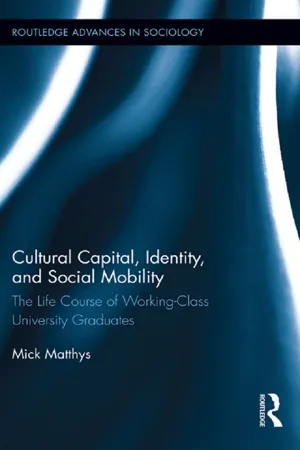
Cultural Capital, Identity, and Social Mobility
The Life Course of Working-Class University Graduates
- 274 pages
- English
- ePUB (mobile friendly)
- Available on iOS & Android
eBook - ePub
Cultural Capital, Identity, and Social Mobility
The Life Course of Working-Class University Graduates
About this book
Information
1 (When) Working-Class Children
Enter Academic Learning
Problem Formulation, the Field
and Method
and Method
1.1 INTRODUCTION
In the introduction of his Dutch study of academically educated children of uneducated parents, Jan Brands (1990) expresses his discontent about a lack of available documentation regarding his subjects’ high school and college experiences. This is also the case regarding their careers following their studies’ completion. Social science studies on the destiny and personal experience of this group of social movers, following academic years, are not plentiful.
At the same time, there is a fascination for the men and women from humble beginnings who “make it, against the odds.” What especially strikes me in the accounts of Brands and the American anthologies (Barney Dews & Leste Law, 1995; Lubrano, 2004; Ryan & Sackrey, 1996; Tokarczyk & Fay, 1993), and also in novels, is the inner struggle that these educated individuals must inevitably undergo, in order to make the most of the opportunities the new social setting has to offer. They are frustrated by the pressure from a perceived necessity to remain loyal to “where they’ve come from” and a constant awareness of the disparity in background with their peers.
Compared to those from a higher class, there is a painful gap between the promise of professional entry-level qualifications (namely a university degree) and the individual, as well as the cultural equipment needed to push of with a career. The significance of above-mentioned studies is the insight they provide into the psychological consequences of this gap and how it is bridged.
From the perspective of origins, age, and career, I too unquestionably belong to this group. That is why these narratives are so familiar to me. Like so many other boys from European Catholic working-class families, a seminary study program paved the way to my university education. Following my taking leave of the seminary at the end of sixties, I became an active member of the student movement and, after graduation, did assembly-line work in a tractor factory. The initial years of my first university job were motivated by the ideology of working-class emancipation and preceded by four years of union organizing.
Thirty years later, it is evident that since the start of my career, the times have changed as I have. From this perspective, comparing my original and current milieu, I see that both changing cultural differences and roles have led to an unmistakable shift. The experience of change is rooted in history and there is a story to be told.
1.2 INITIAL PROBLEM FORMULATION
Several core elements of the issue that I want to investigate further can be revealed through personal experience, literature and interviews. In the initial portrayal of the problem in question, I refer to personal experience. My aim, however, as a result of these experiences, is to explore the constants and patterns in the organization of the lives and careers of those with comparable experiences.
This way, I indicate my personal position regarding this issue and at the same time pose the question of, if and to what extent these specific and unique experiences point to more general social and (inter)subjective configurations. The second chapter will further systematically explore the question, founded on literature.
Constant Awareness of Being Different
Despite an unmistakable sense of integration in my current milieu, an awareness of the significance of a discrepancy in origin has never left me. This awareness manifests itself in various ways. And similar to Brands’s (1992) account, in order to belong I have made use of the values learned from my parental background on various levels. All the while, I have safeguarded such core values with a critical reserve and an emphasis on solidarity and community and with an aversion to pretentiousness. In the course of my life, both the experience and the significance of this discrepancy have been transformed. And I feel that the values that matter most have been incorporated into my identity. Based on this experience, I aim to discover how my target group currently views the significance of the values that define discrepancies, if and how this has changed over time, the direction this change has taken, and the influences that have motivated change.
Ambition Levels
Another discrepancy I experienced, not explicitly revealed by Brands, was the level of ambition at the start of my career. When I initially started my job at the university, I had the sense that I had arrived; I had, after all, the security of a permanent contract.
My father’s approval of this fact was very obvious. His permanent contract as a municipal worker came only late in his career and took a great deal of effort to secure. Contrary to my attitude, colleagues with backgrounds among the higher classes saw their positions as self-evident, in other words “This is where I belong,” as opposed to my outlook, “What have I done to deserve this?” Although I no longer feel this way, it has certainly influenced developments in my career. Also motivating my pursuit is the aim to discover if this also applies to comparable careers and to career-related events.
Family
Despite the fact that my father lacked any formal schooling and my mother had only had vocational training, their children’s education was a key concern.
My siblings and I had intellectual abilities and after overcoming initial feelings of unfamiliarity with the task, my parents took the initiative to actively search for studies for us.
There were, however, certain social antecedents involved. My maternal grandfather was a small agrarian entrepreneur with social ambitions; his daughters encouraged each other with support and solidarity in their approach towards the education of one another’s children. Compared to my father’s peers, in relation to their children, this was a very different mindset. The resultant questions are if this matriarchal incentive and subsequent culture of childrearing is recognizable to others and how it influences the development of personality and career.
The First-Generation College Students
My working-class contemporaries, who followed university studies in the same period I did, were members of the first group to profit from educational democratization (Egerton & Halsey, 1993). Although universities went through a considerable expansion during the first half of the 1900s, university students from working-class backgrounds were an exception (Dyhouse, 2001). Since the 1960s, educational policy has been clearly focused on extending educational opportunities for working-class children; still, initially, their participation remained behind (Wesselingh, 1979). Regardless, numerous families took advantage of these measures and their children became the first in their families to go to college. Thus, for the first time, a generation of college students emerged in working-class families, and consequently so did a diversity of career choices.
This aspect of diversity also applies to the family I come from. Of all the siblings, I was the only one to attend university, albeit via a detour. The study choices of my siblings demonstrated rather the standard pattern as described by Vandekerckhove and Huyse (1976). They show how the orientation is directed towards a steady job as teacher, a profession at a senior secondary vocational level or higher professional educational level. My siblings’ studies, however, took place closer to home and despite the generational battles they fought with my parents—in my place—it was easier for my parents to relate to them than me. They lived at home after graduation and, as customary at the time in Belgian Flanders, handed their salaries over to my parents during the initial years of their careers. I was able to escape the pressure of this demand through the path I took to the university via a pre-seminary program and seminary studies.
Years later, I learned from a brother that my mother’s collaboration with her sisters, aimed at implementing upward social mobility, had been experienced by him as a burden; he felt that the chance to fulfill his career goal as a car mechanic had been frustrated. A similar scheme deprived one of my sisters of the option to attend art academy.
Having presented my parents with the predicament of my determination to study further seems to have been compensated later with an obsessive obligation to choose among a limited range of vocations according to rigid standards. The apparent purpose was to guard socially acceptable boundaries. It appears that a university education unleashes a significant impact on family culture. An additional question is how others have experienced the influence of their own family culture on their study choice, internal family communication and further life.
Communication with the Parental Milieu
A few respondents in Brands’s study portrayed the gap caused by their college education as severed communication. The parents did not have the slightest inkling about the import of their children’s studies and the children, in turn, lacked the ability to explain or discuss their studies with the parents. Even though at first glance this simply resembles a generation gap, it is valid to question if this is actually the case or if there is more beneath the surface than a universal pattern between children and parents. My parents lacked the ability to explain to family and friends what in fact it was that I was studying (social pedagogy) and what it was preparing me to do, career-wise. This was not only because it was too difficult for them to express, but, even more so, genuine interest from the others fell short. Moreover, the fact that they allowed their children to study at all was met with resentment (see also Vandekerckhove & Huyse, 1976).
All the more, I assumed that my new experiences were beyond their grasp or would be met with dismissal. They did not ask and I did not tell. Whether my reaction was triggered by personal interests, loyalty or self defense—aimed at avoiding the chance of alienation—I did not feel that I could involve them with my life away from home. I suspect that this deadlock in communication influenced the manner in which I resigned myself to the situation and learned to deal with problems I have encountered throughout life. This particular illustration of non-communication raises the question if this situation is familiar to other working-class academics.
Study and Career Choices
Who are the other working-class academics? My story and as those of Brands are from academics involved in one way or another with university education and/or research in the social sector. However, Vandekerckhove and Huyse (1976) show that children from working-class families tend towards science and more practical studies: engineering, for example. Later they look for jobs in business or education, as chemistry or physics teachers, for example. Vandekerckhove and Huyse attribute this preference pattern to the preventative social control exercised by parents and family to avoid an excess of alienation between themselves and their child. This control becomes thus internalized and is expressed through the graduate’s desire to remain socially recognizable to parents and family and friends at home; this is further reinforced by the longing for job security (Vandekerckhove & Huyse, 1976: 77).
My desire to remain socially recognizable to my parents was not an alien emotion. By studying philosophy and social sciences I had—at least in my perception—developed interests unknown to them and was now speaking a foreign language. In order to maintain contact, I continued to speak our local dialect at home and joined conversations about the topics central to their lives. Still, these were neither my life nor my topics. Would communication have been smoother if I had become a local high school teacher or opted for a more technical profession—through which common ground for experience and exchange would have continued to exist? Do working-class children more often chose a teaching career because it is easier for parents to relate to such a job and its accompanying status? Do they choose a scientific field because it is closer to their parents’ (practical)way of thinking?
The (Non-)Evident Academic Education
As a youth, I was fascinated by the local university. This fascination, however, was accompanied by the understanding that a study there lay beyond my reach. The question was not if I had the capability to handle the study, but how I could personally survive all the other aspects involved. It never even entered my mind to seek out advice, and apparently no one thought to advise me. For some of my schoolmates university was an attainable option, while for others it was no less than self-evident. Regarding the latter, it was simply a continuation of family tradition. For the former there was ample support to keep the option open. In my case the option was excluded. There was no tradition and—as I believed at the time—no means of support or encouragement. Still, this fascination endured, which eventually resulted in an academic position. The mixed feelings, however, were not so easily shed. When I entered academia as a staff member, my initial feelings were surprise and disbelief. Only later was I able to experience pride at my achievement. Where does working-class children’s fascination for college begin? Is it its infeasibility? Does this lend it a mythical aura?
1.3 CENTRAL QUESTION
The above tentative and personally inspired investigation of the field in question provides a preliminary indication towards both the social and cultural obstacles, such as the stimulating mechanisms, that children from lower social classes encounter when they make the decision to go to college. Even when the aspiration has finally become reality, this brief exploration shows that family culture and childrearing practices leave long-lasting marks in the course of life.
The central and linking question is the following: What is the significance of the original environment for identity, perception and structuring of the life course for men and women from lower social classes, who via a university education attain higher professional positions in society’s higher classes?
This central question is developed in the following sub-questions:
- What have the research group participants experienced along the route of upper social mobility? How have they experienced the diversity of the social contexts in which they have found themselves and how have they attached significance to this diversity?
- What is the meaning of this diversity of social contexts for the way in which they have constructed their own identities and how has this diversity of contexts expressed itself in both personal and professional development?
- How do they perceive their role as agents of their own lives and career courses in relationship to the meaning of social and cultural antecedents?
1.4 THE FIELD: EDUCATION, INEQUALITY AND SOCIAL MOBILITY
In regard to continuing education and upward mobility, my exploration of ...
Table of contents
- Cover
- Half Title
- Full Title
- Copyright
- Contents
- List of Tables
- Preface
- 1 (When) Working Class-Children Enter Academic Learning: Problem Formulation, the Field and Method
- 2 A Tough Life?
- 3 Identity, Context and Agency
- 4 A Firm Foundation
- 5 A Successful Transformation
- 6 Career and Life
- 7 Hicks and Proletarians
- 8 Reflections: The Part I Have Played
- 9 Abstract and Conclusions
- Appendix: List of Respondents
- Notes
- References
- Index
Trusted by 375,005 students
Access to over 1.5 million titles for a fair monthly price.
Study more efficiently using our study tools.
Frequently asked questions
Yes, you can cancel anytime from the Subscription tab in your account settings on the Perlego website. Your subscription will stay active until the end of your current billing period. Learn how to cancel your subscription
No, books cannot be downloaded as external files, such as PDFs, for use outside of Perlego. However, you can download books within the Perlego app for offline reading on mobile or tablet. Learn how to download books offline
Perlego offers two plans: Essential and Complete
- Essential is ideal for learners and professionals who enjoy exploring a wide range of subjects. Access the Essential Library with 800,000+ trusted titles and best-sellers across business, personal growth, and the humanities. Includes unlimited reading time and Standard Read Aloud voice.
- Complete: Perfect for advanced learners and researchers needing full, unrestricted access. Unlock 1.5M+ books across hundreds of subjects, including academic and specialized titles. The Complete Plan also includes advanced features like Premium Read Aloud and Research Assistant.
We are an online textbook subscription service, where you can get access to an entire online library for less than the price of a single book per month. With over 1.5 million books across 990+ topics, we’ve got you covered! Learn about our mission
Look out for the read-aloud symbol on your next book to see if you can listen to it. The read-aloud tool reads text aloud for you, highlighting the text as it is being read. You can pause it, speed it up and slow it down. Learn more about Read Aloud
Yes! You can use the Perlego app on both iOS and Android devices to read anytime, anywhere — even offline. Perfect for commutes or when you’re on the go.
Please note we cannot support devices running on iOS 13 and Android 7 or earlier. Learn more about using the app
Please note we cannot support devices running on iOS 13 and Android 7 or earlier. Learn more about using the app
Yes, you can access Cultural Capital, Identity, and Social Mobility by Mick Matthys in PDF and/or ePUB format, as well as other popular books in Social Sciences & Social Classes & Economic Disparity. We have over 1.5 million books available in our catalogue for you to explore.