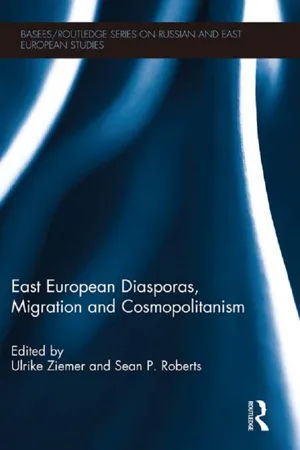
Following the demise of the USSR in 1991, and the ensuing collapse of communist regimes in Eastern Europe, widespread population movements took place across Central and Eastern Europe. Whole nations disappeared and (re)-emerged and diasporic transnational ties and belonging have experienced a revival. This book explores some of the many different facets of diasporic life and migration across Central and Eastern Europe by specifically employing the concept of cosmopolitanism. It examines aspects of migrants' everyday lives and identities, considers some of the difficulties faced by migrant minorities in being accepted and integrated in the host societies, but also examines questions of citizenship and diasporic politics.
eBook - ePub
East European Diasporas, Migration and Cosmopolitanism
- 160 pages
- English
- ePUB (mobile friendly)
- Available on iOS & Android
eBook - ePub
East European Diasporas, Migration and Cosmopolitanism
About this book
Information
Part I
The past in the present
Fostering cosmopolitanism
1 Cosmopolitanism in practice
Perspectives on the Nansen passports
Rebecka Lettevall
The end of the cold war brought many changes within not only the political but also the social, cultural and conceptual understandings of Europe. In response, academic scholarship attempts to explain these changes and challenges Europe faces by re-invigorating the centuries-old concept of cosmopolitanism. Yet, this does not mean that the age-old idea of a world citizenship with roots in ancient Greece was simply transferred to the new post-cold war context. Instead, the concept of cosmopolitanism has been filled with new content, and thus what is usually referred to as new cosmopolitanism has been born. The revised understanding of the old concept and a revised view of a world citizenship and globalization point toward the question to what extent it is possible to practice a cosmopolitan citizenship.
After the end of the First World War, Europe faced many changes, just as after the end of the cold war. These changes saw the appearance of large numbers of stateless people, not least in Europe. In order to solve this situation, the idea of the Nansen passport was born, which in the inter-war period was a widely known and discussed document, but is more or less forgotten today. In this chapter, I discuss the concept of cosmopolitanism and how it is used, or not used. I present an analysis of the Nansen passport and explore whether it might be called cosmopolitanism in practice. Studying the history of concepts like cosmopolitanism is more than just the study of something in the past. It confronts us with the historicity of our own concepts, and makes us aware that our own premises are changeable, historical matter.
Migration in the inter-war period
Migration is an integral part of human life and experience. However, after the end of the First World War, the migration situation in Europe imposed challenges that transgressed the level of nation-state. The number of refugees and the causes of migration were of a scale that affected not only the new but also the old residential countries of refugees. One reason for this was the dissolution of the former Russian, Austro-Hungarian, German and Ottoman Empires, which resulted in the re-drawing of the map of Europe, including the creation of new states in Eastern and Central Europe such as Estonia, Latvia, Lithuania, Poland, Austria, Hungary, Czechoslovakia and Yugoslavia. This great transformation from multicultural empires to nation-states displaced many members of ethnic minorities from the newly formed states. This forced millions of people to leave their home countries. Some of them joined their ethnic group in other states, while others became refugees. Noteworthy here is that the term ‘refugee’ was first used for the French Huguenots who left France after the Edict of Nantes in 1695. The development of the nation-state was connected to a change of view among minorities: suddenly they no longer fitted the state (Zolberg 1983). Some became stateless, no matter whether they had left their country or not.
The global situation was changing too, and from the beginning of the twentieth century, several non-European countries were less willing to host new immigrants without any demands on them. At the same time, as many people lost their citizenship, they also lost their right to work or find dwelling, at least in legal ways, as they did not have proper documents of identification. According to Hannah Arendt, this implies a ‘fundamental deprivation of human rights’ which makes us become aware of the existence of ‘a right to have rights’ (Arendt 1976: 296). The disillusioned atmosphere after the First World War and a widely witnessed sense of loss – not only of human lives and material things but also of ideals, hopes and culture – became evident in the masses of stateless persons and refugees. As the war had changed the map of Europe considerably, millions of men, women and children had lost their identity as citizens and as a consequence had even lost their rights as citizens of one country. The food supply was very poor and caused horrifying starvation, especially in Russia and Ukraine. Newspapers of the inter-war period testify to the incredible amounts of refugees from the ‘old’ Europe of former empires as the ‘new’ Europe was organized in nation-states. This indicates that the refugee question was also an issue in the public sphere. Homeless refugees seem to have been visible in more or less every city in Europe. The official number of refugees at this time varies signif– cantly, but there seems to have been several hundreds of thousands, or even millions.
The development of nationalist doctrines in the new Europe contributed to the refugee situation (Skran 1995: 24f). The development of several national social welfare programmes, ironically enough, made some countries less willing to accept new habitants. Newcomers were also considered as a potential political threat, since they had already shown patriotic disloyalty by having left their country and so could be seen as untrustworthy. Skran (1995: 29) points out that the mass refugee movements of the inter-war period were by-products of the political efforts to create ethnically pure nation-states and ideologically homogeneous political systems.
These refugees needed a legal document. Before the First World War, there were only a few refugees who had a vague legal status, but after the war, thousands of refugees crossed borders in Europe without any legal protection. What was previously acceptable now proved to be inadequate for properly responding to the huge new demands. The legal anomaly of these refugees was identified as a problem by many legal scholars, who tried to solve it in different ways (Grahl-Madsen 1983). A person without citizenship or a legal document was unprotected and had no rights. In this context, it is worth mentioning that Russian refugees faced the worst situation, as they had no new state that would accept them as citizens after the October Revolution in 1917. In this situation, with many states disappearing and new ones arising, the idea of a solution with a new kind of system of identification was born: particularly responsible for its birth was Fridtjof Nansen.
Fridtjof Nansen
The Norwegian scientist, explorer and diplomat Fridtjof Nansen (1861–1930) was the most important entrepreneur behind the idea of Nansen passports and so they were named after him. He is a person who could be easily depicted as a true hero of our times for several reasons. He was tall, blond and handsome and reached fame after his adventurous expedition with the ship Fram (1893–95), which held him caught in the icy north of Russia instead of taking him to the North Pole (Huntford 1997). However, this served as a proof for his theory of the Arctic Ocean streams. He was the first European to cross Greenland from east to west – an experience that he often returned to later. After his scientific expedition and career, he entered the political and diplomatic world. First, he took an active part in the debate about the dissolution of the Swedish – Norwegian union, arguing for the freedom of Norway (Huntford 1997: 393–414). After the separation from Sweden in 1905, Nansen served as Norway’s ambassador to Great Britain (1906–08). During the war, he negotiated with the USA on behalf of Norway in order to secure a grain supply. After the war, he was the chair of the Norwegian Association for the League of Nations, a position he held for the rest of his life. Through his diplomatic experience he became acquainted with many of the people who would turn out to be important for the future. His efforts were awarded with the Nobel Peace Prize in 1922 and the Nansen International Office for Refugees was awarded the same prize in 1938 (www.nobelprize.org).
Had it not been for some problems within the League in finding a unifying and acceptable candidate for the post of High Commissioner for Refugees, Nansen might never have been appointed (Marrus 1985: 87–90). But as his diplomatic career had brought him into contact with humanitarian projects where the problems of Russia were in focus, it proved he had very good experience for the tasks of High Commissioner. Two huge projects are particularly worth mentioning here, as to some extent they demanded a solution to the refugee question. In the 1920s, he was involved in a project to repatriate prisoners of war from Russia and a project to prevent the famine and its consequences in Russia and Ukraine through international aid programmes (Vogt 2007). In short, his suitability for the post of High Commissioner was his persona, including his scientific and explorer background, the ethical credibility he had achieved through his work on the two Russian projects, and that he was a citizen from a neutral state (Lettevall forthcoming).
The Nansen passport
Passports, as documents issued by a national government to identify the holder in terms of name, date and place of birth, sex and, usually, as a national citizen, and in some cases even with a self-defined ethnicity, had generally, and perhaps unexpectedly, lost their importance with the rise of nation-states and nationalism in the nineteenth century. Since the French Revolution, passports or similar documents of identification have been an essential and legitimate means for the state’s monopolization of control over the movement of people. During the relative peace in Europe in the nineteenth century, the amount of travelling increased, not least because of the technological development of steam trains and steam ships, which almost caused the European passport system to break down. However, during the First World War, this passport system was re-established, together with other restrictions of movement (Torpey 2000: 57–143).
In this context, the Nansen passport was created fairly quickly. Fridtjof Nansen was appointed by the League of Nations in 1922. In March, he drew the League’s attention to the difficulties of Russian refugees in migrating and suggested that they should be provided with some kind of travel and identity document. In July 1922, Nansen had an intergovernmental conference on the issue, a conference that ended up with an Arrangement (of 5 July 1922), that is an agreement within the League of Nations that is not legally binding, but rather to be considered as a recommendation for the signing states. The Arrangement introduced the Nansen passport, an identity certificate for Russian refugees. Although this Arrangement introducing the Nansen passport was not legally binding, many states quickly accepted this Arrangement. Initially, the Arrangement was accepted by 16 countries, but soon it was accepted by many more governments, with a peak in 1929 of over 50 states introducing the Nansen passport. Noteworthy here is that this Arrangement was soon extended to include the large group of Armenian refugees in 1924 and thereafter even more refugees were included (Marrus 1985: 74–81).1
Holders of a Nansen passport could travel and were also issued identity cards, which increased their chances of employment and decent dwelling. Nonetheless, the Nansen passport did not guarantee opportunities for work or home, but at least it made them legally possible. Not surprisingly, this very first international refugee agreement had its shortcomings. First, it was primarily directed at Russian refugees, even though there were many ethnically other refugee groups. Second, the freedom of travel was in some ways limited, as passport holders were not always allowed to return to the state of issue, once they had left the state. Finally, on many occasions, there was a fee which had to be paid annually for the renewal of the passport and many passport holders could not afford this fee.
Among the European states that had accepted the Agreement and issued Nansen passports, there were high hopes that the League of Nations would be able to solve the refugee question. Nevertheless, it soon became obvious that despite this Agreement, the issuing of Nansen passports and identity documents was not organized in the right way. The members of the League of Nations did not want to recognize the Soviet Union, and the Soviet Union refused to cooperate with the League of Nations. In addition, the Nansen International Office for Refugees had neither enough funding nor full authority. The League of Nations financed some of the administrative costs of the Nansen International Office for Refugees, but it was mainly supported by private contributions and the yearly fees which were required for the renewal of the Nansen passports. The worldwide Depression of the 1920s also had an impact, as it resulted in high unemployment and growing difficulties for refugees and immigrants to find work and earn an income. As a result, the League of Nations had lost some of its credibility by the time new groups of refugees emerged as a result of the Spanish Civil War in 1936–39. Thus, these circumstances created a specifically difficult situation for the Nansen passport, although it survived a little longer until it completely vanished in connection with the Second World War.
The above discussion has established the background and the development of the Nansen passport and has shown that, despite its various shortcomings, the Nansen passport was a truly international refugee agreement adopted by many states, used to solve the refugee question. In the subsequent discussion, I explore the question of whether the Nansen passport could be seen as not only the first international refugee agreement but also as a kind of cosmopolitanism in practice.
About cosmopolitanism
Concepts have a history, and thus their meaning changes depending on the context. Some seem to be more changing than others. A large number of central concepts in modern politics, such as democracy, war and peace, risk being misunderstood by an ahistorical approach (Lettevall 2011: 179–88). Anyone discussing democracy today who turns to history for support can easily misunderstand Plato or Immanuel Kant, for example. Kant is often portrayed as an advocate of democracy, yet the form of government which he advocated was, more precisely, republicanism (Gerhardt 1995). To be sure, Kant’s republic has some of the features we today associate with democracy, such as division of power and citizenship. At the same time, the concept of democracy in Kant’s writings has a clearly negative connotation; democracy, according to Kant, is characterized by incompetence and disorder, and, as for Plato, threatens to descend into anarchy.
Another concept with a similarly long history is cosmopolitanism, which is explored in the context of the Nansen passports. Could Nansen passports be seen as cosmopolitanism in practice? In order to find answers to this question, cosmopolitanism is discussed through a reflective history perspective. For both Hans-Georg Gadamer and Reinhart Koselleck, language and concepts are central to how we understand the past. Gadamer’s notion of Wirkungsgeschichte and Koselleck’s project of conceptual history offer valuable insights into the historical study of ideas, insights which can move us beyond the simplified opposition between historical and ahistorical approaches to intellectual political history. Any reflective conceptual-historical understanding which aspires to contemporary relevance will gain much from allowing itself to be guided by the idea of Wirkungsgeschichte . This perspective focuses on historical phenomena and the effects of tradition as well as their historical repercussions, and ultimately also the history of scholarship and academic research (Gadamer 1960). Koselleck’s conceptual-historical approach opens up new possibilities for understanding both the past and the present. The changes in meaning exposed by conceptual-historical studies can reveal not only the past but also the present. The idea is that through discussing the Nansen passports, we might not only illuminate an almost forgotten initial practice international refugee politics but also receive a better understanding of cosmopolitanism.
In brief, cosmopolitanism has had three significant periods of importance. According to classic sources, the word originates from the saying of the Cynic Diogenes from Sinope; when asked where he came from, he answered, ‘I am a cosmopolitan,’ referring to the fact that he felt at home everywhere (Diogenes Laertius 1972 [c200 BC]). Nonetheless, it must not be forgotten that this quotation is problematic, as the source of it is Diogenes Laertius, who lived several hundreds of years after Diogenes from Sinope. The Stoics used the concept and integrated it in Stoic thinking, even if the Stoic understanding of it emphasized the moral universalist side of cosmopolitanism.
Some scholars have considered cosmopolitanism as a key concept of the Enlightenment (Brunner 1982 ; Kleingeld 1999). It was developed and influenced from the ideas of universalism and order. In particular, the philosopher Immanuel Kant (1724–1804) is one of the key figures for this development as he systematized cosmopolitan right and combined it with international right as well as with the...
Table of contents
- Cover
- Half Title
- BASEES/Routledge Series on Russian and East European Studies
- Full Title
- Copyright
- Contents
- Contributors
- Acknowledgements
- Introduction: East European diasporas, migration and cosmopolitanism
- PART I The past in the present: fostering cosmopolitanism
- PART II Making and re-making diasporas from former Yugoslavia
- PART III Locating diaspora in and beyond Germany
- PART IV Exploring ethical challenges in research on migration
- References
- Index
Trusted by 375,005 students
Access to over 1.5 million titles for a fair monthly price.
Study more efficiently using our study tools.
Frequently asked questions
Yes, you can cancel anytime from the Subscription tab in your account settings on the Perlego website. Your subscription will stay active until the end of your current billing period. Learn how to cancel your subscription
No, books cannot be downloaded as external files, such as PDFs, for use outside of Perlego. However, you can download books within the Perlego app for offline reading on mobile or tablet. Learn how to download books offline
Perlego offers two plans: Essential and Complete
- Essential is ideal for learners and professionals who enjoy exploring a wide range of subjects. Access the Essential Library with 800,000+ trusted titles and best-sellers across business, personal growth, and the humanities. Includes unlimited reading time and Standard Read Aloud voice.
- Complete: Perfect for advanced learners and researchers needing full, unrestricted access. Unlock 1.5M+ books across hundreds of subjects, including academic and specialized titles. The Complete Plan also includes advanced features like Premium Read Aloud and Research Assistant.
We are an online textbook subscription service, where you can get access to an entire online library for less than the price of a single book per month. With over 1.5 million books across 990+ topics, we’ve got you covered! Learn about our mission
Look out for the read-aloud symbol on your next book to see if you can listen to it. The read-aloud tool reads text aloud for you, highlighting the text as it is being read. You can pause it, speed it up and slow it down. Learn more about Read Aloud
Yes! You can use the Perlego app on both iOS and Android devices to read anytime, anywhere — even offline. Perfect for commutes or when you’re on the go.
Please note we cannot support devices running on iOS 13 and Android 7 or earlier. Learn more about using the app
Please note we cannot support devices running on iOS 13 and Android 7 or earlier. Learn more about using the app
Yes, you can access East European Diasporas, Migration and Cosmopolitanism by Ulrike Ziemer, Sean P. Roberts, Ulrike Ziemer,Sean P. Roberts in PDF and/or ePUB format, as well as other popular books in Social Sciences & Ethnic Studies. We have over 1.5 million books available in our catalogue for you to explore.