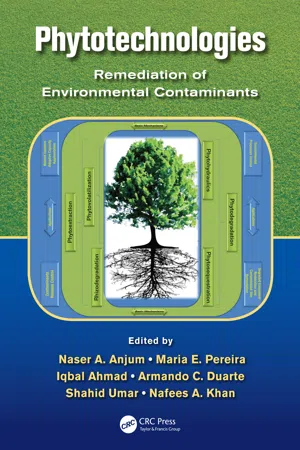
Phytotechnologies: Remediation of Environmental Contaminants highlights the use of natural and inherent traits of plants and associated microbes to exclude, accumulate, or metabolize a variety of contaminants, with the goal of efficiently and sustainably decontaminating the biosphere from unwanted hazardous compounds. Contributed by an internationa
eBook - PDF
Phytotechnologies
Remediation of Environmental Contaminants
- 605 pages
- English
- PDF
- Available on iOS & Android
eBook - PDF
Phytotechnologies
Remediation of Environmental Contaminants
About this book
Information
Table of contents
- Front Cover
- Contents
- Foreword
- Foreword II
- Preface
- Contributors
- Chapter 1 - Introduction
- Chapter 2 - Heavy Metals in the Environment: Current Status, Toxic Effects on Plants and Phytoremediation
- Chapter 3 - Phytotechnology—Remediation of Inorganic Contaminants
- Chapter 4 - Potential of Constructed Wetland Phytotechnology for Tannery Wastewater Treatment
- Chapter 5 - Phytoremediation of Petroleum Hydrocarbon–Contaminated Soils in Venezuela
- Chapter 6 - Fate and Transport Issues Associated with Contaminants and Contaminant By-Products in Phytotechnology
- Chapter 7 - Metals and Metalloids Accumulation Variability in Brassica Species:: A Review
- Chapter 8 - Oilseed Brassica napus and Phytoremediation of Lead
- Chapter 9 - Potential for Metal Phytoextraction of Brassica Oilseed Species
- Chapter 10 - Phytoremediation Capacity of Brown- and Yellow-Seeded Brassica carinata
- Chapter 11 - Phytoremediation of Toxic Metals and the Involvement of Brassica Species
- Chapter 12 - Phytoremediation of Soils Contaminated by Heavy Metals, Metalloids, and Radioactive Materials Using Vetiver Grass, Chrysopogon zizanioides
- Chapter 13 - Effects of Biotic and Abiotic Amendments on Phytoremediation Efficiency Applied to Metal-Polluted Soils
- Chapter 14 - Phytoremediation: Strategies to Enhance the Potential for Toxic Metal Remediation of Brassica Oilseed Species
- Chapter 15 - Enhanced Phytoextraction Using Brassica Oilseeds: Role of Chelates
- Chapter 16 - Organic Acid–Assisted Phytoremediation in Salt Marshes: From Hydroponics to Field Mesocosm Trials
- Chapter 17 - Plant–Microbe Enabled Contaminant Removal in the Rhizosphere
- Chapter 18 - Brassica Oilseeds–Microbe Interactions and Toxic Metals Remediation
- Chapter 19 - Plant Growth-Promoting Bacteria and Metals Phytoremediation
- Chapter 20 - Plant Growth Regulators and Improvements in Phytoremediation Process Efficiency: Studies on Metal Contaminated Soils
- Chapter 21 - Remediation of Sites Contaminated with Persistent Organic Pollutants: Role of Bacteria
- Chapter 22 - Using Endophytes to Enhance Phytoremediation
- Chapter 23 - Genetically Modified Plants Designed for Phytoremediation of Toxic Organic and Inorganic Contaminants
- Chapter 24 - Utilization of Different Aspects Associated with Cadmium Tolerance in Plants to Compare Sensitive and Bioindicator Species
- Chapter 25 - Analytical Tools for Exploring Metal Accumulation and Tolerance in Plants
- Chapter 26 - Metals and Metalloids Detoxification Mechanisms in Plants: Physiological and Biochemical Aspects
- Chapter 27 - Studies on Phytoextraction Processes and Some Plants’ Reactions to Uptake and Hyperaccumulation of Substances
- Chapter 28 - Uptake and Metabolism of Pharmaceuticals and Other Emerging Contaminants by Plants
- Back Cover
Trusted by 375,005 students
Access to over 1.5 million titles for a fair monthly price.
Study more efficiently using our study tools.
Frequently asked questions
Yes, you can cancel anytime from the Subscription tab in your account settings on the Perlego website. Your subscription will stay active until the end of your current billing period. Learn how to cancel your subscription
No, books cannot be downloaded as external files, such as PDFs, for use outside of Perlego. However, you can download books within the Perlego app for offline reading on mobile or tablet. Learn how to download books offline
Perlego offers two plans: Essential and Complete
- Essential is ideal for learners and professionals who enjoy exploring a wide range of subjects. Access the Essential Library with 800,000+ trusted titles and best-sellers across business, personal growth, and the humanities. Includes unlimited reading time and Standard Read Aloud voice.
- Complete: Perfect for advanced learners and researchers needing full, unrestricted access. Unlock 1.5M+ books across hundreds of subjects, including academic and specialized titles. The Complete Plan also includes advanced features like Premium Read Aloud and Research Assistant.
We are an online textbook subscription service, where you can get access to an entire online library for less than the price of a single book per month. With over 1.5 million books across 990+ topics, we’ve got you covered! Learn about our mission
Look out for the read-aloud symbol on your next book to see if you can listen to it. The read-aloud tool reads text aloud for you, highlighting the text as it is being read. You can pause it, speed it up and slow it down. Learn more about Read Aloud
Yes! You can use the Perlego app on both iOS and Android devices to read anytime, anywhere — even offline. Perfect for commutes or when you’re on the go.
Please note we cannot support devices running on iOS 13 and Android 7 or earlier. Learn more about using the app
Please note we cannot support devices running on iOS 13 and Android 7 or earlier. Learn more about using the app
Yes, you can access Phytotechnologies by Naser A. Anjum,Maria E. Pereira,Iqbal Ahmad,Armando C. Duarte,Shahid Umar,Nafees A. Khan in PDF and/or ePUB format, as well as other popular books in Biological Sciences & Botany. We have over 1.5 million books available in our catalogue for you to explore.