- 215 pages
- English
- PDF
- Available on iOS & Android
eBook - PDF
Metabolic and Endocrine Physiology
About this book
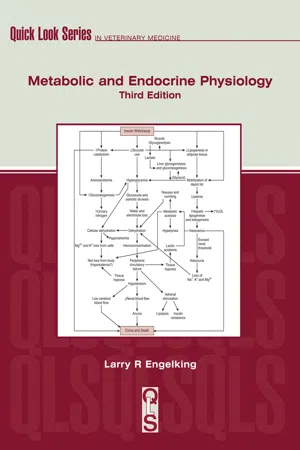
This book is intended to give readers aquick look at metabolic and endocrine physiology. Emphasis is placed on instructional figures, flow diagrams and tables, while text material has been held to a minimum. In general, the endocrine system is first defined and described, and then each endocrine gland is discussed separately. Where appropriate,
Information
Topic
MedicineSubtopic
Veterinary MedicineTable of contents
- Front Cover
- Preface to the First Edition
- Preface to the Second Edition
- Preface to the Third Edition
- Acknowledgments
- Table of Contents
- Chapter 1: Endocrine System (Overview)
- Chapter 2: Endocrine Secretory Control (Autocrine, Paracrine, and Endocrine Mediators)
- Chapter 3: Hormone Disposition, Measurement and Secretion (Production & Distribution Volume, Clearance & Immunoassay)
- Chapter 4: Mechanisms of Catecholamine and Polypeptide Hormone Action: I (Receptors and Second Messengers)
- Chapter 5: Mechanisms of Catecholamine and Polypeptide Hormone Action: II (The Intracellular Ca2+/DG Messenger System)
- Chapter 6: Steroid and Thyroid Hormones (Mechanisms of Action)
- Chapter 7: Hypothalamus and Pituitary (Directors of the Endocrine Orchestra)
- Chapter 8: Proopiomelanocortin and Related Peptides: I (Endogenous Opiate-Like Peptides)
- Chapter 9: Proopiomelanocortin and Related Peptides: II (Melanocyte-Stimulating Hormone)
- Chapter 10: Growth Hormone: I (Actions and Secretory Control)
- Chapter 11: Growth Hormone: II (Hypo- and Hypersomatotropism)
- Chapter 12: Antidiuretic Hormone (Vasopressin)
- Chapter 13: Diabetes Insipidus (Central and Nephrogenic)
- Chapter 14: Calcium (Physiologic Actions)
- Chapter 15: Magnesium and phosphate (Physiologic Actions)
- Chapter 16: Parathormone, Calcitonin, and Vitamin D: I (PTH, PTHrp, and CT)
- Chapter 17: Parathormone, Calcitonin, and Vitamin D: II (CT and 1,25(OH)2D)
- Chapter 18: Disorders of Calcium Homeostasis (Hyper- and Hypocalcemia)
- Chapter 19: Mineral Imbalances: I (Na+, K+, PO4 3–, and Mg2+)
- Chapter 20: Mineral Imbalances: II (Parturient Hypocalcemia and Osteoporosis)
- Chapter 21: ACTH and Glucocorticoids: I (Corticosteroidogenesis and Degradation)
- Chapter 22: ACTH and Glucocorticoids: II (ACTH Secretion and Action)
- Chapter 23: ACTH and Glucocorticoids: III (Organ and Tissue Effects)
- Chapter 24: ACTH and Glucocorticoids: IV (Physiologic and Pharmacologic Actions)
- Chapter 25: Cushing's-Like Syndrome and Disease (Glucocorticoid Excess)
- Chapter 26: Mineralocorticoids (Effects on Na+, K+ and H+)
- Chapter 27: Renin-Angiotensin System: I (The Juxtaglomerular Apparatus)
- Chapter 28: Renin-Angiotensin System: II (Hypertension)
- Chapter 29: Addison’s-Like Disease (Hypoadrenocorticism)
- Chapter 30: Erythropoietin (Production and Action)
- Chapter 31: Natriuretic Peptides (ANP, BNP, CNP, and Urodilatin)
- Chapter 32: Adrenal Medulla: I (Catecholamine Biosynthesis and Degradation)
- Chapter 33: Adrenal Medulla: II (Adrenergic Receptors and the Sympathoadrenal Response)
- Chapter 34: Pheochromocytoma (Catecholamine-Secreting Tumor)
- Chapter 35: Phasic Responses to Trauma (Immediate, Catabolic, and Anabolic)
- Chapter 36: Thyroid: I (Hormone Biosynthesis and Secretory Regulation)
- Chapter 37: Thyroid: II (Metabolic Effects of Thyroid Hormones)
- Chapter 38: Hypothyroidism (Signs and Symptoms)
- Chapter 39: Hyperthyroidism (Signs and Symptoms)
- Chapter 40: Endocrine Pancreas: I (The Islets of Langerhans)
- Chapter 41: Endocrine Pancreas: II (Regulation of Insulin Release)
- Chapter 42: Insulin (Actions and Degradation)
- Chapter 43: Glucagon (Biosynthesis and Metabolic Actions)
- Chapter 44: Diabetes Mellitus (The “Pissing Evil”)
- Chapter 45: Acute Insulin Withdrawal: I (Carbohydrate and Lipid Metabolism)
- Chapter 46: Acute Insulin Withdrawal: II (Protein Metabolism and Electrolyte Depletion)
- Chapter 47: Gastrointestinal Hormones: I (Introduction and Historical Perspective)
- Chapter 48: Gastrointestinal Hormones: II (Gastrins)
- Chapter 49: Gastrointestinal Hormones: III (Gastric HCl Secretion, and CCK)
- Chapter 50: Gastrointestinal Hormones: IV (Secretin and other GI Peptides)
- Chapter 51: APUDomas (Neuroendocrine Tumors of the Gut)
- Reproductive Endocrinology
- Chapter 52: Estrous Cycles (Types and Phases)
- Chapter 53: Ovine, Canine and Feline Estrous Cycles (Endocrine Parameters)
- Chapter 54: Bovine, Equine and Rodent Estrous Cycles (Endocrine Parameters)
- Chapter 55: Primate Menstrual Cycle (Endocrine Parameters)
- Chapter 56: Menstruation and Regulation of Gonadotropin Release (Control of the GnRH Pulse Generator)
- Chapter 57: Spermatogenesis and Ovulation (Gonadotropin Control)
- Chapter 58: Male Reproductive System (The Testes and Accessory Sex Glands)
- Chapter 59: Testosterone, Estrogen and Progesterone (Biosynthesis, Metabolism and Functions)
- Chapter 60: Pineal Gland: I (Photoperiodic Regulation of Reproductive Events)
- Chapter 61: Pineal Gland: II (Nonreproductive Actions of Melatonin)
- Chapter 62: Placental Hormones (Fertilization, the CL and Placenta)
- Chapter 63: Fetal Endocrine System: I (The Fetoplacental Unit)
- Chapter 64: Fetal Endocrine System: II (Glandular Development)
- Chapter 65: Maternal Endocrine System (Functional Alterations during Pregnancy)
- Chapter 66: Maternal Organ Systems (Patterns of Change)
- Chapter 67: Mammary Glands (Mammogenesis and Lactation)
- Chapter 68: Prolactin (Secretory Control and Physiologic Actions)
- Chapter 69: Oxytocin (Physiologic Actions)
- Chapter 70: Neonatal Physiology: I (Thermal, Nutritional, and Cardiovascular Adaptations)
- Chapter 71: Neonatal Physiology: II (Organ System Development)
- Chapter 72: Comparative Aspects of Endocrinology
- Appendix Table I: Blood Chemistry Values for Domestic Animals
- Appendix Table II: Reproductive Patterns of Domestic Animals
- Appendix Table III: Basic Physiological Units
- Learning Objectives and Questions
- Answers
- References
Trusted by 375,005 students
Access to over 1.5 million titles for a fair monthly price.
Study more efficiently using our study tools.
Frequently asked questions
Yes, you can cancel anytime from the Subscription tab in your account settings on the Perlego website. Your subscription will stay active until the end of your current billing period. Learn how to cancel your subscription
No, books cannot be downloaded as external files, such as PDFs, for use outside of Perlego. However, you can download books within the Perlego app for offline reading on mobile or tablet. Learn how to download books offline
Perlego offers two plans: Essential and Complete
- Essential is ideal for learners and professionals who enjoy exploring a wide range of subjects. Access the Essential Library with 800,000+ trusted titles and best-sellers across business, personal growth, and the humanities. Includes unlimited reading time and Standard Read Aloud voice.
- Complete: Perfect for advanced learners and researchers needing full, unrestricted access. Unlock 1.5M+ books across hundreds of subjects, including academic and specialized titles. The Complete Plan also includes advanced features like Premium Read Aloud and Research Assistant.
We are an online textbook subscription service, where you can get access to an entire online library for less than the price of a single book per month. With over 1.5 million books across 990+ topics, we’ve got you covered! Learn about our mission
Look out for the read-aloud symbol on your next book to see if you can listen to it. The read-aloud tool reads text aloud for you, highlighting the text as it is being read. You can pause it, speed it up and slow it down. Learn more about Read Aloud
Yes! You can use the Perlego app on both iOS and Android devices to read anytime, anywhere — even offline. Perfect for commutes or when you’re on the go.
Please note we cannot support devices running on iOS 13 and Android 7 or earlier. Learn more about using the app
Please note we cannot support devices running on iOS 13 and Android 7 or earlier. Learn more about using the app
Yes, you can access Metabolic and Endocrine Physiology by Larry Engelking in PDF and/or ePUB format, as well as other popular books in Medicine & Veterinary Medicine. We have over 1.5 million books available in our catalogue for you to explore.