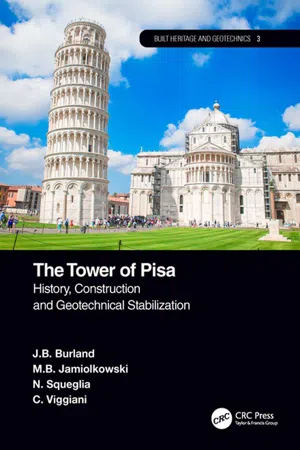
The Leaning Tower of Pisa is known worldwide for its five-degree lean. The Tower is the Campanile of the Cathedral, which together with the Baptistry and Cemetery form a breath-taking collection of monuments which are regarded as supreme examples of early Renaissance Romanesque architecture. In March 1990 the Tower was closed to the public as it was declared unsafe and close to collapse. A Commission was set up by the Italian Government with the task of developing and implementing stabilization measures.
This book begins with a brief description of the history of the Tower and its construction. The reader is then introduced to the huge challenges faced by the Commission in designing and implementing appropriate stabilization measures whilst at the same time satisfying the demanding requirements of conserving a world heritage monument. In particular, two historical studies are described which proved to be most valuable in arriving at suitable stabilization measures. The first was a deduction of the history of inclination of the tower during and subsequent to construction. The results of this study were used to calibrate a sophisticated numerical model of the tower and the underlying very soft ground which proved vital in evaluating the effectiveness of various stabilization schemes. The second study was of measurements of movement made since 1911. This latter study revealed an unexpected mechanism of foundation movement which proved crucial in developing the temporary and permanent stabilization measures and which resulted in the Tower being re-opened to the public in June 2001.
The book will appeal to both professionals and students in the fields of Architecture and Civil Engineering. It will also interest specialised audiences of geotechnical engineers and conservation architects. It may also be of wider interest to anyone planning to visit Pisa or who is intrigued as to what caused the Tower to lean and how it was stabilized.
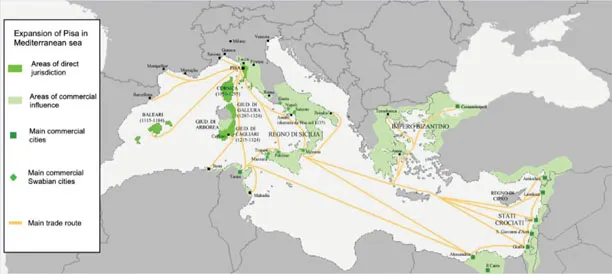
The town of Pisa, located on the Arno river near the Tyrrhenian coast of Italy, became a flourishing commercial center and a powerful maritime republic in the 11th century. Having defeated the Saracens in a series of sea battles, it grew into a very important commercial and naval center, took control of the Mediterranean sea and acquired colonies in Sardinia, Corsica, Elba, Southern Spain and North Africa (Fig. 1.1). In the 12th century, it was the naval base for the First Crusade in which a fleet of 120 Pisan ships participated; it established a number of settlements in the Holy Land, founding colonies in Antioch, Acre, Jaffa, Tripoli, Tyre and Larakia.
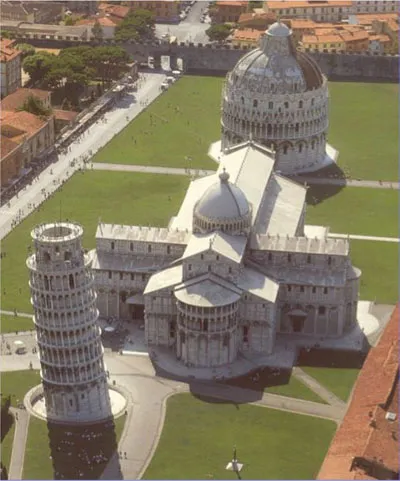
It was in the period of maximum splendor of the Republic, in the 12th and 13th centuries, that the monuments in Piazza dei Miracoli (Miracles Square) were erected. The Square, with the Cathedral, the Baptistery and the Leaning Tower (Fig. 1.2), is the awesome manifestation of the ideal unity that reigned at the time among religious, spiritual and political powers. In its monuments, civil history and history of art intertwine, giving them an extraordinary character as sign and symbol of the city (Franchi Vicerè, Viggiani et al., 2005; Franchi Vicerè, Veniale et al., 2005). Civic pride, identity and a sense of belonging are evident in an engraving on a stone on the façade of the Cathedral, recalling in epic tone that the treasures captured from the Saracens, after taking Palermo harbor in 1063, initially funded the construction.
Figure 1.1Commercial and territorial expansion of the Republic of Pisa in the 12th century: trade routes, colonies and warehouses
Figure 1.2Pisa, Piazza dei Miracoli: the Leaning Tower, the Cathedral and the Baptistery
About one century later, in 1172, a lady named Berta, widow of Calvo, left to the Opera della Primaziale (the institution of the bishopric, still in charge of the monuments) a testamentary bequest of 60 coins “for the stones of the bell tower.” This is the first known reference to the Tower.
More than eight centuries later, the authors became the geotechnical team of an International Committee appointed by the Italian Government “for the Safeguard of the Tower of Pisa.” In 11 years of difficult, intense and stimulating work, the Committee succeeded in the task of stabilizing the monument while at the same time respecting its integrity. This book tells the tale of this project.
Chapter 2
The Leaning Tower
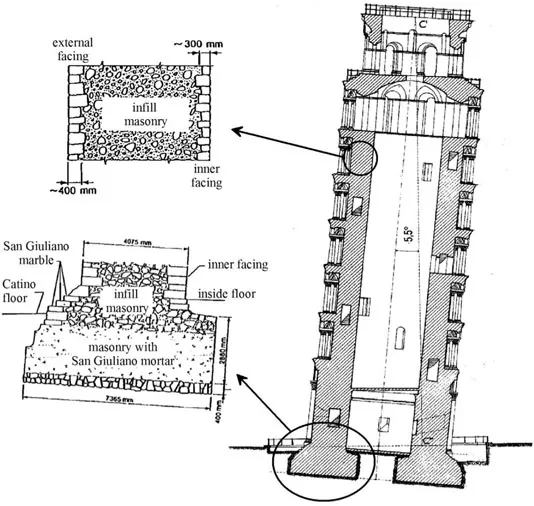
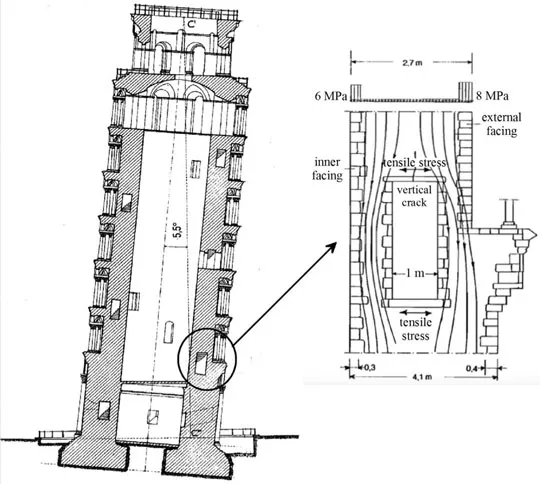
The Tower is composed of a cylindrical masonry body surrounded by loggias with arches and columns that rest on the base cylinder and that are surmounted by a belfry. The structure is subdivided into eight segments, called “orders” (Locatelli et al., 1971). A vertical section on the plane of maximum inclination (the direction of maximum inclination is very close to being north–south) is shown in Figure 2.1. The monument is 58.4 m in height from the plane of the foundation, rising above ground level for more than 55 m. Its weight has been estimated at 142 MN; the center of gravity is 22.6 m above the foundation plane. The ring foundation has an external diameter of 19.6 m; the center hole, 4.6 m. The foundation area is thus 285 m2; the average pressure exerted on the ground is 497 kPa. In 1993, the inclination was 5.5° (in other words, about 10%); the corresponding value for eccentricity in the foundation was 2.3 m.
Figure 2.1 Cross section of the Tower with the plane of maximum inclination, the direction of the inclination being very nearly southward
The central body is a hollow cylinder made up of two facings in dressed stone and, between them, a zone filled with rubble masonry of lime mortar and irregularly shaped stones. Inside this zone, there is the spiral stairwell and stairway, which leads to the belfry with its 293 steps.
Evaluations of the state of stress in the masonry (Macchi and Ghelfi, 2005) show that the most highly stressed section is that on the south side just above the level of the first cornice, where the cross section of the masonry undergoes an abrupt reduction. What is more, the section is weakened by the presence of the staircase and door openings; in this zone, the stress in the external facing on the south side has been evaluated at 8 MPa (Fig. 2.2). The fissure pattern is not easy to interpret due to the repairs that have been carried out over the whole life span of the monument; nevertheless, more fissures and cracks are apparent on the south side of the structure than on the north. This situation aroused many worries concerning the structural safety of the Tower and led, in 1990, to the decision to close it to visitors. What was feared was a brittle failure of the masonry and phenomenon of local instability in the most highly stressed areas of the external facing on the south side and at the level of the first cornice. Due to the fragility of the materials, this type of phenomenon could have caused the entire Tower to collapse almost without warning.
Figure 2.2 Stress concentration in the masonry
The section in Figure 2.1 shows the excavation that today runs around the base of the Tower (the so-called catino). It was added in 1838 to expose the lowest portion of the Tower, until that time hidden in the ground due to a settlement of at least 3 m.
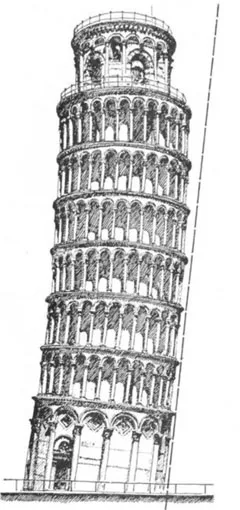
Finally, the Tower is not straight, but its axis is curved, with the concavity toward the north. This characteristic may be perceived in the exaggerated drawing of Figure 2.3; it is described, quite irreverently, as the “banana shape” of the Tower.
Figure 2.3 So-called banana shape of the Tower
Chapter 3
The subsoil of the Tower
Figure 3.1 shows a schematic north–south section of the ground underlying the Tower (Viggiani and Pepe, 2005). The subsoil of Piazza dei Miracoli, like the entire plain of Pisa, consists of geologically recent lagoon and marsh deposits (Pleistocene–Holocene). These are silts, clays and fine sands intercalated with the wind-borne sands of the ancient coastal dunes.
From the ground surface (that is located at 2.5 ÷ 3 m above the mean sea level) downward, we encounter three main layers with different geotechnical properties.
Layer A is about 10 m thick. After 2 ÷ 3 m of ground made with various archaeological remains, it consists mainly of estuarine deposits, laid down under tidal conditions. The soils are therefore rather irregularly layered sands, silts and clays. At t...
Table of contents
Cover
Half Title
Series
Title
Copyright
Contents
Foreword
1 Introduction
2 The Leaning Tower
3 The subsoil of the Tower
4 History of the construction and inclination
5 The results of monitoring, 1911–1990
6 Studies and undertakings in the 20th century
7 Leaning instability
8 The work of the International Committee, 1990–2001
9 And now?
10 Concluding remarks
References
Index
Trusted by 375,005 students
Access to over 1.5 million titles for a fair monthly price.
Study more efficiently using our study tools.
Frequently asked questions
Yes, you can cancel anytime from the Subscription tab in your account settings on the Perlego website. Your subscription will stay active until the end of your current billing period. Learn how to cancel your subscription
No, books cannot be downloaded as external files, such as PDFs, for use outside of Perlego. However, you can download books within the Perlego app for offline reading on mobile or tablet. Learn how to download books offline
We are an online textbook subscription service, where you can get access to an entire online library for less than the price of a single book per month. With over 1.5 million books across 990+ topics, we’ve got you covered! Learn about our mission
Look out for the read-aloud symbol on your next book to see if you can listen to it. The read-aloud tool reads text aloud for you, highlighting the text as it is being read. You can pause it, speed it up and slow it down. Learn more about Read Aloud
Yes! You can use the Perlego app on both iOS and Android devices to read anytime, anywhere — even offline. Perfect for commutes or when you’re on the go. Please note we cannot support devices running on iOS 13 and Android 7 or earlier. Learn more about using the app
Yes, you can access The Tower of Pisa by J.B. Burland,M.B. Jamiolkowski,N. Squeglia,C. Viggiani in PDF and/or ePUB format, as well as other popular books in Social Sciences & Architecture General. We have over 1.5 million books available in our catalogue for you to explore.