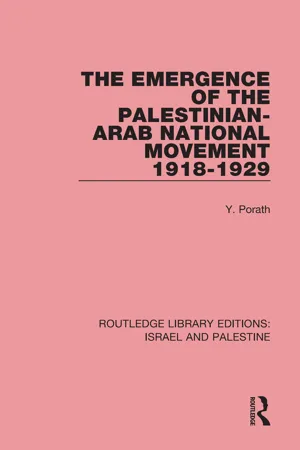
The resurgence of Palestinian nationalism in the wake of the 1967 Arab-Israeli war tended to overshadow the fact that Palestinian national consciousness is not a new phenomenon, but traces its origins back to the time when the first stirrings of nationalism were being felt in many parts of the under-developed world. This work, first published in 1974, is based on both Arabic and Hebrew primary sources as well as English and French official and unofficial documents, and was the first detailed study of the infancy period of Palestinian nationalism. The book begins by establishing the position of Palestine and Jerusalem in Islamic history and their significance within the concepts of Islam, and outlines the social and political features of the Palestinian population at the beginning of the First World War. The author then charts in detail the development of Palestinian nationalism over the decade after the War. Two major forces influenced this development and reacted with it: Zionism, with its ambitious schemes for settling Jews in Palestine and creating a National Home for them there, and Arab nationalism on a wider scale, which was emerging spontaneously with the disintegration of the Ottoman Empire and the spreading of ideas of self-determination. The growing threat posed by Zionism awoke the Palestinian population to the need for organization and the establishment of their own identity to oppose it, while the focus of their national aspirations widened or narrowed according to the ability which they felt at any given time to confront Zionism and achieve self-expression within a Palestinian rather than an all-Syrian national framework. The events of these turbulent years – the confrontations with the British, delegations, boycotts, proposals and rejections, the emergence of al-Hajj Amin al-Husayni, the Wailing Wall conflict and its repercussions – are all described within the context of these wider considerations, which also include Britain's own role as holder of the Mandate over Palestine.
eBook - ePub
The Emergence of the Palestinian-Arab National Movement, 1918-1929 (RLE Israel and Palestine)
- 414 pages
- English
- ePUB (mobile friendly)
- Available on iOS & Android
eBook - ePub
The Emergence of the Palestinian-Arab National Movement, 1918-1929 (RLE Israel and Palestine)
About this book
Information
Table of contents
- Cover
- Half Title
- Title Page
- Copyright Page
- Original Title Page
- Original Copyright Page
- Table of Contents
- Acknowledgements
- List of Abbreviations
- INTRODUCTION The Religious Status of Jerusalem and Palestine in Medieval Islam
- CHAPTER ONE The Rejection of Zionism and the Crystallization of Palestinian-Arab Ideology
- CHAPTER TWO From “Southern Syria” to Palestine
- CHAPTER THREE Confrontation with the British Government
- CHAPTER FOUR The Emergence of al-Ḥājj Amīn al-Ḥusayni
- CHAPTER FIVE The Origin of the Opposition and its Development
- CHAPTER SIX The Turning Point 1924–1929
- CHAPTER SEVEN The Conflict over the Wailing Wall and its Repercussions
- CHAPTER EIGHT Organizational and Social Aspects of the Development of the Movement
- CONCLUSION
- NOTES
- BIBLIOGRAPHY
- APPENDIX A The Executive Committees 1920–1934
- APPENDIX B The Composition of the Supreme Muslim Council
- APPENDIX C Chronological Table
- APPENDIX D Glossary
- INDEX
Trusted by 375,005 students
Access to over 1.5 million titles for a fair monthly price.
Study more efficiently using our study tools.
Frequently asked questions
Yes, you can cancel anytime from the Subscription tab in your account settings on the Perlego website. Your subscription will stay active until the end of your current billing period. Learn how to cancel your subscription
No, books cannot be downloaded as external files, such as PDFs, for use outside of Perlego. However, you can download books within the Perlego app for offline reading on mobile or tablet. Learn how to download books offline
Perlego offers two plans: Essential and Complete
- Essential is ideal for learners and professionals who enjoy exploring a wide range of subjects. Access the Essential Library with 800,000+ trusted titles and best-sellers across business, personal growth, and the humanities. Includes unlimited reading time and Standard Read Aloud voice.
- Complete: Perfect for advanced learners and researchers needing full, unrestricted access. Unlock 1.5M+ books across hundreds of subjects, including academic and specialized titles. The Complete Plan also includes advanced features like Premium Read Aloud and Research Assistant.
We are an online textbook subscription service, where you can get access to an entire online library for less than the price of a single book per month. With over 1.5 million books across 990+ topics, we’ve got you covered! Learn about our mission
Look out for the read-aloud symbol on your next book to see if you can listen to it. The read-aloud tool reads text aloud for you, highlighting the text as it is being read. You can pause it, speed it up and slow it down. Learn more about Read Aloud
Yes! You can use the Perlego app on both iOS and Android devices to read anytime, anywhere — even offline. Perfect for commutes or when you’re on the go.
Please note we cannot support devices running on iOS 13 and Android 7 or earlier. Learn more about using the app
Please note we cannot support devices running on iOS 13 and Android 7 or earlier. Learn more about using the app
Yes, you can access The Emergence of the Palestinian-Arab National Movement, 1918-1929 (RLE Israel and Palestine) by Yehoshua Porath in PDF and/or ePUB format, as well as other popular books in Languages & Linguistics & French Language. We have over 1.5 million books available in our catalogue for you to explore.