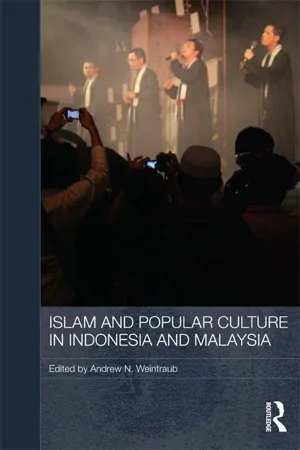
Home to approximately one-fifth of the world's Muslim population, Indonesia and Malaysia are often overlooked or misrepresented in media discourses about Islam. Islam is a religion but there is also a popular culture, or popular cultures of Islam that are mass mediated, commercialized, pleasure-filled, humorous, and representative of large segments of society. During the last forty years, popular forms of Islam, targeted largely towards urbanized youth, have played a key role in the Islamisation of Indonesia and Malaysia. This book focuses on these forms and the accompanying practices of production, circulation, marketing, and consumption of Islam. Dispelling the notion that Islam is monolithic, militaristic, and primarily Middle Eastern, the book emphasizes its dynamic, contested, and performative nature in contemporary South East Asia. Written by leading scholars alongside media figures, such as Rhoma Irama and Ishadi SK, the case studies although not focused on theology per se, illuminate how Muslims (and non-Muslims) in Indonesia and Malaysia make sense of their lives within an increasingly pervasive culture of Islamic images, texts, film, songs, and narratives.
- 280 pages
- English
- ePUB (mobile friendly)
- Available on iOS & Android
eBook - ePub
Islam and Popular Culture in Indonesia and Malaysia
About this book
Information
1 Introduction
The study of Islam and popular culture
in Indonesia and Malaysia
Andrew N. Weintraub
Sermon-filled soap operas, veils on rock stars, Muslim magazines, newspapers, and portals, consumption of special Ramadan foods at McDonald's, Facebook “Hadiths of the Day,” and the rippling effects of Prophet cartoons saturate the mediascape of the contemporary Malay world. Ideas, sounds, images, and meanings about Islam abound in contemporary popular cultural forms including film, music, television, radio, comics, fashion, magazines, and cyberculture. Mass mediated, commercialized, pleasure-filled, humorous, and speaking for large segments of a society or community, popular forms and practices are central to the contemporary definition and meaning of Islam. These forms and accompanying practices of production, circulation, marketing, and interpretations of Islam are all part of everyday lived Islam in Southeast Asia today.1
Islam is a religion, based in the revelations of God's words in the Qur'an, the Hadiths of the Prophet Muhammad, and the laws (sharia) that guide human behavior. The case studies in this volume, while not focused on theology per se, illuminate how Muslims (and non-Muslims) in Indonesia and Malaysia make sense of their lives within an increasingly pervasive culture of Islamic images, texts, songs, and narratives. Popular culture and Islam have become mutually constitutive as sites for defining Muslim lives in the Malay world. Islam in popular culture is particularly powerful in Southeast Asia where localized, flexible, and widespread forms of “popular Islam” have existed for centuries.
Home to approximately one-fifth of the world's Muslim population, Indonesia and Malaysia are often overlooked or misrepresented in media discourses about Islam, especially those emanating from the U.S. and Europe.2 For example, in a 2008 New York Times Book Review issue on the topic of Islam (January 6, 2008), there was not a single article about Islam in Asia, not to mention Islam in Indonesia, the country with the largest population of Muslims in the world. The overwhelming attention given to Islam in the Middle East often leads to a misperception that Islam does not exist elsewhere. Further, Western popular media since the September 11, 2001 attacks on the U.S. has been preoccupied with reporting on groups that support radical views of Islam in conjunction with acts of violence. Such attention to the radical minority is understandable and necessary, but it mutes the voices of the majority of Muslims throughout the world. In Indonesia and Malaysia, there are multiple interpretations about the proper ways to practice Islam, some of them quite liberal and others fundamentalist. This collection of essays argues against notions that Islam is monolithic, militaristic, and primarily Middle Eastern. The authors view popular culture as a site of struggle over what counts as Islam in contemporary Indonesia and Malaysia.
Popular culture and popular Islam
Islam has a universal dimension, in which its teachings are understood to be applicable to all adherents at all times. On the one hand, Islam is believed to be eternal, divine, God-given, ageless, and transcendent. On the other hand, popular culture is thought to be fleeting, man-made, cheap, and worldly. Associated with pleasure, commerce, and “the West,” popular culture is often discursively produced as “bad” for Islamic communities. The narrative that places Islam in opposition to popular culture is based in reductive and essentialist ways of understanding Muslim life, in general, and processes of mass mediation in contemporary societies in particular.3 This narrative assumes a passive one-way street of communication where meaning is determined at the point of production. As Talal Asad points out in his influential essay “Toward an Anthropology of Islam,” Islam does not belong to a “fixed stage of an Islamic theater” (Asad 1986: 11). Treating Islam as “a drama of religiosity expressing power” omits indigenous discourses, and turns Islamic behavior into a readable gesture (italics mine, ibid.: 9). The essays in this collection challenge the notion of a monolithic and unchanging Islam as a blueprint for behavior by illustrating how people create multiple and sometimes conflicting meanings about ways of leading proper Muslim lives.4
Importantly, the modern mediated forms through which people live Islam are neither “Western” nor all that new. Even those technologies of mass-mediated popular culture that originated in “the West” do not carry technologically determinate meanings mimicked by “the rest.” Rather, people invest popular print media, music, film, and television with new cultural meanings, and these meanings change across space and over time. Mass mediations are dynamic and collaborative social processes that involve compromise and negotiation as well as resistance. The uses of mediated forms have strategic cultural, political, and economic implications, which are revealed in social practices and corresponding forms of representation and authority.
There are several ways that “the popular” can be understood in relation to Islam in Indonesia and Malaysia. All of these ways of understanding Islam and popular culture are consistent with the important notion of difference in Islam or multiple “Islams” (El-Zein 1977) in Southeast Asia. Due to the diversity of experiences, voices, and cultural identities among Muslims, to study Islam is to ask which discursive community is being addressed. Nevertheless, there is an underlying unity that informs all of these Islams: heterogeneity does not mean an absence of shared traditions (Asad 1986: 16).
First, this book highlights the notion of Islam and “the popular” as belonging to large numbers of people. Indonesia and Malaysia are the two largest majority Muslim nation-states in Southeast Asia; Indonesia (total population 243 million, 86 percent Muslim) and Malaysia (total population 26 million, 60 percent Muslim).5 In terms of scale, Islam has the largest number of adherents compared to other religions in Indonesia and Malaysia. However, popular Islam is not only based on scale, as I will describe below.
Second, the concepts of “popular Islam” and “scripturalist Islam” or “literalist Islam” have a dialogic relationship in contemporary Indonesia and Malaysia. Popular Islam belongs to the populace or the masses as opposed to the orthodox official forms of Islam regulated by a small group of elites (Gaffney 1992: 38). The notion of Muslim popular culture is inclusive, widely appealing, and “of the people.” In Southeast Asia, popular Islam refers to the traditions of Sufi-inspired Islam adapted to local circumstances (Geertz 1968; Woodward 1989; Bowen 1993; Howell 2001). It was through Sufism that Islam originally spread to Southeast Asia, where it blended and localized with adat (customary law), HinduBuddhist beliefs, and local mystical practices. Syncretic and mixed, popular Islam celebrates local ideas, beliefs, values, and practices. In Malaysia and Indonesia, localizing the messages of Islam involves tafsir (Quranic exegesis) using vernacular language, parables, metaphors, and humor (Noor 2003; see also Bowen 1993). But this volume focuses much more on a different kind of “popular Islam,” that is, mass-produced, mass-mediated, more urban than rural, and more globalized and cosmopolitan, for the most part, than rural, traditional versions of popular Islam. These modern, globally conscious forms are often localized, simultaneously influenced by Western consumer culture as well as by forms of Islamic orthodoxy and resurgence emanating from the Middle East and elsewhere in the Islamic world.
Scripturalist Islam is “scholastic, legalistic, and doctrinal” and adheres closely to the texts of the Qur'an as explicated by ulama (religious scholars) (Geertz 1968: 62). Literalist readings of the canonical texts (Qur'an and Hadiths) are contrary to more liberal and widespread practices including Sufism (Howell 2008: 41). In contemporary Indonesia, advocates of “radical Islam” including Laskar Jihad, Front Pembela Islam (FPI), and Jemaah Islamiah (JI), are aligned with orthodox Islam (Bruinessen 2002; Fealy et al. 2006). Despite their heightened use of new media, these orthodox movements do not appeal to large segments of the population (that is, they are “not popular”). However, this is not to say that “popular” always mean “widespread.” The term “popular culture” often refers to fringe forms of underground culture, even if they are not part of the mainstream commercial culture.6 Some forms that are not widespread can be considered part of popular Islam. For example, in Malaysia, independent films are neither commercially successful or widespread, but they use popular technology (digital), embody a cosmopolitan sensibility, and focus on the most pressing issues of the day.
In contrast to scripturalist Islam, Indonesia and Malaysia are nation-states characterized by “moderate Islam.” Moderate Islam refers to flexible interpretations of major religious and legal sources regarding scripture, law, gender, and democracy that respond to the contemporary needs of Muslims. Moderate Islam maps well onto popular culture as both are widespread, participatory, dialogic, and tolerant of diversity and debate. However, orthodox, scripturalist understandings of Islam often reach more people through mass media than the rural, syncretic versions of Islam. In this sense, “popular Islam” does not necessarily celebrate local ideas, beliefs, and practices (and may in fact condemn them).
Third, “the popular” in Islam refers to the common everyday activities of people leading a Muslim life as prescribed by the Qur'an. Islam as a “practical” religion refers to “how ordinary people (peasants, proletarians, merchants as well as mystics and scholars) order and articulate categories, symbols and the relations between them in the pursuit of comprehending, expressing and formulating social practice and experience” (Ellen 1988: 54). Islam as “a way of life” encompasses personal, political, economic, and legal dimensions. The essays in this volume show how tightly Islam and popular culture are interwoven into the fabric of everyday life of Muslims in Indonesia and Malaysia.
Fourth, popular culture has been an integral part of Islamization (also called revival or resurgence).7 In the last four decades, mass-mediated forms of Islam, targeted largely to urbanized youth, have played a key role in Islamization in Indonesia and Malaysia. This is not to say that people did not have a profound sense of their Islamic identities before, or that Islam existed outside the realm of the popular (see my comments about “popular Islam” above). Since the late 1970s, “mosques have proliferated in towns and villages; religious schools and devotional programs have expanded; a vast market in Islamic books, magazines, and newspapers has developed” (Hefner 1997: 5). In Indonesia, Suharto's New Order regime paved the way for new political parties, schools, and sharia banks, and expanded the role of religious courts and other Islamic insitutions. During this period, Islam became more politically institutionalized, symbolically pervasive, and ideologically pluralistic.
Islamic resurgence in Malaysia (known as the dakwah movement, from the Arabic root da'a, “to call”) dates to the late 1960s or early 1970s (Peletz 1997: 233). Resurgence grew out of a cricitism of secularism, disillusionment with Westernization, and rejection of materialism. Former prime minister Mahathir bin Mohamad (1981 to 2003) supported resurgence through political institution-building, economic modernization, and technology development. Most of its adherents were urban, young, and middle class (university students, teachers, civil servants, and the urban working class; see Muzaffar 1986: 8).8 Focused on “questions of identity and the symbols and rituals which help define it” (Muzaffar 1986: 7), resurgence was expressed in Muslim attitudes, behavior, and appearance (Funston 2006: 57).
The public presence of Islamic symbols, ideas, and texts in film, television, popular print media, music, and the Internet in Indonesia and Malaysia has been growing since the 1990s. While these media may not present a religious sermon or offer an interpretation of a Qur'anic text, they function as sites for reflecting on Muslim ideas and practice. Perhaps the most pervasive and semiotically charged image of contemporary Islam in Southeast Asia is the headscarf or veil ( jilbab; tudung). The headscarf signifies different meanings about women, fashion, agency and freedom of expression. It has served as a symbol of alternative modernity (Brenner 1996); Islamization (Smith-Hefner 2007); commercial fashion (Jones 2007); urban middle class identity (Rachmah 2008), and Malay ethnicity (Khoo, Chapter 12 this volume). In chat rooms, the smiley, a graphic representation of a smiling face, may be wearing a head scarf (Bunt 2009: 11). These examples stand outside of institutionalized religion, and they are not directly focused on presenting a specific message about Islam. But they are important for generating debates about Muslim values, images, beliefs, and practices.
The spaces where Islam and popular culture intersect in everyday life oftentimes result in conflicts over morality, freedom of expression, and cultural rights. In some Salafist communities, for example, popular music is thought to lead people away from religion to immorality and irreligiousity.9 Debates about music as haram (forbidden) relate to the use of musical instruments as well as associations with sexuality, entertainment, dance, and women's bodies. In Malaysia, popular music bands from the U.S. have been prohibited from performing because of the perceived sexualized performance of women's bodies (e.g., Beyonce, 2009) or the perceived negative effects on youth (e.g., Linkin Park, 2003).10 Black metal bands have been similarly censored for allegedly practicing satanic rituals.11 However, popular music is increasingly considered a privileged medium for promoting Islamic ideas and values, as shown in this volume by Sutton, Irama, and Barendregt (Chapters 5, 11, and 14, respectively). By focusing on popular culture, the essays in this collection emphasize the dynamic, contested, and performative nature of Islam in contemporary Indonesia and Malaysia.
Mediated Islam: commodification, consumption, and collaboration
Popular Islam is part of an “emerging Muslim public sphere” that relies on using new media to link Muslims around common interests and Muslim identity politics outside institutions not controlled by nation-states (Eickelman and Anderson 1999: 1). Eickelman and Anderson describe how, as the role of media has increased, the gatekeeper role of nation-states has decreased, and, as a result, more people have gained access to redefining Muslim publics. New and increasingly accessible modes of communication regarding the symbolic language of Islam has facilitated a more fragmented production of texts, generating new and diverse styles of interpretation. New media, new people, and “reintellectualization” (presenting Islamic disourse in accessible, vernacular terms) of Islam has broad implications for what gets articulated in the public sphere (ibid., 14).
The study of media and religion brings changing modes of authority and representation into sharp relief. The fall of Suharto's New Order and subsequent democratization in Indonesia gave Islamic political parties and institutions an unprecedented opportunity to gain significant power to shape public discourse. This expanded idiosphere included the most liberal voices of Islam as well as the most radical. In the 2000s, Muslim–Christian conflicts erupted in Maluku and Sulawesi; attacks on Christian ...
Table of contents
- Front Cover
- Islam and Popular Culture in Indonesia and Malaysia
- Media, Culture and Social Change in Asia
- Title Page
- Copyright
- Contents
- Acknowledgements
- List of contributors
- List of figures
- Conventions and orthography
- 1 Introduction: the study of Islam and popular culture in Indonesia and Malaysia
- PART I Commercial, educational, government, and religious institutions
- PART II Social processes of media production, circulation, and reception
- PART III Islamic perspectives on film, music, and literature
- PART IV Representations, values, and meanings
- Index
Trusted by 375,005 students
Access to over 1.5 million titles for a fair monthly price.
Study more efficiently using our study tools.
Frequently asked questions
Yes, you can cancel anytime from the Subscription tab in your account settings on the Perlego website. Your subscription will stay active until the end of your current billing period. Learn how to cancel your subscription
No, books cannot be downloaded as external files, such as PDFs, for use outside of Perlego. However, you can download books within the Perlego app for offline reading on mobile or tablet. Learn how to download books offline
Perlego offers two plans: Essential and Complete
- Essential is ideal for learners and professionals who enjoy exploring a wide range of subjects. Access the Essential Library with 800,000+ trusted titles and best-sellers across business, personal growth, and the humanities. Includes unlimited reading time and Standard Read Aloud voice.
- Complete: Perfect for advanced learners and researchers needing full, unrestricted access. Unlock 1.5M+ books across hundreds of subjects, including academic and specialized titles. The Complete Plan also includes advanced features like Premium Read Aloud and Research Assistant.
We are an online textbook subscription service, where you can get access to an entire online library for less than the price of a single book per month. With over 1.5 million books across 990+ topics, we’ve got you covered! Learn about our mission
Look out for the read-aloud symbol on your next book to see if you can listen to it. The read-aloud tool reads text aloud for you, highlighting the text as it is being read. You can pause it, speed it up and slow it down. Learn more about Read Aloud
Yes! You can use the Perlego app on both iOS and Android devices to read anytime, anywhere — even offline. Perfect for commutes or when you’re on the go.
Please note we cannot support devices running on iOS 13 and Android 7 or earlier. Learn more about using the app
Please note we cannot support devices running on iOS 13 and Android 7 or earlier. Learn more about using the app
Yes, you can access Islam and Popular Culture in Indonesia and Malaysia by Andrew N. Weintraub in PDF and/or ePUB format, as well as other popular books in Ciencias sociales & Estudios étnicos. We have over 1.5 million books available in our catalogue for you to explore.