Historiography, Empire and the Rule of Law considers the intersection of these terms in the historical development of what has come to be known as the 'rule of law'. The separation of governmental powers, checks and balances, and judicial independence signified something entirely new in the way in which politics was imagined and practiced. This 'rule of law' cannot, as it often is, be traced to the justification and practice of government as originating in a social contract among the governed; but rather, by analogy with a popular conveyancing innovation of the era, to the trust – a device by which the power of ownership of land could be restrained. But how could the restraint of power remain consistent with the avoidance of anarchic disagreement among those granted the task of supervision and restraint? In response, it is argued here, the central legal and political task became one of managing disagreement and change peacefully and constructively – by drawing on a colonial tradition that emphasised civility, negotiation and compromise. And the study of all of these qualities as they evolved, Ian Duncanson contends, is vital to understanding the emergence of the 'rule of law'. Historiography, Empire and the Rule of Law will be invaluable for all those engaged in research and the postgraduate study of socio-legal and constitutional studies, and early modern and modern history.
eBook - ePub
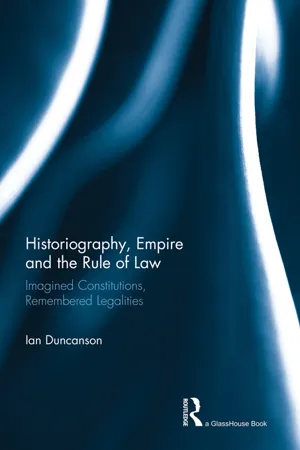
Historiography, Empire and the Rule of Law
Imagined Constitutions, Remembered Legalities
- 258 pages
- English
- ePUB (mobile friendly)
- Available on iOS & Android
eBook - ePub
Historiography, Empire and the Rule of Law
Imagined Constitutions, Remembered Legalities
Table of contents
- Cover
- Half Title
- Title Page
- Copyright
- Dedication
- Contents
- Acknowledgements
- Foreword by Stewart Motha
- Preface
- 1. The themes introduced: law, the subject, sovereignty and certainty
- 2. Making good the lack: the form of the phantom in the progress from sovereignty to civility
- 3. The Scottish writing of the civility of the “Englishman”
- 4. The government of empire and its implications for the “metropolis”
- 5. Governing the “natives” at home in nineteenth century Britain
- 6. Cultural studies, education and legality
- 7. The “problem” of the English discipline and the rise and possible fall of legal positivism
- Conclusion
- Bibliography
- Index
Trusted by 375,005 students
Access to over 1.5 million titles for a fair monthly price.
Study more efficiently using our study tools.
Frequently asked questions
Yes, you can cancel anytime from the Subscription tab in your account settings on the Perlego website. Your subscription will stay active until the end of your current billing period. Learn how to cancel your subscription
No, books cannot be downloaded as external files, such as PDFs, for use outside of Perlego. However, you can download books within the Perlego app for offline reading on mobile or tablet. Learn how to download books offline
Perlego offers two plans: Essential and Complete
- Essential is ideal for learners and professionals who enjoy exploring a wide range of subjects. Access the Essential Library with 800,000+ trusted titles and best-sellers across business, personal growth, and the humanities. Includes unlimited reading time and Standard Read Aloud voice.
- Complete: Perfect for advanced learners and researchers needing full, unrestricted access. Unlock 1.5M+ books across hundreds of subjects, including academic and specialized titles. The Complete Plan also includes advanced features like Premium Read Aloud and Research Assistant.
We are an online textbook subscription service, where you can get access to an entire online library for less than the price of a single book per month. With over 1.5 million books across 990+ topics, we’ve got you covered! Learn about our mission
Look out for the read-aloud symbol on your next book to see if you can listen to it. The read-aloud tool reads text aloud for you, highlighting the text as it is being read. You can pause it, speed it up and slow it down. Learn more about Read Aloud
Yes! You can use the Perlego app on both iOS and Android devices to read anytime, anywhere — even offline. Perfect for commutes or when you’re on the go.
Please note we cannot support devices running on iOS 13 and Android 7 or earlier. Learn more about using the app
Please note we cannot support devices running on iOS 13 and Android 7 or earlier. Learn more about using the app
Yes, you can access Historiography, Empire and the Rule of Law by Ian Duncanson in PDF and/or ePUB format, as well as other popular books in History & British History. We have over 1.5 million books available in our catalogue for you to explore.