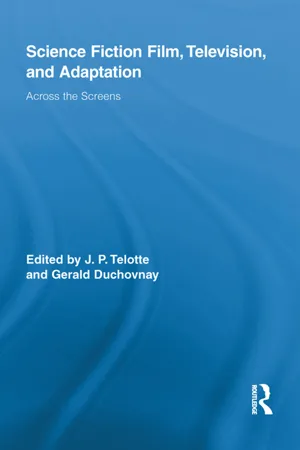
While film and television seem to be closely allied screen media, our feature films and television series have seldom been successfully adapted across those screens. In fact, rather than functioning as portals, those allied media often seem, quite literally, screens that filter out something that made the source work so popular in its original form. Differences in budget, running times, cast, viewing habits, screen size and shape all come into play, and this volume's aim is to track a number of popular texts in the course of their adaptive journeys across the screens in order to sketch the workings of that cross-media adaptation. For its specific examples, the volume draws on a single genre—science fiction—not only because it is one of the most popular today in either film or television, but also because it is arguably the most self-conscious of contemporary genres, and thus one that most obviously frames the terms of these technological adaptations. The essays included here mine that reflexive character, in both highly successful and in failed efforts at cross-media adaption, to help us understand what film and television achieve in screening science fiction, and to reveal some of the key issues involved in all of our efforts to navigate the various screens that have become part of contemporary culture.
eBook - ePub
Science Fiction Film, Television, and Adaptation
Across the Screens
- 212 pages
- English
- ePUB (mobile friendly)
- Available on iOS & Android
eBook - ePub
Science Fiction Film, Television, and Adaptation
Across the Screens
About this book
Information
Part I
Cross-Screen Dynamics
1 Domesticating Space
Science Fiction Serials Come Home
Before they first came to television in the late 1940s, with their spectacular tales of robots, rocket ships, and alien encounters, early science fiction serials had captured the imaginations of theater audiences one thrilling chapter at a time. Each week, futuristic heroes such as Flash Gordon, Buck Rogers, and Commando Cody championed humanity and democracy against the forces of evil, both earthly and alien, as fans watched in wonder, creating a Saturday morning tradition that would come to define youth entertainment from the 1920s through the 1950s. With their arrival on broadcast television, however, the thrills and chills of sf serials and space operas found another home—in their audience’s homes—opening a new era in sf entertainment. Although only a small number of theatrical sf serials were reproduced on television, their format would provide the template for numerous televised programs that confronted producers, writers, cameramen, and actors with the challenge of adapting fantastic tales of outer space from the formalized, big-picture public screenings of cinema into the new domestic, small-screen experience of the home.
Considerations of these early televised sf series and space operas typically focus on the technical challenges of adaptation across screens, noting the inherent differences between film and television in production values, narrative structure, content, viewing styles, and the ability to create spectacle. Still in its infancy, early television production was often found lacking in comparison to its cinematic counterpart, derided for low production values resulting from the physical limitations of live studio soundstages and the creative—and budgetary—limitations of its effects technology. Whatever television was not able to duplicate (via kinescope), it also was not able to replicate (via live special effects). However, when thinking about televised sf series, a direct comparison with commercial cinema may be of limited usefulness. Early televised sf series often have less in common with seamless cinematic texts than with the comics, radio serials, and short stories from which many of them were drawn. With roots in these other “domestic” and often sequential media, televised sf series are not quite cinematic narratives out-of-place, but a different form of narrative. Indeed, their adaptation to television may be thought of as sf serials coming home.
ONE CHAPTER AT A TIME
Serials, or chapterplays as they are often called, with their high adventure, low budgets, and cliffhanger endings, played a significant role in cinematic entertainment for more than half a century.1 Produced in episodes of fifteen to twenty minutes in length, serials such as The Perils of Pauline (1914), The Master Mystery (1919), and The Hope Diamond Mystery (1921) typically ran for twelve to fifteen episodes that were screened weekly in theaters. From the silent era onward, these serial dramas were popular screen attractions that netted profits for studios and theaters, advanced the careers of their stars, and contributed to a spectacle-based culture of attractions distributed in weekly installments.2 Whereas a number of early serials contained elements of the fantastic (most notably The Master Mystery), sf serials, which prominently featured themes of space and superscientific technologies,3 only became a staple of neighborhood movie houses in the mid-1930s, with serials such as The Vanishing Shadow (Universal, 1934), The Lost City (Krellberg/Regal Pictures, 1935), and The Phantom Empire (Mascot, 1935). Most closely identified with youthful audiences, these serials were the stuff of which childhood fantasies, and Saturday matinees, were made. As Weiss and Goodgold (1981) relate:
The serials were a world of their own. For approximately twenty minutes you were totally involved in a series of hair-raising escapes, spectacular battles, mile-a-minute chases, hidden treasures, secret plans, and diabolical scientific devices, all held together by a plot which was at once highly tenuous and at the same time complicated almost beyond comprehension. (vi)
Avid serial fans, young viewers always watched a second time, “looking for clues [they] might have missed the first time around,” becoming highly literate in the serials’ narrative form and plot devices, as well as reliable consumers of serials as an entertainment genre (Weiss and Goodgold, vi). Later, as sf serials were adopted as broadcast television programming, similar young audience members, who often watched together with their parents,4 would become the core of the genre’s fan base in its new medium, as well as primary consumers of its social and commercial messages as sf series became integrated into domestic life.5
Because of their close identification with youthful audiences and their association with second-tier studios,6 early sf serials were almost never shown at first-run theaters, which led both their production and content to be dismissed as inconsequential (Kinnard 5). Even so, the fantastic plots of these chapterplays breathed new life into motion picture serials and created a new era in film entertainment as they spoke not only to Americans’ fascination and fear surrounding technological advancements in the machine age but to the increasing interweaving of science and popular culture. 7 The sf genre’s speculative power, “its ability to speak to the wonder and curiosity that are ultimately bound up in our scientific and technological developments” (Telotte, Replications 3) safely cast as children’s entertainment, would later become one of its most celebrated and studied qualities.
With the advent of broadcast television in the US in the 1940s, the terrain of entertainment media shifted, transporting the fantastic directly into the home. A technological marvel that, for many, seemed science fictional itself, the television had already been prefigured in numerous sf serials long before it made its way to many households, often taking the form of “remote viewing screens” for the purpose of surveillance rather than entertainment. One such example can be found in the film serial The Phantom Empire, a musical-Western-sf hybrid, starring soon-to-be cowboy icon Gene Autry. The film takes place in the present but showcases the futuristic world of Murania far beneath Earth’s surface, where scientific marvels such as moving sidewalks, robots, video phones, a reviving chamber, and ray guns are part of everyday life, and the empire’s icy Queen Tika (Dorothy Christie) uses her viewing screen to monitor both her realm and the world above—bringing all into her domain.8 When The Phantom Empire was released in 1935, a good deal of experimentation had been done with television in the audience’s “real” world, yet only about four hundred sets existed in the US, and it would be four more years before the beginning of commercial television broadcasting, coinciding with the technology’s public debut at the 1939 New York World’s Fair, would start American television’s move into the domestic realm.
Between 1946 and 1948, regular network television broadcasts began on ABC, NBC, CBS, and the DuMont Television Network, and network executives anxiously grappled with the challenge of providing programming that would draw viewers to the nascent medium. First, there were the obvious postwar limitations on personnel, facilities, distribution, advertising support, raw materials needed for equipment manufacture, and programming content (Hawes 12). Beyond those overarching limitations, though, the live television format used for most programming was also constrained by small sound stages, limitations on image production, demands on actors unlike those posed by stage or film, and the rate at which audiences developed a common grammar for “reading” new televisual codes and cues. Integrating television into family life meant not only adjusting to its physical presence but also constructing an intimate, shared culture that encompassed both the world of the narrative and the world of the viewers. The industry and audiences alike were still making sense of the technologies and possibilities of the new medium. As one CBS vice president noted, “television is a challenge to creative imaginations to learn the basic characteristics of the medium and then devise suitable material for it” (Wilk xii).
And then there was the question of programming itself as major film companies, understandably wary of competition, attempted to stifle the aspirations of the fledgling medium by using threats and contractual bans to prevent actors from “crossing over” into television and claiming ownership of film rights, including the transmission of blurry sixteen-millimeter kinescope reproductions.9 Further, motion picture studios sought to block network access to existing stage plays and scripts, which forced television studios to turn to public domain and original material for their programming (Wilk 125–26). Producers and studio executives reflected this increasing tension between older medium and new. In 1946, Twentieth Century-Fox studio chief Darryl F. Zanuck pronounced, “Television won’t be able to hold onto any market it captures after the first six months. People will soon get tired of staring at a plywood box every night” (Becker 17). But only three years later, producer Samuel Goldwyn predicted that “the television age” would have “revolutionary effects” on the motion picture industry:
The competition we feared in the past—the automobile in early movie days, the radio in the twenties and thirties, and the developing of night sports quite recently—will fade into insignificance by comparison with the fight we are going to have to keep people patronizing our theaters in preference to sitting at home and watching a program of entertainment. (200)
Goldwyn further cautioned that in direct competition with the new medium, the motion picture industry would lose: “If the movies try to lick television, it’s the movies that will catch the licking.” Instead, he advocated finding ways to fit movies into “the new world created by television” (200).
A DOMESTIC MEDIUM
The power Goldwyn predicted can be glimpsed in John Ellis’s examination of television as an integral part of the structure and replication of domestic culture. Ellis observed that broadcast television is “a profoundly domestic phenomenon” (113)—programming that circulates in specific patterns of production, distribution, and consumption that are intricately interwoven with the culture of home and hearth. Etched into the everyday rhythms and routines of households and families, television programming becomes part of home life and the dynamic commercial culture that has been built up around it. That commercial culture makes assumptions about family composition, gender roles, and sexual orientation that, in turn, inform programming and affect not only on-screen representations, but scheduling and advertising as well. Consequently, broadcast television not only reflects but also creates particular kinds of viewers in service of its own social, political, and commercial agenda—and that commercialism, for many, formed the crux of the big screen-small screen divide. Films were cast as high-quality cultural products with high-quality stars, whereas television’s commercialism was derided as a “corrupter of the dramatic arts” (Becker 28). Actor Dana Andrews (Laura [1944], The Best Years of Our Lives [1946]) summed up these sentiments, contending that “TV is controlled by bookkeepers who don’t care about the quality of their shows as long as they reach the people and sell merchandise” (Becker 28).
Television’s segmented forms of narration combined with commercialization, however, are key to both its framing of audiences and its successful integration into the domestic realm. Unlike cinema, where audiences purchase tickets for a single narrative event that is cast as spectacle and bracketed in time and space from their daily routines and relationships, early television programming had to meet the needs of a domestic setting brimming over with distractions and intrusions that were competing for the attention of the viewing audiences, from household schedules to interpersonal demands. Thus, its offerings have typically taken the form of segments—a series of sequential programs and advertisements—that accommodate natural shifts in attention. This segmentalization is television’s own creation, one as innovative as the medium itself, and extends across virtually the whole of television’s output (Ellis 120).
Early television’s landmark forms of segmented programming were the serial and the series, two formats that contained similarities but also significant differences. Both generated multiple segments from basic thematic material, and both contained a form of continuity-with-difference that suited the medium’s nature, providing recurring characters and tropes, revisiting familiar settings and locations, and supplying enough repetition to acculturate new viewers or fill in gaps from missed episodes. Serials, however, led viewers down an episodic path of accumulated knowledge to a story’s conclusion, whereas series did not. Serials, with their continuing narrative progression, brought additional features to each episode’s beginnings and endings, many opening with title sequences that introduced characters and relationships as well as summarized the episode’s current adventure. Cliffhangers, which left characters—and sometimes, entire worlds—in peril, added suspense to each episode’s closing. Their to-be-continued drama also resisted any resolution of danger or suspense, guaranteeing the weekly return of existing viewers.10
Successful film serials, such as Flash Gordon (1936), Buck Rogers (1939), and Radar Men from the Moon (1952), offered material that was adaptation-ready. Typically public domain, and thus free of motion picture studios’ claims to copyright and control, the segmentation of these serials offered an ideal fit for the framework of daily television programming with its need to accommodate domestic viewing patterns and commercial interruption. I...
Table of contents
- Cover
- Half Title
- Title Page
- Copyright Page
- Contents
- List of Figures
- Acknowledgments
- Introduction: Across the Screens: Adaptation, Boundaries, and Science Fiction Film and Television
- PART I. Cross-Screen Dynamics
- PART II. Case Studies: Film to Television
- PART III. Case Studies: Television to Film
- PART IV. Issues in Science Fiction Adaptation
- Notes on Contributors
- Selective Filmography/Videography
- Bibliography
- Index
Trusted by 375,005 students
Access to over 1.5 million titles for a fair monthly price.
Study more efficiently using our study tools.
Frequently asked questions
Yes, you can cancel anytime from the Subscription tab in your account settings on the Perlego website. Your subscription will stay active until the end of your current billing period. Learn how to cancel your subscription
No, books cannot be downloaded as external files, such as PDFs, for use outside of Perlego. However, you can download books within the Perlego app for offline reading on mobile or tablet. Learn how to download books offline
Perlego offers two plans: Essential and Complete
- Essential is ideal for learners and professionals who enjoy exploring a wide range of subjects. Access the Essential Library with 800,000+ trusted titles and best-sellers across business, personal growth, and the humanities. Includes unlimited reading time and Standard Read Aloud voice.
- Complete: Perfect for advanced learners and researchers needing full, unrestricted access. Unlock 1.5M+ books across hundreds of subjects, including academic and specialized titles. The Complete Plan also includes advanced features like Premium Read Aloud and Research Assistant.
We are an online textbook subscription service, where you can get access to an entire online library for less than the price of a single book per month. With over 1.5 million books across 990+ topics, we’ve got you covered! Learn about our mission
Look out for the read-aloud symbol on your next book to see if you can listen to it. The read-aloud tool reads text aloud for you, highlighting the text as it is being read. You can pause it, speed it up and slow it down. Learn more about Read Aloud
Yes! You can use the Perlego app on both iOS and Android devices to read anytime, anywhere — even offline. Perfect for commutes or when you’re on the go.
Please note we cannot support devices running on iOS 13 and Android 7 or earlier. Learn more about using the app
Please note we cannot support devices running on iOS 13 and Android 7 or earlier. Learn more about using the app
Yes, you can access Science Fiction Film, Television, and Adaptation by Jay Telotte, Gerald Duchovnay, Jay Telotte,Gerald Duchovnay,J. P. Telotte in PDF and/or ePUB format, as well as other popular books in Media & Performing Arts & Film & Video. We have over 1.5 million books available in our catalogue for you to explore.