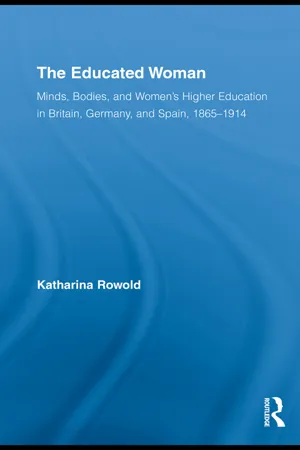
The Educated Woman is a comparative study of the ideas on female nature that informed debates on women's higher education in the late nineteenth and early twentieth centuries in three western European countries. Exploring the multi-layered roles of science and medicine in constructions of sexual difference in these debates, the book also pays attention to the variety of ways in which contemporary feminists negotiated and reconstituted conceptions of the female mind and its relationship to the body. While recognising similarities, Rowold shows how in each country the higher education debates and the underlying conceptions of women's nature were shaped by distinct historical contexts.
eBook - ePub
The Educated Woman
Minds, Bodies, and Women's Higher Education in Britain, Germany, and Spain, 1865-1914
- 312 pages
- English
- ePUB (mobile friendly)
- Available on iOS & Android
eBook - ePub
The Educated Woman
Minds, Bodies, and Women's Higher Education in Britain, Germany, and Spain, 1865-1914
About this book
Information
Part I
Britain
1
Science, Feminism, and Sexual Difference
Moulding Female Nature through Higher Education, 1860s–1890
In 1874, the psychiatrist Henry Maudsley caused a stir when he discussed aspects of women’s physiology in the Fortnightly Review to voice his opposition to women’s entry into higher education.1 He was quickly rebuked by the lawyer Herbert Cowell: ‘however appropriate to the pages of a medical publication, [this] is a novelty in English current literature’.2 At the time of this exchange, the higher education of women was turning into a stormily debated issue in Britain. Numerous writings by physicians and scientists appeared on the question in the 1870s and 1880s, increasingly often in literary journals, bringing specialized scientific and medical knowledge to the general public.3 In these decades, feminist campaigners more and more engaged with and appropriated medical and scientific theories of the female mind and body in the higher education campaigns. Gaining access to university education was one of the campaigns of the nineteenth-century women’s movement that gathered momentum in the 1860s in Britain, and it was one of the successful campaigns. The first women’s college, Hitchin, later Girton, was founded in 1869 and four years after the publication of Henry Maudsley’s article, in 1878, the University of London admitted women to its degrees. Women’s entry into the universities took place in piecemeal process in Britain; the process was only fully completed in 1947 when women were admitted to full membership at Cambridge University. The gradual admission of women to the universities was accompanied by intense debates, which peaked in the 1870s and 1880s but continued well into the early twentieth century. Questions about differences between women and men came to the fore in these debates, and fierce controversies about women’s nature and how it related to their social roles ensued.
The peak of the higher education debates coincided with a fundamental shift of authority and prestige from religious to naturalistic belief, much noted by contemporary observers. While the number of professional scientists rose in this period, scientific ideas were also increasingly dispersed at a popular level.4 Historians have shown that Victorian science and medicine were strongly gendered, and that there was noticeable opposition by scientists and physicians to the prospect of women’s higher education.5 Many physicians and scientists articulated theories of sexual difference that reinforced and justified the exclusion of women from university education. Nonetheless, the role of medical and scientific knowledge about female nature in the higher education debates was complex. Late nineteenth-century medical and scientific discourse contained notions that favoured a more intellectually oriented education of the female sex, and these theories were often extensively explored and developed by feminist campaigners. Furthermore, while some historians have postulated that there existed unanimity amongst scientists on the woman question,6 more recently others have drawn attention to the ways in which medical and scientific ideas about sexual differences were often contested within the scientific commu-nity.7 Medical and scientific representations of sexual difference were never unanimous, and they were riddled with inconsistencies and ambiguities. As the literary critic Jill Matus has noted, this suggests that biomedical discourse might have been ‘more open, exploratory, and less ideologically obedient’ than previously thought.8
Scholarship on the gendering of nineteenth-century medicine has sometimes suggested that physicians’ theory of femininity and associated prescription of social roles, due to its validation from science, did not raise opposition.9 However, late nineteenth-century medical, as well as scientific, ideas were explored and appropriated outside of the scientific community, and feminists increasingly appropriated aspects of medical and scientific theories to support their arguments for higher education in the last quarter of the nineteenth century. Indeed, medical and scientific theories about the female mind and body came to strongly influence feminist ideas in Britain. There has been much recent interest in the relationship between turn-of-the-century feminism and eugenics.10 The groundwork for feminists’ appropriation of eugenic ideas was laid earlier: the influence of contemporary medical and scientific theories on feminist arguments became increasingly apparent during the 1870s and early 1880s. Medical and scientific discourses on sexual difference were sites of competing definitions, and feminist campaigners participated in these discourses.11 While not the only languages feminists employed, medical and scientific ideas became increasingly influential in feminist arguments. In the controversy about women’s higher education, medical and scientific knowledge played a multilayered role, as will be explored in this and the following chapter.
In this chapter, I will first provide a brief overview of feminist ideas on women’s higher education during the 1860s. I will then proceed to how the higher education question was framed by evolutionary theorists. Discussing Charles Darwin’s ambivalent position on the question, the chapter will also explore the ways in which evolutionary theory could reinforce the exclusion of women from higher education. However, evolutionary theory contained the understanding that sexual difference was mutable. This was an understanding that blurred the borders between nature and culture, and for some evolutionists it meant that under changed circumstances the mental evolution of women would take on new directions. The question of the influences of environmental determinants on women’s nature also focused on women’s bodies, and the chapter will address what became a defining aspect of the higher education debates in the 1870s and 1880s in Britain: the question about the relationship between women’s education, their physiology, and their health. Subsequently, the chapter will address feminists’ engagement with the scientific and medical theories that were popularized. It will explore the impact of theories of evolution and inheritance on feminists’ approaches to women’s higher education, and the final section will examine feminist participation in the discourse on education and health.
BEFORE GIRTON COLLEGE: THE WOMEN’S MOVEMENT AND WOMEN’S HIGHER EDUCATION
In Britain, education was always only one of many foci of feminist campaigning. The women’s movement, which emerged in the late 1850s and 1860s, had a wide-ranging agenda from its onset, and there were different societies and centres of activity campaigning on different issues. A host of different groups and associations demanded reforms in marriage law, the repeal of the Contagious Diseases Acts, and suffrage, as well as the expansion of the range of employment open to women, improving secondary education, and making higher education in general and medical education in particular accessible to women. By working through a range of groups and associations, as well as through the ‘pioneering efforts’ of individual women, such as Emily Davies, Elizabeth Garrett Anderson, and Sophia Jex-Blake, higher education was one of the aims that the women’s movement achieved in the second half of the nineteenth century.12
There was a history of some women attending college and public lectures in Scottish and English universities reaching back into the eighteenth century. The late 1840s saw the establishment of Queen’s College and Bedford College to provide a better education for governesses, which helped to pave the way for higher education at university level. In the second half of the nineteenth century, the first women, Elizabeth Blackwell and Elizabeth Garrett, were put on the medical register in 1858 and 1866 respectively. Blackwell after having studied medicine in the USA in the late 1840s, and Elizabeth Garrett by having passed the licentiate of the Apothecaries Society in 1865. Emily Davies, who had formed a committee in 1862 to press for the admission of women to universities, became instrumental in ensuring that girls’ schools were included in the term of reference of the Taunton Commission, and in having Oxford and Cambridge Local Examinations made available to girls as a means of external assessment. In 1869, she founded the first women’s college, Hitchin, later Girton.13 Other women’s colleges were founded in Cambridge and Oxford soon afterwards in the 1870s. In the year of the foundation of Hitchin College, Sophia Jex-Blake and four other women were provisionally admitted to the University of Edinburgh to study medicine, but the University later won a ruling that the admission of the women had been illegal and that the University had no responsibility to them. In 1876, Jex-Blake, Elizabeth Garrett Anderson, and Elizabeth Blackwell set up the London School of Medicine for Women, and in 1877 the Irish College of Physicians and Queen’s University, Belfast, agreed to recognize the new school. Women were admitted to degrees by the University of London, essentially only an examining body, in 1878. University College London opened most of its classes to women in the same year, and thus became the first co-educational college. Other universities in England gradually followed suit. Legislative changes in Scotland in the late 1880s and early 1890s allowed women to be admitted to the Scottish universities, and the charter of the University of Wales, granted in 1893, stipulated that women were eligible for degrees. While still far from uncontroversial, by the 1890s it was widely perceived that higher education was obtainable for women. Women could attend colleges at Cambridge and Oxford, although not receive official degrees, and degrees were available at other universities. The decentralized university system in Britain, with its mixture of private and public institutions, facilitated the setting up of women’s colleges, but it also meant that women’s admission to the universities had to be achieved in a gradual way. In any event, women were not admitted to degrees at Oxford until 1920 and to full membership in Cambridge until 1948.
A range of different reasons underlay the search for educational reform as the campaigns took on shape in the late 1850s and 1860s. I will set these out here, and later examine the changing nature of feminist arguments in the last decades of the nineteenth century. The women’s movement’s focus on secondary and higher education throughout the second half of the nineteenth century was suggestive of the middle-class nature of the education campaigns and the narrow class base targeted. This was largely also the case in Germany and Spain. In the mid-Victorian period, the claim for educational opportunities was strongly influenced by Victorian liberalism. Demands for a ‘free trade in knowledge’ were voiced, and for the full cultivation of the mental powers for women to ‘attain to the dignity of rational human beings’, as well as the right of the female individual to choose what was and what was not suitable for her needs.14 Hence Emma Wallington argued in an article in the Victoria Magazine in 1869:
Every man and woman has a right to the free use and development of his or her own faculties; and if a woman has the vocation, and undergoes the necessary training, she should be as free to enter the learned professions as men.15
The lack of educational rights was seen as an important tool of women’s subordination and education was understood to be the key to a range of other freedoms. Reforms in education were a necessity for single as much as for married women. Education was to increase middle-class women’s possibilities of employment. In the early years, the women’s movement focused particularly on the employment prospects of single women, and the figure of the spinster became an important element in feminist theorizing, as she problematized the association of middle-class women with unpaid labour in the domestic sphere. Emily Faithfull, a member of the Langham Place Circle, a group of middle-class activists that had met since the late 1850s, for instance, explained in 1862 that ‘[t]hose who argued in the face of facts that woman’s place was nowhere but by her own fireside, or the care of children were readily enough answered: the firesides were not always to be had …’.16
When it came to the combination of marriage and paid employment, mid-Victorian feminists were divided: whereas some such as Frances Power Cobbe, Josephine Butler, Millicent Garrett Fawcett, and John Stuart Mill thought that women should give up any other occupation on marriage, other such as Emily Davies and Elizabeth Garrett Anderson insisted that marriage and career were compatible.17 Unlike in Germany, however, where the middle-class women’s movement had an important ideological basis in the Kindergarten movement of the early nineteenth century and a section of the movement showed much interest in the problem of childcare by the end of the nineteenth century, the middle-class feminists in Britain never spent much time discussing the practical implications of combining work and motherhood, and largely neglected the question of childcare provisions. Those who supported such a combination implicitly assumed the employment of nannies and tutors.18
While emphasis on employment opportunities was driven by concern about the problem of potentially destitute unmarried women in the mid-Victorian period, education was also presented as a means to relieve the boredom and idleness said to characterize many middle-class women’s daily lives. Particularly daughters were thus afflicted. Their days were passed in ‘laborious trifling’ and their nights in dissipation. Frivolity was rife. But rather than aping the life of the aristocracy, women of the middle class should partake in the values of their own class. Idleness, ‘which is the root of all evil for men, is not particularly suited to be the root of all virtue for women’, Frances Power Cobbe declared.19 Women’s roles as wives and mothers were also going to benefit from greater educational opportunities. The possibility of intellectual intercourse between spouses would enhance women’s moral influence on their husbands, and educated women could better fulfil their maternal duties as the first guides and educators of the next generation. This role, as Millicent Garrett Fawcett maintained, made their education an issue of national welfare.20
While liberal political and economic ideas were important in the demand for educational reforms, the nineteenth-cen...
Table of contents
- Routledge Research in Gender and History
- Contents
- Acknowledgments
- Introduction
- Part I Britain
- Part II Germany
- Part III Spain
- Notes
- Bibliography
- Index
Trusted by 375,005 students
Access to over 1.5 million titles for a fair monthly price.
Study more efficiently using our study tools.
Frequently asked questions
Yes, you can cancel anytime from the Subscription tab in your account settings on the Perlego website. Your subscription will stay active until the end of your current billing period. Learn how to cancel your subscription
No, books cannot be downloaded as external files, such as PDFs, for use outside of Perlego. However, you can download books within the Perlego app for offline reading on mobile or tablet. Learn how to download books offline
We are an online textbook subscription service, where you can get access to an entire online library for less than the price of a single book per month. With over 1.5 million books across 990+ topics, we’ve got you covered! Learn about our mission
Look out for the read-aloud symbol on your next book to see if you can listen to it. The read-aloud tool reads text aloud for you, highlighting the text as it is being read. You can pause it, speed it up and slow it down. Learn more about Read Aloud
Yes! You can use the Perlego app on both iOS and Android devices to read anytime, anywhere — even offline. Perfect for commutes or when you’re on the go.
Please note we cannot support devices running on iOS 13 and Android 7 or earlier. Learn more about using the app
Please note we cannot support devices running on iOS 13 and Android 7 or earlier. Learn more about using the app
Yes, you can access The Educated Woman by Katharina Rowold in PDF and/or ePUB format, as well as other popular books in Education & Higher Education. We have over 1.5 million books available in our catalogue for you to explore.